
A capo should be an invisible extension of your fret hand—one quick squeeze and every chord rings true a half-step higher. But the wrong clamp introduces fret buzz, pulls your strings sharp, and fights your hand shape during fast key changes. The best capos vanish into your playing: they deliver even pressure across all six strings, sit clear of the fretboard radius, and let you slide up the neck without resetting the tension every time.
I’m Mohammad Maruf — the founder and writer behind Drink4Good. I’ve spent years parsing user reviews and engineering specs for niche musical accessories, comparing spring rates, pad materials, and neck-radius compatibility so you don’t have to guess.
Whether you play an acoustic dreadnought, a classical nylon-string, or a solid-body electric, the best guitar capos deliver buzz-free intonation without scratching your instrument.
How To Choose The Best Guitar Capos
Every capo does one thing: it shortens the vibrating length of the strings. But the mechanism that achieves that—spring-loaded clamp, screw-adjust, or trigger-style—dictates whether your guitar stays in tune and whether the capo scuffs the neck finish. Three factors separate a backstage-ready capo from a drawer-filler.
Pad Material and Neck Protection
The surface that contacts the strings and the back of the neck is the single most important wear component. Silicone and natural rubber absorb vibration and grip the fretboard without sliding. Hard plastics or exposed metal edges chip lacquer and scratch polyurethane finishes. A full silicone pad that covers both the top bar and the bottom brace is the benchmark—anything less invites fretboard wear over repeated clamp cycles.
Spring Tension and Adjustability
Fixed-tension capos (most quick-change models) rely on a single spring rating. If that spring is too strong for a classical guitar’s lower tension, the capo pulls the strings sharp. If it’s too weak for a heavy-gauge acoustic set, you get sympathetic buzz. Adjustable capos with a lever or screw mechanism let you dial in exactly enough pressure to stop the strings without warping pitch. That micro-adjust capacity is critical for players who switch between multiple guitars with different neck profiles.
Neck Radius Compatibility
Acoustic guitars typically use a 12-inch radius; classical guitars are flatter, closer to a 16-inch radius; electrics vary widely. A capo that can’t conform to the fretboard radius will only press down the middle strings while leaving the outer strings buzzing or dead. Some premium capos ship with interchangeable radius inserts. Budget models rely on a curved rubber bar that compresses enough to cover both acoustic and electric necks—check the product’s listed intstrument type before buying.
Quick Comparison
On smaller screens, swipe sideways to see the full table.
| Model | Category | Best For | Key Spec | Amazon |
|---|---|---|---|---|
| Kyser Quick-Change (Acoustic) | Premium | One-handed live play | Aircraft-grade aluminum, 0.07 kg | Amazon |
| Shubb C1 Standard | Premium | Micro-adjustable precision | Nickel-plated brass, lever lock | Amazon |
| Kyser Classical Rosewood | Premium | Nylon-string classical | Optimized radius, 0.07 kg | Amazon |
| Sondery 4-in-1 | Mid-Range | Multi-tool utility | Zinc alloy, built-in cutter & puller | Amazon |
| Salvori Gradient Blue | Mid-Range | Style + 3-in-1 function | Blue-plated zinc alloy, silicone cushion | Amazon |
In‑Depth Reviews
1. Kyser Quick-Change Capo for 6-string acoustic guitars

The aircraft-grade aluminum body weighs only 0.07 kilograms, so it never drags on your headstock even when clipped there all night. The spring tension is calibrated for 6-string acoustic steel strings, and the contoured bar presses evenly across a standard 12-inch radius without choking the neck.
What sets this sunburst model apart from the pack is the finish-matched aesthetic and the legendary lifetime guarantee from a brand that manufactures in the USA. Owners report zero fret buzz even after the capo survived a dog’s chewing session—the aluminum frame simply doesn’t deform. The grip material is bare metal on the lever and a proprietary rubber pad on the string bar; the lever sticks out slightly from the headstock, which is a non-issue for most chord shapes above the 3rd fret.
If you gig regularly or switch keys between songs during a set, this is the capo that becomes muscle memory. It won’t micro-adjust the way a screw-lock model will, but for standard acoustic and electric work, the fixed tension is tuned perfectly from the factory.
Why it’s great
- One-hand operation is instant and reliable
- Lifetime guarantee from a USA manufacturer
- Parks on the headstock without rattling
Good to know
- Not adjustable for variable neck depths or gauges
- Lever protrudes slightly, may interfere on narrow classical necks
2. Shubb C1 Standard Acoustic Guitar Capo – Polished Nickel
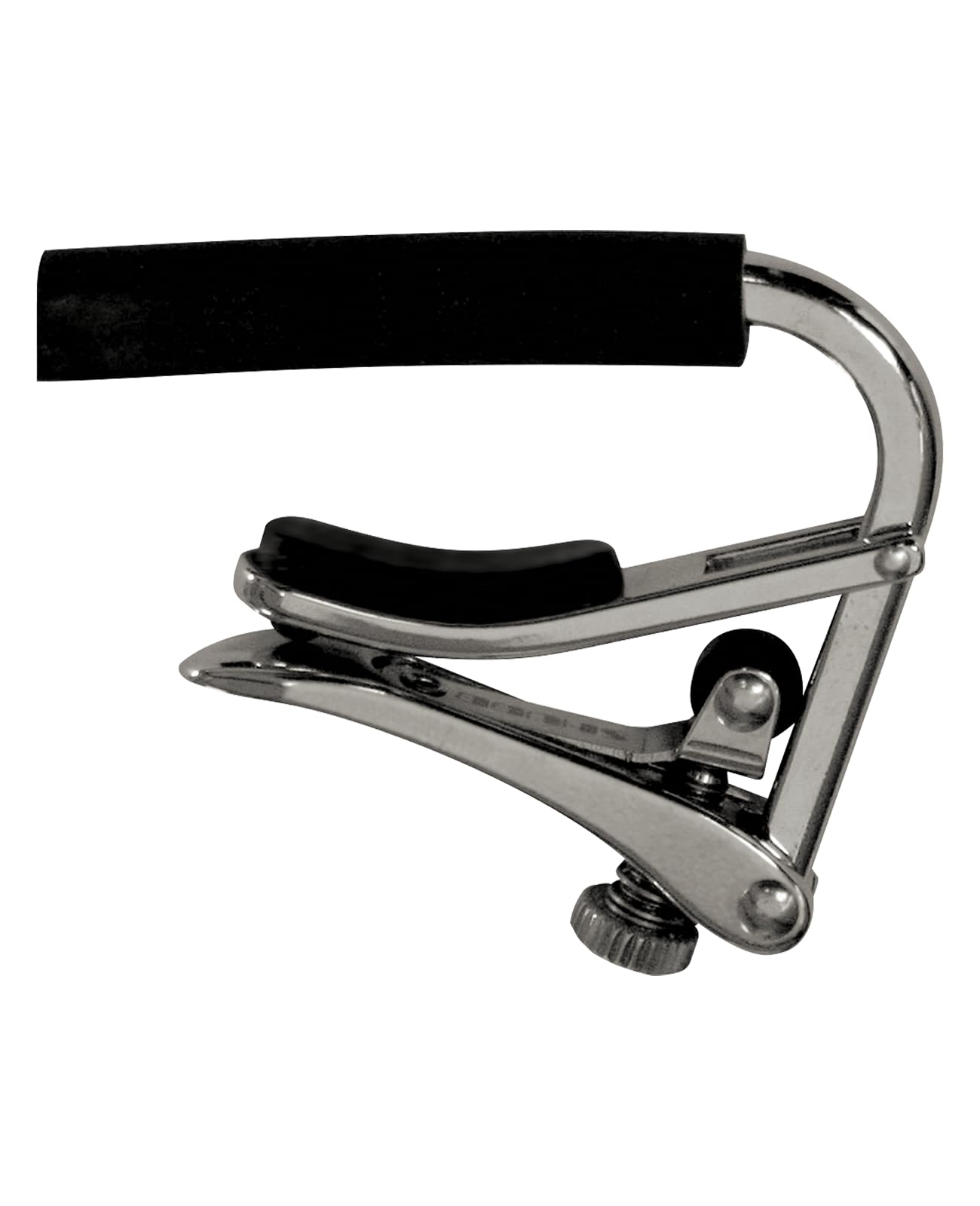
The Shubb C1 has been an engineer’s capo for over three decades because it solves the problem that fixed-tension capos can’t: variable neck depth. The nickel-plated brass frame houses a lever that locks with a screw-adjust pivot, letting you dial in exactly the pressure needed to stop all six strings without pulling them sharp. Once set, the “set it and forget it” mechanism holds that repeatable tension every time you flip the lever open and closed.
The custom rubber pad mimics the feel of a fingertip, which means the capo actually grips the fretboard rather than sliding around during aggressive strumming. Reviewers consistently report that tuning remains accurate up to the 7th fret on a Martin D-18, which is unusual for a non-trigger-style capo. The polished nickel finish resists corrosion, and at 0.1 pounds it feels dense and solid in the hand without being heavy on the neck.
One design trade-off: the C1 does not park on the headstock. You have to stow it in a case or pocket between uses. If you frequently swap between capped and open positions during a single performance, the Kyser quick-clamp is faster. But if intonation consistency from fret to fret is your priority—especially in recording or fingerstyle work—the Shubb’s micro-adjust is the category winner.
Why it’s great
- Screw-adjust lever provides repeatable, buzz-free tension
- Stays in tune further up the neck than fixed-spring capos
- Compact form factor doesn’t crowd the fretting hand
Good to know
- Does not clip to the headstock for storage
- Requires a few seconds of initial tension adjustment
3. Kyser Quick-Change Guitar Capo, KGCRWA, Rosewood
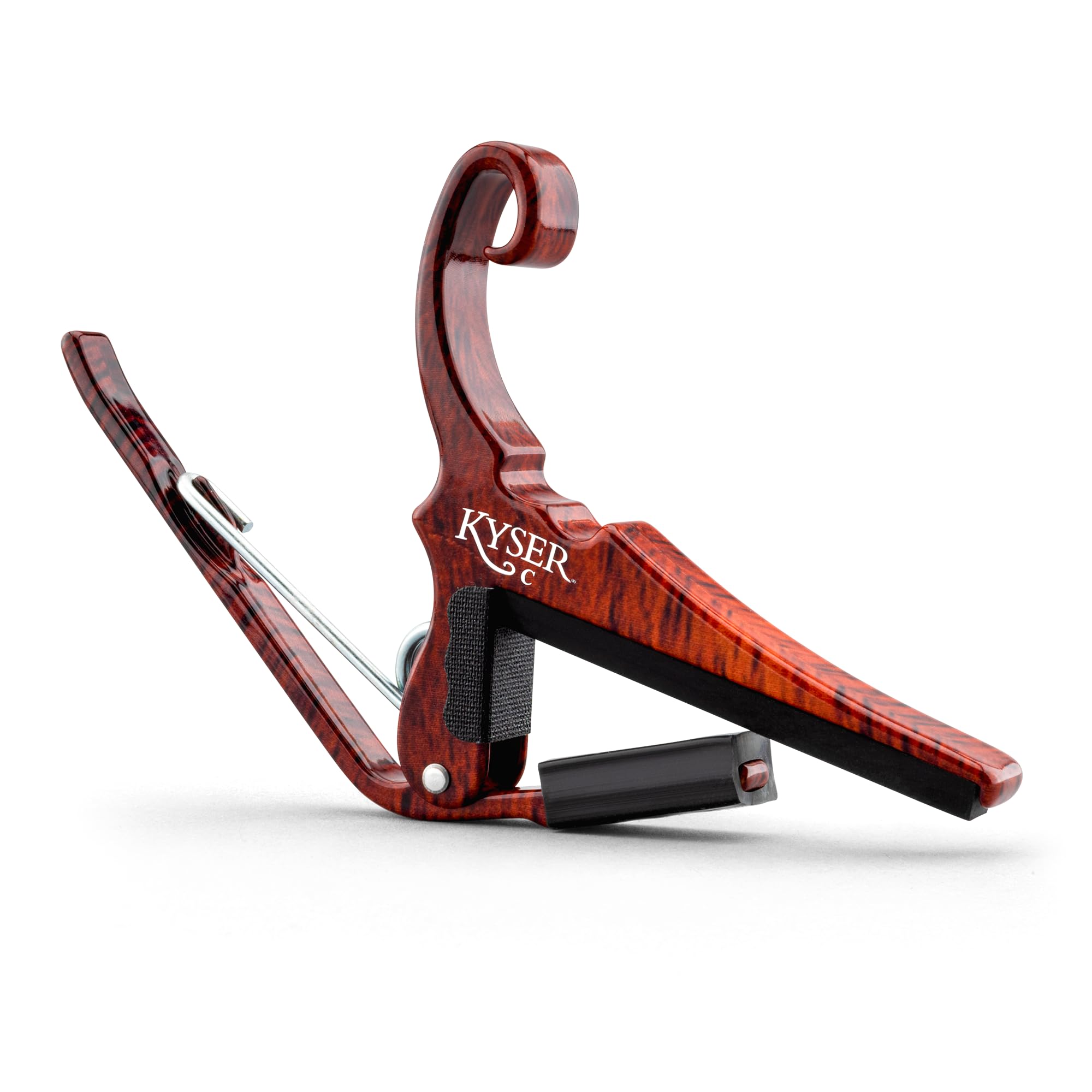
Classical guitars have wider, flatter necks with lower-tension nylon strings—a standard acoustic capo often over-clamps them, causing sharp pitch bends and fret rattle. Kyser specifically optimized this rosewood model’s fretboard radius for classical and flamenco instruments. The spring tension is slightly lighter than the standard acoustic Quick-Change, and the bar curvature matches a classical neck’s 16-inch plus radius rather than the acoustic’s 12-inch curve.
The rosewood finish on the lever is a cosmetic upgrade that visually ties into a traditional classical guitar’s aesthetic, but the real value is the consistent clamping force that doesn’t collapse the nylon string’s lower tension. Customer reviews call out zero buzzing on classical guitars and no issues with tuning stability when capping up to the 5th fret. The unit weighs just 0.07 kilograms and still parks on the headstock—a critical feature for performers who switch between open and capoed passages mid-piece.
The trade-off is simple: this capo works brilliantly on classicals but is too light in tension for heavy-gauge steel strings on a dreadnought acoustic. If you own both a classical and an acoustic, you’ll need a second capo for the steel-string. But if nylon-string is your primary instrument, this is the dedicated solution that generic capos cannot replicate.
Why it’s great
- Radius is specifically matched to classical/flamenco necks
- Light spring tension won’t pull nylon strings sharp
- Rosewood finish blends perfectly with traditional classical guitars
Good to know
- Not suitable for standard steel-string acoustics
- Some players report light retuning needed after prolonged capping
4. Sondery Guitar Capo 4-in-1 with String Cutter & Puller

The Sondery 4-in-1 capo is built for players who want a single accessory that handles capo work, string changes, and pick storage without reaching for a separate toolkit. The main body is cast from zinc alloy with a gloss black finish and weighs 0.11 kilograms—slightly heavier than the pure aluminum models but still balanced enough for the headstock. The integrated string cutter and bridge pin puller are hidden in the capo body and deploy when needed, making this a strong choice for traveling musicians or anyone who does their own restringing.
Under the capo pad, scratch-proof silicone cushions protect both the guitar neck finish and the strings. The spring tension is calibrated for 6-string acoustic and electric guitars, and early users report no fret buzz on Les Paul and Alvarez models. The package includes five assorted picks and a velvet pouch, which adds material value for a price that sits well below premium-tier capos. A small but telling detail: the hidden tools are completely out of the way during normal playing—you don’t feel them in your strumming hand.
The downside is that multi-tool capos rarely match the mechanical refinement of single-purpose designs from Kyser or Shubb. The spring tension is fixed and the pressure is uniform across the fret but lacks the micro-adjustability that session players demand for flawless intonation. For the practicing guitarist or grab-and-go player, this is a smart consolidation. For the recording artist, a dedicated capo will produce more consistent results.
Why it’s great
- Built-in string cutter and pin puller eliminate extra tools
- Silicone pads protect the guitar finish from scratches
- Includes picks and a pouch, making it a complete starter kit
Good to know
- Heavier than premium aluminum capos
- Fixed spring tension lacks micro-adjustability
5. Salvori Exclusive Gradient ‘Blue-Plated’ Heavy-Duty Guitar Capo

Salvori’s blue-plated capo is a visual standout. The zinc alloy body is electroplated with a gradient that shifts from deep navy to turquoise depending on the viewing angle—an entirely cosmetic feature that nonetheless earns a spot on a stage guitar where aesthetics matter. Beyond the finish, the capo uses an industrial-strength spring that provides exact, even tension across the fretboard, and the custom silicone cushion wraps fully around both the top bar and the bottom brace to shield the guitar from scratches.
The 3-in-1 functionality includes a pick holder embedded in the lever and a string puller at the rear, similar in spirit to the Sondery, though without the integrated string cutter. The capo weighs 0.11 kilograms and measures 2.83 x 0.51 x 3.23 inches, which is compact enough to fit in a side guitar case pocket. Owners consistently praise the heavy-duty feel of the zinc alloy and the fact that it keeps the guitar in tune up to the 4th fret without requiring a retune. The included four picks are a welcome bonus, though the picks themselves are basic.
The main drawback reported by multiple users is that the lever extends slightly beyond the fretboard width on standard acoustics. For players with smaller hands or who regularly fret near the capo, that extra extension can interfere with chord shapes. The blue gradient finish is also prone to showing fingerprints and smudges quicker than a matte black or nickel surface. If visual flair and a solid clamp are your priorities, this capo delivers—but if you need an unobtrusive shape for aggressive lead playing, a shorter profile may serve better.
Why it’s great
- Distinctive gradient electroplated finish stands out on stage
- Full silicone cushion protects the fretboard and finish
- Industrial spring provides reliable tension without slipping
Good to know
- Lever extends past the fretboard, can interfere with chord shapes
- Glossy blue surface shows fingerprints and smudges
FAQ
Will a capo damage a satin-finished guitar neck?
Why does my guitar go out of tune after I clamp the capo?
Final Thoughts: The Verdict
For most players, the best guitar capos winner is the Kyser Quick-Change (Acoustic) because it blends instant one-hand operation, a lifetime guarantee, and lightweight aircraft-grade aluminum that never fatigues. If you need micro-adjustable tension for precise intonation across multiple guitars, grab the Shubb C1 Standard. And for a classical or nylon-string player who wants a dedicated capo that matches the neck radius and lower string tension, nothing beats the Kyser Rosewood Classical.