
Nothing kills a great guitar tone faster than a noisy signal chain. When you plug in a row of pedals daisy-chained from a single wall wart, you risk humming, hissing, and ground loops that bury your clean riffs and leads. A dedicated unit with isolated outputs eliminates that noise by giving each pedal its own dedicated, filtered power rail. The right one also ensures your digital delays and high-current modulation pedals get the steady milliamps they need to operate at their full dynamic range.
I’m Mohammad Maruf — the founder and writer behind Drink4Good. I’ve spent hundreds of hours analyzing the electrical specs, customer feedback, and real-world performance of dozens of pedalboard power supplies to separate the quiet workhorses from the noisy boxes.
Whether you are building your first pedalboard or upgrading from a daisy-chain setup, finding the right guitar effects power supply means matching output count, current capacity, and isolation type to your specific pedal collection.
How To Choose The Best Guitar Effects Power Supply
Selecting the right power supply is a balancing act between the number of pedals you own, their current demands, and whether you gig or practice at home. A mismatch in any of these areas will leave you with unwanted noise or a pedal that shuts off mid-performance.
Output Isolation vs. Daisy Chain
The single most important feature is output isolation. A fully isolated power supply uses separate transformer windings for each output, which completely breaks ground loops between pedals. This eliminates the 60-cycle hum and digital hiss that plague daisy-chained supplies. If you have even one digital pedal, choose a unit that advertises fully isolated outputs.
Current Capacity Per Output
Every pedal has a current draw measured in milliamps (mA). Analog overdrive pedals usually draw under 50mA, while digital delays, reverb units, and multi-effects processors can demand 300mA or more. Look at the mA rating per output, not just the total. You need at least one high-current output (300mA or above) for each power-hungry digital pedal on your board.
Adjustable Voltage Outputs
Some pedals, like certain overdrives and preamps, can be run at 12V or 18V to increase headroom and dynamic response. An adjustable output that lets you switch between 9V, 12V, and 18V adds flexibility for experimenting with pedal biasing. Not every board needs this, but for tone explorers it is a valuable feature.
Quick Comparison
On smaller screens, swipe sideways to see the full table.
| Model | Category | Best For | Key Spec | Amazon |
|---|---|---|---|---|
| Voodoo Lab Pedal Power 2 Plus | Premium | Gigging players, studio use | 8 isolated outputs, 1100mA total | Amazon |
| Truetone 1 SPOT Pro CS12 | Premium | Large boards, high-current pedals | 12 isolated outputs, 3000mA total | Amazon |
| MXR M238 Iso-Brick | Premium | Compact high-end boards | 10 isolated outputs, 2 adjustable | Amazon |
| Truetone 1 SPOT PRO CS7 | Mid-Range | Small to medium boards | 7 isolated outputs, 1x18V | Amazon |
| Ernie Ball Volt | Mid-Range | Ultra-compact setups | 5 isolated outputs, 300mA per port | Amazon |
| JOYO JP-05 | Budget | Portable on-the-go rigs | 8 isolated, rechargeable battery | Amazon |
| Mosky ISO 10 | Budget | Entry-level noise-free upgrade | 10 isolated outputs, USB port | Amazon |
In‑Depth Reviews
1. Voodoo Lab Pedal Power 2 Plus

The Voodoo Lab Pedal Power 2 Plus is the industry standard for a reason. Its eight fully isolated outputs provide clean, regulated DC power that eliminates the hum and ground loops that plague daisy-chained setups. The stainless steel chassis is built to survive years of gigging and studio use, and the detachable AC power cord is a practical touch that makes packing up your board less of a headache.
Four of the outputs are switchable between 9V and 12V, and two feature a variable voltage “sag” control that lets you simulate a dying battery on vintage fuzz pedals — a subtle effect that can dramatically alter your tone. The total current capacity of 1100mA is enough to power around eight typical analog pedals, though you will need to mind the draw of digital units. The unit also includes a courtesy outlet and a set of useful output cables.
Some users report that the provided cable lengths are a bit short for larger pedalboard layouts, requiring additional extension cables. The lack of a dedicated power switch means you will need to unplug the AC cord or use a switched power strip to turn the board off. Despite these minor quirks, its reliable, noise-free performance makes it the benchmark that every other pedal power supply is compared against.
Why it’s great
- Fully isolated outputs eliminate ground-loop noise completely.
- Durable stainless steel enclosure and detachable AC cord.
- Voltage sag feature on two outputs for vintage fuzz tone shaping.
Good to know
- Output cables are on the shorter side for larger boards.
- No built-in power switch — requires a switched strip to power down.
2. Truetone 1 SPOT Pro CS12

The Truetone 1 SPOT Pro CS12 is the ultimate solution for players with large, current-hungry pedalboards. With 12 isolated outputs and a massive total current capacity of 3000mA, it can power multiple high-draw digital delays, reverb units, and looper pedals without breaking a sweat. The low-profile flat design fits neatly underneath most Pedaltrain-style boards, saving valuable surface space for more pedals.
The output layout is incredibly versatile: it includes two 9V outputs rated at 250mA, two at 500mA, four switchable 9/12V outputs, two variable 9V outputs (one with a sag control), a dedicated 18V output, and a 9V AC output for vintage or specialty pedals. The proprietary design allows you to draw more current than the labeled rating on any single output, as long as the total draw stays under 3000mA. Every cable and mounting bracket you need is included in the box.
At this premium tier, the price point places it as a serious investment for serious players. The included cables are color-coded by length, which makes routing under the board easier, but some users wish the AC adapter cord was just a bit longer for pedalboards mounted in road cases. If you run a large board with more than ten pedals, the CS12 is the power supply that will grow with your collection.
Why it’s great
- Highest total current (3000mA) of any mainstream isolated supply.
- Includes 9V AC output for vintage pedals and 18V output for high-headroom units.
- Comes with all cables, adapters, and mounting hardware.
Good to know
- AC adapter cord length may be tight for deep road cases.
- Premium price reflects the extensive output flexibility.
3. MXR M238 Iso-Brick

The MXR M238 Iso-Brick packs ten fully isolated outputs into a pedalboard-friendly chassis that is smaller than many standard stompboxes. This makes it an ideal choice for players who want to keep their board as compact as possible while still running a substantial number of effects. The alloy steel enclosure feels rock-solid and has proven reliable through years of gigging for many users.
Two of the outputs are adjustable between 9V and 18V, allowing you to experiment with increased headroom on overdrive pedals or power high-voltage preamps. The remaining outputs are set at 9V with a mix of 300mA and 100mA rails, providing enough juice for most analog and digital pedals. The bundle includes three MXR patch cables, which is a nice head start for wiring your board. Noise performance is outstanding, with zero reported hum or hiss even when running eight to ten pedals simultaneously.
A commonly mentioned concern is the thin gauge of the included power adapter cord. While many users report years of trouble-free use, players who tour heavily may want to upgrade to a thicker cord for added durability. The lack of any voltage sag feature means fuzz pedal enthusiasts will need to look elsewhere for that specific tone-shaping tool. For most clean-sounding boards, the Iso-Brick delivers silent, reliable power in a compact footprint.
Why it’s great
- Extremely compact footprint frees up pedalboard real estate.
- Two adjustable 9/18V outputs for versatile pedal biasing.
- Sturdy alloy steel construction built for regular gigging.
Good to know
- Included power adapter cord can feel thin for heavy touring.
- No voltage sag feature for vintage fuzz tone manipulation.
4. Truetone 1 SPOT Pro CS7
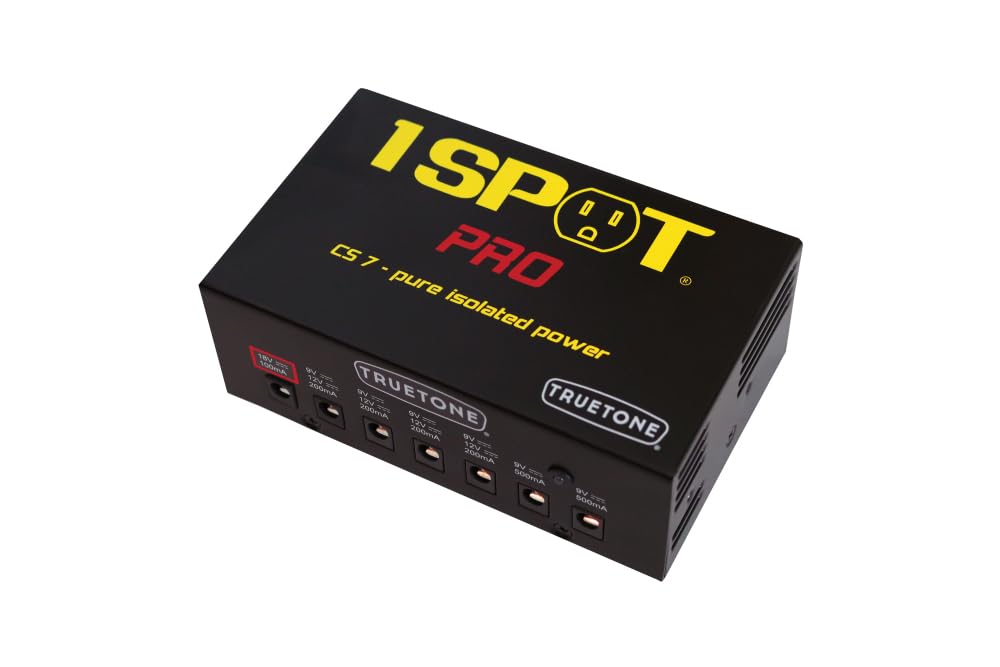
The Truetone 1 SPOT Pro CS7 is the ideal sweet spot for players with small to medium pedalboards who still demand the noise-free performance of true output isolation. Its seven outputs include a dedicated 18V rail, four switchable 9/12V outputs, and two fixed 9V outputs. This configuration covers the needs of most gigging guitarists without driving up the price to the level of the larger CS12.
Like its bigger sibling, the CS7 allows you to draw more current than the labeled per-output rating as long as the total draw stays under its internal limits. This flexibility means you can safely run a high-current digital pedal on a port labeled 100mA if the total system draw is within range. The unit is slightly heavier than some competitors due to its internal transformer design, but that heft translates to rock-solid, noise-free power that professionals trust for studio sessions and live shows alike.
The included mounting brackets are compatible with Pedaltrain boards for easy under-deck installation. The absence of a power switch means you will need to unplug the supply or use a switched power strip to turn off your board. If your pedal collection numbers seven or fewer and you want a premium, isolated supply without the price tag of a 12-output unit, the CS7 is the clear choice.
Why it’s great
- True isolation in a compact 7-output package for small boards.
- Flexible current draw allows powering high-mA pedals on any port.
- Includes mounting brackets for easy under-board installation.
Good to know
- Heavier than some comparable isolated supplies.
- No dedicated power switch on the unit itself.
5. Ernie Ball Volt

The Ernie Ball Volt is built for the guitarist who demands a minimal footprint without sacrificing audio quality. Each of its five outputs provides a robust 300mA of isolated power, meaning even a digital delay or reverb pedal can be powered on any port without worrying about current starvation. The enclosure is impressively small — barely larger than a standard stompbox — making it easy to mount under a compact board with just a strip of Velcro.
Two of the outputs are switchable between 9V and 18V, offering flexibility for pedals that benefit from increased voltage. The entire unit is extremely quiet in operation, with users reporting a complete elimination of the buzz and hum that plagued their previous single-supply daisy-chain setups. The included universal AC adapter comes with four different plug types for international travel, though the adapter itself is quite large and the cable connecting it to the Volt is on the short side.
With only five isolated outputs, the Volt is best suited for smaller boards with around four to six pedals. If your board grows, you can daisy-chain low-current analog pedals off a single output to stretch the port count, though this reintroduces some noise risk. For the minimalist player who values a clean signal path above all else, the Ernie Ball Volt delivers surprising power in an incredibly small package.
Why it’s great
- Very small footprint fits easily under compact pedalboards.
- 300mA per output provides plenty of headroom for digital pedals.
- Includes international AC plugs for touring musicians.
Good to know
- Wall wart is bulky and has a short cable to the unit.
- Only five isolated outputs limit expansion without daisy-chaining.
6. JOYO JP-05 Rechargeable
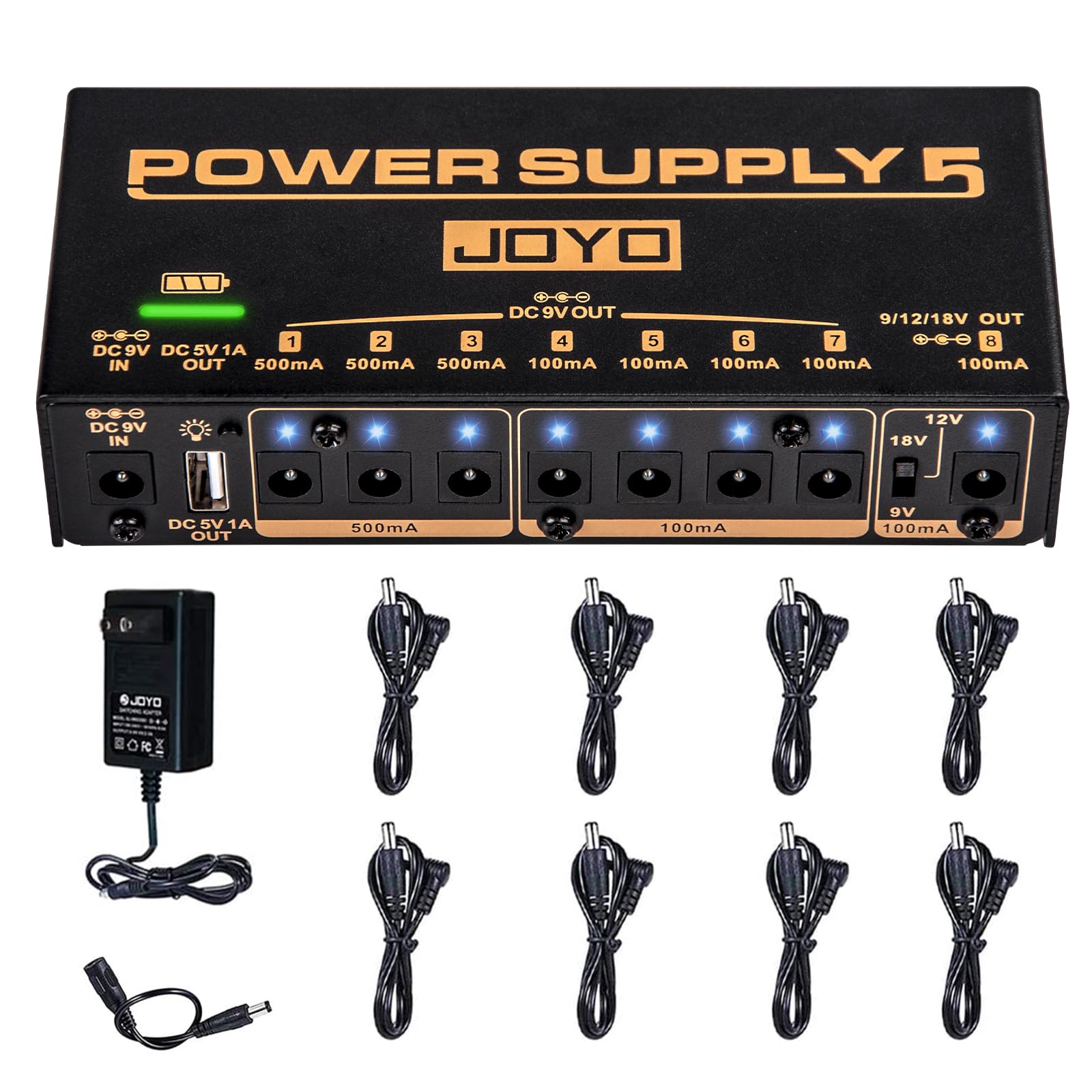
The JOYO JP-05 stands out in the market for one major reason: a built-in 4400mAh rechargeable battery. This means you can run a fully loaded pedalboard for hours without being tethered to a wall outlet. The unit delivers eight isolated outputs, with three ports rated at 500mA for high-current digital pedals, four ports at 100mA for analog pedals, and one switchable 9/12/18V output for versatile biasing. A USB output on the side can even charge your phone during a session.
Musicians who play street corners, park jams, or living room sessions without easy access to power will find the JP-05 liberating. The battery indicator uses green, yellow, and red LEDs to show remaining charge. User reports indicate you can expect around two hours of runtime with a fully loaded board of digital pedals, and up to ten hours when powering eight low-current analog pedals. The blue LED lights on each output look cool but can be turned off to save battery power.
The battery life is the trade-off for this portability. If you are running a board full of high-current digital effects, a single set might not outlast a full multi-set gig. The included wall charger feels inexpensive compared to the rest of the unit. The JP-05 is best viewed as a specialized tool for players who genuinely need battery-powered operation rather than a primary home or studio supply.
Why it’s great
- Built-in rechargeable battery enables untethered play anywhere.
- Three 500mA outputs handle power-hungry digital pedals.
- USB output doubles as a mobile device charger.
Good to know
- Battery life drops significantly under heavy digital pedal loads.
- Included wall charger feels less durable than the power supply itself.
7. Mosky ISO 10

The Mosky ISO 10 delivers ten isolated outputs at a fraction of the price of other multi-output supplies. It includes seven 300mA 9V outputs, one dedicated 500mA 9V output, and two switchable 9/12/18V outputs also rated at 500mA. A USB charging port is built into the side for powering a phone or tablet. For the budget-conscious player looking to eliminate daisy-chain noise, this unit offers genuine isolation without breaking the bank.
The aluminum alloy enclosure keeps the unit lightweight and helps dissipate heat, though it lacks the mounting brackets found on pricier competitors. Each output has its own LED indicator that turns off in the event of a short circuit, making fault diagnosis simple during a sound check. Users report that the ISO 10 completely silences the hum and hiss from daisy-chained digital pedals, proving that effective isolation is no longer exclusive to the high end of the market.
The trade-offs come in the details. The included DC cables are short and some users report receiving a defective cable, though replacements are inexpensive. The unit lacks an on/off switch and the wall-wart power adapter does not include a ground pin, which may be a concern in some setups. For home studios, practice spaces, and occasional gigging where budget matters most, the Mosky ISO 10 is the best way to get clean isolated power for a board of up to ten pedals.
Why it’s great
- Ten isolated outputs at an extremely competitive price point.
- Two adjustable 9/12/18V outputs support versatile pedal biasing.
- Short-circuit LEDs make troubleshooting fast and easy.
Good to know
- Included DC cables are short and quality can be inconsistent.
- Wall-wart power supply lacks a grounding pin and an on/off switch.
FAQ
Can I power a 9V pedal from an 18V output?
How do I calculate the total current I need for my pedalboard?
What causes humming in a daisy-chained power supply?
Final Thoughts: The Verdict
For most users, the guitar effects power supply winner is the Voodoo Lab Pedal Power 2 Plus because its eight fully isolated outputs, voltage sag feature, and rock-solid build quality make it the industry benchmark for a reason. If you run a large board with high-current digital pedals, grab the Truetone 1 SPOT Pro CS12 for its unmatched 3000mA capacity and 12 outputs. And for a budget-friendly upgrade that still offers true isolation, nothing beats the Mosky ISO 10.