
The hum of a tube amp is irreplaceable, but the versatility of a modern digital brain is undeniable. Every guitarist hits the wall where a single stompbox can’t cover the setlist, and a pedalboard becomes a logistical puzzle of power supplies, patch cables, and tap dancing. The all-in-one solution has evolved far beyond a box of presets; it’s now the central nervous system of a rig, capable of replacing a van full of gear with a single, programmable unit that fits in a backpack.
I’m Mohammad Maruf — the founder and writer behind Drink4Good. My buying guides are rooted in hundreds of hours of spec analysis, signal chain logic, and mapping hardware features to real-world playing scenarios, from bedroom recording to packed club stages.
This guide cuts through the firmware hype to focus on the hardware, interface logic, and modeling architecture that actually define a great guitar effects processor.
How To Choose The Best Guitar Effects Processor
Selecting the right processor is about more than just the effect count. The hardware requirements for a quiet home studio are drastically different from those of a touring musician relying on a single device for FOH sound. Focus on three pillars: modeling architecture, physical interface, and connectivity.
Modeling Engine and DSP Power
The core of any processor is its digital signal processing (DSP) chip. A more powerful DSP allows for higher-quality amp models, more simultaneous effects blocks, and lower latency. Look for specs like 32-bit floating-point processing, dynamic range above 110 dB, and support for high-resolution impulse responses (1024 samples or higher). A weak chip results in a “flat” or “lifeless” feel under your fingers.
User Interface and Live Usability
A processor is only as good as your ability to control it mid-song. Stompbox-style layout with dedicated footswitches per effect is the gold standard for live use. For deeper editing, a large touchscreen or a companion desktop app is invaluable. Evaluate the expression pedal: is it integrated and durable, or an optional add-on? The number of simultaneous effects and the speed of preset switching are critical for live performance.
Connectivity and I/O
Your rig’s expansion depends on the I/O. An effects loop (send/return) allows you to integrate your favorite analog dirt pedals or a real tube preamp. Stereo outputs with cabinet simulation are essential for direct-to-PA use. XLR outputs, MIDI I/O, and a USB-C audio interface for recording and re-amping separate a bedroom toy from a professional tool.
Quick Comparison
On smaller screens, swipe sideways to see the full table.
| Model | Category | Best For | Key Spec | Amazon |
|---|---|---|---|---|
| Line 6 HX Stomp | Premium Compact | Pedalboard Integration | 300+ HX Models | Amazon |
| HeadRush Prime | Premium Flagship | Guitar & Vocal Rig | 7″ Touchscreen, Amp Cloner | Amazon |
| HeadRush Flex Prime | Mid-Range Flagship | Portable Rig & Studio | 700+ Emulations, Wi-Fi | Amazon |
| BOSS ME-90 | Premium Live | Live Stompbox Feel | 60 GT-1000 Effects | Amazon |
| Valeton GP-200 | Mid-Range Power | Direct Recording | 4.3″ Color LCD, 240+ FX | Amazon |
| NUX MG-30 | Mid-Range Desktop | Desktop/Ampless Rig | Dual NXP Processors, 2ms Latency | Amazon |
| Donner Arena 2000 | Mid-Range Versatile | Home Practice & Recording | 278 Effects, 23.2ms IR | Amazon |
| Sonicake Matribox II | Budget Value | Beginners & Budget Rigs | Effects Loop, 200+ FX | Amazon |
| MOOER GE150 Pro | Budget Portable | Battery-Powered Practice | 9 Hour Battery, 55 Amp Models | Amazon |
In‑Depth Reviews
1. Line 6 HX Stomp

The Line 6 HX Stomp is the benchmark for compact, high-end modeling. It packs the same HX engine from the flagship Helix into a chassis smaller than a shoebox, offering over 300 amp, cab, and effect models. The 24-bit AD/DA converters and 32-bit floating-point processing create a dynamic, responsive feel that rivals analog gear, making it a staple on professional pedalboards worldwide.
Its genius lies in its flexibility. The three capacitive-sensing footswitches can be assigned to bypass, snapshot, or tap tempo functions, while the stereo send/return loop allows seamless integration of external pedals. The HX Stomp also functions as a class-compliant USB audio interface with re-amping capabilities, making it equally powerful in the studio. The 6-block signal chain is a limitation for huge rigs, but its sound quality is untouchable at this size.
This is the processor for the player who demands pro-level sound and a tiny footprint. It excels in scenarios where every inch of pedalboard space matters. The learning curve for deep editing is real, and the stock factory presets are best used as starting points. With the HX Edit software, you can craft almost any tone imaginable.
Why it’s great
- Pro-grade Helix sound engine in a compact design.
- Excellent stereo effects loop for external gear.
- Functions as a full USB audio interface for recording.
Good to know
- Only 6 simultaneous blocks, limiting some complex rigs.
- Deep editing is much easier using desktop software.
- Stock presets often need significant tweaking.
2. HeadRush Prime

The HeadRush Prime is a do-everything command center for guitar and vocals. Its 7-inch color touchscreen provides a visual, drag-and-drop rig building experience that is incredibly fast. Beyond the usual amp and effect models, the Prime includes an Amp Cloner that allows you to capture the sound of your real tube amp, and a full vocal processing suite with Antares Auto-Tune, making it a unique all-in-one solution.
The library is vast, with 700+ precise models and 350+ built-in IRs from Celestion and other top brands. The 12 footswitches with customizable OLED displays are ideal for creating complex live setups with scene changes and looper control. The integrated drum machine with Alesis patterns and a powerful looper with MIDI sync make it a songwriting tool as much as a gigging device.
This unit is best for the gigging musician who wants to simplify their rig and control their entire sound from one box, including vocals. It is a heavy unit in a large chassis, so it is not a pedalboard stompbox but rather the pedalboard itself. The Wi-Fi and Bluetooth connectivity for preset sharing and editing are industry-leading.
Why it’s great
- Unique vocal processing with Antares Auto-Tune.
- Intuitive 7-inch touchscreen rig builder.
- Amp Cloner lets you capture your real tube amp.
Good to know
- Large frame size is not pedalboard friendly.
- High premium price point for a full rig solution.
- Some find the touch-only navigation less tactile for live use.
3. HeadRush Flex Prime

The HeadRush Flex Prime distills the flagship Prime’s insane library into a smaller, more affordable pedalboard-friendly format. It features the same massive library of 700+ emulations, a 4-inch color touchscreen, and the innovative Clone/SuperClone IR loader. This gives you access to top-tier amp sounds and the ability to load your own captures without the bulk of the larger Prime.
Its strength is its connectivity and cloud integration. Wi-Fi allows you to download presets from the HeadRush Cloud, share your own, or sync with Dropbox. The included ReValver 5 software turns your computer into a powerful recording and cloning tool. The three footswitches and integrated expression pedal are adequate for most presets, but for complex live switching, you would need the smaller Core model or an external switch.
This is an ideal processor for the home studio player and gigging musician who values tone quality and workflow over number of footswitches. The sound quality is a massive step up from budget options, with realistic amp dynamics and touch sensitivity. The small touchscreen can be fiddly for deep editing on the fly, but the Wi-Fi remote editor on a tablet solves this problem perfectly.
Why it’s great
- High-end HeadRush modeling in a compact pedal.
- Wi-Fi and Bluetooth for wireless editing and cloud access.
- Includes ReValver Amp Cloner software.
Good to know
- Only three footswitches limit hands-free control.
- Screen is small for detailed touch editing.
- Desktop/tablet app is almost required for deeper editing.
4. BOSS ME-90
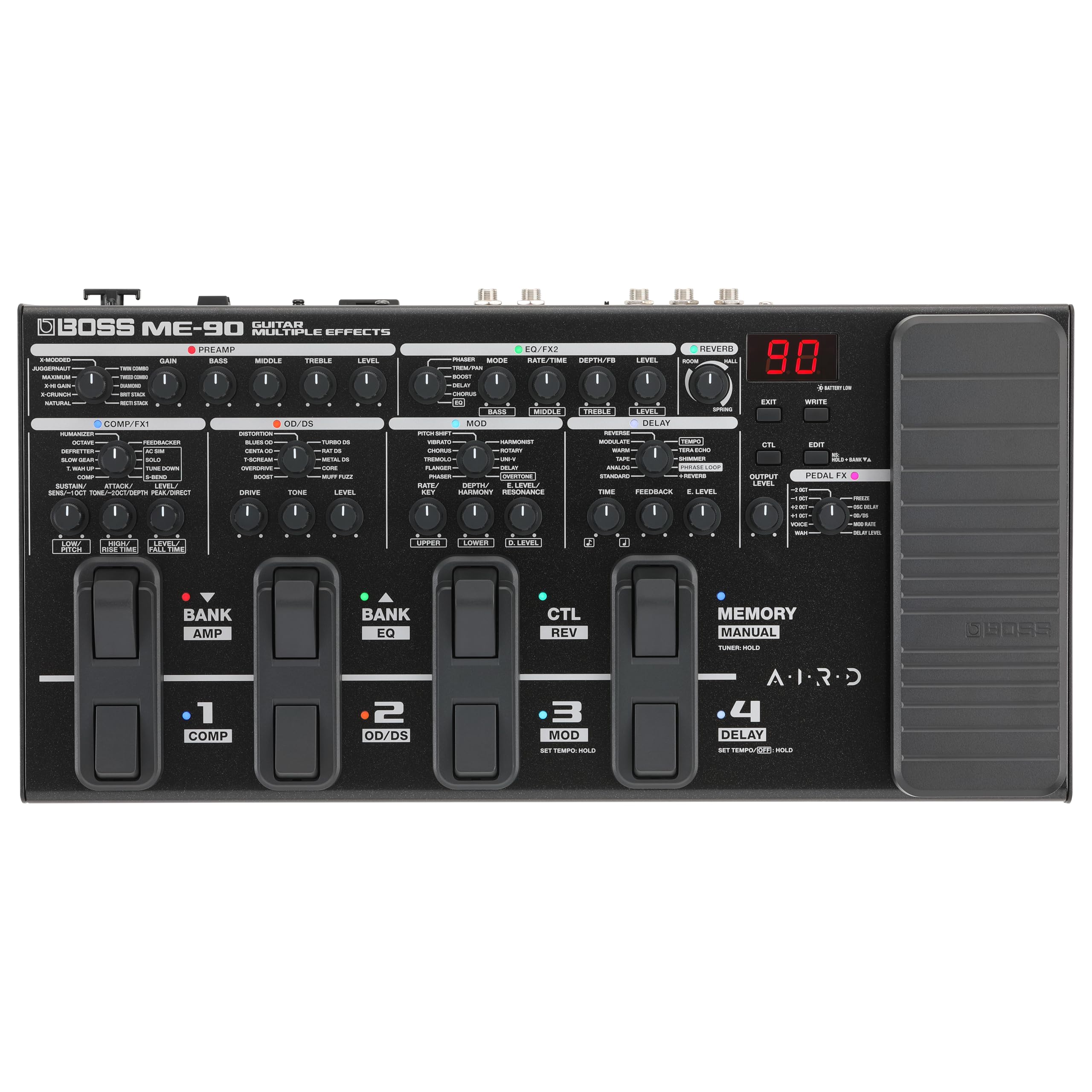
The BOSS ME-90 is designed for the guitarist who wants the feel of a pedalboard without the menu-diving. It provides immediate, knob-based sound shaping. The knobs are the primary interface, letting you dial in drive, EQ, modulation, delay, and reverb just like you would on individual pedals. It uses 60 effects derived from the flagship GT-1000, including legendary BOSS and MXR stompbox simulations.
The 11 AIRD amp models are versatile and sound excellent, especially when run into a real tube amp’s return loop or directly into a PA. The eight multi-function footswitches and redesigned expression pedal are fantastic for live performance, allowing instant stompbox-style control over individual effects and volume. It even runs on six AA batteries for quick setups.
This processor is for the player who hates screens and wants a tactile, immediate experience. While the user interface is its greatest strength, the effect count and routing flexibility are less than competitors like the HeadRush or Line 6. The internal presets are known to be a bit “hot,” but the BOSS Tone Studio app allows for deep editing and IR loading to refine the sound.
Why it’s great
- Fast, intuitive knob-based controls.
- Eight footswitches and a smooth expression pedal.
- High-quality BOSS effects and AIRD amp models.
Good to know
- FX loop is less flexible than some competitors.
- Fewer total effects than many budget models.
- Factory presets are often overly aggressive.
5. Valeton GP-200

The Valeton GP-200 feels like a flagship unit from a few years ago at a mid-range price. Its massive 4.3-inch TFT color LCD screen provides a clear, user-friendly interface for building presets with up to 11 simultaneous effect blocks. The library is generous, with 240+ effects based on 140 legendary amps and cabs, plus support for loading third-party IRs.
Its connectivity is a huge selling point. It includes a full stereo effects loop for analog pedals, 5-pin MIDI I/O for external control, and stereo XLR outputs for direct connection to a mixing console. The USB-C port acts as a full audio interface with OTG support for mobile recording. The all-metal construction feels durable, and the 8 customizable LED footswitches make live navigation easy.
This is an outstanding choice for the player building a home studio or a versatile live rig on a budget. It competes directly with units costing much more while offering a larger screen and more flexible I/O. Some users report a slight “digital” flavor to the highest gain settings, but the clean and crunch models are exceptional, especially with a good IR loaded.
Why it’s great
- Large, clear 4.3-inch color display for easy editing.
- Full stereo FX loop and MIDI I/O for expansion.
- Direct USB-C audio interface for recording.
Good to know
- High-gain models can sound a bit digital.
- Expression pedal is an optional add-on.
- Stock presets are mostly unusable for direct playing.
6. NUX MG-30

The NUX MG-30 is built around a powerful dual NXP processor architecture, delivering a claimed ultra-low 2ms latency. This makes it one of the most responsive and “analog-feeling” digital units on the market. Its 4-inch color LCD screen and intuitive 5-way encoder provide a fast editing workflow, which is complemented by the free QuickTone editor software.
With 35 premium amp models (for guitar, bass, and acoustic) and the acclaimed Solid Studio IR cab simulation technology, the sound quality is top-tier for its class. It features 11-block signal routing and 56 effect modules, plus a dedicated NMP-2 dual footswitch and an expression pedal input for hands-free control. The USB interface supports stereo recording and re-amping.
This is the perfect processor for the bedroom producer and ampless player. The latency is genuinely imperceptible, making it feel like you are playing through a real amplifier. It is not ideal for the traditional live performer looking for a pedalboard replacement with many footswitches, but for a simple set-and-forget rig, it excels. The included footswitch is a nice touch, but a dedicated expression pedal is needed for volume swells.
Why it’s great
- Exceptional low-latency performance for realistic feel.
- High-quality Solid Studio IR cabinet simulation.
- Excellent amp models for bass and acoustic as well.
Good to know
- No built-in expression pedal is standard.
- Complex preset switching system (01A-32D).
- Build feels a bit light compared to metal competitors.
7. Donner Arena 2000

The Donner Arena 2000 is a feature-packed unit that offers an immense sandbox for tone exploration. With 278 effect types, 100 amp and cab models, and a total of 100 IR slots (50 built-in, 50 user), it provides deep sound sculpting capabilities. Its FAVCM technology is designed to reduce the “plastic” digital feel, aiming for a more organic and layered sound.
It is built for the creative player, featuring a 60-second looper with a built-in 40-pattern drum machine. The connectivity is comprehensive, offering XLR, MIDI, USB-C, and separate cabsim on/off for the XLR and 1/4-inch outputs. The Bluetooth app allows for wireless editing on your phone, which is a helpful feature for on-the-go tweaking, though the drag-and-drop interface is not as smooth as the desktop app.
This processor is best for the home musician who loves to experiment and build complex presets. The sheer number of options is overwhelming but incredibly rewarding for those who love to dig into the signal chain. The learning curve is steep, the manual is minimal, and some connectivity quirks have been reported. However, after firmware updates, it becomes a very capable and warm-sounding unit for a very accessible price.
Why it’s great
- Impressive number of amp, cab, and effect models.
- 100 IR slots for deep tonal customization.
- Dual expression pedal inputs and Bluetooth app.
Good to know
- Steep learning curve and sparse manual.
- Requires an external power supply (no battery).
- Some initial units had connectivity issues.
8. Sonicake Matribox II

The Sonicake Matribox II punches far above its weight class by including features often reserved for premium units. The most notable is an external effects loop, which is almost unheard of at this price point. This allows you to insert your favorite analog overdrive or delay pedals into the digital signal chain, blending the best of both worlds. It also includes 200+ effects, 63 amp models, and 61 IR cabinets.
The user interface is straightforward and beginner-friendly. The integrated expression pedal is a major plus at this price, and its low current draw (around 260mA) makes it a dream for pedalboard power supplies. It also functions as a USB audio interface with stereo streaming and free editor software for deeper control. The signal chain is adjustable with up to 10 simultaneous effect blocks.
This is the ultimate gateway processor for the guitarist upgrading from a single multi-fx pedal to a more serious rig. The inclusion of the FX loop is a fantastic teaching tool and a practical feature for integrating analog gear later on. The sound quality is “good” but not “great,” and the amp models do not quite reach the depth of the NUX or Valeton units, but for the price, the features are unmatched.
Why it’s great
- Rare external FX loop for seamless pedal integration.
- Excellent price-to-feature ratio.
- Very power-efficient for pedalboard use.
Good to know
- Amp models are decent but not top-tier.
- No built-in battery compartment.
- Interface quality is a step below premium models.
9. MOOER GE150 Pro

The MOOER GE150 Pro is the ultimate grab-and-go practice tool. Its defining feature is the optional integrated lithium battery that provides up to 9 hours of playtime, making it perfect for jamming in the park, backstage, or the living room. It is built on MOOER’s MNRS modeling technology, which accurately captures the sound and feel of tube amps and pedals, offering 55 amp models and 26 cab simulations.
Despite its small size, it packs serious functionality. It features a 40-pattern drum machine, an 80-second stereo looper, and a USB-C port for recording directly to your phone via OTG. The four multi-purpose footswitches and integrated expression pedal provide decent control for navigating presets or controlling the looper and volume. The white finish of the standard unit is sleek and modern.
This processor is designed for the on-the-go musician and beginner who wants a portable all-in-one solution. It is not a studio-grade unit or a stage workhorse, but it is an incredibly fun and creative tool for instant inspiration. The expression pedal is a bit plasticky, and the high-gain tones are usable but not spectacular. The 9-hour battery is a genuine game-changer for portable use.
Why it’s great
- Exceptional 9-hour battery for true portability.
- Built-in looper and drum machine for practice.
- USB-C recording directly to mobile devices.
Good to know
- Expression pedal build feels a bit flimsy.
- High-gain models are decent, not pro-grade.
- Small LCD screen is hard to see in bright light.
FAQ
Can I use a guitar effects processor with a real tube amplifier?
What is the difference between digital amp modeling and an impulse response (IR)?
How many simultaneous effects do I need for a good processor?
Does a higher bit depth really make a difference in sound quality?
Final Thoughts: The Verdict
For most users, the guitar effects processor winner is the Line 6 HX Stomp because it delivers undeniable pro-grade sound and studio connectivity in the smallest, most pedalboard-friendly package available. If you want a dedicated live performer with the best tactile controls and classic tones, grab the BOSS ME-90. And for the ultimate portable practice rig that you can take anywhere without a power outlet, nothing beats the MOOER GE150 Pro.