
Building a layered guitar part live — rhythm, melody, then a solo on top — demands a loop pedal that captures every transient without latency or muddiness. The wrong pedal introduces a click at loop close, buries your dry signal in noise, or runs out of recording time mid-idea.
I’m Mohammad Maruf — the founder and writer behind Drink4Good. My approach to this guide involved hundreds of hours analyzing customer feedback, isolating failure patterns like static pops on loop end and inaccurate fade-out behavior, and cross-referencing actual specs against real-world usability for stage and studio use.
Whether you need a compact tool for quick practice or a fully-featured station for song-based live looping, the right guitar loop pedal delivers clean audio, reliable foot-switching, and enough memory to capture your ideas without compromise.
How To Choose The Best Guitar Loop Pedal
The right loop pedal depends less on brand loyalty and more on three variables: recording time per slot, the number of saved phrase memories, and the quality of your audio path (sample rate and bit depth). A pedal that sounds great at home may introduce a low-level hiss through a stage amp, so checking for Analog-Dry-Through or 32-bit floating-point processing matters more than the physical size.
Recording Time & Memory Slots
Some loopers offer only three slots, each limited to six minutes, while others provide 99 memories with over 13 hours of stereo recording. If you create specific loops for different songs, more slots let you recall them instantly during practice or a gig. A single-track pedal with long recording time suits drone or ambient players, while a multi-slot pedal with shorter time works better for structured songwriting.
Audio Processing & Signal Integrity
Entry-level pedals often use 16-bit/44.1kHz processing, which is fine for basic practice. Higher-end units (like the 32-bit AD/DA and 32-bit floating-point found in the BOSS RC-5) preserve dynamic range even after many overdubs. If you stack eight or more layers, lower bit-depth will introduce audible noise floors and digital artifacts that muddy your high frequencies.
Built-In Rhythm Engine vs External Drummer
Pedals with an integrated drum machine save you from carrying a separate metronome or drum unit. The BOSS RC-10R offers 280 preset rhythm styles across sixteen kits, making it nearly a standalone backing band. Budget models like the FLAMMA FC01 include only 16 drum grooves but still improve rhythmic accuracy during practice. Prioritize a rhythm engine with A/B section variations if you write songs with distinct verse and chorus parts.
Quick Comparison
On smaller screens, swipe sideways to see the full table.
| Model | Category | Best For | Key Spec | Amazon |
|---|---|---|---|---|
| BOSS RC-5 | Premium Compact | Pro loop quality in a small footprint | 32-bit float / 13 hours / 99 memories | Amazon |
| BOSS RC-10R | Premium Station | Song-based looping with 280 rhythm styles | 2-track stereo / 6 hours / 50 user rhythms | Amazon |
| TC Electronic DITTO+ | Mid-Range | Simple one-button operation | 60 minutes / 99 session memories | Amazon |
| MOOER X2 | Mid-Range | Dual-footswitch stereo control | 300 minutes / 77 save slots / Fade Out | Amazon |
| MOOER Micro II | Budget Compact | Massive recording time at low cost | 480 minutes / 48 slots / AUTO REC | Amazon |
| FLAMMA FC01 | Budget Combo | Looper + drum machine on a budget | 16 drum grooves / 20 minutes / Tap Tempo | Amazon |
| LEKATO Looper | Budget Basic | Ultra-compact with USB transfer | 18 minutes / 3 loops / 48kHz 24-bit | Amazon |
In‑Depth Reviews
1. BOSS RC-5 Loop Station
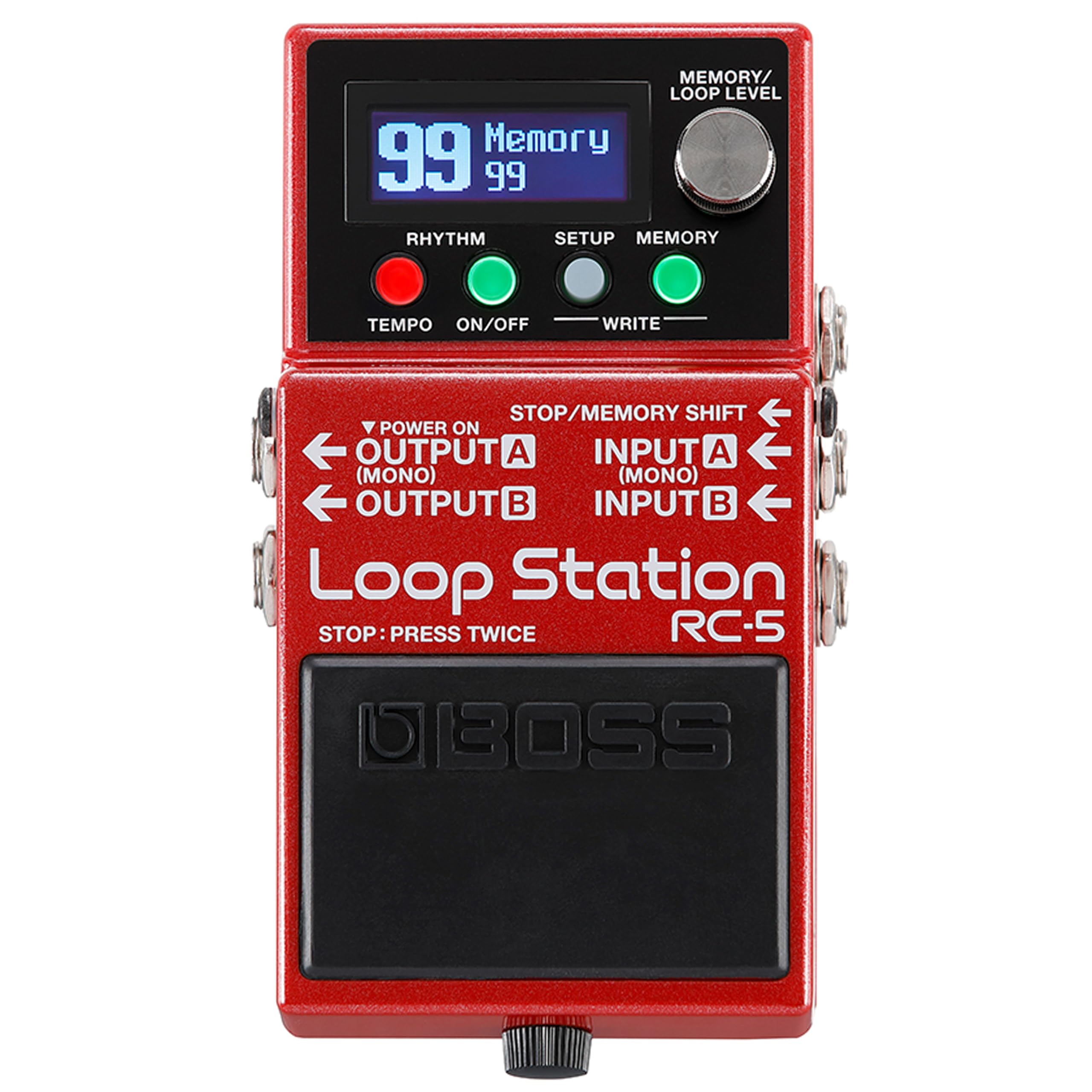
The BOSS RC-5 delivers class-leading 32-bit AD/DA and 32-bit floating-point processing inside a compact chassis that fits any pedalboard. This processing architecture ensures that even after a dozen vocal and guitar overdubs, your high-end sparkle and low-end punch remain clean — no digital stair-stepping or noise creep. The 99 onboard phrase memories each handle up to 13 hours of stereo recording, giving you more than enough space to store entire setlists or session ideas.
Its multi-color LCD displays loop status, waveform position, and rhythm tempo at a glance, which eliminates the guesswork during live performance. The built-in rhythm engine offers 57 patterns across 7 drum kits, each with A/B variations, so you can toggle between verse and chorus feels without reaching for another pedal. MIDI I/O via mini TRS jacks allows you to sync the RC-5 with external sequencers or DAWs for studio integration.
One detail worth noting: the single footswitch controls record, play, overdub, undo, redo, and stop through different tap patterns. While these commands become intuitive quickly, some players add an external footswitch (like the BOSS FS-7) to stop loops without double-tapping. The pedal operates on a 9V battery for roughly three hours, but you’ll want the PSA adapter for anything beyond a short practice session.
Why it’s great
- 32-bit processing keeps multi-layer loops transparent and noise-free
- 99 memories with 13 hours per slot cover studio sessions and live sets
- Full MIDI I/O for sync with drum machines and DAWs
Good to know
- Single footswitch requires learned tap patterns for stop and undo
- Battery drains quickly; external power supply recommended for gigs
2. BOSS RC-10R Rhythm Loop Station

The RC-10R is the tool for songwriters who think in sections — verse, chorus, bridge, solo. Its two-track stereo operation lets you build one loop for the verse part and a second independent loop for the chorus, then switch between them seamlessly. With 280 preset rhythm styles drawn from the BOSS and Roland libraries, you get realistic drum patterns in nearly every genre, from jazz brushwork to hard-rock backbeats.
Each rhythm style includes two unique sections plus intro/ending fills and two transition fills, which means your backing track breathes like a real drummer instead of a static one-bar loop. The 16 drum kits range from acoustic to electronic, and the selectable output filter optimizes guitar and rhythm frequencies depending on whether you run through a guitar amp or a full-range PA. Storing 99 phrase memories and 50 user rhythms ensures that complete song arrangements can be recalled instantly.
The learning curve here is real — navigating the LCD menus requires scanning the manual and watching a few tutorials. Programming your own rhythm patterns from scratch involves some menu diving. But once the basic workflow clicks, the RC-10R becomes a complete songwriting partner. Its dual circular indicators show loop and rhythm status at all times, so you never lose track of where you are in the arrangement.
Why it’s great
- Two-track operation enables independent verse and chorus loops
- 280 preset rhythms with fills and intro/ending sections
- Output filter optimizes guitar and drum sound for amp or PA
Good to know
- Menu navigation requires practice before live use
- Larger footprint than standard compact loopers
3. TC Electronic DITTO+ LOOPER

The DITTO+ retains the legendary one-button simplicity of the original while adding enough memory for extended practice sessions. Its 60-minute recording time and 99 storage slots let you build a library of riffs, song ideas, and exercises without needing a computer. The Extend Loop mode is a clever addition — it lets you lay down long dubs over short loops, which opens up ambient textures and soundscape work from a compact unit.
Auto Cue in Extend Loop mode automatically places your next loop layer at the right wrap-around point, removing the typical timing anxiety that beginners feel. The pedal outputs true stereo (TRS input and output), so you can run stereo effects chains or route directly into an audio interface. Its 100mA current draw means nearly any pedalboard power supply can handle it without a dedicated outlet.
One trade-off is the lack of an internal rhythm engine — if you want a click or drum backing, you’ll need to bring your own source. The single footswitch design is intuitive for basic record/overdub/stop workflows, but stopping a loop and clearing it both require a double-tap, which can be tricky if you’re mid-solo. The enclosure is metal and built to travel, and the overall audio quality is transparent enough for studio use.
Why it’s great
- One-button operation with 99 session recalls
- Extend Loop mode with Auto Cue for long dubs over short loops
- Full stereo I/O and low 100mA power draw
Good to know
- No built-in drum patterns or metronome
- Requires 500mA supply despite low draw spec
4. MOOER Looper X2

The MOOER Looper X2 combines dual-footswitch control with 300 minutes of total recording time spread across 77 save slots. The two switches give you independent control over recording and playback functions — one footswitch manages record/overdub/play, while the other handles stop, undo, or track selection depending on your mode. This dual design reduces the tap-dancing that single-switch pedals require during a live set.
Its Fade Out function is a standout feature: tracks can fade naturally instead of cutting abruptly, which is essential for ambient or cinematic looping where a clean ending matters. The stereo I/O allows you to process loops through a stereo effect chain or pan them across the stage. MOOER provides desktop editor software for importing and exporting audio tracks, plus USB-C connectivity for firmware updates and file transfer.
The AUTO REC mode starts recording automatically when it detects an input signal, which helps beginners who struggle with precise foot timing. The pedal ships with a power supply and USB-C cable, so there are no hidden accessories to buy. Some users report that the manual could be clearer about the two footswitch mode configuration, but after a few practice runs the workflow becomes intuitive. The metal enclosure feels roadworthy and the compact 4.53″ x 2.95″ footprint leaves room for other pedals.
Why it’s great
- Dual footswitches reduce complex tap patterns during live play
- Fade Out function prevents abrupt loop endings
- Desktop software for audio import/export and firmware updates
Good to know
- AUTO REC mode can trigger on quiet background noise
- Dedicated mode configuration can be unclear initially
5. MOOER Micro Looper II

The MOOER Micro Looper II offers the largest total recording time in its class — 480 minutes across three banks of 16 slots each. Each slot supports up to 10 minutes of recording with unlimited overdub layers, making this the ideal choice for songwriters who want to capture full-length improvisations, ambient soundscapes, or even entire setlists without micro-managing memory allocation. The compact metal casing (3.68 inches square) fits on any board.
The AUTO REC function is a time-saver: when the pedal detects an incoming signal above a custom threshold, it begins recording automatically. This is especially useful when your hands are busy playing and you don’t want to rely on foot timing. The threshold can be adjusted or turned off entirely if you prefer manual control. Saving and recalling slots is simple — bank selection uses a dial, and you scroll through the 16 slots within each bank.
A few users report that some units failed after a month, which suggests that build quality may vary between production batches. The pedal runs on 300mA at 9V and has no battery compartment, so a dedicated power supply is mandatory for use. The audio quality is analog-through for your dry signal, keeping your guitar tone uncolored, while the loop layer processing uses a clean digital path that remains quiet through a few overdubs.
Why it’s great
- 480 minutes across 48 slots — unmatched storage for the price
- AUTO REC with adjustable sensitivity for hands-free operation
- Undisturbed analog dry-through for transparent guitar tone
Good to know
- Reports of some units failing within a month
- No battery power option — requires external 9V supply
6. FLAMMA FC01 Drum Loop

The FLAMMA FC01 combines a looper and a drum machine in a single compact enclosure, making it a great all-in-one practice companion. It offers 20 minutes of loop time with unlimited recordings, plus 16 drum grooves across 8 styles. The Tap Tempo function lets you dial in the drum speed by hand or by tapping on the corresponding control, keeping your loop timing locked to the rhythm.
Three operating modes (Drum only, Looper only, and Drum+Looper) let you use each functionality independently or together. When using both, the drum beat and the loop remain synchronized even during overdubs, which helps you stay in time without a separate metronome. The enclosure measures just 3.27 x 1.85 inches, fitting into tight pedalboard spaces where a full-size drum machine would never fit.
The drum sounds lean toward the realistic side for blues and jazz patterns, but rock and metal beats sound more synthetic. The footswitch quality can require an occasional dab of contact cleaner according to long-term users, and the power supply (300mA minimum) is not included. For the price, the combination of looping and rhythm is hard to beat for casual practice and idea generation.
Why it’s great
- All-in-one looper and drum machine saves board space
- Tap Tempo keeps loops synced to the internal drum beat
- Diminutive footprint fits on even the smallest pedalboards
Good to know
- Drum sounds are less convincing for rock and metal genres
- Footswitch may require occasional maintenance
7. LEKATO Looper Pedal

The LEKATO Looper brings 48kHz/24-bit uncompressed audio and three independent loop slots (each up to 6 minutes for 18 total) in a compact gray enclosure. Its Analog-Dry-Through design ensures your unaffected guitar signal remains pure while only the looped layer is processed, preserving your original tone. The built-in tuner function is a welcome bonus for stage use where every pedalboard inch counts.
USB connectivity allows you to import and export WAV files to and from a PC, so you can pre-load backing tracks or back up your recorded loops. The pedal automatically saves recordings even when power is cut, preventing accidental loss of inspiration. Single-knob volume control and single-footswitch operation (record, overdub, undo, and stop all via tap patterns) make it approachable for beginners.
Some users note a static noise pop when ending a loop recording, which makes this pedal less suited for quiet-performance settings. The three loop slots (not 99 or 48) will feel limiting if you need to recall many distinct loops across different songs. The power supply is not included — you need a 9V center-negative adapter, and the pedal draws 300mA. For home practice and basic loop sketching, the LEKATO delivers clean audio at a very accessible entry point.
Why it’s great
- 48kHz/24-bit uncompressed audio with Analog-Dry-Through
- USB import/export for backing tracks and file backup
- Compact size with built-in chromatic tuner
Good to know
- Static pop noise on loop end may appear in some units
- Only three loop slots limit song-specific organization
FAQ
What does 32-bit floating-point processing do for loop quality?
How many memories do I need for a live set?
Why does my loop pedal make a static pop noise at the end of a recording?
Final Thoughts: The Verdict
For most users, the guitar loop pedal winner is the BOSS RC-5 because it delivers pro-grade 32-bit processing, 99 memories with 13-hour slots, and 57 built-in rhythms in a footprint that fits any board. If you want a song-focused looper with 280 rhythm styles and two independent tracks for verse/chorus switching, grab the BOSS RC-10R. And for the best balance of dual-footswitch control and stereo flexibility at a mid-range price, nothing beats the MOOER Looper X2.