
Your signal chain is the backbone of your sound, and the right stompbox can be the difference between a performance that cuts through the mix and one that gets lost. Whether you are chasing the creamy breakup of a classic overdrive or the spacious wash of a modulated delay, nailing your tone starts with a smart selection from a crowded field.
I’m Mohammad Maruf — the founder and writer behind Drink4Good. I spend my days analyzing the hardware specifications and market trends within the guitar gear industry, from component-level circuit design to the latest DSP modeling technology.
After combing through hundreds of user reports and engineering specs, I have put together this guide to help you find the right guitar pedals that match your playing style and budget without introducing noise or signal degradation.
How To Choose The Best Guitar Pedals
Selecting the right pedal goes beyond brand recognition. You need to evaluate the circuit topology, bypass method, and how the unit interacts with your amplifier’s preamp section. A poor match can rob you of headroom or inject unwanted hiss into your signal path.
Bypass Method and Signal Integrity
A true-bypass pedal completely disconnects the circuit when disengaged, preserving your dry signal. However, long cable runs with many true-bypass pedals can cause high-frequency roll-off. Buffered bypass units, like those from BOSS, maintain a consistent signal level across a long chain, which is critical for large pedalboards.
Power Requirements and Isolation
Every pedal has a specific current draw, measured in milliamps (mA). Digital units with large color screens or USB interfaces draw significantly more power than analog circuits. A daisy-chain power supply can introduce ground-loop hum; an isolated power supply is essential for keeping the noise floor low in a multi-pedal setup.
Analog vs. Digital Character
Analog overdrives and distortions clip the signal using diodes and op-amps, giving a touch-responsive, dynamic feel. Digital multi-effects units use DSP algorithms to recreate amp cabinets and modulation effects, offering near-infinite flexibility but sometimes lacking the immediate tactile response of pure analog.
Quick Comparison
On smaller screens, swipe sideways to see the full table.
| Model | Category | Best For | Key Spec | Amazon |
|---|---|---|---|---|
| VALETON GP-200 | Multi-Effects | Full rig replacement | 240+ effects, 140 amp sims | Amazon |
| BOSS CH-1 SUPER CHORUS | Modulation | Stereo chorus clarity | Stereo outputs, EQ shaping | Amazon |
| IBANEZ TUBE SCREAMER MINI | Overdrive | Classic blues/rock push | 3.5″ x 1.37″ mini footprint | Amazon |
| M-VAVE TANK-G | Multi-Effects | Portable practice rig | 3000mAh, 36 presets | Amazon |
| TC ELECTRONIC DARK MATTER | Distortion | Warm, dynamic rock crunch | 2-band EQ, Voicing switch | Amazon |
| DONNER ALPHA CRUNCHER | Multi-Effects | Budget 3-in-1 chain | Delay/Chorus/Distortion combo | Amazon |
| LEKATO LOOPER PEDAL | Looper | Practice and song building | 18-min record, 3 loops | Amazon |
In‑Depth Reviews
1. VALETON GP-200

The VALETON GP-200 is a flagship multi-effects processor that aims to replace an entire pedalboard and amplifier rig. With over 240 effects, 140 legendary amplifier and cabinet simulations, and support for 20 third-party IR files, this unit offers truly professional-grade flexibility in a compact, all-metal chassis. The 4.3-inch TFT color screen provides detailed visual feedback for patch editing and tuner display, while 8 customizable LED footswitches allow for quick scene changes on stage.
Signal processing runs at 24-bit/44.1kHz, ensuring clean, high-fidelity conversion. The GP-200 includes a built-in drum machine with 100 rhythms and a 180-second looper, making it a complete practice and performance tool. Its FX loop lets you integrate your favorite analog stompboxes, while the USB Type-C audio interface supports stereo streaming and OTG connection to mobile devices for silent recording.
Users consistently report that the amp modeling feels organic, with clean tones breaking up naturally and drive sounds reacting to guitar volume changes. The included 9V power supply and multi-language UI make it accessible right out of the box, differentiating it from competitors that require separate power purchases.
Why it’s great
- Vast preset library with re-orderable signal chains
- Studio-grade IR cab simulation with third-party support
- Built-in audio interface eliminates external recording gear
Good to know
- Global settings must be adjusted for proper cab emulation
- Menu diving required for deep editing without desktop software
2. BOSS CH-1 SUPER CHORUS

The BOSS CH-1 is a studio-standard chorus pedal that has been a staple on pedalboards since its 1989 introduction. Its clean, brilliant sound is achieved through an analog BBD (Bucket Brigade Device) chipset paired with a dedicated EQ control that lets you shape the high-frequency sheen. The four-knob layout — Effect Level, EQ, Rate, and Depth — provides precise control over the modulation character, from subtle, warbling vibrato to deep, swirling flanger-like textures.
This pedal features mono input and stereo outputs, allowing you to run dual amplifiers for a wide, immersive soundstage. The buffered bypass maintains signal integrity over long cable runs, a BOSS hallmark that keeps your tone consistent even on a large board. At just 13 milliamps of current draw, it is extremely power-efficient and can run on a standard daisy chain without introducing noise.
Musicians appreciate its ability to cut through a dense mix without sounding thin or phasey. It works beautifully on electric guitar, keyboard, and even acoustic-electric rigs with piezo pickups.
Why it’s great
- Stereo output for immersive spatial effects
- Dedicated EQ knob for precise high-end shaping
- Ultra-low current draw for flexible power options
Good to know
- AC adapter not included; requires optional BOSS PSA
- More conservative sound than boutique chorus units
3. Ibanez Tube Screamer Mini

The Ibanez Tube Screamer Mini packs the iconic asymmetrical clipping circuit of its full-sized ancestors into a footprint that saves significant real estate on your pedalboard. Measuring only 3.5 inches long by 1.37 inches wide, it frees up space for additional modulation or delay units. The classic Drive/Tone/Level control layout allows you to dial in everything from a clean boost with a slight mid-hump to a saturated overdrive that pushes your amp’s preamp into sweet breakup.
The true-bypass switching ensures that when the pedal is off, your dry signal passes through completely uncolored. Its 100mA draw is slightly higher than some mini pedals, but still manageable on most isolated power supplies. The circuit retains the Tube Screamer’s signature mid-frequency emphasis that helps single-coil guitars cut through a band mix without getting lost in the bass frequencies.
Users report that it cleans up aggressive, muddy metal tones and works exceptionally well as a low-gain overdrive for blues and classic rock, pairing perfectly with Fender-style amplifiers. The mini enclosure still provides a responsive footswitch that is easy to engage.
Why it’s great
- Compact footprint without sacrificing classic tone
- True-bypass preserves signal integrity when disengaged
- Mid-hump EQ helps solos cut through the mix
Good to know
- Requires separate 9V adapter (not included)
- No battery compartment; must be powered externally
4. M-VAVE TANK-G
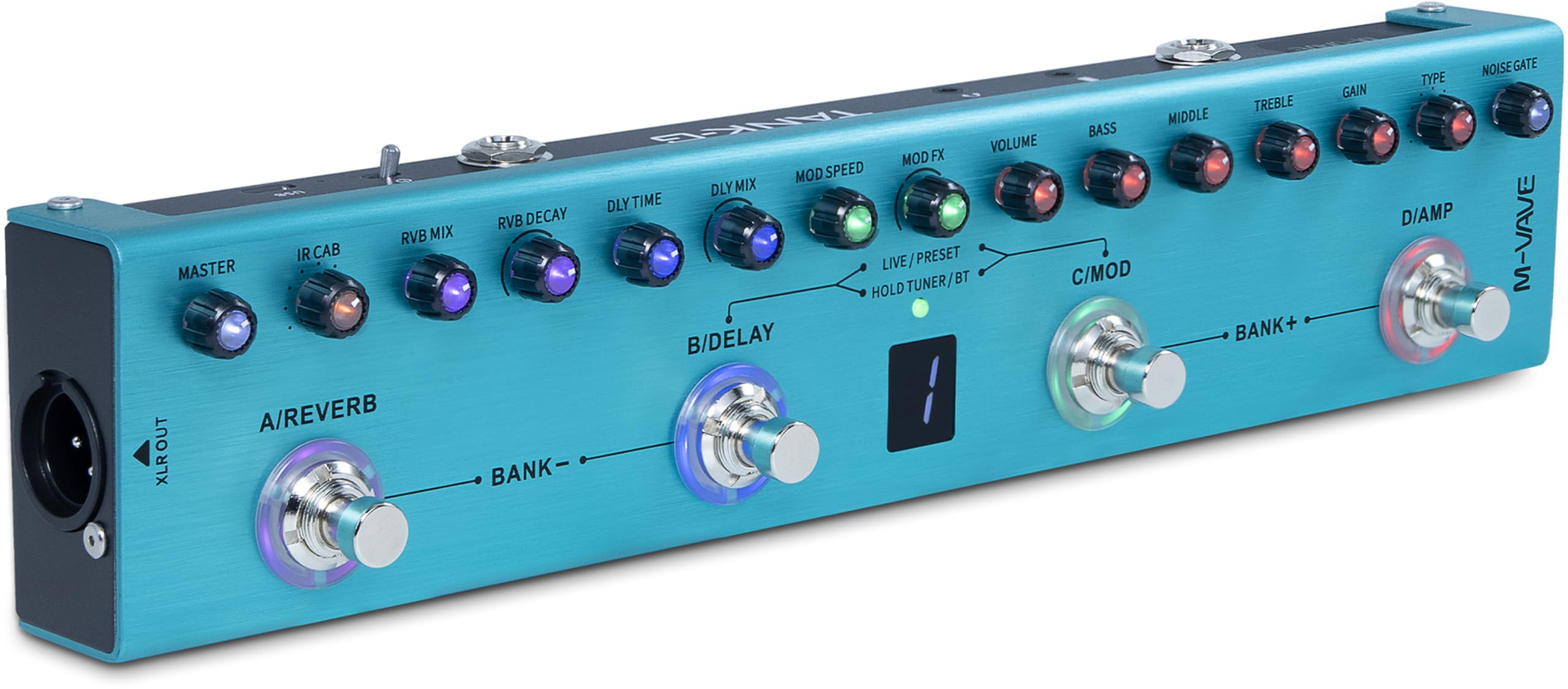
The M-VAVE TANK-G is a battery-powered multi-effects unit designed for maximum portability. Its internal 3000mAh rechargeable battery provides up to 12 hours of continuous operation, making it ideal for busking, backstage warm-ups, or jamming without wall power. The unit houses 36 editable presets spread across 9 banks, each configurable with a chain of up to 11 effect blocks including Noise Gate, Preamp selection, 3-band EQ, Modulation, Delay, and Reverb.
The built-in 8 IR cabinet slots allow you to load custom speaker impulses via USB for authentic amp-in-the-room tones. The headphone output with XLR balanced output and USB Type-C audio interface support make it a capable recording tool. The desktop software and companion app enable full preset management and sharing, including the ability to import third-party IR files.
Players note that the stock presets require tweaking to sound their best, but the hardware delivers clear, low-noise performance once dialed in. The compact, all-metal build feels solid, though the footswitch spacing can be tight for larger feet.
Why it’s great
- Long battery life for mobile practice sessions
- Flexible IR loading and preset sharing via desktop app
- XLR balanced output for direct PA connection
Good to know
- Stock presets often need major editing to sound good
- Some users report occasional signal lag with delay engaged
5. TC Electronic Dark Matter Distortion

The TC Electronic Dark Matter Distortion is an analog distortion pedal that focuses on dynamic, responsive crunch rather than high-gain mayhem. Its four-knob layout — Gain, Level, Bass, and Treble — paired with a Voicing switch, gives you extensive control over your distortion character. The Voicing switch shifts the bass response, letting you toggle between a tight, focused low-end and a more open, saggy feel that responds to picking dynamics.
The true-bypass switching eliminates tone suck when disengaged, while the compact BOSS-sized enclosure fits neatly onto any board. The circuit uses symmetrical clipping to produce a warm, organic breakup that cleans up beautifully when you roll back your guitar’s volume knob. It is particularly well-suited for classic rock, blues, and hard rock tones, delivering a sound reminiscent of a Marshall Plexi pushed into natural overdrive.
Reviewers praise its clarity and note definition, even on complex chords, and its ability to work well on both guitar and bass. The distortion is less aggressive than a RAT or a Metal Zone, making it a better choice for players who prefer dynamic touch sensitivity over wall-to-wall gain.
Why it’s great
- Voicing switch offers flexible low-end response
- Warm, dynamic distortion responds to volume knob changes
- Full 2-band EQ for detailed tone shaping
Good to know
- Not suitable for ultra-high-gain, downtuned metal
- Build quality feels less rugged than BOSS or MXR units
6. Donner Alpha Cruncher

The Donner Alpha Cruncher is a three-in-one effects pedal that chains Distortion, Chorus, and Delay into a single compact unit, eliminating the need for patch cables and multiple power connections. The distortion section delivers a classic British-style hi-gain sound, the chorus offers a pure, warm modulation, and the delay provides up to 1000ms of analog-voiced repeats. Each effect has three dedicated control knobs, giving you independent shaping over each block.
True-bypass switching routes your dry signal cleanly when the pedal is off, while the all-aluminum alloy chassis is built to withstand the rigors of gigging and travel. The unit includes a power adapter, which is a welcome addition at this tier. The 70mA current draw is low enough that the Cruncher can be powered from most standard daisy-chain supplies.
Players find it an excellent entry point for beginners building their first board or as a compact backup option for gigging musicians. The distortion is versatile enough for 70s-90s rock and grunge, and the chorus and delay effects are surprisingly robust for the form factor.
Why it’s great
- Three effects in one saves space and cabling
- Power adapter included for immediate use
- Aluminum chassis is lightweight and road-ready
Good to know
- Distortion can be trebly or harsh at high settings
- Chorus is subtle; lacks depth for extreme modulation
7. LEKATO Looper Pedal

The LEKATO Looper Pedal is a dedicated loop station that offers three independent loop slots with a total recording time of 18 minutes (6 minutes per loop). It supports unlimited overdubs, allowing you to layer chords, leads, and bass lines on top of each other for full song construction. The 48kHz/24-bit audio sampling rate ensures uncompressed, lossless quality, keeping your loops clean and free of digital artifacts.
Its built-in synchronous recording mode lets you enter recording state mid-playback without missing a beat, and the integrated high-sensitivity tuner eliminates the need for a separate tuning pedal. The USB port enables importing and exporting of WAV loop files from a PC, and recorded files are automatically saved even when power is lost. The Analog-Dry-Through design ensures that your dry signal passes without coloring.
Users appreciate the simple one-button control for Record, Undo/Redo, Stop, and Erase, with a single knob for playback volume. The LED screen shows loop time progress clearly. It is an excellent tool for practice, songwriting, and even live performance, though some players note that the three-slot limit may restrict complex arrangements.
Why it’s great
- Lossless 48kHz/24-bit audio quality
- USB import/export for WAV file management
- Built-in tuner saves pedalboard space
Good to know
- Only 3 loop slots; not ideal for complex multi-section songs
- Power supply not included; requires 9V center-negative adapter
FAQ
Can I use a guitar distortion pedal with a bass guitar?
How do I set up a stereo pedal like the BOSS CH-1 on my board?
Why does my multi-effects pedal sound thin through an amplifier?
Final Thoughts: The Verdict
For most users, the guitar pedals winner is the VALETON GP-200 because it replaces an entire rig with professional-grade amp modeling, IR cab simulation, and an all-in-one USB interface. If you want a classic analog overdrive for blues and rock, grab the Ibanez Tube Screamer Mini. And for a budget-friendly, battery-powered practice board, nothing beats the M-VAVE TANK-G.