
A volume pedal is the most direct way to shape your dynamics without taking your hands off the fretboard. The challenge is finding one that delivers a smooth, silent sweep without robbing your tone or taking up half your pedalboard.
I’m Mohammad Maruf — the founder and writer behind Drink4Good. I’ve spent countless hours analyzing the specs, pot types, sweep rates, and build materials across the most talked-about volume pedals to separate the transparent performers from the noisy compromises.
Whether you need a passive unit for pure signal paths or an active wah/volume hybrid for maximum flexibility, this guide to the best guitar volume pedal covers seven models that handle everything from subtle swells to full-on boot-scootin’ control.
How To Choose The Best Guitar Volume Pedal
A volume pedal is a simple tool on the surface, but the wrong one can add noise, alter your impedance, or feel jerky underfoot. Here are the key factors that separate a great pedal from a frustrating one.
Passive vs. Active Circuitry
Passive pedals operate without external power and use a potentiometer to bleed off signal. They are simple and reliable but can load down your pickups if the impedance isn’t matched, causing a loss of high-end sparkle. Active pedals require 9V DC power and use a buffer to maintain signal integrity across any impedance. They are essential if you have a long cable run or are using the pedal with effects that are sensitive to input impedance.
Potentiometer Taper and Sweep Feel
Most volume pedals use either an audio/log taper or a linear taper pot. Audio taper gives a more natural fade that matches your ear’s perception of loudness, while linear taper can feel sudden at the start and slow at the end. The key spec here is the resistance value — 250K pot for passive signals and 25K-50K pot for active signals. A non-standard taper means you’ll fight the pedal for control of your swells.
Footprint and Physical Build
A full-size volume pedal like the Ernie Ball VP Jr. takes up roughly 10 x 3.5 inches of pedalboard real estate. Mini pedals like the Dunlop Volume (X) cut that footprint in half, which is a massive advantage on a crowded board but may feel cramped for players with larger feet. Build material matters — metal chassis pedals resist flex and last longer on the road, while high-quality plastic can shave off weight for portable rigs.
Quick Comparison
On smaller screens, swipe sideways to see the full table.
| Model | Category | Best For | Key Spec | Amazon |
|---|---|---|---|---|
| Ernie Ball VP JR 250K | Passive Volume | Reliable studio and stage swells | 250K audio taper pot | Amazon |
| JOYO WAH-II | Wah/Volume Hybrid | Versatile wah with active volume | 6-mode sweep + Q control | Amazon |
| Dunlop Volume (X) Mini | Mini Passive | Pro-grade control in small footprint | 1 million cycle band-drive | Amazon |
| Hotone Soul Press II | 4-in-1 Multi | Wah, volume, & expression hybrid | True bypass + LED position | Amazon |
| HOTONE Ampero Press | Passive EX/Vol | Saving space with dual function | Dual independent jacks | Amazon |
| Donner Viper | Passive 2-in-1 | Budget expression + volume | Auto-switching input jack | Amazon |
| Donner Vowel | Active Wah/Volume | Inexpensive wah with volume | Classic-inspired wah resonance | Amazon |
In‑Depth Reviews
1. Ernie Ball VP JR 250K Volume Pedal

The Ernie Ball VP JR has been a staple on pro boards for decades, and the 250K version is the one to get for passive signals. Its brushed aluminum chassis feels solid without being heavy, and the string-driven potentiometer delivers a buttery-smooth sweep from silent to full output. The taper switch lets you choose between two swell rates, which is an underrated feature for dialing in either slow cinematic fades or quick volume cuts.
The mono design keeps the signal path simple, and the 10 x 3-inch footprint is a comfortable size for most pedalboards. Players report the internal string may wear after extended use, but it is user-replaceable with a cheap part. The audio taper pot provides a natural fade that responds to your foot without any jumpiness.
At under 2.5 pounds, it is lighter than most full-size options but still feels bombproof. The VP JR is the gold standard for a reason — it does one job and does it flawlessly, without adding noise or coloring your tone.
Why it’s great
- Smooth, reliable audio taper sweep
- Durable brushed aluminum housing
- Selectable swell rate via taper switch
Good to know
- String may wear over time (user replaceable)
- Mono only; no expression output
2. JOYO Compact Wah/Volume WAH-II

The JOYO WAH-II packs a staggering amount of control into a 6.5 x 3-inch red aluminum box. With six selectable wah frequency ranges and a dedicated Q control, you can dial in everything from a tight funk cluck to a wide, vocal sweep. In volume mode, the active buffer preserves your high end, and the Minimum Volume knob lets you set the heel-down floor from silent to a defined boost — perfect for going from rhythm to lead without a separate volume jump.
True bypass in wah mode means your guitar’s signal is untouched when the wah is off, though the volume circuit remains active (as is the case with most active volume pedals). The dual green LEDs give clear visual feedback on the rocker position, a nice touch for dark stages. Players with size 10+ shoes should note the compact treadle is best used mounted on a pedalboard for a comfortable foot angle.
The Zener diode-based clipping and adjustable Q give this pedal a sound that rivals wahs costing twice as much. If you need both wah and volume in a single pedalboard-friendly unit, the WAH-II is a smart choice that doesn’t compromise on tonal flexibility.
Why it’s great
- Six sweep ranges for any wah style
- Adjustable minimum volume for swells
- Compact footprint saves board space
Good to know
- Treadle small for larger feet without board mount
- Requires 9V DC power; no battery support
3. Dunlop Volume (X) Mini Pedal (DVP4)

The Dunlop Volume (X) Mini proves that a smaller pedal doesn’t have to mean compromised feel. Its low-friction band-drive mechanism is tested to over one million cycles, delivering a smooth, consistent rocker action that feels as substantial as a full-size unit. The internal controls let you set heel/toe polarity, adjust the minimum heel-down FX level, and switch the Aux jack between tuner mode and expression mode — giving pro-level flexibility in a package that is 6 x 3.5 inches.
The rubber tread on the rocker keeps your foot planted, and the adjustable torque lets you dial in the resistance to your liking. The passive design means no power supply is needed, and the tuner output is handy for muting your signal while silently tuning. Players across electric guitar, bass, and modelers like the Helix HX Stomp praise its duality as both an analog volume pedal and an expression controller.
The build quality is genuinely tank-like — this is a pedal built for touring. The trade-off is a higher entry price, but for players who need a bulletproof mini pedal with expression flexibility, the DVP4 is worth every penny.
Why it’s great
- Extremely durable band-drive mechanism
- Adjustable torque for custom feel
- Aux output doubles as tuner or expression
Good to know
- Premium pricing compared to mini alternatives
- Internal switches require opening the chassis
4. Hotone Soul Press II

The Hotone Soul Press II is a 4-in-1 pedal that combines wah, volume, expression, and a volume/wah blend mode into a single compact chassis. The wah circuit is inspired by the vocal-like sounds of the 1960s, with adjustable tone and width controls that let you fine-tune the resonance. The volume mode features a clean active buffer, and the real-time LED indicators on the rocker give visual feedback of the sweep position — a genuinely useful feature for live use.
True bypass switching keeps your signal pure when the pedal is disengaged, and the increased non-slip footprint (6.38 x 3.19 inches) provides a stable platform. Players note that the volume sweep ramps up from zero a bit quickly, which can make slow swells a challenge without practice. The expression port works well with modelers like the HX Stomp, and the wah sound competes with dedicated units.
For players who need wah, volume, and expression control in one slot on their board, the Soul Press II is a space-saving powerhouse. The flexibility is unmatched for its size, though you will need to work around the volume taper’s touch sensitivity.
Why it’s great
- True bypass in wah mode
- Adjustable wah tone and width
- LED rocker shows sweep position
Good to know
- Volume sweep can be touch-sensitive at heel
- Durability questions from long-term users
5. HOTONE Ampero Press 2-in-1

The HOTONE Ampero Press is a passive 2-in-1 pedal that serves as both a volume pedal and an expression controller without needing any power. Its standout design feature is the independent volume and expression output jacks — you don’t have to share one jack or flip a switch to change modes. The high-quality potentiometer delivers a precise response through the sweep, and the included 15cm TS cable gets you started immediately.
The aluminum alloy body feels solid and road-ready, and the 6.38 x 2.01-inch silhouette is compact enough to fit on tight pedalboards. Players using modelers or multi-effects units appreciate the expression mode for controlling parameters on the fly. A key note: for full expression functionality, you will need a TRS cable, as the included TS cable only handles volume mode.
The sweep is slightly shorter than a full-size pedal, but most players find it workable after a brief adjustment. For musicians juggling both volume swells and expression control, the Ampero Press delivers real versatility in a passive, no-power package.
Why it’s great
- Passive design with no power needed
- Independent volume and expression jacks
- Durable aluminum chassis
Good to know
- Requires TRS cable for expression mode
- Slightly shorter sweep than full-size pedals
6. Donner Viper Volume/Expression Pedal
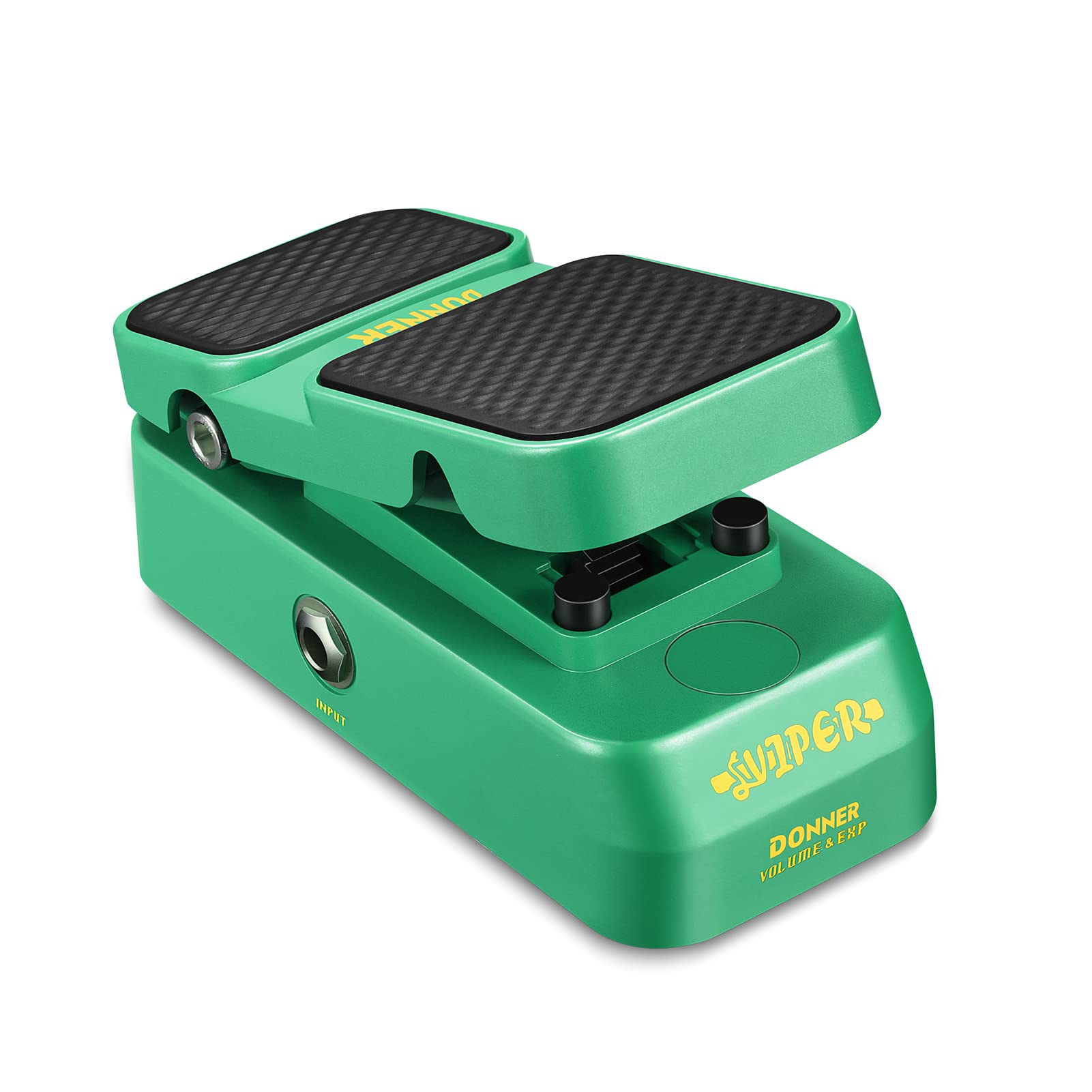
The Donner Viper is a passive 2-in-1 pedal that switches between volume and expression modes automatically by detecting which type of jack is inserted. No power supply needed, no switches to flip — just plug in and go. The hard plastic casing keeps it lightweight at just 280 grams, and the 5.85 x 2.58-inch footprint makes it one of the most compact volume pedals available.
The sweep from heel to toe is smooth and noise-free for most players, with a consistent fade from 0 to 100 percent. The sturdy plastic construction holds up well for stationary and home studio use, though some users report a static or hum in the middle of the sweep on certain units. The automatic mode switching is genuinely convenient for players who want a simple, no-frills solution for volume and expression control.
For the budget-conscious player or someone just starting to explore volume swells and expression control, the Viper is a solid entry point. It does not include a battery compartment, but being passive, you do not need one. Check your unit for any noise issues early in the return window.
Why it’s great
- Auto-switching between volume and expression
- Lightweight and very compact
- Passive — no power supply required
Good to know
- Some units may have noise in mid-sweep
- No battery compartment
7. Donner Vowel Wah/Volume Pedal

The Donner Vowel is an active 2-in-1 pedal that brings a classic 1970s-inspired wah sound together with an active volume circuit in one compact enclosure. The wah resonance is deep and filter-heavy, reminiscent of vintage Maestro units, with a smooth sweep that works especially well for doom, stoner rock, and funk. The active volume mode eliminates signal loss, providing a powerful and clean output with no popping or buzzing.
The plastic housing is lightweight and features a solid metal hinge design for durability. At just 0.38 kilograms and a footprint of 2.6 x 2.2 inches, it is one of the smallest dual-function pedals on the market, ideal for mini boards. The indicator lights clearly show the working state, and the footswitch toggle lets you switch between wah and volume modes quickly.
A few caveats: the plastic build is not designed for heavy touring, and some users report a slight gain increase or hiss in wah mode. The unit does not include a battery compartment or power adapter. For hobbyists, church musicians, or players exploring wah for the first time, the Vowel is a fun and affordable way to add both effects to your rig.
Why it’s great
- Classic wah tone with deep resonance
- Active volume eliminates signal loss
- Extremely compact and lightweight
Good to know
- Plastic housing not for heavy touring
- No power adapter or battery included
FAQ
Will a 250K pot volume pedal work with active pickups?
Why does my volume pedal add noise or a scratchy sound?
Can I use a volume pedal as an expression pedal?
Do I need true bypass in a volume pedal?
Final Thoughts: The Verdict
For most users, the best guitar volume pedal winner is the Ernie Ball VP JR 250K because it combines a proven, smooth audio taper sweep with a durable aluminum build that fits comfortably on any board. If you need wah and volume in one compact unit with extensive sweep customization, grab the JOYO WAH-II. And for a mini pedal that doubles as a pro-grade expression controller, nothing beats the Dunlop Volume (X) Mini.