
Cutting the cable is one of the most liberating moves a guitarist can make, but poorly designed wireless transmitters introduce noise, dropouts, and distracting latency that ruin a performance. Whether you practice at home, play small clubs, or tour full-time, the right unit preserves your instrument’s natural tone and dynamic response while giving you total freedom on stage.
I’m Mohammad Maruf — the founder and writer behind Drink4Good. I spend my time analyzing hardware specifications, reading through hundreds of verified customer reports, and comparing the real-world performance of digital audio gear so musicians can make informed buying decisions without wasting time on shaky products.
After cross-referencing latency figures, frequency ranges, battery reliability, and real user experiences across several price tiers, I’ve isolated the most dependable options for different playing scenarios so you can quickly identify the right guitar wireless transmitter for your rig without sifting through dozens of confusing listings.
How To Choose The Best Guitar Wireless Transmitter
The market is crowded with budget-friendly to premium units, and the primary differentiators are operating frequency, latency, compatibility with your pickups, and battery longevity. Understanding these core specs will help you avoid returns and disappointment.
Frequency Band: 2.4GHz vs 5.8GHz
2.4GHz transmitters are widely compatible but share the crowded spectrum with household Wi-Fi and Bluetooth devices, which can cause dropouts in dense urban areas or venues. The 5.8GHz band is much cleaner and less prone to interference, making it the preferred choice for professional gigging musicians who need a reliable signal in any environment.
Latency and Audio Quality
Look for a latency specification of under 6 milliseconds (ideal is sub-5ms). Higher latency creates a noticeable “swimming” sensation that feels disorienting when playing fast passages. Also verify the bit depth — 24-bit/48kHz ensures your instrument’s tonal fidelity is preserved without the compressed, lifeless sound of cheaper 16-bit systems.
Battery Life and Charging Convenience
Stage players need a minimum of 4 to 5 hours of continuous run time. Units with USB-C charging are preferred for faster top-ups. A charging case can be a game-changer for musicians who play multiple sets, as it keeps the transmitter and receiver topped off between uses without fumbling with cables.
Quick Comparison
On smaller screens, swipe sideways to see the full table.
| Model | Category | Best For | Key Spec | Amazon |
|---|---|---|---|---|
| NUX C-5RC | Premium | Traveling gigging musicians | 5.8GHz + Charging Case | Amazon |
| Xvive A58 | Premium | Active pickup guitars | True Diversity 5.8GHz | Amazon |
| Positive Grid Spark Link | Premium | Spark amp ecosystem | Sub-3ms Latency | Amazon |
| Line 6 G10TII | Mid-Range | Line 6 & Yamaha amp users | 7-Hour Battery Life | Amazon |
| Sondery A4 | Mid-Range | Visual feedback monitoring | Built-in Display Screen | Amazon |
| LEKATO WS-50 | Mid-Range | Outdoor performance range | 300ft Range (Outdoor) | Amazon |
| LEKATO WS-80 | Budget-Friendly | Budget-conscious beginners | 8-Hour Battery Life | Amazon |
In-Depth Reviews
1. NUX C-5RC 5.8GHz Wireless Guitar System

The NUX C-5RC delivers a comprehensive package for the working musician, pairing 24-bit/48kHz audio quality with a 5.8GHz frequency that completely sidesteps the congestion of the 2.4GHz band. The included charging case is the headline feature here — it automatically charges both the transmitter and receiver when stored, eliminating the anxiety of dead batteries between sets. The cable emulation switch is a subtle but powerful addition that tames excessive treble, particularly helpful when using active pickups on an acoustic-electric guitar.
Real users consistently report flawless performance with both passive and active pickups, noting that the auto-matching feature makes setup instantaneous. The unit provides up to 100 feet of line-of-sight range and has a handy mute function for silent instrument swaps during a performance. Some players experienced interference from nearby WiFi routers during initial setups at home, but these issues did not translate to live gig environments where the 5.8GHz band remains clean and reliable.
Battery fade after roughly three years of heavy use is the main longevity concern — the cells are replaceable with soldering, but the factory warranty covers only the first twelve months. Musicians who gig consistently should keep a backup cable handy, though the convenience of the charging case and the lack of interference issues make this the most well-rounded unit for traveling performers who value reliability above all else.
Why it’s great
- Charging case keeps both units topped off during transport
- 5.8GHz band avoids WiFi and Bluetooth interference
- Cable emulation switch tailors high-end response for active pickups
Good to know
- Batteries fade after ~3 years; soldering required for replacement
- Warranty limited to 12 months from the distributor
- Home WiFi routers can cause minor interference during setup
2. Xvive A58 5.8GHz Wireless Guitar System
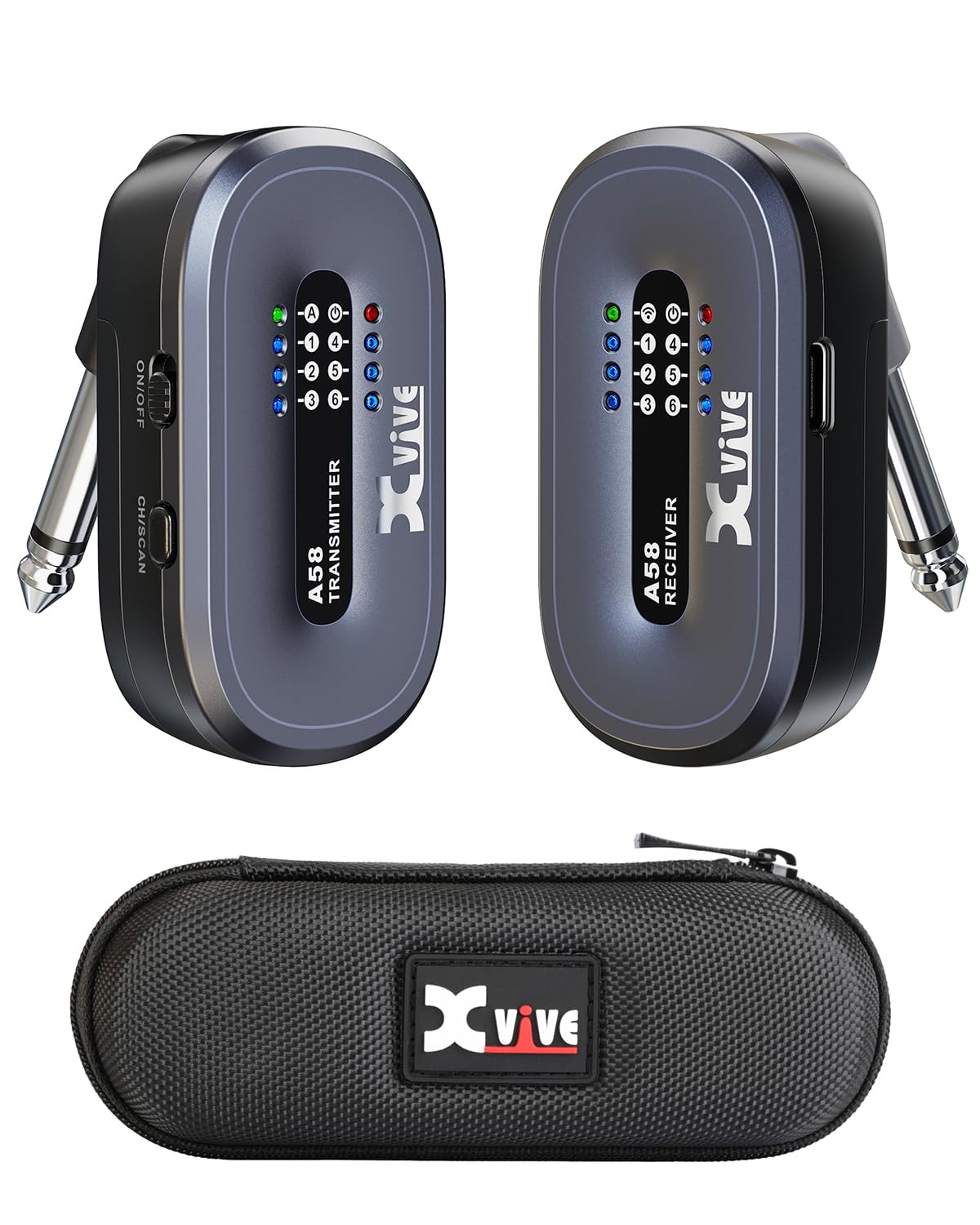
Xvive’s A58 represents a significant upgrade from their previous 2.4GHz model, using true diversity technology on the 5.8GHz band to maintain a rock-solid connection. The standout feature is the dedicated Active and Passive mode switch — holding the transmitter’s channel button for three seconds toggles between the two, allowing the unit to handle high-output active pickups without audio distortion. This makes it one of the most versatile options for players switching between a passive Strat and an active Ibanez in the same setup.
The sound quality is genuinely impressive for the price point. The 24-bit/48kHz signal delivers a full frequency response from 20Hz to 20kHz, and users report no perceptible latency when playing fast passages. Channel scan mode automatically finds the clearest frequency when turned on, eliminating manual channel hunting. The included Y-shaped USB-C cable charges both the transmitter and receiver at the same time, though the battery life is around four to five hours depending on how it’s used.
Build quality feels lightweight but slightly less robust compared to competitors like the NUX. The oblong shape sits well in the guitar jack but some players have reported that the plastic housing feels less durable for regular tour use. The 100-foot transmission range is accurate when line of sight is maintained, but walls and obstructions reduce it to roughly 40 feet. For the price, this unit offers excellent interference rejection and is a strong choice for musicians who need a clean signal in environments with heavy 2.4GHz traffic.
Why it’s great
- Active/Passive mode switch prevents distortion with high-output pickups
- True diversity scanning finds cleanest frequency automatically
- USB-C charging is fast and convenient
Good to know
- Plastic housing feels less tour-ready than metal alternatives
- Battery life drops to ~4 hours in real-world conditions
- Range degrades significantly through walls and obstructions
3. Positive Grid Spark Link

Positive Grid designed the Spark Link to pair seamlessly with the Spark amp ecosystem, but this 2.4GHz system works well with any amplifier or audio interface. The headline spec is the sub-3ms latency — the fastest in this roundup — which rivals the feel of a high-quality cable. The 110-degree hinged plug is unique and solves the fitment issues common with fixed-angle transmitters, though it still does not accommodate deeply recessed jacks like those found on PRS Silver Sky models.
Audio quality is excellent at 24-bit/48kHz with a 20Hz-to-20kHz frequency response. The 70-foot transmission range is adequate for most club stages and practice spaces. The transmitter feels solid with an aluminum alloy enclosure, and the dual-end USB-C cable keeps both units charged. Real-world battery life consistently hits around 6 hours, and the auto-off feature after 30 minutes of inactivity helps conserve power when you step away.
The primary drawbacks are the 2.4GHz band, which is more susceptible to interference in venues with heavy WiFi traffic, and the fitment limitation on certain guitars. A small number of users have reported internal wiring failures after heavy bending of the plug, but Positive Grid’s customer support has been responsive with replacements. This is an outstanding choice for Spark amp users or anyone prioritizing the absolute lowest latency available in a consumer wireless system.
Why it’s great
- Fastest latency in the category at under 3ms
- Aluminum alloy enclosure feels premium and durable
- 110-degree hinge improves fit on most guitar bodies
Good to know
- 2.4GHz band faces more interference than 5.8GHz alternatives
- Does not fit PRS Silver Sky or similar recessed jacks
- Internal wiring can fail if plug is bent repeatedly
4. Line 6 G10TII

The Line 6 G10TII is not a standalone wireless system in the traditional sense — it is a dedicated transmitter designed to work exclusively with Line 6 Relay G10 and G10S receivers, POD Go Wireless, Spider V/VMKII amps, and Yamaha THR-II wireless amps. If you already own one of these platforms, the G10TII offers a seamless plug-and-play experience with zero setup. The transmitter charges directly through the amp’s audio input, meaning no USB cables or separate charging docks are required when using a compatible amplifier.
Battery life is a strong 7 hours on a full charge, and the build quality feels solid with a copper contact material. Users report immediate pairing with no dropouts within 20 feet of the receiver, making it a reliable option for home practice and small gigs. The sound quality and volume levels are effectively identical to a standard guitar cable, which is exactly what most players want.
The closed ecosystem is the obvious drawback — this transmitter is useless outside the Line 6 and Yamaha THR-II wireless ecosystem. Some users have reported intermittent dropouts even within three feet of the base station with the G10TII, whereas the original G10T was more reliable in this regard. The dongle-style design is also prone to breaking if left plugged into a guitar while stored in a case. For players locked into the Line 6 ecosystem, it is a convenient solution, but it offers no value for anyone using a different amplifier or pedalboard.
Why it’s great
- Charges directly through compatible Line 6 and Yamaha amps
- 7-hour battery life covers long practice sessions and gigs
- True plug-and-play with zero setup required
Good to know
- Only works within the Line 6 Relay and Yamaha THR-II ecosystem
- G10TII has reported dropouts near base station compared to the original G10T
- Dongle breaks easily if left in guitar during storage
5. Sondery A4 5.8GHz Wireless Transmitter Receiver

The Sondery A4 offers a unique visual feedback advantage in the mid-range category thanks to its built-in OLED display, which shows real-time connection status, battery levels, and signal strength. This is a practical feature for stage players who need to glance down and confirm their system health without fumbling with phone apps or menu diving. The 5.8GHz frequency keeps things clean, and the 24-bit/48kHz audio delivers rich, vibrant tone with active and passive instruments alike.
Latency is rated at sub-5.6ms, which falls into the imperceptible range for most players. The 115-foot line-of-sight range is generous, and four units can operate simultaneously on different channels without cross-interference. The 220-degree rotatable plug accommodates most guitar jacks, and the dual-USB cable charges both units at once. The auto-shutoff feature on the receiver after 30 minutes is a nice power-saving touch.
The real-world range is heavily dependent on line of sight — users report that placing the receiver near the floor causes the signal to cut out at 15 to 20 feet, especially during softer playing dynamics where signal amplitude is lower. Battery life sits around 3 to 4 hours in real use, which is below the average for this category. A small number of users have reported units failing after six months of light use, so longevity is a question mark. The display and 5.8GHz reliability make it a solid choice for musicians who value visual monitoring and live in areas with congested 2.4GHz spectrum.
Why it’s great
- OLED display shows battery life and signal strength at a glance
- 5.8GHz band stays clean in crowded WiFi environments
- USB-C charging is fast and modern
Good to know
- Line-of-sight dependent — range drops dramatically with obstructions
- Real battery life is around 3-4 hours, less than some competitors
- Some units have failed after several months of light use
6. LEKATO WS-50 5.8GHz Wireless Guitar System

The LEKATO WS-50 is the mid-range workhorse that prioritizes range above all else. The 5.8GHz UHF technology delivers an advertised 300 feet outdoors, and real-world users confirm stable transmission up to 40 to 50 feet even through walls and trees. The 110dB dynamic range combined with 24-bit/48kHz audio provides excellent tonal clarity with no hiss or fidelity loss. This is an ideal option for guitarists who perform in large venues, outdoor stages, or church settings where the receiver might be positioned far from the performance area.
Setup is straightforward — plug-and-play with a 220-degree rotatable plug that fits most electric and acoustic-electric instruments. The build quality receives consistent high marks, with users describing it as top-notch for the price tier. The battery life in real-world use hovers around 5 to 6 hours, and a full recharge takes roughly one hour. The four-channel support allows multiple band members to use the system simultaneously without interference.
The most notable limitation is the battery life, which is slightly below average at 5 hours compared to the 8-hour LEKATO WS-80. Some users have reported minor noise interference when the unit is placed near a laptop, so it is worth keeping the transmitter away from electronics. The unit is also slightly larger than some competitors in the budget space, making it a touch more visible on the guitar body. Overall, the WS-50 is a reliable choice for players who need extended range and are willing to accept slightly shorter battery life in exchange for that freedom.
Why it’s great
- 300-foot range is the longest in this roundup
- 24-bit/48kHz audio with wide 110dB dynamic range
- Solid build quality with clear, intuitive instructions
Good to know
- Battery life of 5 hours is below the average for this category
- Can pick up noise when placed near a laptop or electronic devices
- Slightly larger than some competitors, more visible on the guitar
7. LEKATO WS-80 2.4GHz Wireless Guitar System

The LEKATO WS-80 is the most popular budget-friendly entry into the wireless guitar market, and for good reason. Despite its low cost, it delivers 2.4GHz operation with sub-5ms latency and a 20-meter range that is more than sufficient for home practice, small venues, and church settings. The battery life is exceptional at 8 hours, meaning you can play for multiple days on a single charge without thinking about power. The 220-degree rotatable plug works with virtually any electric guitar, bass, or electro-acoustic instrument.
Sound quality is surprisingly transparent for the price point. Multiple users have reported that the audio fidelity is indistinguishable from a cable and that the sustain and dynamic response feel entirely natural. The pairing process is simple — power on both units, press the receiver’s button, then hold the transmitter’s button for two seconds — and the unit starts working immediately. The four-channel support allows two sets to be used simultaneously without channel conflicts during band practice.
The biggest drawback is the reliance on the 2.4GHz band, which can experience interference in venues with dense WiFi or Bluetooth activity. Some users have reported dropouts at church events where the wireless spectrum was particularly crowded, so it is not recommended for mission-critical professional gigs in dense urban environments. The build quality feels light and somewhat fragile compared to metal-bodied units, so careful handling is required during transport. For the price, it is an incredible value for home players and small venue musicians who need a reliable cable-free experience.
Why it’s great
- 8-hour battery is the longest in this entire guide
- Transparent sound quality that rivals much more expensive units
- Simple pairing process with clear instructions for beginners
Good to know
- 2.4GHz band can drop out in crowded WiFi and Bluetooth environments
- Build quality feels light and less durable for heavy touring
- Not recommended for professional gigs in dense urban venues
FAQ
Can I use a guitar wireless transmitter with active pickups?
Will a 5.8GHz transmitter work with my existing 2.4GHz receiver?
How do I choose between 2.4GHz and 5.8GHz for my guitar transmitter?
Final Thoughts: The Verdict
For most users, the guitar wireless transmitter winner is the NUX C-5RC because the included charging case and 5.8GHz stability make it the most practical all-in-one solution for gigging musicians who value reliability and convenience. If you want the absolute lowest latency and own a Spark amp, grab the Positive Grid Spark Link. And for a budget-friendly entry point that still delivers excellent battery life and sound quality, nothing beats the LEKATO WS-80.