
Every squat, lunge, or stair climb sends a shock wave through your patellar tendon, and if you have chronic knee pain, that wave can feel like a spike. The right choice isn’t about working out less—it’s about finding machines that keep your joints tracking naturally under zero impact. We’ve analyzed nine gym equipment options specifically engineered to let you build strength and cardio endurance without grinding cartilage into inflammation.
I’m Mohammad Maruf — the founder and writer behind Drink4Good. I’ve spent weeks cross-referencing biomechanical specs, resistance mechanisms, stride geometries, and real user feedback on every unit in this guide to isolate exactly which features protect compromised knees. This is not a generic fitness list; every machine here was selected for its low-impact, joint-friendly design profile.
Whether you need a seated elliptical to keep your legs moving during work hours or a full recumbent station for high-intensity cardio without the punishment, this deep-dive breakdown of the best available gym equipment for bad knees will help you pin down the perfect match for your space, budget, and rehab goals.
How To Choose The Best Gym Equipment For Bad Knees
Not every “low-impact” label actually spares your patellofemoral joint. The wrong stride length or a fixed pedal arc can torque the medial collateral ligament and worsen your condition. Here are the four non-negotiable filters you must apply before buying any machine for knee-sensitive training.
Resistance Type: Magnetic or Electromagnetic Only
Felt-pad resistance systems create friction that degrades over time, causing jerky stops and uneven pedal loads. Magnetic resistance, whether manual or electronically controlled, delivers smooth, drag-free tension that doesn’t spike torque into your knee ligaments mid-stroke. Every product on this list uses magnetic resistance.
Stride Geometry and Foot Path
Ellipticals and recumbent cross-trainers with a fixed foot arc can lock your knee into an unnatural circular path. Look for machines that offer a natural stepping motion—like a recumbent stepper or a long-stride elliptical that lets your foot roll through a gait cycle rather than a strict pedal circle. The Teeter FreeStep uses a patented physical therapy stride that mimics walking without vertical impact.
Seat Adjustability and Back Support
If your knee pain is tied to poor hip alignment or a weak core, a recumbent bike with an infinitely adjustable seat rail and a high mesh backrest allows you to maintain a neutral pelvic tilt. This prevents the hip from rotating externally, which often pulls the knee out of tracking. Look for seat rails that adjust in millimeter increments rather than fixed pre-drilled holes.
Weight Capacity and Frame Stability
Equipment rated for 300 to 400 pounds uses thicker gauge steel that won’t flex during heavy exertion. A wobbly frame introduces micro-movements at the pedal interface that can cause your knee to search for stability, leading to soft-tissue strain. Check the maximum weight specification—it’s a proxy for overall chassis rigidity.
Quick Comparison
On smaller screens, swipe sideways to see the full table.
| Model | Category | Best For | Key Spec | Amazon |
|---|---|---|---|---|
| Teeter FreeStep LT3 | Recumbent Stepper | Full-body PT-style stride | 13 magnetic resistance levels | Amazon |
| Sunny Elite Recumbent Cross Trainer | Recumbent Elliptical | Programmed workouts | 16 electromagnetic resistance levels | Amazon |
| XVGVSV 2-in-1 Recumbent Bike | Recumbent Bike/Elliptical | Dual-mode cardio | 16 magnetic resistance levels | Amazon |
| Sunny Health Smart Recumbent Bike | Recumbent Bike | App-guided workouts | 16 magnetic resistance levels | Amazon |
| MERACH S19 Recumbent Bike | Recumbent Bike | Compact, quiet sessions | 8 car-style resistance levels | Amazon |
| VANSWE RB405 Recumbent Bike | Recumbent Bike | Heavy-duty support | 8 magnetic resistance levels | Amazon |
| pooboo W216 Recumbent Bike | Recumbent Bike | Upper/lower dual motion | 8 magnetic resistance levels | Amazon |
| pooboo E399 Elliptical | Elliptical Machine | Full stride home cardio | 16 magnetic resistance levels | Amazon |
| Cubii Total Body V2 | Under-Desk Elliptical | Seated desk mobility | 12 magnetic resistance levels | Amazon |
In‑Depth Reviews
1. Teeter FreeStep Recumbent Cross Trainer Stepper LT3

The Teeter FreeStep uses a patented stride licensed from commercial physical therapy steppers, making it the only home machine on this list that aligns the hip, knee, and ankle through a natural gait cycle rather than a fixed pedal circle. The 13 magnetic resistance levels deliver friction-free tension that won’t spike torque into the patellar tendon even during high-intensity intervals. The UltraGlide bearings ensure the start-up inertia is negligible—your first step feels fluid, not forced.
Comfort features include SoftStep pedals with a durable grip surface and a larger ComfortSelect seat that reclines in three positions. The 54″ by 38″ footprint is relatively compact for a full-body stepper, and the 300-pound weight capacity sits on a rigid alloy steel frame. The BILT app provides free trainer-led classes, and the console tracks time, distance, speed, and calories burned without requiring a plug-in outlet.
Assembly can take up to four hours for a solo builder, and the seat sits about 30 inches high—users under 5’4″ may need a small step stool or a cushion to reach the pedals comfortably. The seat itself is firm; some users add a gel pad for extended sessions. That said, the zero-impact natural stepping motion is unmatched for anyone with meniscus tears, patellar tracking issues, or post-replacement rehab.
Why it’s great
- Patented PT stride keeps knee joints in neutral alignment
- Whisper-quiet magnetic resistance with zero friction spikes
- Full upper and lower body engagement without vertical impact
Good to know
- High seat position may require a step stool for shorter users
- Assembly is lengthy and best tackled with a second person
- Hard seat cushion; many riders add an aftermarket pad
2. Sunny Health & Fitness Elite Recumbent Cross Trainer

Sunny Health & Fitness built this recumbent cross trainer with 16 levels of electromagnetic resistance—a step up from manual magnets—allowing the machine to adjust tension instantaneously mid-stride. The elliptical-sized foot pedals glide on a fixed arc, but the recumbent seating position shifts your center of gravity backward, reducing shear force across the knee joint compared to an upright elliptical. The contoured mesh backrest keeps your spine neutral, which stabilizes the pelvis and prevents hip rotation from pulling the knee out of track.
The digital performance monitor displays time, speed, RPM, distance, Watts, calories, heart rate, and target heart rate. You can choose from 12 pre-programmed workouts or create up to 4 custom user profiles. The SunnyFit app adds over 1,000 trainer-led sessions and 10,000 scenic virtual tours at no extra cost. The step-through design makes on and off access simple, which matters if your knee is stiff before a warm-up.
At 113 pounds and a 71.7″ length, this machine takes up significant floor space and requires a power outlet—it’s not battery-operated. The pedal distance is shorter than a commercial elliptical, so taller users (over 6’2″) may find the range of motion restrictive. The seat cushion is firm and can slide forward slightly on the mesh fabric during intense sessions. For rehab-focused cardio with guided programming, this unit offers the most data-rich experience in the mid-premium tier.
Why it’s great
- Electromagnetic resistance changes seamlessly during workouts
- 12 built-in programs plus 4 custom user profiles
- Step-through design for easy mounting with sore knees
Good to know
- Requires a power outlet—not battery-operated
- Long 71.7″ frame demands dedicated floor space
- Pedal stride length may feel short for users over 6’2″
3. XVGVSV 2-in-1 Elliptical Recumbent Bike (W241)
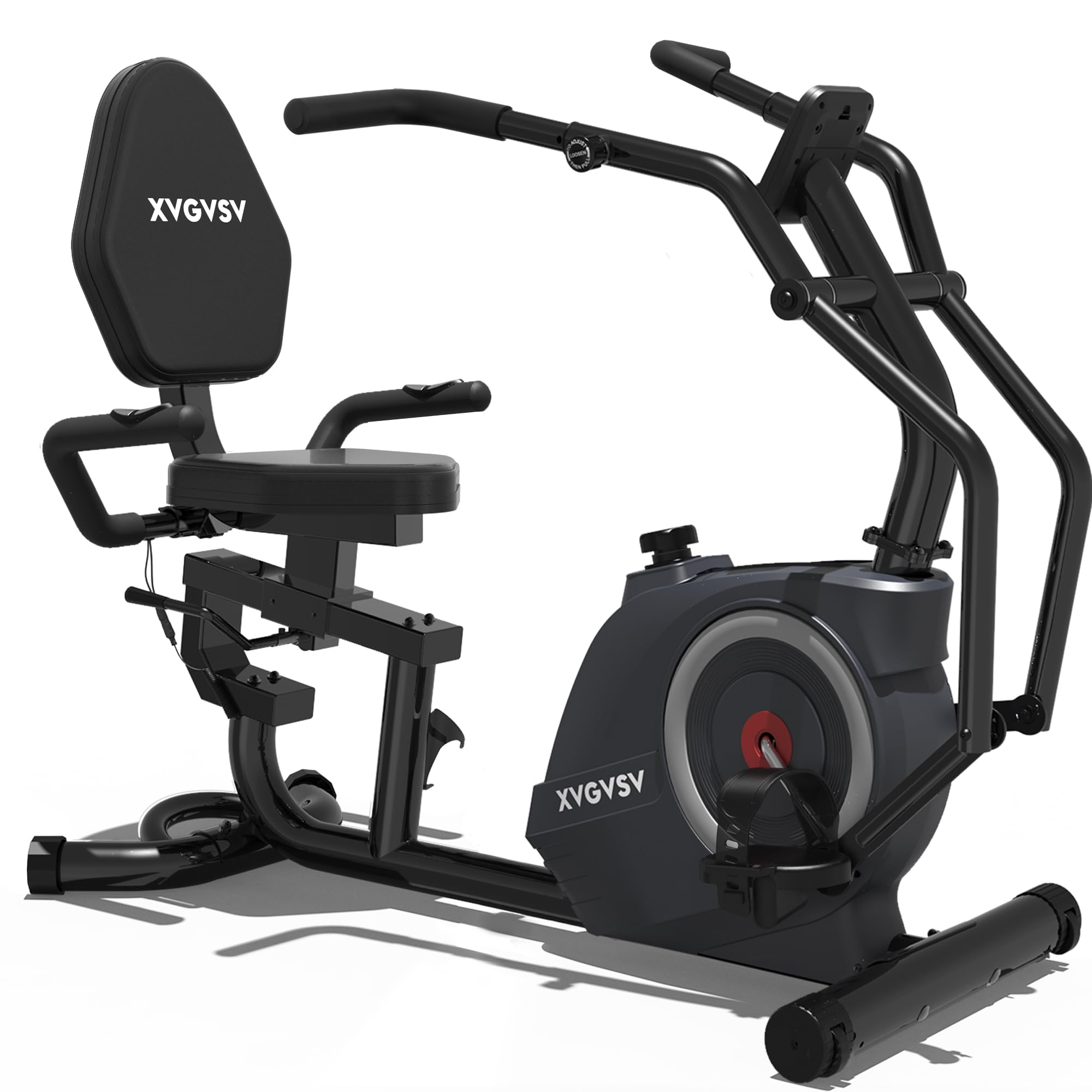
The XVGVSV W241 is the only unit on this list that switches between a recumbent bike cycle and an elliptical stride on the same chassis. The recumbent position uses a plush padded seat and ergonomic backrest, while the elliptical mode engages the glutes and hamstrings through a longer lateral arc. The 16-level magnetic resistance is whisper-quiet and adjusts via a simple tension knob, so you can dial in exactly the load that doesn’t aggravate your patellar tendon.
Commercial-grade steel supports up to 400 pounds, making this one of the most stable frames in the mid-premium group. The lever-based seat adjustment fits users from 5’1″ to 6’4″ without pre-drilled holes—you can micro-adjust to the millimeter. The LCD monitor tracks time, speed, distance, calories, odometer, and heart rate through built-in pulse sensors. Assembly is 85 percent pre-assembled and takes about 30 minutes.
The elliptical stride is not as long as a full-size upright elliptical—taller users may find the motion slightly compact. The pedal spacing is narrower than a dedicated recumbent elliptical, so your feet sit closer together, which may feel unnatural if you’re used to a wider stance. For the price, the dual-mode versatility is unmatched, and the frame rigidity is exceptional for the weight class.
Why it’s great
- Switches between recumbent bike and elliptical stride modes
- 400-pound capacity on a wobble-free steel frame
- Quick 30-minute assembly with included tools
Good to know
- Elliptical stride length is shorter than standalone machines
- Pedal spacing is narrow; wider stance users may find it compact
- Seat padding is medium-firm; some may prefer extra cushion
4. Sunny Health & Fitness Smart Recumbent Bike (SF-RB424006)
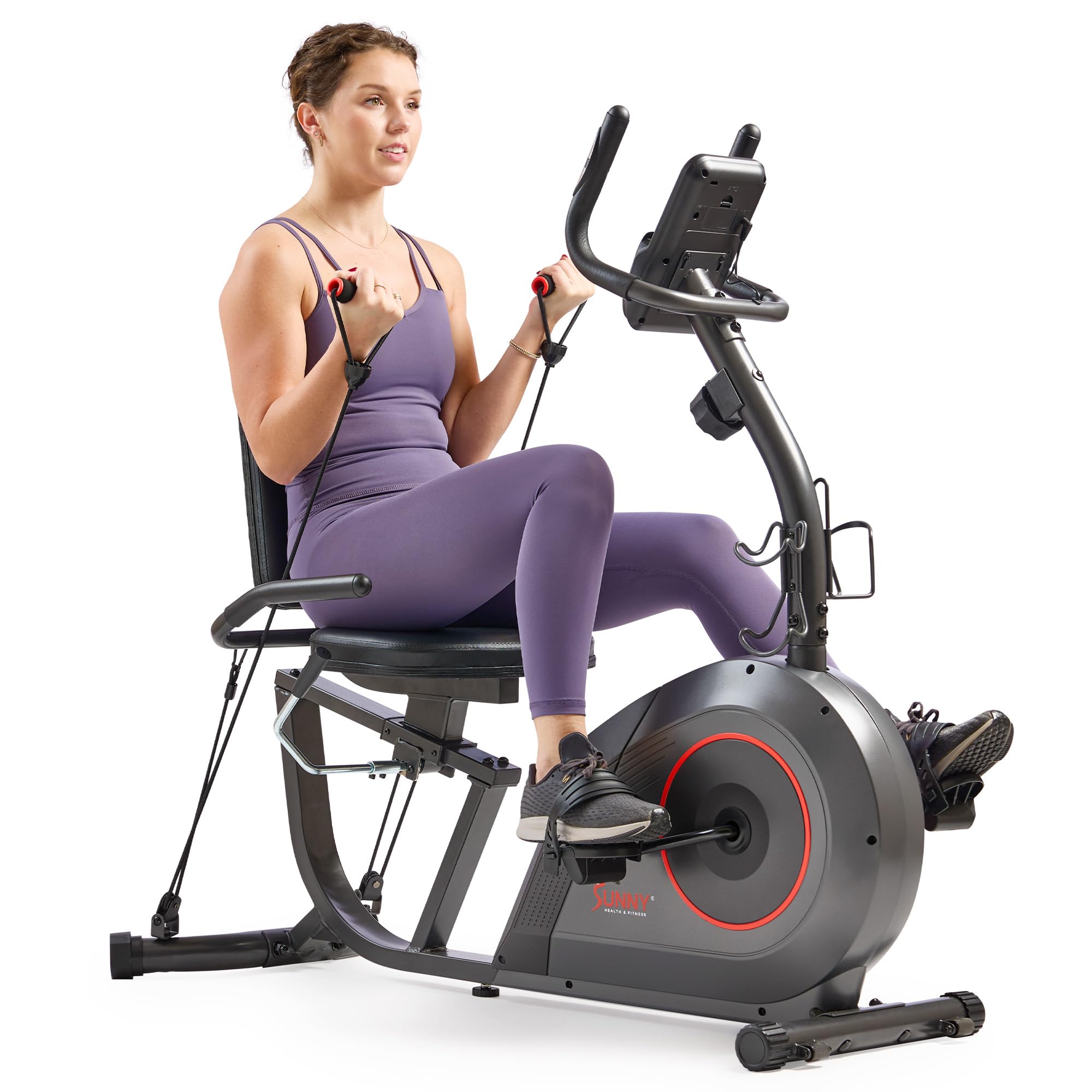
The SF-RB424006 pairs a wide cushioned seat with a padded backrest and flip-able side handles that make on-and-off access simple for stiff hips and knees. The 16-level magnetic belt-drive system operates at a near-silent 20-decibel range—your workout won’t wake anyone in the next room. Each resistance level increases smoothly without the friction spike typical of felt pads, which matters when your knee is in the vulnerable early range of motion during a pedal stroke.
Sunny’s free fitness app gives you access to over 1,000 trainer-led classes and 10,000 virtual scenic tours without a subscription fee. The Bluetooth connectivity syncs your ride data for tracking progress. The unit comes with two 20-pound resistance bands attached to the frame, adding a full range-of-motion upper body component that reduces shoulder tension while the legs spin. The seat adjusts easily, and the long inseam accommodates taller riders.
The resistance range is adequate for steady-state cardio but may not challenge advanced athletes who need high-intensity intervals—the top end feels moderate. The pulse monitor sits only on the top handles, making it inconvenient to check heart rate during continuous pedaling. The unit weighs 64 pounds, which is light enough to move but can feel slightly less stable during aggressive movement compared to 400-pound-rated machines.
Why it’s great
- Flip-able side handles for easy mounting with limited mobility
- Free SunnyFit app with thousands of guided workouts
- Includes dual 20-lb resistance bands for upper body engagement
Good to know
- Top-end resistance may not satisfy advanced interval training
- Heart rate sensors are only on the top stationary handles
- Lighter frame may shift slightly during high-intensity use
5. MERACH S19 Recumbent Exercise Bike
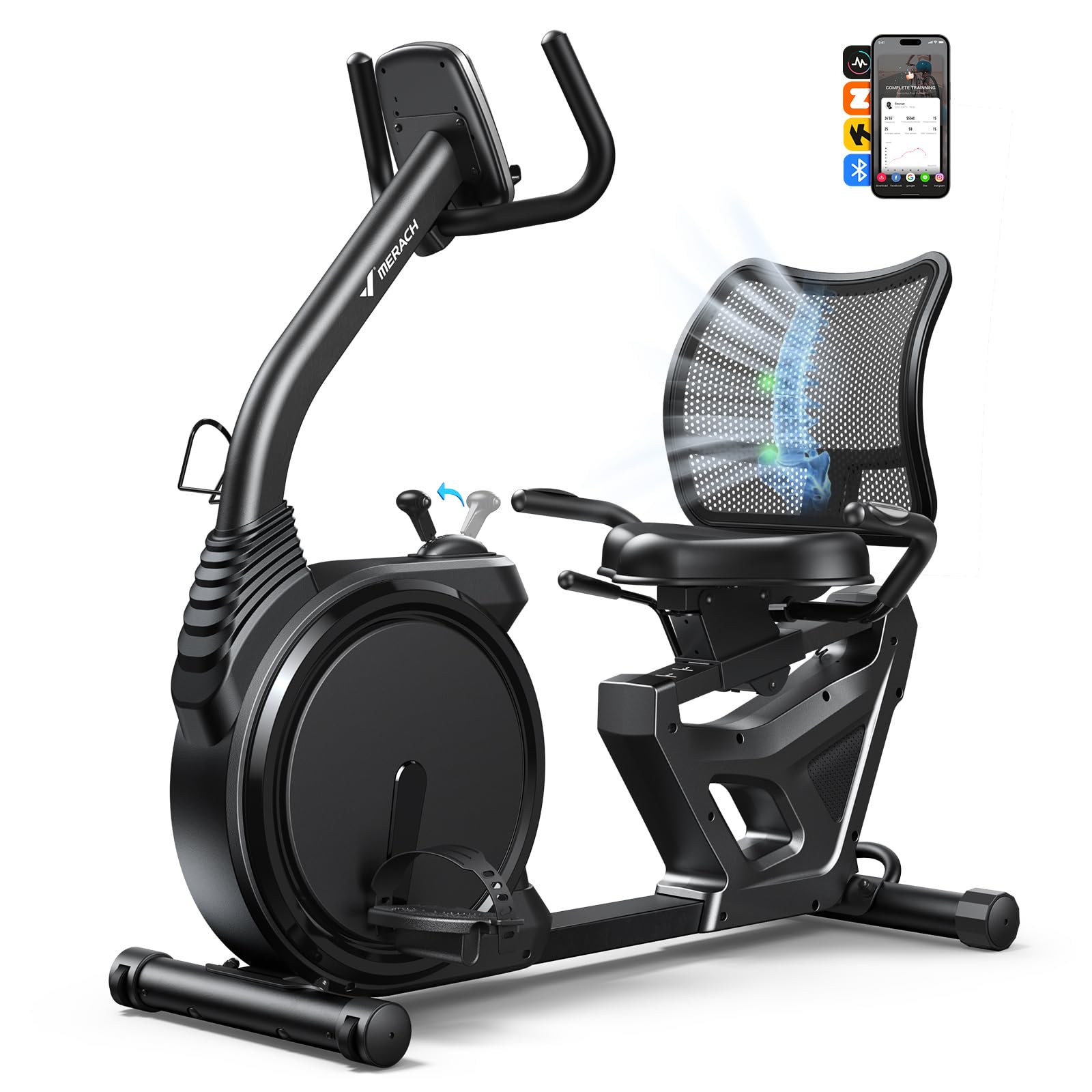
The MERACH S19 uses a dual-belt drive system with a 6.6-pound perimeter-weighted flywheel that delivers near-silent operation at any cadence. The recumbent frame positions the pedals slightly in front of the hips, opening the knee angle to a more comfortable 90- to 110-degree range compared to upright bikes that force acute flexion. The 8-level car-style lever adjusts resistance without fumbling for a knob mid-ride, which is useful during interval changes when you don’t want to drop cadence.
The seat adjusts across 8 positions with a simple lever, and the breathable mesh backrest prevents sweat buildup during longer sessions—a real issue for bad-knee riders who need 40+ minutes of steady-state movement to build quad strength. The LCD display shows time, speed, distance, calories, and heart rate. The MERACH self-developed app syncs via Bluetooth for real-time stats and has a gamified FantomFite mode that turns your ride into a visual challenge.
The maximum weight capacity is 330 pounds, and the recommended height range caps at 5’10”, so taller users may feel cramped. The seat adjustment rail uses a grease-dependent slide system that can feel a bit sticky initially. Some users report that the bottom resistance levels (1-5) feel too light even for rehab work. Still, for quiet, low-impact cardio in a small apartment, this is one of the most space-efficient recumbent bikes available.
Why it’s great
- Dual-belt drive delivers whisper-quiet operation
- Car-style resistance lever allows mid-ride adjustments
- Mesh backrest keeps you cool during long steady-state rides
Good to know
- Recommended height maxes out at 5’10″—not ideal for taller users
- Low resistance levels may feel too easy for some riders
- Seat rail requires periodic greasing to stay smooth
6. VANSWE RB405 Recumbent Exercise Bike
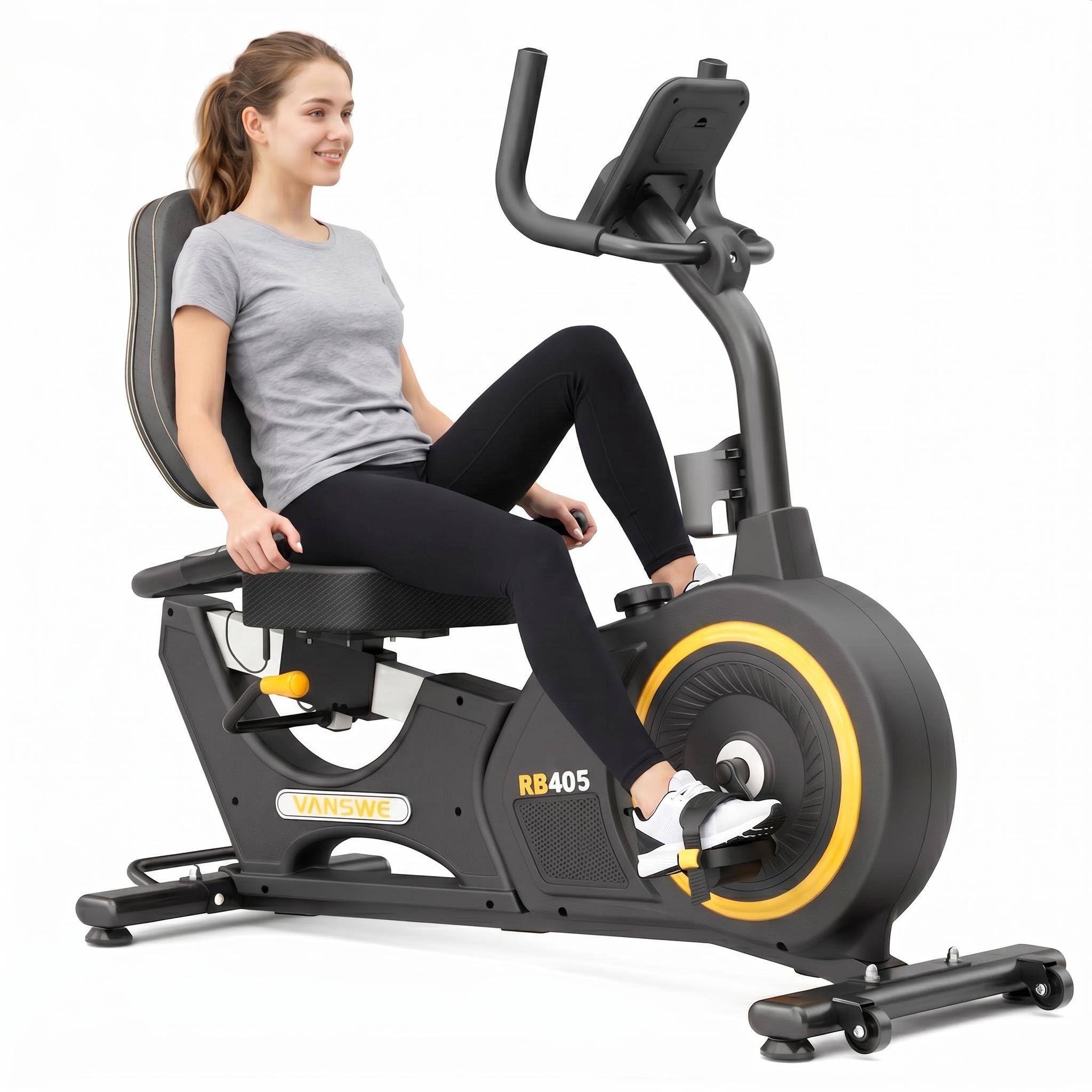
The VANSWE RB405 uses a commercial-grade steel frame with a 400-pound capacity, ensuring zero wobble even during high-cadence intervals. The Infinite Slider Seat System adjusts in millimeter increments—no pre-drilled holes—so you can dial in exactly the leg extension that keeps your knee flexion between 90 and 100 degrees at the bottom of the stroke. For bad knees, that precise fit prevents the patella from grinding against the femur during full extension.
The 11-pound precision flywheel paired with 8-level magnetic resistance delivers a virtually silent ride. The backlit LED monitor displays time, speed, distance, calories, and heart rate through the pulse handle. Bluetooth connectivity syncs with Kinomap and Zwift for interactive virtual cycling—a great motivator for long indoor sessions. The 3.4-inch extra-thick padded cushion and contoured backrest provide serious comfort for users with lower back issues that often accompany knee problems.
Assembly is rated at 90 percent pre-assembled, and most users complete setup in under 30 minutes. The pedals sit close to the crank arm, which may feel tight for riders with larger feet (size 13 or above). The grip bars are narrow for users with a wider waist, and the LED display ships with batteries that can drain quickly if left on. For the price and build quality, this is the most rock-solid recumbent option in the mid-range tier.
Why it’s great
- 400-lb commercial steel frame with absolute zero wobble
- Infinite slider seat adjusts to the millimeter for knee alignment
- 3.4-inch thick padded cushion reduces lower back pressure
Good to know
- Pedal spacing is tight for users with size 13+ feet
- Narrow grip bars may feel restrictive for larger riders
- LED display battery can drain quickly if left on between rides
7. pooboo W216 Recumbent Exercise Bike
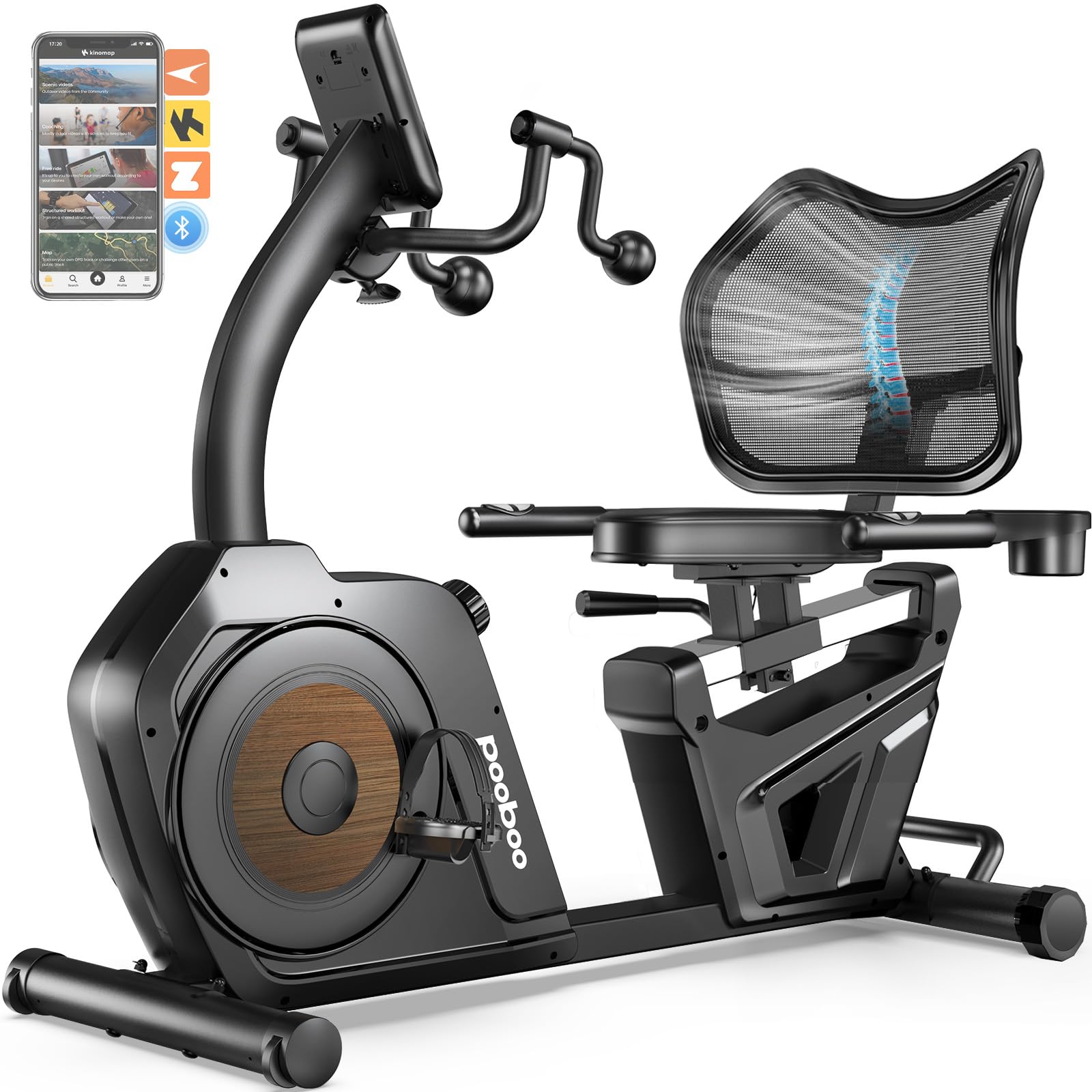
The pooboo W216 stands out for its hand-cranked armrest that allows you to work your upper body independently or in sync with your legs. The recumbent position keeps your weight supported on the breathable mesh backrest while the 15-pound flywheel and belt drive system maintain a 20-decibel operating volume. The 8-level magnetic resistance knob is intuitive enough that you can shift tension without breaking stride—important when you feel a knee twinge mid-workout and need to back off instantly.
The adjustable sliding seat rail extends from 0 to 18.5 inches, accommodating user heights up to 6’3″. The pedal straps feature 8 hole positions to fit different shoe sizes, so your foot stays locked in place without unnecessary lateral slipping that can torque the ankle and knee chain. The LCD monitor tracks speed, distance, time, calories, odometer, and pulse through handlebar sensors. The KINOMAP and Zt app connectivity adds virtual ride options if you get bored with static targets.
Assembly is straightforward at 80 percent pre-assembled, but the heavy-duty one-piece frame weighs 80 pounds—you’ll want help moving it into place. The mesh backrest is excellent for airflow but can be less supportive for users with significant kyphosis or rounded upper backs. The resistance range is adequate for moderate cardio but may not supply enough drag for aggressive hill-climb intervals.
Why it’s great
- Hand-crank armrest enables synchronized upper/lower body training
- Breathable mesh backrest fits natural spine curvature
- Pedal straps with 8 hole positions keep feet stable
Good to know
- 80-pound frame is heavy to maneuver during setup
- Mesh backrest may lack support for users with rounded backs
- Upper resistance range is moderate, not high-intensity
8. pooboo E399 Elliptical Machine
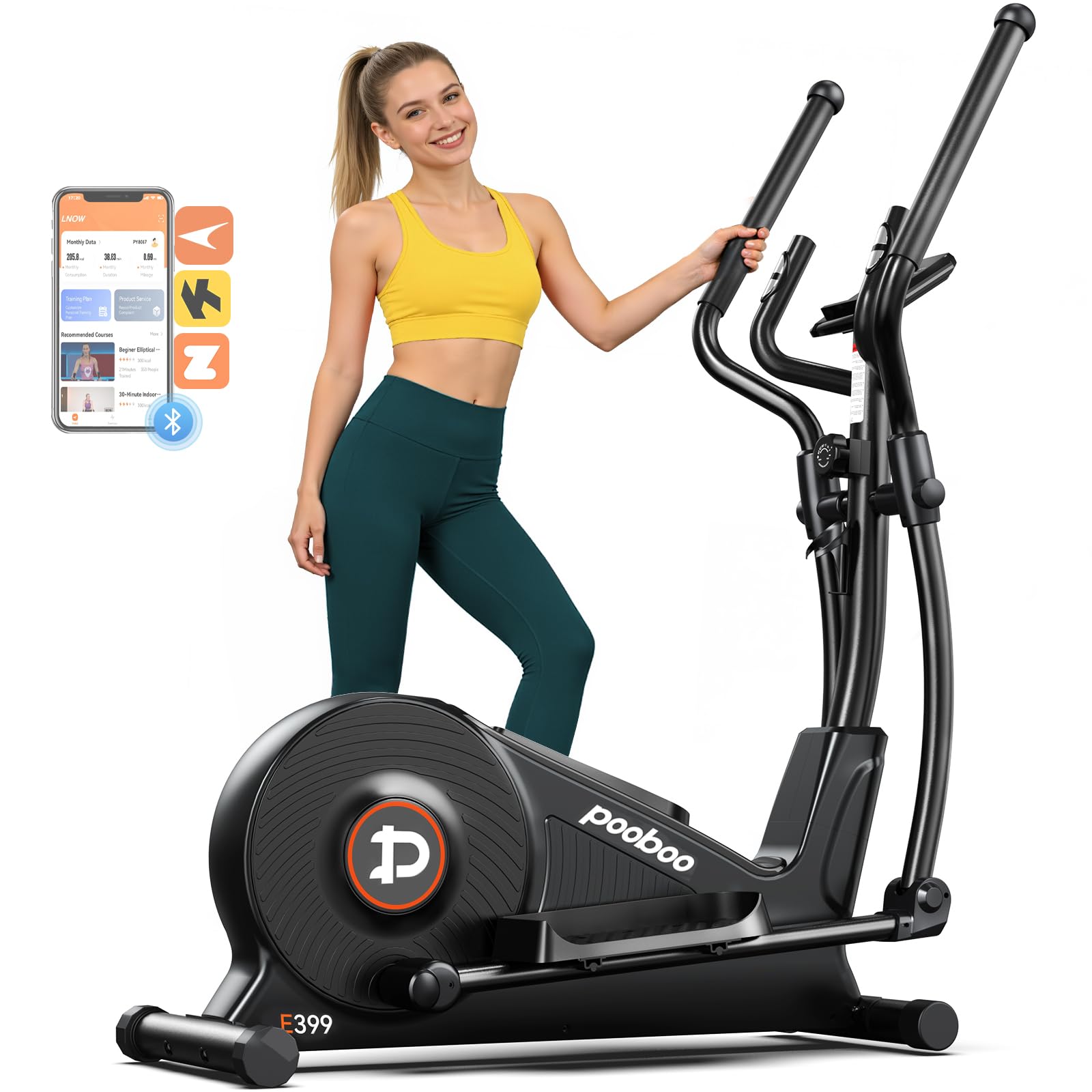
The pooboo E399 is a traditional rear-drive elliptical with a 15.5-inch stride that closely mirrors the natural walking gait. The 16-pound rear flywheel shifts the center of gravity backward, reducing the load on the patellar tendon compared to front-drive machines that pull your weight forward. The 16-level magnetic resistance knob allows incremental adjustments, so you can find the exact tension that strengthens your quadriceps without causing patellar compression at the top of the stride.
The thickened steel pipe frame supports up to 350 pounds, and the extra-wide non-slip pedals give your feet a stable platform—critical when you’re generating power through a compromised knee joint. The LCD monitor displays scan, time, speed, distance, calories, pulse, and odometer. The unit folds for storage and includes transport wheels, making it much easier to tuck away compared to a full-size elliptical. The KINOMAP and Zt app integration adds virtual training options.
The fixed stride length of 15.5 inches means the motion arc is predetermined—riders with shorter or longer legs may feel the circle doesn’t match their natural biomechanics. The resistance levels require manual knob turning; there’s no quick-shift mechanism for mid-workout tension changes. Some users report minor creaking from the pedal arm joints after extended use, usually resolved by lubricating the pivot points. For a budget-friendly full-stride elliptical, the E399 delivers solid stability and a low-impact path.
Why it’s great
- Rear-drive flywheel reduces forward knee shear force
- Extra-wide non-slip pedals for stable foot positioning
- Folds for storage with built-in transport wheels
Good to know
- Fixed 15.5-inch stride may not suit all leg lengths
- No quick-shift resistance change mid-workout
- Minor pedal arm creaking possible after extended use
9. Cubii Total Body Under Desk Elliptical V2
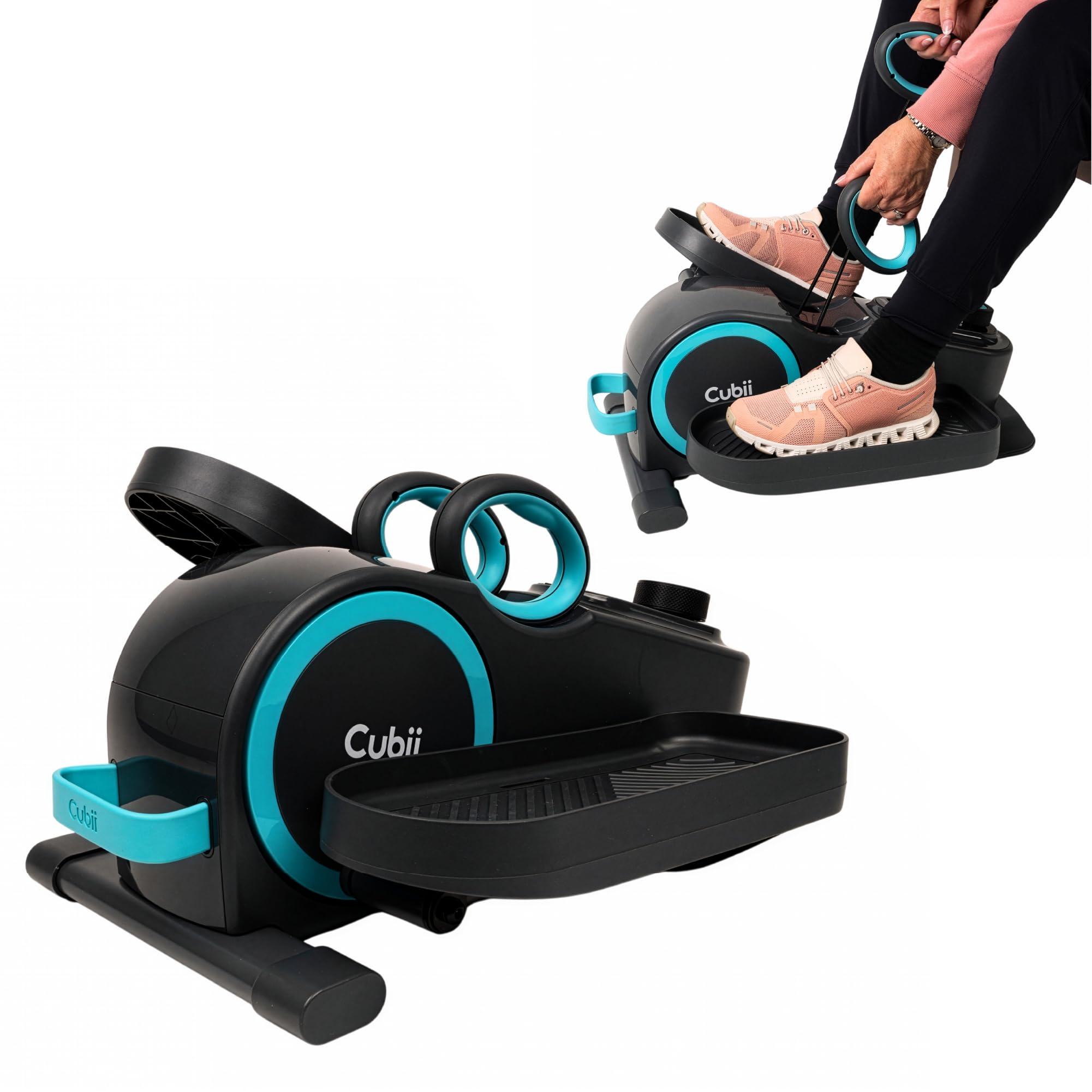
The Cubii Total Body V2 is the only under-desk elliptical on this list, designed specifically for users who need to keep their knee joints moving during long sitting hours without standing up. Magnetic resistance covers 12 levels, and the pedals move forward and backward, giving you a low-impact elliptical motion that avoids the high flexion angles of a full-sized elliptical. The built-in upper body resistance bands attach to an ergonomic pulley system for simultaneous arm curls, flies, and rows while you pedal.
The compact frame measures 22.2 by 13 by 12.6 inches and fits under most standard-height desks. The LCD display tracks time, distance, and resistance level for one or two users. The unit operates without a power cord—your legs drive the flywheel, so there’s zero noise from an electric motor. The 300-pound weight capacity is generous for a compact unit, and the magnetic resistance ensures smooth operation without periodic pad replacements.
The elliptical arc is short—about 12 inches—so it won’t provide the same range of motion as a full-sized machine. The pedals are cupped to hold your feet in place, which works well but can feel restrictive if you prefer a more open deck. The resistance bands drag slightly against the desk surface if the unit is positioned too far back. For the specific goal of adding low-impact leg movement to a seated workday without disturbing neighbors, the Cubii V2 is uniquely effective.
Why it’s great
- Fits under desks for seated movement during work hours
- Magnetic 12-level resistance with no motor noise
- Upper body bands integrate arms into the seated workout
Good to know
- Short 12-inch stride limits leg extension range
- Cupped pedals may feel restrictive for some foot positions
- Resistance bands can drag on desk surfaces if not positioned correctly
FAQ
Is a recumbent bike better for bad knees than an upright elliptical?
Can under-desk ellipticals provide enough resistance to strengthen my knees?
What does “magnetic resistance system” mean for joint safety?
How many minutes per day should I use recumbent equipment for knee rehab?
Does a higher weight capacity machine automatically mean better knee protection?
Final Thoughts: The Verdict
For most users, the gym equipment for bad knees winner is the Teeter FreeStep LT3 because its patented physical therapy stride keeps your hip, knee, and ankle aligned through a natural gait cycle while delivering zero vertical impact. If you want programmable workouts with electromagnetic resistance, grab the Sunny Elite Recumbent Cross Trainer. And for the most stable recumbent frame with infinite seat adjustment for precise knee angle, nothing beats the VANSWE RB405 at its price point.