
Laying bare concrete under a barbell is a fast track to cracked slabs, shattered plates, and noise complaints from the neighbors below. The right surface layer does more than cushion your joints — it protects the structural integrity of your foundation while absorbing the high-impact shock of deadlifts, kettlebell drops, and box jumps.
I’m Mohammad Maruf — the founder and writer behind Drink4Good. My market analysis focuses on material composites, compression recovery rates, and the real-world thickness thresholds that separate a mat that simply sits on the floor from one that genuinely isolates vibration on a concrete substrate.
This guide distills the key performance metrics — thickness density, material construction, and coverage efficiency — to help you select the best gym flooring over concrete for your specific training environment and intensity level.
How To Choose The Best Gym Flooring Over Concrete
Concrete is unforgiving. It offers zero give, conducts sound and cold efficiently, and chips under repeated impact. Selecting the correct overlay requires matching your workout’s impact profile to a material’s compression rating, total thickness, and grip behavior on a slick mineral surface.
Thickness and Material Density
For bodyweight floor work and yoga, a mid-range tile with a combined thickness of 0.4 to 0.5 inches of EVA foam typically suffices. Once you introduce iron — dumbbells, kettlebells, or a loaded barbell — that floor needs a dedicated rubber top layer, at least 2 mm thick, bonded to an EVA base that measures no less than 0.5 inches total. The rubber deflects point-load forces while the foam absorbs the broad energy wave before it reaches the concrete slab.
Interlocking Mechanism and Edge Stability
Concrete floors rarely sit perfectly level. An interlocking system with robust male-female tabs prevents tiles from separating during lateral movement (think burpees or sled pushes). Look for reviews that mention “seams staying flush” or “edges not curling” — those indicate a puzzle-piece lock that holds even when the subfloor has minor undulations.
Vibration Isolation and Sound Dampening
Dropping a plate on concrete transmits vibration through the slab into the room below. A mat’s ability to decouple that energy depends on the foam layer’s closed-cell structure. Higher-density EVA (typically above 35 kg/m³) compresses less under static load but rebounds faster, converting kinetic energy into heat rather than sound waves. If you train in an apartment or above a finished space, prioritize a system with a dedicated closed-cell EVA layer at least 0.5 inches thick.
Quick Comparison
On smaller screens, swipe sideways to see the full table.
| Model | Category | Best For | Key Spec | Amazon |
|---|---|---|---|---|
| SUPERJARE 96 Sq Ft | Dual-Layer Tile | Heavy weights & all-purpose protection | 0.4 in. thick; EPDM rubber top + high-density EVA foam base | Amazon |
| ProsourceFit Weaved Puzzle Mat | EVA Foam Tile | Large-area cushioning with moderate equipment loads | 0.75 in. thick; 96 sq. ft. coverage; non-slip textured surface | Amazon |
| GymCope Large Exercise Mat | Roll-Out PVC Mat | Cardio, jump rope, and shoe-friendly training | 7 mm thick; 8’ x 6’ single-piece; high-density PVC with carrying bag | Amazon |
| Rubber King 10 Piece Tiles | Recycled Rubber Tile | Sustainable, low-odor gym flooring with professional feel | 0.24 in. thick; 100% recycled rubber; FloorScore certified | Amazon |
| Rubber-Cal Recycled Floor Mat | Roll-Out Rubber Mat | Under-equipment vibration protection | 3/8 in. thick; dense recycled rubber; 4’ x 6’ sheet | Amazon |
| BalanceFrom Puzzle Mat 1-Inch | EVA Foam Tile | Maximum cushion for bodyweight training and play areas | 1 in. thick; 72 sq. ft. coverage; double-sided non-slip | Amazon |
| VEVOR 0.56-Inch Rubber Top Tiles | Dual-Layer Tile | Budget-friendly entry-level rubber-top flooring | 0.56 in. thick; 48 sq. ft.; 2 mm synthetic rubber over 12 mm PE foam | Amazon |
In‑Depth Reviews
1. SUPERJARE 0.4-inch Thick 96 Sq Ft Rubber Top Exercise Mats

The SUPERJARE tiles use a bonded architecture: a high-density EVA foam core underneath a 0.4-inch EPDM rubber top. That rubber surface gives you the grip needed for landmine presses and slides while the foam layer eats the vibration before it reaches the concrete slab. With 24 tiles covering 96 square feet, this system works for a full garage gym or a dedicated weight room.
Customer feedback confirms that temporary indentations from heavy rack feet and plate stacks recover within 48 hours, and the rubber odor largely dissipates within a single day of unrolling. The interlocking edges hold tight enough that the seams become nearly invisible after a few sessions of foot traffic.
If you are outfitting a concrete-floor gym with a mix of heavy iron, HIIT drills, and bodyweight work, the SUPERJARE system delivers the broadest performance envelope at this thickness. It feels like a commercial grade floor without the industrial price tag.
Why it’s great
- EPDM rubber top provides superior traction and resists tearing under point loads.
- Foam base recovers its shape quickly after sustained equipment pressure.
- Minimal odor out of the box — gym-ready within 24 hours.
Good to know
- At 0.4 inches, it is thinner than dedicated bumper-plate drop zones; consider stacking an extra layer under a deadlift platform.
- Seam lines may remain slightly visible under bright overhead lighting.
2. GymCope Large 8’x6’ Exercise Mat

The GymCope mat is a single-piece roll-out surface made from high-density PVC at 7 mm thickness. Unlike interlocking tile systems, there are no seams for debris to collect or for the mat to separate during dynamic lateral movement. Its double-sided anti-slip surface grips concrete aggressively, and the 8’ x 6’ footprint accommodates jump rope circuits, MMA drilling, and treadmill placement without requiring piecemeal assembly.
Users report that the mat lays flat immediately with zero curling at the edges — a common problem with rolled PVC on concrete. The material is shoe-friendly, meaning sneakers won’t leave scuff marks or degrade the surface over time. The included carrying bag and straps make it easy to reposition if your gym layout changes seasonally.
For anyone training on concrete who primarily does cardio, bodyweight calisthenics, or Zumba, the seamless surface of the GymCope eliminates the trip hazard that interlocking seams can create during rapid footwork.
Why it’s great
- Zero seams means no separation or dirt traps during high-speed drills.
- Double-sided non-slip surface stays planted on smooth concrete.
- Lays flat immediately out of the package with no edge curl.
Good to know
- At 7 mm, it is thinner than dedicated weightlifting tiles; dropped barbells may transfer force directly to concrete.
- PVC material can feel warm underfoot in unconditioned garages.
3. ProsourceFit Weaved Pattern Extra Thick Puzzle Mat 3/4-Inch

The ProsourceFit puzzle mat uses 0.75-inch thick high-density EVA foam without phthalates, lead, or latex. The 24-tile pack covers 96 square feet — enough for an entire stall of a garage or a dedicated home gym room. The non-skid textured surface provides traction for yoga, Pilates, and general floor work while protecting the concrete from scratches caused by dragging equipment feet.
Customer feedback highlights how easy the tiles are to cut with a utility knife for irregular room shapes, and the included 12 end borders give the installation a finished look. The foam is dense enough to support gym equipment like a squat rack or bench without bottoming out, though heavy plate stacks can leave temporary surface compression marks.
If you need to cover a large concrete area with a comfortable, kid-safe surface that still holds up to moderate gym use, the ProsourceFit Weaved Mat offers the highest square-foot-per-dollar ratio among the premium foam options.
Why it’s great
- 3/4-inch thickness absorbs impact without feeling mushy underfoot.
- Non-toxic EVA formulation makes it safe for children and pets.
- Limited lifetime warranty covers manufacturing defects.
Good to know
- Foam-only construction means dropped iron weights can damage the mat and concrete underneath.
- Edges may curl slightly in humid garages if not weighed down.
4. Rubber King 10 Piece Interlocking Tiles
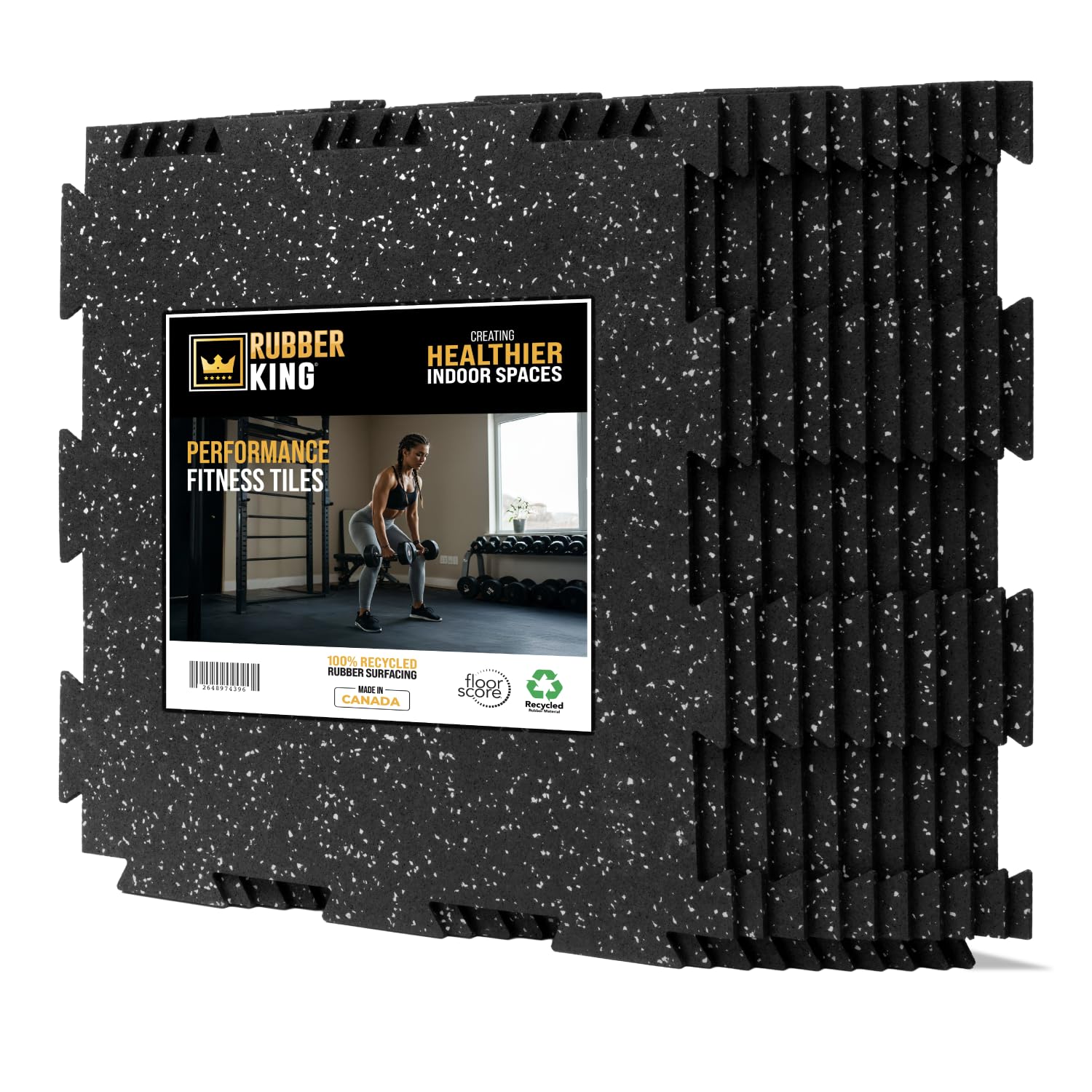
Rubber King tiles are made from 100% recycled rubber tires, formed into non-vulcanized 19” x 19” interlocking squares. At 6 mm thick, they are definitely a thinner profile, but the dense rubber composition provides more point-load protection per millimeter than EVA foam alone. The anti-slip, water-resistant surface works well for free weight zones and cardio stations, and the FloorScore certification means low VOCs — vital for enclosed basement gyms.
Real-world reports confirm that these tiles give a true “commercial gym” feel underfoot. They absorb the shock of moderate dumbbell drops (up to 25 pounds) and are comfortable enough for standing or kneeling exercises. The interlocking tabs snap together tightly, and the tiles can be cut with a utility knife for custom fits.
For the environmentally conscious lifter who wants a genuine rubber surface — not a foam imitation — the Rubber King tiles are the most sustainable option here, backed by a 5-year limited warranty and a North American manufacturing heritage that spans over 30 years.
Why it’s great
- Recycled rubber composition offers superior durability and point-load resistance.
- FloorScore certification ensures low VOCs for indoor air quality.
- 5-year limited warranty provides long-term peace of mind.
Good to know
- At 6 mm thick, it is not ideal for heavy deadlift drops; consider stacking or a dedicated platform.
- Each package covers only 23.5 square feet, so large rooms require multiple packs.
5. BalanceFrom Puzzle Exercise Mat 1-Inch Thick

The BalanceFrom mat is the thickest foam-only option in this list, reaching a full 1 inch of high-density EVA foam. That depth translates directly into joint protection: spine, hips, knees, and elbows get genuine cushioning when performing planks, sit-ups, or stretching on bare concrete. The double-sided non-slip surfaces mean the mat stays put even during sweaty sessions, and the 72 square feet of coverage (18 tiles plus 36 end borders) fits a compact home gym zone.
Users consistently praise the mat’s ability to absorb impact from bodyweight exercises, martial arts drills, and moderate equipment use. The tiles interlock easily, though some report that the cut edges (called “fringe”) can cause cumulative size loss if removed. The foam is moisture-resistant and wipes clean with soap and water.
If your training skews toward gymnastics, yoga, or martial arts — where joint compression on a hard surface is the primary concern — the BalanceFrom 1-inch mat delivers the deepest foam cushion available without switching to rubber.
Why it’s great
- Full 1-inch thickness maximizes shock absorption for joint-sensitive training.
- Double-sided non-slip surface prevents movement on polished concrete.
- 2-year manufacturer warranty covers material and workmanship.
Good to know
- Foam-only construction cannot withstand repeated heavy weight drops without damage.
- Initial rubber odor may linger for up to two weeks in enclosed spaces.
6. Rubber-Cal Recycled Floor Mat 3/8-Inch

The Rubber-Cal mat is a heavy, dense slab of recycled rubber measuring 3/8-inch thick by 4 feet by 6 feet. Weighing nearly 14 pounds per sheet, it is designed to stay put without adhesive. Its primary purpose is vibration isolation: placed under a treadmill, it absorbs up to 90 percent of the foot-strike vibration that would otherwise travel through the concrete into the structure below.
Users have deployed this mat in third-floor apartments above neighbors, in laundry rooms to quiet appliance rattle, and under squat racks to protect concrete from foot impact. The “new tire” smell fades within a week, and the material cuts cleanly with a circular saw for irregular room dimensions. The dense rubber means dropped plates will bounce minimally, but the mat itself survives the force without tearing.
If your concrete gym is upstairs or adjacent to living spaces, the Rubber-Cal mat is the most effective vibration dampener in this group, sacrificing coverage area and thickness for pure mass-based isolation performance.
Why it’s great
- Dense recycled rubber construction neutralizes vibration better than foam equivalents.
- Heavy weight keeps the mat in place without adhesives or tape.
- Survives high-impact drops from plates and dumbbells without puncturing.
Good to know
- At 3/8-inch, it offers minimal cushion for bodyweight floor work compared to thicker foam options.
- Single-sheet format limits coverage customization and requires precise measurement before cutting.
7. VEVOR 0.56-Inch Rubber Top Gym Flooring Tiles
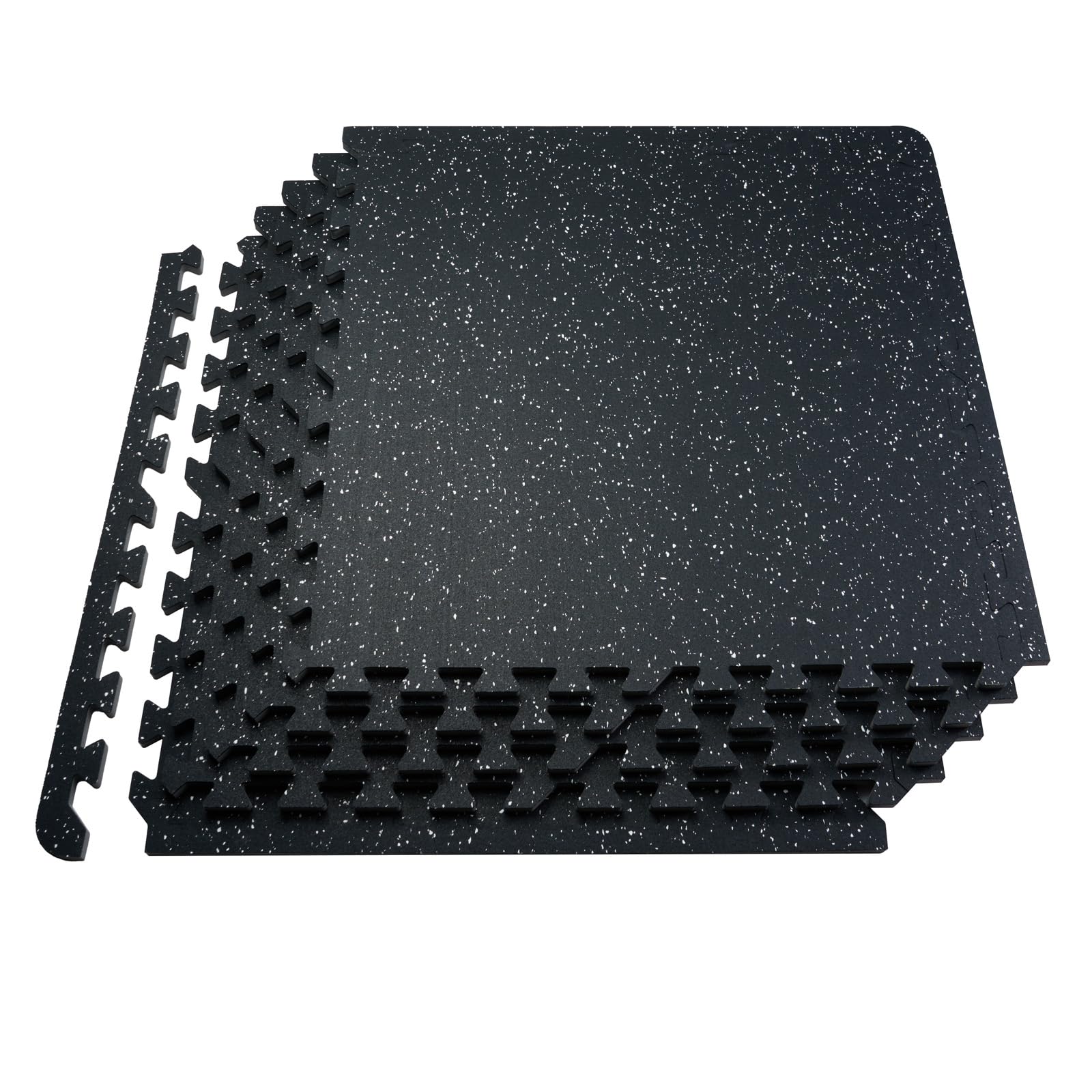
The VEVOR tiles combine a 2 mm synthetic rubber top layer with a 12 mm PE foam base, totaling 0.56 inches of thickness. This dual-layer construction gives you the slip resistance and scratch protection of rubber where your feet and equipment contact the floor, with a forgiving foam layer underneath to soften impact on concrete. The 12-tile pack covers 48 square feet — a size well suited for a small home gym corner, a Peloton zone, or a dedicated deadlift area.
Buyers consistently report that the mats feel firm yet easy on the knees, and that heavy equipment indentations from rack feet or barbell plates fade gradually over time. The interlocking edges snap together without difficulty, and the surface wipes clean with a damp cloth. Some users note that the initial chemical smell can take up to two weeks to fully dissipate in a poorly ventilated space.
For anyone building their first concrete-floor gym on a tight budget, the VEVOR tiles offer a legitimate rubber-top experience at an entry-level coverage price. The trade-off is smaller total square footage and a thinner foam base than premium competitors.
Why it’s great
- Rubber top layer provides genuine scratch and slip resistance without a premium price.
- 0.56-inch thickness offers a solid balance of cushion and stability.
- Lightweight construction makes transport and layout simple.
Good to know
- Initial odor requires ventilation for up to two weeks to fully clear.
- Interlocking tabs on some tiles may not be fully cut through, requiring minor trimming.
FAQ
Can I put gym mats directly on concrete without a moisture barrier?
How thick should gym flooring be for deadlifting on concrete?
Will interlocking tiles separate when I do burpees or sprints on concrete?
Final Thoughts: The Verdict
For most users, the best gym flooring over concrete winner is the SUPERJARE Rubber Top Mat because its dual-layer construction handles heavy weights, recovers from indentations, and covers a full room with minimal odor. If you want a seamless single-piece surface for cardio and bodyweight drills, grab the GymCope Large Exercise Mat. And for the most effective vibration isolation under a treadmill or rack, nothing beats the Rubber-Cal Recycled Floor Mat.