
A poorly chosen net or a dim projector can turn your dream indoor golf studio into a frustrating waste of space. The difference between a setup you use daily and one that collects dust often comes down to three things: impact absorption, projection brightness, and the accuracy of your launch monitor. Each component must work in harmony to deliver a realistic and durable practice experience.
I’m Mohammad Maruf — the founder and writer behind Drink4Good. I have spent months analyzing the hardware specifications, customer durability reports, and real-world performance data for the most popular home simulator components on the market.
After reviewing dozens of nets, enclosures, projectors, and launch monitors, this guide breaks down the top contenders to help you build the best indoor golf simulator for your budget, space, and skill level.
How To Choose The Best Indoor Golf Simulator
Building a home simulator involves selecting four main pillars: a net or enclosure to catch the ball, a projector for visual feedback, a launch monitor for data, and a hitting surface. The most common mistake is overspending on one component while ignoring the structural safety and durability of the net or enclosure. You need a system that stops a 200+ mph ball speed without ricochet and displays clear, lag-free images in moderate light.
Net Tension and Frame Rigidity
A net that absorbs impact quietly and returns the ball to your feet saves time and reduces noise. Look for a frame made from powder-coated steel or aircraft-grade aluminum that won’t wobble after repeated strikes. The netting material should have a tight weave to prevent ball escape, especially if you are using real golf balls indoors.
Projector Brightness and Throw Ratio
For a simulator, 3000 ANSI lumens is the entry point for a usable image in a dimly lit garage. A short-throw projector (0.6 to 0.8 throw ratio) lets you get a 100-inch image from just a few feet away, reducing shadow interference from your body during the swing. Full HD (1080p) is sufficient for most software, but a high contrast ratio (at least 10,000:1) ensures you can see the fairway and green details clearly.
Launch Monitor Accuracy
The launch monitor is the brain of your simulator. For serious practice, you need at least ball speed, launch angle, and spin rate. A unit that uses a camera system rather than just doppler radar will generally provide more consistent indoor data, especially with limited space. Integrated displays remove the need for a separate computer, simplifying the entire setup.
Quick Comparison
On smaller screens, swipe sideways to see the full table.
| Model | Category | Best For | Key Spec | Amazon |
|---|---|---|---|---|
| Garmin Approach R50 | Launch Monitor | Full simulator with putting | 10″ touchscreen, 4 hr battery | Amazon |
| BenQ TK700ST | Projector | 4K gaming with short throw | 3000 lumens, 16ms lag | Amazon |
| Optoma GT2100HDR | Projector | Bright laser for day use | 4200 lumens, 30000 hr lamp | Amazon |
| GoSports Sim Enclosure | Enclosure | Complete blackout bay | Multi-layer screen, 10×8 ft | Amazon |
| Anything Sports Enclosure | Enclosure | Included projector mount | 4K-ready screen, 11×8 ft | Amazon |
| Net Return Home/Pro | Net | Pro-level durability | Aircraft aluminum, 240 mph | Amazon |
| GoSports Elite Net | Net | Commercial-grade frame | 7.5×7.5 ft, 47.6 lbs | Amazon |
| BenQ TH575 | Projector | Bright 1080p gaming | 3800 lumens, 16.7ms lag | Amazon |
| ViewSonic PS502X | Projector | Short throw for small spaces | 4000 lumens, XGA resolution | Amazon |
| YUNIC Golf Cage | Cage | Alloy steel frame with mat | 8x8x8 ft, foam covers | Amazon |
| Spornia SPG-7 | Net | Auto ball return system | 60×60″ target, 20 lbs | Amazon |
In‑Depth Reviews
1. Garmin Approach R50

The R50 sits at the top of the launch monitor category, integrating a 10-inch color touchscreen directly into the unit. This means you do not need a separate tablet or laptop to access over 43,000 courses with the Home Tee Hero subscription. The three-camera system captures ball speed, launch angle, face to path, and spin axis with impressive accuracy, even indoors.
Battery life reaches four hours, making it truly portable for range sessions. The built-in barometer adjusts carry distance based on atmospheric pressure. Users consistently report that the putting function and high-speed impact video provide immediate feedback that feels like a premium coaching session.
The main trade-off is cost, placing it well above entry-level options. Some users note that ambient lighting must be sufficient for the cameras to track every swing accurately at night. For anyone looking to build a complete simulator without a separate computer, the R50 is the most seamless all-in-one solution on the market.
Why it’s great
- Integrated display removes need for external computer
- Accurate spin and axis data with included club stickers
- Battery powered for true portability
Good to know
- Subscription required for full course access
- Requires good lighting over hitting area for night use
2. BenQ TK700ST

The TK700ST is widely considered the gold standard for garage simulator projectors. It projects a 100-inch 4K image from just 6.5 feet away, which virtually eliminates body shadows during your swing. The 3000-lumen brightness is enough to maintain a vivid picture even when the garage door lets in some ambient light.
Input lag sits at 16ms at 4K 60Hz, making it responsive enough for both simulator software and console gaming. Reviews from simulator owners highlight how the HDR10 and HLG support bring course details to life — you can see the texture of the green and the contours of the fairway. The lamp life extends to 15,000 hours in SmartEco mode, reducing long-term maintenance.
The most common concern involves the eco mode behavior, with some users finding the brightness inconsistent. Others received units with Chinese menus, so checking the seller is wise. For a dedicated simulator bay, the short throw and 4K clarity make the TK700ST the projector to beat.
Why it’s great
- 100-inch image from only 6.5 feet away
- True 4K resolution with HDR support
- Long 15,000-hour lamp life
Good to know
- Some users report eco mode locking issues
- Brightness lower than some dedicated home theater units
3. Optoma GT2100HDR

The GT2100HDR stands out for its laser light source, which delivers 4200 ANSI lumens and a 30,000-hour lifespan. This brightness level means you can still see your simulator software clearly if your garage has windows or if you prefer practicing with the lights on. The compact design, roughly the footprint of a letter-sized sheet of paper, makes mounting easier in tight spaces.
While it outputs 1080p resolution, it accepts 4K HDR input signals, so future software upgrades will look clean. The 300,000:1 dynamic contrast ratio provides deep blacks for evening use. One reviewer reported running it 12 hours daily for their golf simulator with no performance drop, which speaks to the laser durability.
The remote buttons are not intuitive, and the unit lacks horizontal keystone correction. The fan noise is noticeable but not distracting during active play. For those who prioritize brightness and long life over native 4K resolution, the GT2100HDR is a compelling, energy-efficient choice.
Why it’s great
- 4200 lumens handles ambient light very well
- Laser source rated for 30,000 hours
- Ultra-compact footprint saves space
Good to know
- Remote control buttons are poorly labeled
- No horizontal keystone adjustment
4. GoSports Simulator Enclosure

This enclosure kit from GoSports delivers a complete solution with a heavy-duty impact screen, frame poles, and blackout side curtains. The multi-layer screen is designed to minimize rebound, and it does — testers report almost no ball bounce-back even at driver swing speeds. The specialized dyeing process on the fabric creates a true blackout effect that dramatically improves projector contrast.
Assembly is straightforward, with numbered poles that go together in about an hour. The 10×8-foot size fits a standard garage bay. The screen has survived thousands of hits without tearing, and the customer service team is responsive if any issues arise.
Some users note that the included padding is minimal, and certain wedge shots can still produce a hard rebound. Side shank nets are not included, which some buyers prefer to add. For a turnkey enclosure that prioritizes image quality and structural integrity, this is a top-tier pick.
Why it’s great
- True blackout fabric enhances projector image
- Multi-layer screen stops high-speed balls safely
- Numbered poles make assembly intuitive
Good to know
- Padding may not stop all wedge shot rebound
- Side shank nets sold separately
5. Anything Sports Enclosure
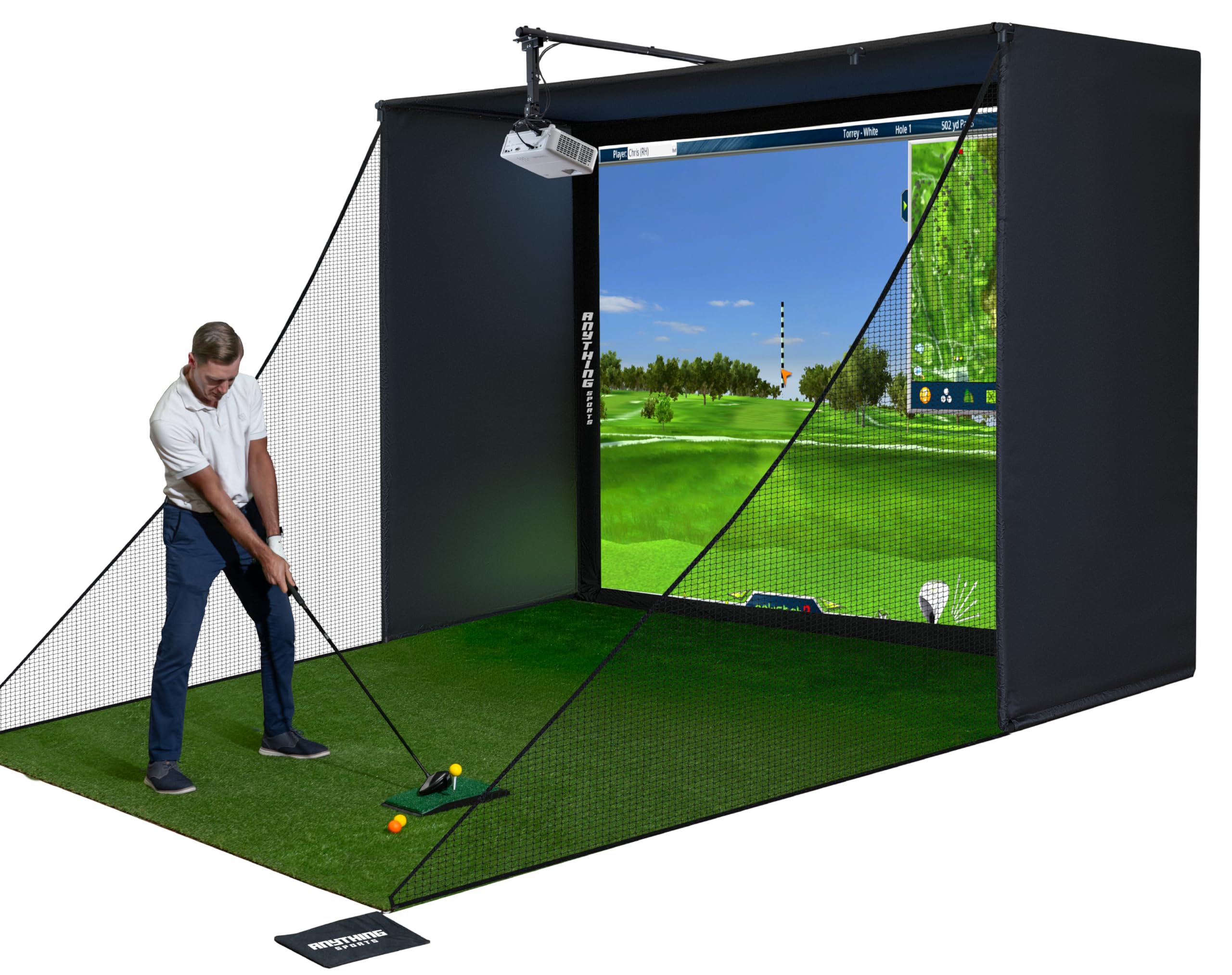
Anything Sports offers a complete enclosure package that goes a step beyond by including a projector mount in the box. The impact screen is 4K-ready, with a tight weave that provides a smooth surface for projector images. The frame uses heavy-gauge metal poles that create a rigid structure, and the black tarp backing prevents light bleed for a more immersive experience.
Assembly takes under an hour, though the instructions are sparse. Online photos and videos fill the gap. The screen material feels thick and rubbery, which absorbs impact well without excessive noise. The projector mount includes a 12-inch extension, giving flexibility for ceiling heights.
The bungee cord attachment system can be finicky, and balls may bounce forward initially before the netting settles. The 12-month no-questions-asked warranty offers peace of mind. For a budget-friendly complete bay that includes a projector mount, this is a strong contender.
Why it’s great
- Projector mount included saves significant cost
- 4K-ready screen with minimal light bleed
- Responsive US-based customer support
Good to know
- Instructions are lacking detail
- Bungee attachment system can be difficult to tension
6. Net Return Home/Pro Series

The Net Return is the most battle-tested net in this lineup, trusted by Bryson DeChambeau and used by NFL teams. The frame is made from aircraft-grade aluminum, making it lightweight at 28 pounds yet absurdly durable. The patented S-Shape return system rolls the ball back to your feet on center hits, while off-center strikes provide immediate shot-shape feedback.
Setup takes five minutes with the push-button Quick Color Connect System — no tools required. The three-year warranty and 250,000-shot guarantee are unmatched in this category. The netting weave is tighter and uses thicker cord than budget nets, which prevents dangerous hole development over time.
It is expensive for a standalone net, and the frame can dent from a direct pole hit, though functionality remains intact. The side barriers and simulator screen are sold separately, which increases the total investment for a full bay. For serious players who want tour-proven durability, the Net Return is the benchmark.
Why it’s great
- Unmatched 250,000-shot durability guarantee
- Five-minute tool-free assembly
- Lightweight aircraft-grade aluminum frame
Good to know
- Premium price for a net-only solution
- Side barriers and screen are additional purchases
7. BenQ TH575

The TH575 is a 1080p DLP projector that punches well above its price point with 3800 ANSI lumens and a 15,000:1 contrast ratio. It produces a crisp, bright 100-inch image from 10.8 feet, which works in most garage depths. The 16.7ms input lag at 60Hz keeps swing-to-screen response tight for simulator software.
Color accuracy and brightness consistency are strong enough for outdoor dusk viewing, as multiple reviews confirm. The built-in speaker works for casual use, but most simulator owners will route audio separately. The fan is quieter than the Optoma, and the menu system is intuitive.
The main limitation is that it is a standard throw projector, meaning you need more distance from the screen than a short-throw model. This can create body shadows if your hitting area is not offset. For a bright, responsive 1080p projector that leaves room in the budget for an enclosure, the TH575 is a fantastic anchor.
Why it’s great
- 3800 lumens work well with some ambient light
- Low input lag for responsive simulator feel
- Excellent color and contrast for the price
Good to know
- Standard throw requires more distance than short throw
- Fan noise is noticeable in a quiet room
8. ViewSonic PS502X

The PS502X is a short-throw XGA projector with a 0.6 throw ratio, meaning it can cast a 100-inch image from just 13 feet. The 4000 ANSI lumens are sufficient for rooms where you cannot achieve total darkness. The DLP engine and SuperColor technology deliver bright, balanced images for simulator software.
Multiple reviewers specifically mention using it for their golf simulator and being impressed with the clarity. Auto keystone and vertical keystone make ceiling mounting less painful. The compact chassis fits into tighter ceiling mount brackets compared to larger home theater units.
The XGA resolution is lower than 1080p, which means text and course details will look softer. A few users reported poor image quality and fan noise. For a short-throw projector at a very accessible price point, it gets the job done, but it is a compromise on resolution for simulator purists.
Why it’s great
- Short throw reduces body shadows
- 4000 lumens handle moderate ambient light
- Auto keystone eases installation
Good to know
- XGA resolution is lower than typical simulator needs
- Some units have reported quality issues
9. GoSports Elite Practice Net

The GoSports Elite Net features a robust steel frame that weighs 47.6 pounds, giving it a planted feel that resists tipping even during mishits. The high-tension netting is rated three times stronger than GoSports’ standard model, making it suitable for real golf balls with driver swing speeds. The 7.5×7.5-foot hitting area provides a generous target for free swinging.
Users report that the net holds up well to thousands of swings, with the ball dropping gently at your feet after impact. The frame has held up against wind and rain for users who leave it outdoors in Maine, though some minor rust appeared on connections after three years. The carrying case is useful for seasonal storage.
Setup and breakdown take around 15 to 20 minutes, which is slower than a pop-up net but expected for the rigidity. The net is not designed for frequent travel. For a mid-range hitting net that bridges the gap between budget pop-ups and premium enclosures, the Elite offers excellent longevity.
Why it’s great
- Heavy steel frame eliminates wobble
- Netting handles thousands of real ball strikes
- Balls drop straight down for efficient practice
Good to know
- Setup takes longer than quick-fold nets
- Rust may appear on frame connections over time
10. YUNIC Golf Driving Cage

The YUNIC Driving Cage is an 8x8x8-foot metal frame enclosure that includes a Tri-Turf hitting mat and foam covers for the poles. The three-layer netting system — an outer net, an inner net, and a target cloth — ensures almost zero ball escape, even from errant shots. The steel frame uses push-button locks for secure assembly without tools.
Users are consistently impressed by the included accessories: a quality hitting mat, rubber tees, and even a hat. The foam padding on the pipes is a safety feature that budget nets often skip. The cage handles swing speeds up to professional level, and the thick canvas target cloth holds up well over time.
The assembly instructions are sparse, and matching unlabeled pipe pieces can be an initial puzzle. The cage is not designed to be packed up daily. For a complete hitting station that includes a mat and high safety margins, the YUNIC cage delivers substantial value without requiring separate purchases.
Why it’s great
- Includes hitting mat and rubber tees
- Full foam padding on all metal frame parts
- Three-layer netting for maximum ball capture
Good to know
- Assembly instructions are poorly written
- Not designed for frequent breakdown and setup
11. Spornia SPG-7

The Spornia SPG-7 is one of the best-selling practice nets due to its automatic ball return system and quick setup. The patented target sheet absorbs high-speed impact while directing the ball gently down a chute to your feet. The net weighs only 20 pounds and sets up in under 30 seconds, making it the most portable option for indoor and outdoor use.
The 60×60-inch target area is large enough to inspire confidence, and the side barriers extend the safe hitting zone. Users praise the sturdy construction, noting that it handles swings from sand wedge to driver without tearing. The included red chipping basket attaches at multiple angles for short-game practice.
The instructions are poor, and the roof feature can fail on very high flop shots. Balls occasionally hang in the back netting instead of rolling forward. For a golfer who needs a portable, fast-deploying net with automatic ball return, the SPG-7 remains a top-selling and well-loved choice.
Why it’s great
- Setup and breakdown in under 30 seconds
- Automatic ball return to hitting position
- Lightweight at only 20 pounds
Good to know
- Roof feature may not hold up to high flop shots
- Assembly instructions are lacking
FAQ
Can I use a regular home theater projector for a golf simulator?
Do I need a launch monitor with a built-in screen?
How much ceiling height do I need for a simulator?
Final Thoughts: The Verdict
For most users, the indoor golf simulator winner is the Garmin Approach R50 because it combines a professional-grade launch monitor with a built-in screen, eliminating the need for a separate computer. If you want a premium projector that delivers 4K clarity with minimal shadows, grab the BenQ TK700ST. And for a complete enclosure that includes a projector mount and thick impact screen, nothing beats the value of the Anything Sports Enclosure.