
That shoebox of fading polaroids and the stack of loose prints from the 90s aren’t going to digitize themselves. A dedicated photo scanner is the only tool that can handle the sheer volume without bending corners or leaving dust streaks under the glass. The trick is matching the right scan engine—CCD vs. CIS, feed path vs. flatbed—to the actual condition and quantity of your photo stock.
I’m Mohammad Maruf — the founder and writer behind Drink4Good. This guide compresses many hours of spec-level research across budget, mid-range, and premium photo scanners to help you pick the one that won’t leave you with a backlog of unsorted JPEGs.
Whether you are a home archivist facing a few hundred prints or a small business needing batch workflow, understanding the difference between a document scanner and a purpose-built photo scanner is the single biggest decision that determines whether your digital copies look true to the original or washed out and cropped wrong.
How To Choose The Best Photo Scanner
A photo scanner is not a document scanner. Documents are flat, dry, and uniform; photos are glossy, curled, and delicate. The wrong feed mechanism will scratch your prints, and the wrong sensor will turn a sunset into a muddy brown. Here are the three specs that separate a photo scanner from an office shredder in disguise.
CCD vs. CIS Sensor — The Texture Trade-Off
CCD (Charge-Coupled Device) sensors capture a wider dynamic range and better color fidelity, which is critical for old photos where the ink has faded and the paper has yellowed. CIS (Contact Image Sensor) scanners are thinner, cheaper, and use less power, but they struggle with curled edges and deep shadows. For serious photo archiving, CCD delivers the richer tonal depth, even though it makes the scanner body thicker.
Optical Resolution — The 600 dpi Ceiling
Most photo paper prints at 300 dpi. Scanning at 600 dpi optical resolution captures every grain of silver halide without interpolating fake detail. Anything above 600 dpi on a consumer photo scanner is software interpolation and will not add real sharpness—it will just bloat your file size. Look for a true optical resolution of at least 600 dpi and skip the marketing numbers.
Feed Path — Sheet-Fed vs. Flatbed
Sheet-fed photo scanners are fast—you can feed 30 prints in two minutes. But if your photos are wrinkled, mounted on cardstock, or have tape residue, a flatbed scanner is the only safe choice. Dedicated photo scanners like the Canon RS40 use a gentle roller path that minimizes contact, but no sheet-fed design can match the non-contact safety of a flatbed for fragile originals.
Quick Comparison
On smaller screens, swipe sideways to see the full table.
| Model | Category | Best For | Key Spec | Amazon |
|---|---|---|---|---|
| Plustek ePhoto Z300 | Photo Dedicated | High-volume photo archiving | CCD sensor, 2-sec 4×6 scan | Amazon |
| Canon imageFORMULA RS40 | Photo & Document | Mixed stacks of photos & paper | 40 ipm duplex, auto feeder | Amazon |
| ScanSnap iX2400 | Document Focused | Fast office document digitization | 45 ppm simplex, 100-sheet ADF | Amazon |
| Epson ES-580W | Wireless Document | Wireless cloud workflow | 35 ppm duplex, 4.3″ touchscreen | Amazon |
| ScanSnap iX2500 | High-Speed Doc | High-volume office with Wi-Fi 6 | 45 ppm duplex, 5″ touchscreen | Amazon |
| HP FilmScan FS500 | Slide & Negative | Converting 35mm slides & negatives | 22MP interpolation, 5″ touchscreen | Amazon |
| KODAK Slide N SCAN | Slide & Negative | Budget slide/negative conversion | 22MP output, 5″ LCD screen | Amazon |
| HP PS100 | Portable Document | On-the-go single-sheet scanning | 15 ppm simplex, 300 dpi fixed | Amazon |
| Plustek S410 Plus | Portable Document | Ultra-light document digitizing | 600 dpi, 0.9 lb, bus-powered | Amazon |
In‑Depth Reviews
1. Plustek ePhoto Z300

The Plustek ePhoto Z300 is the closest you will get to a dedicated photo-only scanner without stepping into industrial territory. Its CCD sensor captures the tonal range of a faded Polaroid far better than any CIS-based document scanner can, and the 2-second scan time for a 4×6 print means you can chew through a shoebox in an afternoon. Real-world owners have reported scanning over 12,000 photos in three months with consistent color and no roller damage.
The feed path is a single-slot insert design—you drop one photo in at a time. That is slower than an ADF-based office scanner, but it is also why the Z300 does not jam on curled prints from the 1970s. The included software handles auto-crop, deskew, and one-click color restoration for faded highlights. At 300 dpi the output is crisp without bloating file sizes; you only need the 600 dpi setting for detailed 5x7s or larger.
One recurring note from long-term users is that the feed rollers need periodic cleaning with the included pad, especially after scanning thousands of photos. Some minor dust accumulation can cause a single streak line, but the cleaning process takes under 30 seconds. For anyone whose primary goal is digitizing a large volume of loose prints, the ePhoto Z300 sets the benchmark for reliability and image fidelity in its tier.
Why it’s great
- CCD sensor delivers richer color than any CIS scanner at this price point.
- 2-second scan speed at 300 dpi makes high-volume archiving realistic.
- Auto-crop and deskew work reliably on odd-sized prints and Polaroids.
Good to know
- Single-photo feed path limits batch speed; no automatic document feeder.
- Roller dust streaks can appear after several hundred scans; requires periodic cleaning.
- Higher resolution (600 dpi) nearly doubles scan time.
2. Canon imageFORMULA RS40

The Canon RS40 is one of the few scanners that bridges the gap between photo scanning and document scanning without doing either poorly. Its 40-ipm duplex speed with an automatic feeder lets you load a stack of 20 photos and walk away, and the bundled CaptureOnTouch software includes photo-specific enhancements like red-eye correction and digital face smoothing. The RGB LED light source also reduces the heat exposure that can accelerate fading in photos over time.
Where the RS40 really earns its keep is the dual-use workflow. The auto feeder handles mixed sizes—4×6 prints, 5×7 cards, receipts, and even driver’s licenses—without constant recalibration. The software detects photo boundaries automatically and saves each image as a separate JPEG. The trade-off is that the feeder path is not as gentle as a flatbed, and some users report dust streaks appearing after roughly 10 photos, requiring a quick feeder cleaning with the supplied cloth.
A well-documented quirk is that the CaptureOnTouch software does not automatically delete temporary cache files, which can fill the C: drive and crash the app after about 800 scans. This is a preventable issue—manually clearing the temp folder every few hundred scans solves it—but it is worth knowing going in. For anyone scanning both old photos and daily documents, the RS40 is the most versatile hybrid on this list.
Why it’s great
- Duplex scanning at 40 ipm with an auto feeder for high-volume batch jobs.
- Photo-specific enhancements (face smoothing, red-eye correction) built into the software.
- Handles mixed sizes and paper types in a single feed cycle.
Good to know
- Feeder path can produce dust streaks every 10-15 scans; needs regular cleaning.
- Software cache files accumulate and must be manually deleted to prevent crashes.
- Photo color correction is less refined than Epson’s FastFoto software.
3. HP FilmScan FS500
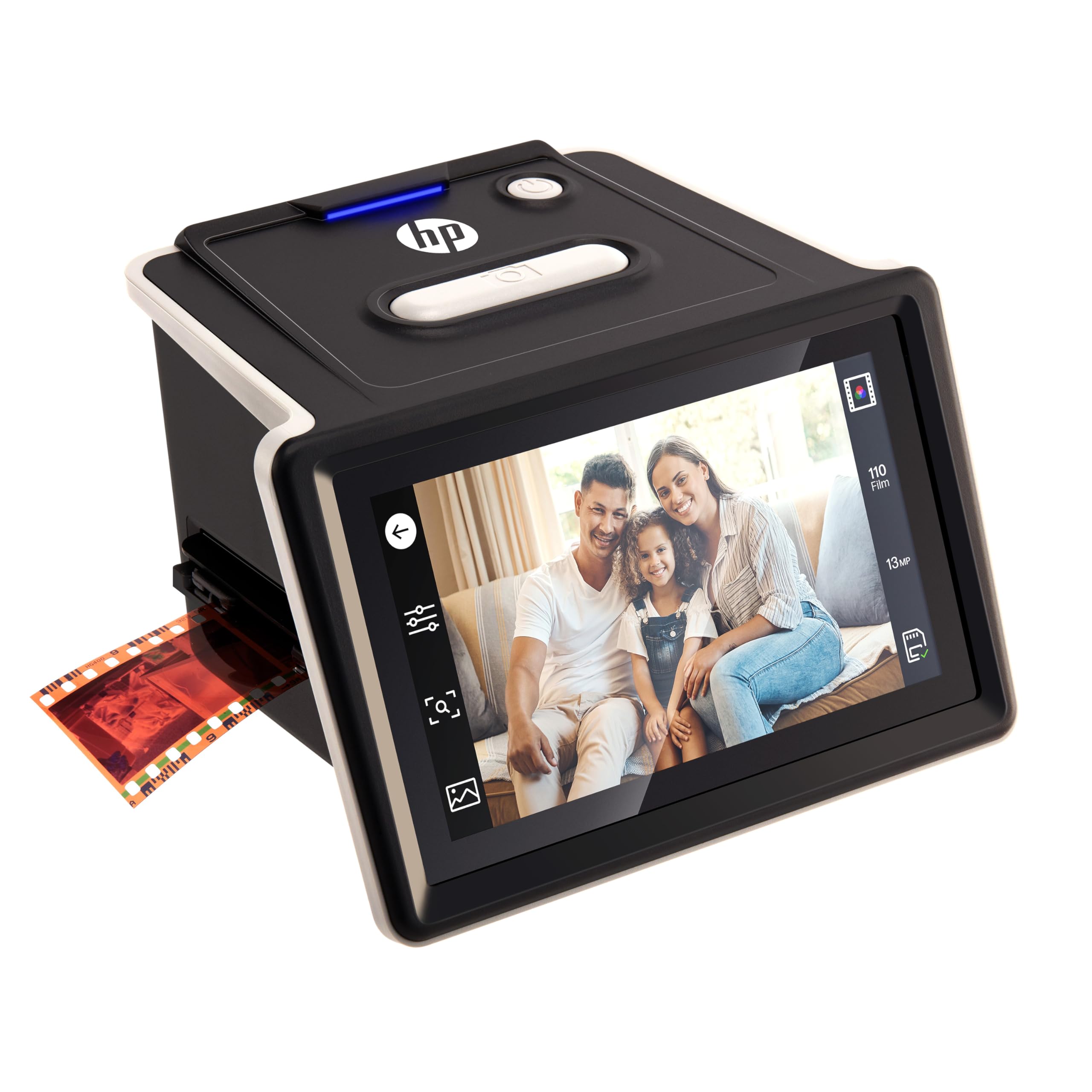
The HP FilmScan FS500 is a standalone slide and negative scanner that does not need a computer to operate. The 5-inch touchscreen lets you preview, rotate, and crop images on the device before saving to an SD card. The 13MP CMOS sensor with 22MP interpolation captures enough detail for 8×10 prints from 35mm slides, and the USB-C power means you can run it from a laptop or a standard 5V adapter without a wall wart.
What sets the FS500 apart is the all-angle touchscreen gallery mode. Once you scan a batch of slides, you can remove the SD card, slot it back in, and use the scanner as a digital picture frame. The quick-load tray system handles 135, 126, and 110 negative strips as well as mounted slides, and users report that the loading process is intuitive enough to hand to a family member. Color accuracy is good straight out of the box, though some users note the default red saturation runs slightly high.
A few practical considerations: the scanner collects dust on the internal optics fairly quickly, so the included cleaning brush gets regular use. The device also requires a separate SD card—it does not come with onboard storage. And because this is a sensor-based capture (like a digicam macro shot) rather than a true scanning pass, the depth of field is shallow; slides that are not perfectly flat may show soft corners. For the price, though, the HP FS500 offers the best screen-based slide experience in its class.
Why it’s great
- Standalone operation with a crisp 5-inch touchscreen; no computer needed.
- Multi-format support for 135, 126, 110 slides and negatives.
- Gallery mode turns the scanner into a digital picture frame.
Good to know
- Uses a CMOS sensor with interpolation, not a true optical scan pass.
- Dust accumulates on the internal sensor; requires frequent cleaning.
- Red saturation is slightly elevated out of the box; may need post-processing.
4. Epson Workforce ES-580W
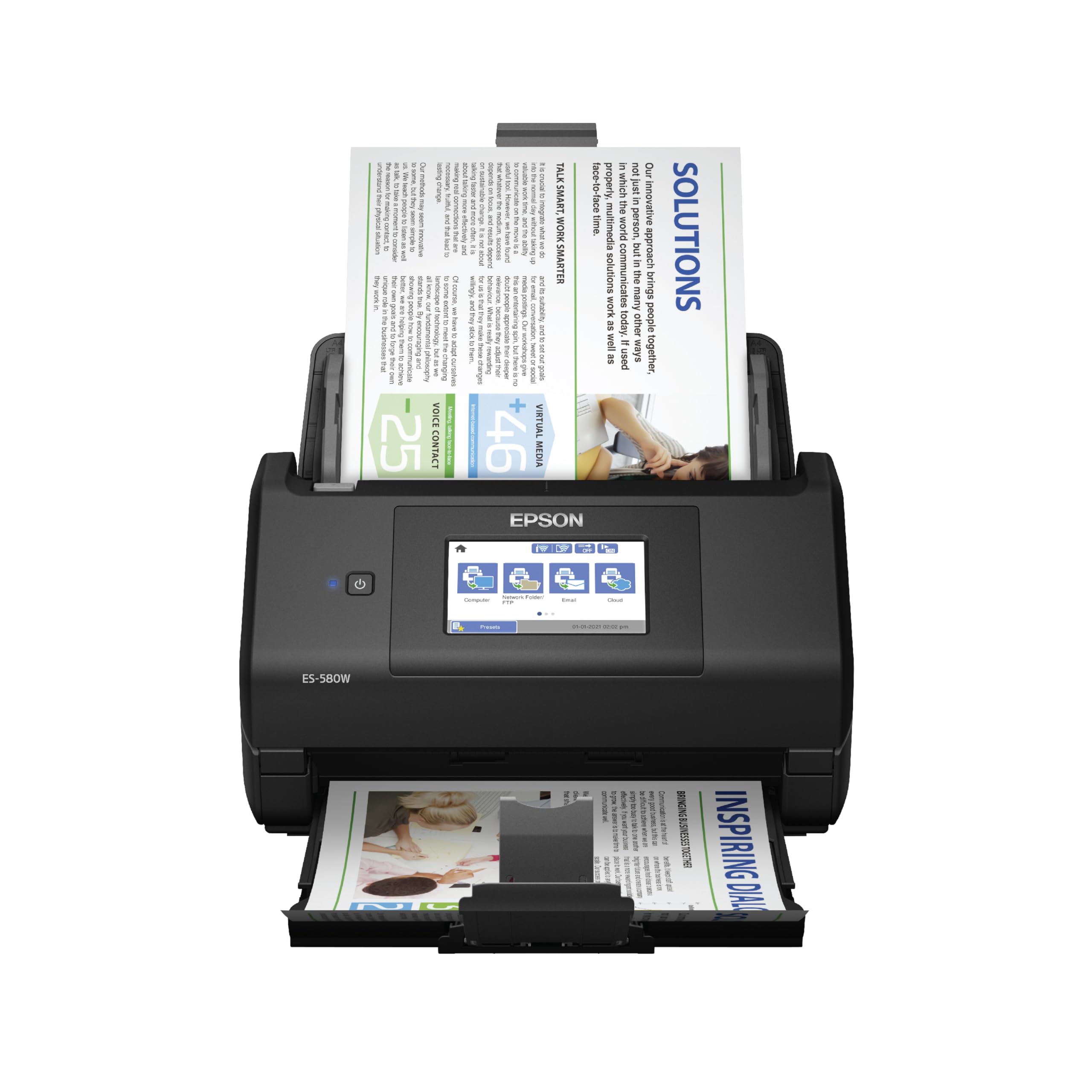
The Epson ES-580W is primarily a document scanner, but its CCD sensor and color-processing engine make it a capable photo scanner for anyone who also needs wireless cloud workflow. The 100-sheet auto document feeder handles mixed media: you can load a stack of 4×6 photos on top of receipts and contracts, and the scanner sorts them into separate folders based on size detection. The 4.3-inch color touchscreen lets you initiate scans without touching a computer.
Where the ES-580W excels is flexibility. It scans directly to email, USB, Dropbox, Google Drive, or OneDrive without a PC. The included Epson ScanSmart software applies auto-crop, background removal, and blank page deletion on the fly. The duplex scanning at 35 ppm is fast enough for light business use, and the CCD sensor gives better shadow detail than the CIS sensors found in smaller Epson models. For photos specifically, the auto-crop is reliable on standard 4×6 and 5×7 sizes.
The main drawback for photo purists is that the ES-580W does not offer any photo-specific correction tools like red-eye removal or face smoothing—you get general image enhancements. The ADF path is also rougher on thin, curled prints than purpose-built photo scanners. If you need a wireless scanner that does double duty as a document digitizer and occasional photo handler, the ES-580W is the best-balanced option available.
Why it’s great
- Wireless scanning to cloud services with no computer required.
- 100-sheet ADF handles mixed media sizes in a single batch.
- CCD sensor delivers better tonal depth than CIS-based competitors.
Good to know
- No photo-specific correction tools (face smoothing, red-eye removal).
- ADF path can be rough on thin, curled photo prints.
- Lacks Ethernet port; wireless and USB only.
5. ScanSnap iX2400
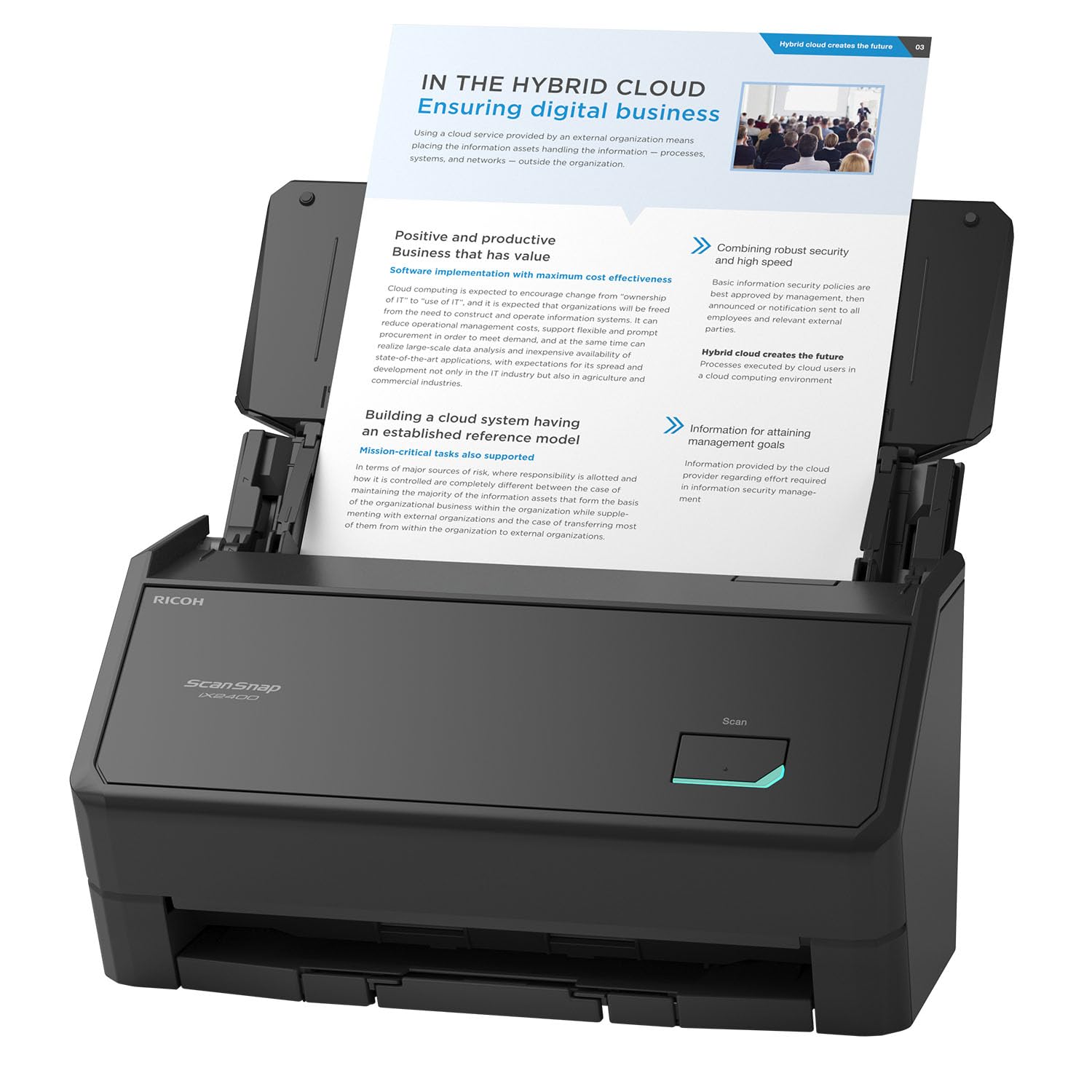
The ScanSnap iX2400 is the successor to the legendary iX1400 and it inherits the same relentless speed: 45 pages per minute simplex, 90 images per minute duplex. For high-volume document digitization, there is nothing faster in this price tier. The 100-sheet automatic document feeder handles standard paper sizes without jamming, and the one-touch button means you press once and walk away. The included ScanSnap Home software auto-detects document size and color depth, removes blank pages, and deskews crooked scans.
Where the iX2400 falls short is photo handling. The CIS sensor is optimized for document text and business card contrast, not the subtle gradients of a faded print. Photos can come out looking contrasty and flat, and the feeder path is aggressive enough to leave roller marks on glossy surfaces. The software also lacks any photo-specific enhancements like color restoration or face smoothing. This is a document-first machine that can technically scan photos, but you will need to adjust expectations on final image quality.
Reliability, however, is class-leading. The previous-generation iX1400 was known to run for seven years without major issues, and early user reports on the iX2400 echo that durability. The brake roller system prevents multi-feed jams, and skew detection stops feeding before paper damage occurs. For a home office or small business that processes hundreds of receipts and contracts per week and occasionally needs to scan a photo, the iX2400 is the unstoppable speed machine.
Why it’s great
- Industry-leading scan speed at 45 ppm simplex with a 100-sheet ADF.
- Reliable brake roller system prevents jams and paper damage.
- One-touch scanning with automatic blank page deletion and deskew.
Good to know
- CIS sensor produces flat, contrasty results on photo prints.
- No photo-specific software enhancements available.
- Feeder path can leave roller marks on glossy photo paper.
6. ScanSnap iX2500
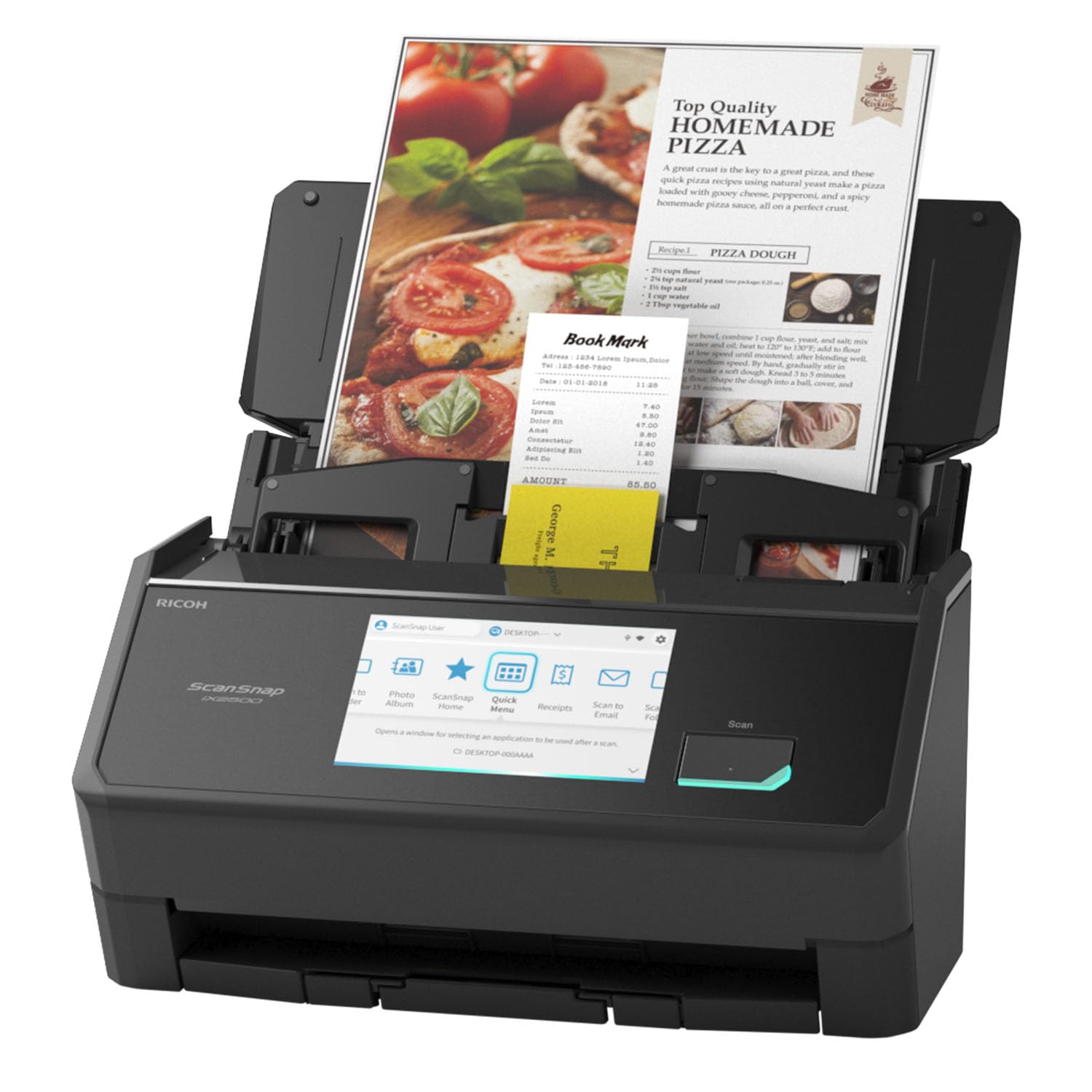
The ScanSnap iX2500 is the ultimate evolution of the ScanSnap line, adding a large 5-inch touchscreen, built-in Wi-Fi 6, and USB-C connectivity on top of the 45-ppm duplex speed. This is the scanner for the fully paperless office: you can load a stack of documents, select a profile on the touchscreen, and send the scans to a PC, Mac, mobile device, or cloud service without touching a keyboard. The auto-optimization engine handles document color, orientation, and blank page deletion in real time.
The iX2500 inherits the same photo limitations as the iX2400: the CIS sensor is not designed for photo tonal depth, and the feeder path does not handle glossy prints gently. ScanSnap explicitly markets this as a document and receipt scanner, not a photo scanner. The file compression is also aggressive—a four-page color document at 300 dpi can still produce a 1.2 MB file—which makes photos look soft. For documents, the quality is outstanding.
What makes the iX2500 worth the premium over the iX2400 is the connectivity and the touchscreen. Wireless setup takes under 10 minutes, and the Wi-Fi 6 connection is fast enough that wireless scanning is only about 10% slower than USB. The 100-sheet feeder with the brake roller system is rock-solid, and users report scanning 25,000 pages per year without hardware issues. If your primary load is documents and receipts with occasional photo digitization, the iX2500 delivers the smoothest workflow.
Why it’s great
- Large 5-inch touchscreen with customizable profiles for one-touch workflows.
- Wi-Fi 6 and USB-C for flexible, fast connectivity.
- Proven reliability for high-volume document digitization (25k+ pages/year).
Good to know
- CIS sensor and aggressive compression yield poor photo color depth.
- Not recommended for glossy or delicate photo prints.
- Software can be slow on large batch conversions and requires frequent firmware updates.
7. KODAK Slide N SCAN

The KODAK Slide N SCAN is the entry-level gateway to slide and negative digitization. The 5-inch LCD screen lets you preview each image before saving to an SD card, and the included adapters cover 135, 126, and 110 film formats as well as 50mm mounted slides. The output resolution is 22 megapixels via interpolation from a lower-res CMOS sensor, which is good enough for sharing on social media and making 5×7 prints, but you will notice pixel-level softness compared to a dedicated film scanner.
What buyers consistently praise is the speed. Users report digitizing 500 to 1,200 slides in a single weekend. The quick-load tray system lets you feed slides in continuous batches without fiddling with individual holders. The one-touch scan button automatically sets brightness and color, and you can adjust the film type (color negative, black-and-white, or slide) before starting. For a family archiver facing a lifetime of vacation slides, the Slide N SCAN is the fastest path from box to digital.
The limitations are real but manageable at this entry-level price. The built-in CMOS sensor is effectively a digital camera taking a picture of the slide, not a true scan pass, so the depth of field is shallow—curved slides show soft edges. The included editing options are basic: brightness and color tint only, no advanced restoration. Using an SD card that is too large (over 16 GB) can cause compatibility issues. For a budget-friendly tool that gets the job done on thousands of slides, the KODAK Slide N SCAN is the right choice.
Why it’s great
- Plug-and-play speed: digitize hundreds of slides per hour.
- Included adapters for 135, 126, 110 film and 50mm slides.
- Large 5-inch LCD preview screen for on-the-fly editing.
Good to know
- CMOS sensor uses interpolation; not a true optical scan.
- Shallow depth of field—curved slides produce soft corners.
- May lock up after transferring photos; requires power cycle to reset.
8. HP PS100

The HP PS100 is a portable document scanner designed for travelers, remote workers, and light home use. At 3 ounces and with a footprint smaller than a sheet of paper, it slides into a laptop bag without adding noticeable weight. The simplex scanning speed of 15 pages per minute is modest, but it draws power directly from the USB port—no wall adapter needed. Setup is truly plug-and-play on both Windows and macOS.
The PS100 is best understood as a document digitizer, not a photo scanner. The fixed 300 dpi resolution is fine for text and receipts, but photo scans lack the detail and color depth needed for archival work. The included HP WorkScan software handles basic auto-crop and background cleanup, but there are no photo-specific enhancements. Users who tried scanning family photos with the PS100 report acceptable results only for small web-size sharing.
What makes the PS100 worth considering is its sheer portability and affordability. It handles business cards, receipts, bills, and letter-sized documents without the bulk of a flatbed. The single-sheet feed path is reliable for standard paper, though thin or wrinkled pages may cause feed errors. If you need a lightweight sidekick for digitizing office paperwork on the go, the PS100 fits that niche perfectly. For photo digitizing, you will want a dedicated photo scanner instead.
Why it’s great
- Extremely lightweight and portable at just 3 ounces.
- Bus-powered via USB; no external power adapter required.
- Plug-and-play setup on both Windows and macOS.
Good to know
- Fixed 300 dpi resolution—not suitable for archival-quality photo scans.
- Simplex only (single-sided); no duplex scanning capability.
- Struggles with thin, wrinkled, or curled paper.
9. Plustek S410 Plus

The Plustek S410 Plus is a button-free portable sheet-fed scanner designed for the desk worker who needs to digitize documents, business cards, and receipts without software fuss. The automatic scanning feature instantly processes and saves images to a designated folder as soon as a page enters the feed—no button press, no preview window. At 0.9 pounds, it is light enough to toss into a briefcase and bus-powered via USB.
Like the HP PS100, the S410 Plus is a document-first device. The 600 dpi optical resolution is technically higher than the HP, but the CIS sensor and the simplex feed path mean photo scans come out looking flat and lacking the richness of a CCD-based scanner. Where the S410 Plus shines is in OCR-capable document digitization: the bundled Plustek DocAction software converts scanned text into searchable PDFs, Excel, or Word files with solid accuracy on standard typefaces.
User feedback highlights the simplicity of the auto-feed mechanism. It handles letter and legal sizes as well as plastic ID cards and business cards without jams. The lack of any scan button or software interface does take some getting used to—you simply insert the paper and it goes. For a home office or small workspace that processes a steady stream of documents and occasionally needs to digitize a photo for reference purposes, the S410 Plus delivers reliable, simple operation.
Why it’s great
- Button-free automatic scanning: insert paper and it instantly saves.
- Lightweight (0.9 lb) and bus-powered for true portability.
- Bundled OCR software converts scanned documents into editable Word/Excel files.
Good to know
- CIS sensor produces flat, contrasty results on photo prints.
- Simplex only; no automatic document feeder for batch scanning.
- No wireless connectivity—USB cable required at all times.
FAQ
Can I use a document scanner to digitize old photos?
What is the best dpi setting for scanning 4×6 photos?
Why do my scanned photos have white streaks or dust marks?
Final Thoughts: The Verdict
For most users archiving a lifetime of family photos, the photo scanner winner is the Plustek ePhoto Z300 because its CCD sensor and 2-second feed speed strike the ideal balance between image quality and throughput for the average shoebox. If you need to digitize thousands of slides in a single weekend, grab the HP FilmScan FS500 for its standalone touchscreen experience. And for a hybrid workflow that handles both photos and office documents, nothing beats the Canon imageFORMULA RS40.