
When the workshop temperature drops below freezing, your productivity halts and your tools can become sluggish. A direct-fired propane heater solves this instantly, blasting a wave of dry warmth across concrete floors and metal shelving, but most buyers end up with a unit that sounds like a jet engine idling in the corner.
I’m Mohammad Maruf — the founder and writer behind Drink4Good. I spend my time parsing through technical datasheets, BTU ratings, safety certifications, and hundreds of real-world buyer reviews to separate the genuinely effective machines from the noisy gas hogs that fail after a handful of uses.
After analyzing the current lineup, I have narrowed the field down to the strongest performers that balance raw heating power with durability and real-world usability, revealing the very best propane garage heater options available for the serious workspace.
How To Choose The Best Propane Garage Heater
Selecting the right propane heater for a garage is a different process than picking one for a living room. The space is often uninsulated, semi-open, and full of combustible materials like sawdust or chemical fumes. You need a machine that prioritizes both raw output and strict safety protocols.
Match BTU to Your Garage Volume
British Thermal Units (BTUs) measure raw heat output. A common mistake is buying based on square footage alone. You must calculate cubic feet — length times width times ceiling height. A standard two-car garage (20x20x8) is 3,200 cubic feet. A mid-range heater around 60,000 BTU will raise the temperature 30–40°F in that space in about 20 minutes, whereas an 18,000 BTU unit will struggle to make a dent in those conditions.
Forced Air vs. Radiant Heat
Forced-air heaters use a fan to blow air across a heated element, warming the entire space rapidly. These are the standard choice for drafty garages and workshops. Radiant heaters, like the Gasland MHA18BN or the Dyna-Glo wall units, heat objects and people directly without a fan. These are quieter and better for sealed, insulated spaces, but they lack the convective punch to fight cold drafts coming under a garage door.
Safety Certifications Aren’t Optional
Any heater running inside a garage must have a certified oxygen depletion sensor (ODS) and a tip-over auto shutoff. Look for CSA certification on the spec sheet — this confirms the unit passed third-party testing for gas flow integrity and flame-out protection. Units without these features are strictly for outdoor use and should never power a workshop.
Quick Comparison
On smaller screens, swipe sideways to see the full table.
| Model | Category | Best For | Key Spec | Amazon |
|---|---|---|---|---|
| DEWALT 68,000 BTU | Forced Air | Cordless Job Site Use | 68,000 BTU / 1,700 sq ft | Amazon |
| GASLAND Flame Jet 125K | Forced Air | Large Industrial Spaces | 125,000 BTU / 3,100 sq ft | Amazon |
| Dyna-Glo RMC-FA60DGD | Forced Air | Standard 2-Car Garage | 60,000 BTU / 1,350 sq ft | Amazon |
| Remington LP 60,000 | Forced Air | Rough Construction Sites | 60,000 BTU / 1,500 sq ft | Amazon |
| Gasland MHA18BN | Radiant | Small Quiet Workshops | 18,000 BTU / 450 sq ft | Amazon |
| Hiland HIL-SHOP-LP40 | Forced Air | Budget Shop Heating | 40,000 BTU / Stand Included | Amazon |
| Flame King 60,000 BTU | Forced Air | Budget Large Garage | 60,000 BTU / 1,500 sq ft | Amazon |
| Mr. Heater Blue Flame | Vent Free | Indoor Permanent Install | 20,000 BTU / 700 sq ft | Amazon |
| Dyna-Glo BF20NMDG | Vent Free | Wall-Mounted Backup | 20,000 BTU / 700 sq ft | Amazon |
In‑Depth Reviews
1. DEWALT 68,000 BTU Forced Air Propane Heater

The DEWALT 68,000 BTU heater is the most versatile machine in this lineup thanks to its dual-power capability. It runs on a standard 120V wall outlet or on a DEWALT 20V battery (not included), which makes it usable on job sites without any extension cords. Real users report that an 8Ah battery powers the unit most of the day during winter work, with the heater raising a 450-square-foot insulated shop from 50°F to 65°F in under ten minutes.
The forced-air design pushes heat across 1,700 square feet of coverage, making it suitable for large garages and horse barns. The steel housing is built to take rough handling, and the thermocouple flame-out shutoff ensures the gas flow stops if the flame extinguishes. One consistent observation from the reviews is that the unit requires re-ignition every 20 to 30 minutes to maintain temperature, and there is no built-in thermostat to automate that cycle.
On the noise front, the forced-air fan is noticeable but significantly quieter than many competitor units in the same BTU class. The propane burn is clean enough that users report no lingering fumes, which is critical for enclosed workshops. For a premium product that can go cordless when needed, this is the most thoughtfully engineered option on the list.
Why it’s great
- Dual power flexibility (battery or AC) for remote sites
- Fast temperature rise with clean, fume-free combustion
- Durable steel chassis withstands job site abuse
Good to know
- No built-in thermostat requires manual cycling
- Battery sold separately adds to overall cost
2. GASLAND Flame Jet 125,000 BTU Propane Force Air Heater
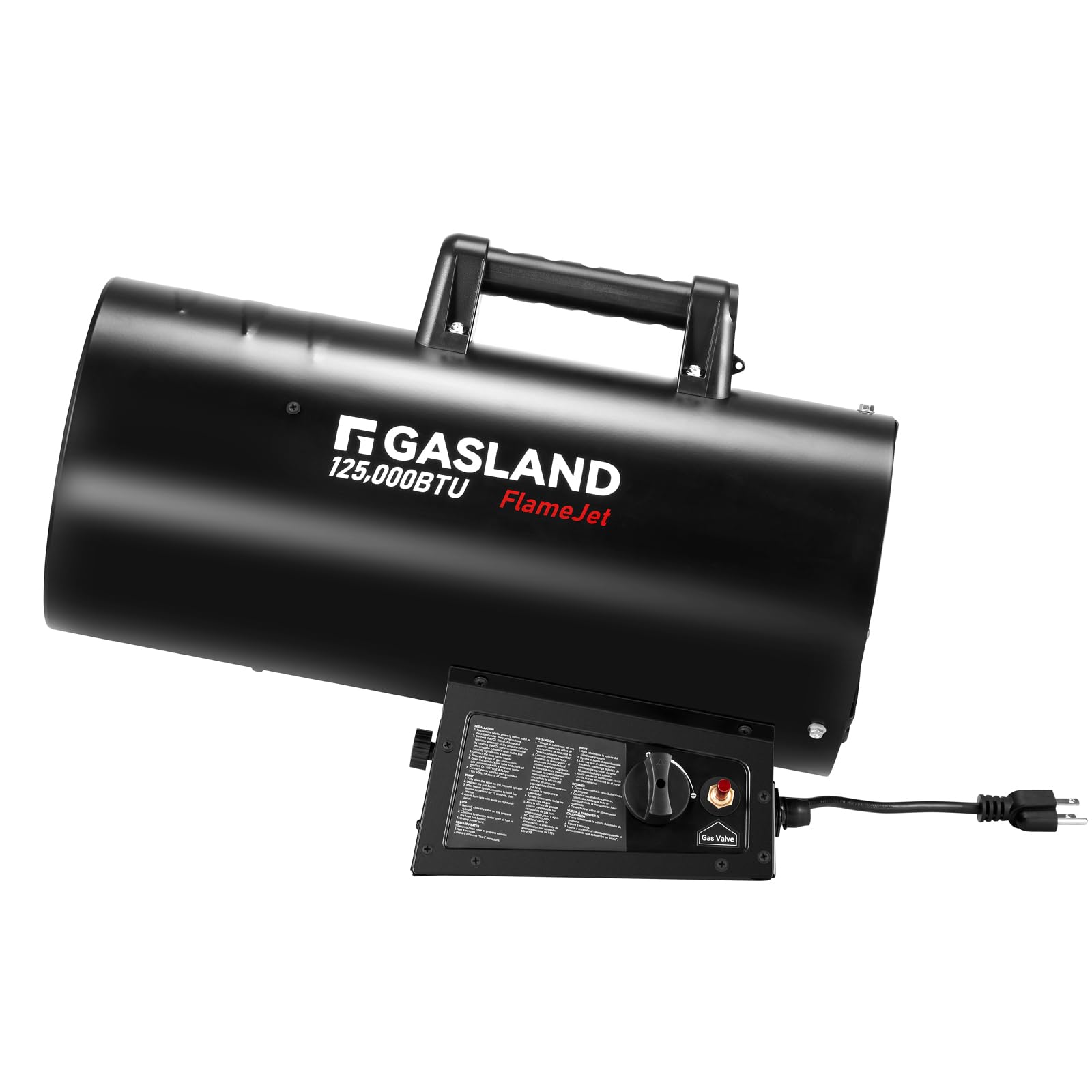
The GASLAND Flame Jet is the highest-output forced-air unit in this review, delivering an adjustable range from 75,000 to 125,000 BTUs. That power allows it to heat up to 3,100 square feet, making it the only model here that can handle a warehouse, a large metal barn, or an oversized three-car shop without breaking a sweat. The continuous electronic ignition eliminates the dangerous delayed ignition that can plague piezo-style starters.
Construction is heavy-duty steel with a compact footprint, and the included 10-foot hose and regulator make connection to a standard 20-pound propane tank straightforward. On the low setting, a full tank provides approximately five hours of run time, which is reasonable for intermittent use. CSA certification covers the overheat detection system and the thermoelectric safety valve that cuts gas flow if the flame is lost.
Noise is present but typical for a forced-air machine of this size — the fan moves a large volume of air and does so audibly. Buyers with smaller garages should note that even the low setting may produce more heat than a 450-square-foot space requires, so this unit is best reserved for large, open, well-ventilated areas where raw BTUs are the priority.
Why it’s great
- Massive 125,000 BTU output for oversized spaces
- Continuous electronic ignition prevents delayed start hazards
- Adjustable heat angle and variable output control
Good to know
- Overkill for a standard two-car garage
- No thermostat, requires manual adjustment
3. Dyna-Glo Delux RMC-FA60DGD 60,000 BTU Forced Air Heater
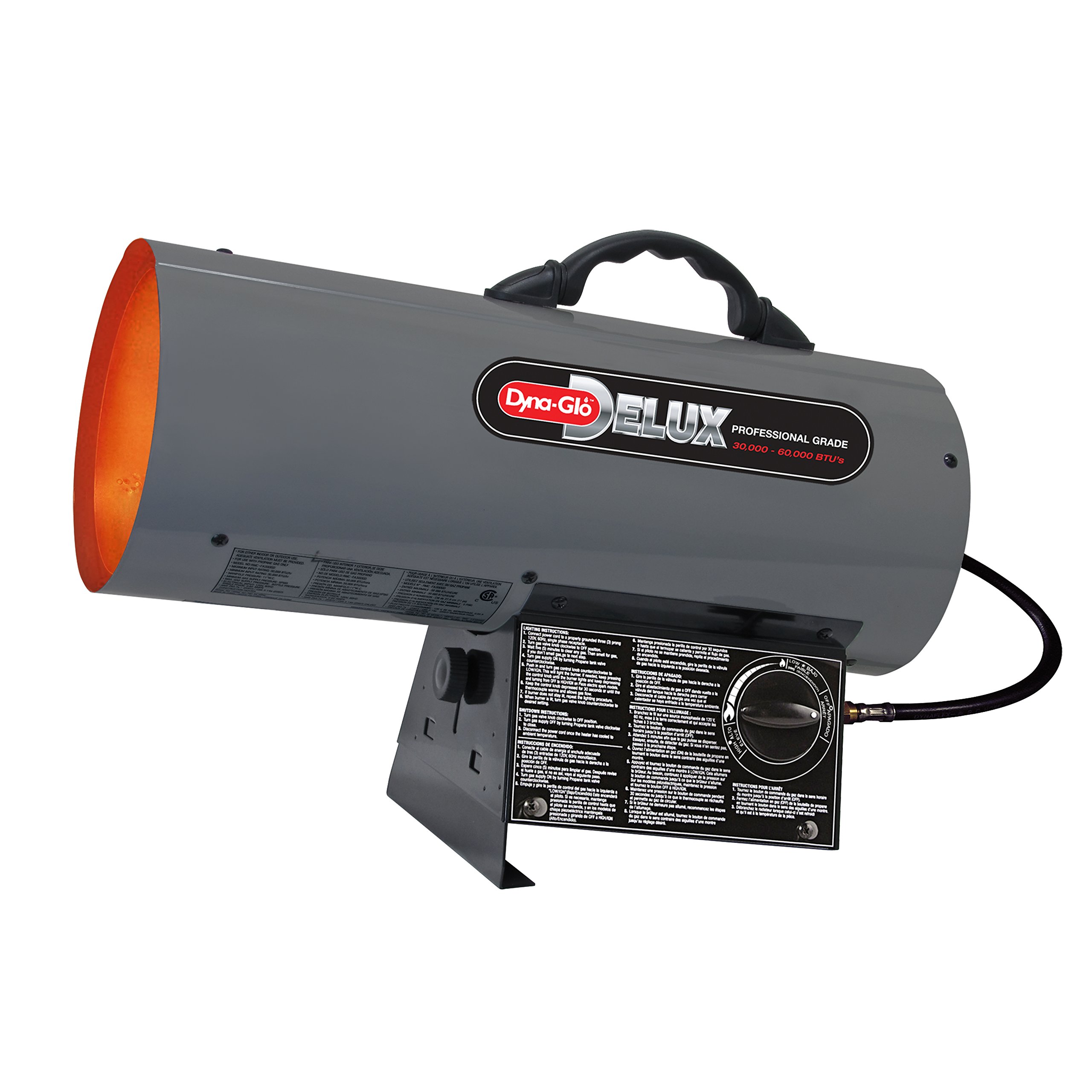
The Dyna-Glo RMC-FA60DGD hits the sweet spot for the majority of garage owners with its continuously variable BTU output between 30,000 and 60,000 BTUs, covering up to 1,350 square feet. Real-world data from a buyer shows it heating a 4,600-cubic-foot garage from 28°F to 56°F in a single hour when outdoor temps were 4.6°F, which is exceptional performance for this price tier. The adjustable heat angle lets you direct the flow where it is needed most.
The flame-out safety shutoff and overheat protection are standard, but the standout feature is the continuous electronic ignition. Unlike piezo sparkers that require repeated attempts, this system keeps the igniter active during operation, preventing the dangerous gas buildup that can occur if the flame blows out and reignites later. The unit comes with a 10-foot hose and regulator, so you can connect it immediately.
Build quality is where the compromise shows — several buyers noted a pinched air tube on arrival and a throttle knob that is too long for the housing. The power cord is short, and the handle feels flimsy under full weight. For the price, however, the thermal performance is undeniable. If you can tolerate its rough edges, it delivers heat output that rivals units costing significantly more.
Why it’s great
- Excellent heat output for the mid-range price point
- Continuous variable BTU dial for fuel efficiency
- Continuous electronic ignition prevents delayed ignition
Good to know
- Some units arrive with cosmetic or assembly defects
- Short power cord and flimsy handle included
4. Remington LP 60,000 BTU Forced Air Heater
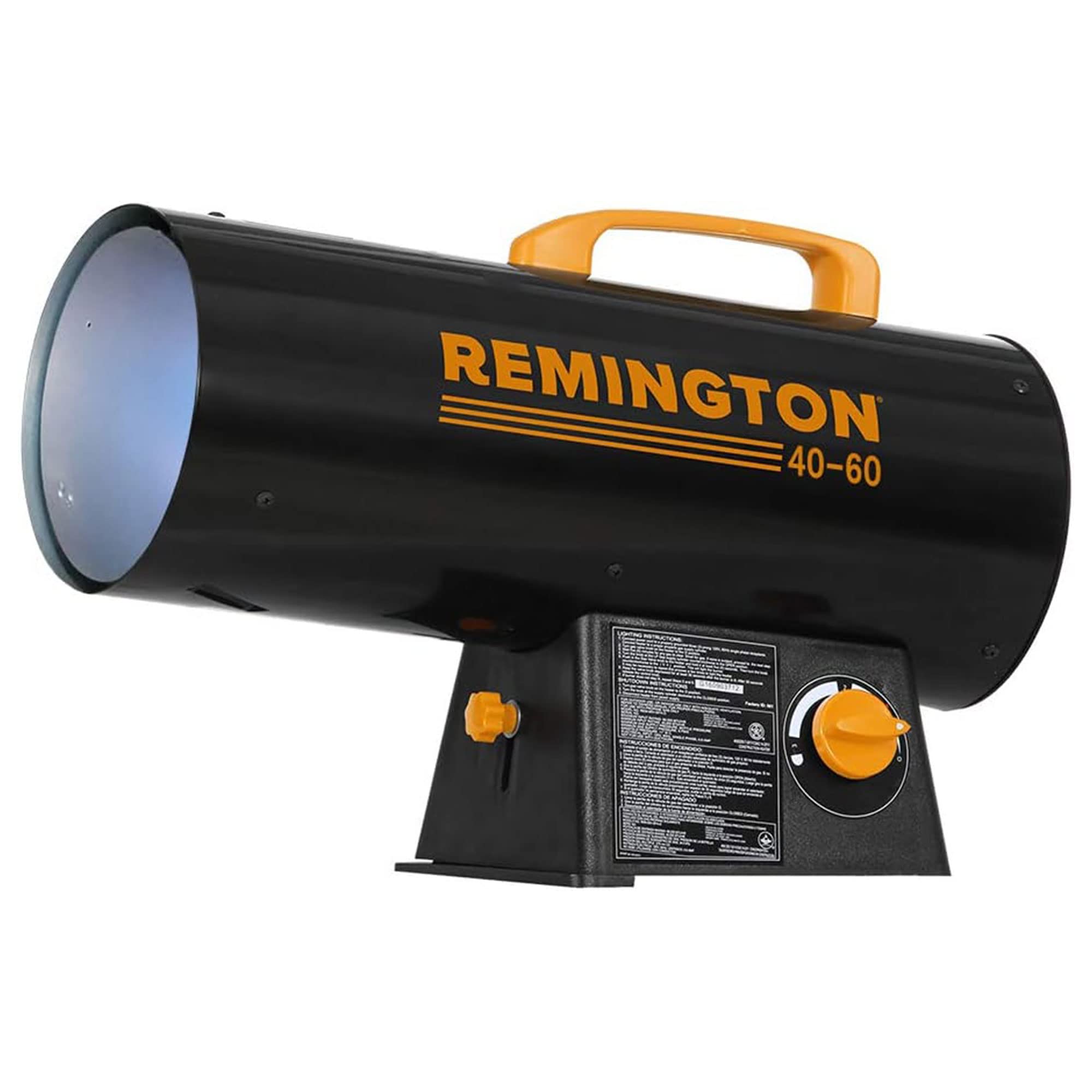
The Remington 60,000 BTU forced-air heater is built with heavy-gauge steel and designed for the punishing conditions of construction sites and barns. The electronic ignition fires reliably, and the thermocouple, high-temperature limit shutoff, and flame-out fuel cut-off provide triple-layer safety. The adjustable height pedestal and variable heat settings give you control over the distribution pattern, which is useful when you are working in a specific corner of a large space.
Coverage is rated for 1,500 square feet, and owners consistently confirm that it handles an 800-square-foot shop with ease. The included 10-foot hose and regulator make hookup simple, and the unit weighs only 11 pounds, making it genuinely portable despite the steel exterior. Buyers report excellent heat distribution across large open areas, which is the primary reason to choose a forced-air design over a radiant one.
The primary drawback is noise. Multiple owners describe it as extremely loud, with one returning the unit specifically because of the noise level. The LP hose connection also requires a forceful push-and-turn motion that some users found difficult. If the noise is tolerable for your workflow, the heating performance and build quality are solid for the mid-range investment.
Why it’s great
- Tough steel chassis withstands job site conditions
- Adjustable height and variable BTU settings
- Triple safety shutoff system for peace of mind
Good to know
- Noticeably louder than comparable forced-air units
- LP hose connection requires significant force
5. Gasland MHA18BN Propane Radiant Heater 18,000 BTU

The Gasland MHA18BN is the quietest heater in this comparison because it uses radiant heat rather than forced air. There is no fan motor, no propeller noise — the only sound is the soft whisper of the gas burner. This makes it ideal for spaces where you need to think, read, or hold a conversation without shouting over machinery. The maximum output of 18,000 BTUs covers 450 square feet, making it suitable for a small workshop, office above the garage, or a 33-foot travel trailer.
Safety is handled by a tip-over shutoff switch and an oxygen depletion sensor that cuts the gas if the room becomes too airtight. The cabinet-style design houses the 20-pound propane tank inside, keeping it out of sight and reducing the risk of accidental knocks. Three heating modes (high, medium, low) allow you to dial in the temperature without wasting fuel, and the unit requires no electricity to operate, making it functional during power outages.
Ignition can be a bit finicky on the first try, with some buyers reporting a need for multiple attempts before the pilot stays lit. The wheels make it easy to move even with a full tank inside, but the 450-square-foot coverage limit means it will not replace a forced-air unit in a standard two-car garage. For quiet, localized warmth in a sealed space, this is the most comfortable option.
Why it’s great
- Near-silent operation with no fan or motor noise
- No electricity required, works during power outages
- Integrated propane tank cabinet keeps space tidy
Good to know
- Limited to 450 sq ft of heating coverage
- Pilot ignition can be temperamental initially
6. Hiland HIL-SHOP-LP40 40,000 BTU Forced Air Heater

The Hiland 40,000 BTU forced-air heater is an entry-level unit that punches above its weight class for smaller shops. It includes a sturdy stand out of the box, which is a welcome addition since many units in this price bracket expect you to buy a stand separately. CSA certification confirms flame-out protection and overheating protection, and the piezo ignition starts the burner reliably on the first pull.
Real-world feedback from a buyer who runs this in a 14-by-40-foot space reports that after two hours the area becomes comfortably warm. Another user noted the heater makes their 20×20 garage toasty in minutes, but emphasized that the heat output feels closer to a strong 40K BTU than the cheap 150K claimants on the market. The noise is typical for a small forced-air machine — owners describe it as similar to a jet engine, which is expected for this heating method.
The biggest functional complaint is that the heater lacks multi-heat selection. It runs at full blast or off, which can lead to rapid propane consumption if you only need a slight temperature lift. For the price, it is a reliable source of raw heat, but you will need to manually cycle it to maintain a comfortable temperature without wasting fuel.
Why it’s great
- Comes with a durable stand, no extra purchase needed
- Throws significant heat for a compact footprint
- Short cord is manageable with a switched power strip
Good to know
- Only runs at full output with no variable heat settings
- Noisy operation typical of forced-air designs
7. Flame King 60,000 BTU Portable Propane Forced Air Heater

The Flame King 60,000 BTU forced-air heater is the most budget-conscious option for heating up to 1,500 square feet. The stainless steel housing is lightweight at just one pound, making it extremely portable, though that weight savings comes from much thinner metal than the Remington or DEWALT units. Owners report that it heats a standard 24-by-24-foot garage by 20–30°F in about 15 minutes when paired with a radiant heater for supplemental warmth.
Safety features include a fuel shutoff, fire detection system, and a tilt shutoff switch. The auto piezo ignition and gas control button give you basic heat management. It runs for up to eight hours on a standard 20-pound propane bottle at full 60,000 BTU output, which is good efficiency for forced air. The included LP hose with a built-in regulator simplifies setup.
Quality control is the main concern here. One buyer reported that the unit stopped working after three days — the heater would only run while the gas button was manually held down. The piezo igniter can also be finicky, occasionally requiring multiple attempts to light. For the entry-level price, the thermal performance is strong, but you are assuming some risk with long-term reliability. This unit is best for occasional use where cost is the primary driver.
Why it’s great
- Strong heat output for the lowest cost of entry
- Extremely lightweight and portable at one pound
- Eight-hour runtime on a standard propane tank
Good to know
- Inconsistent quality control across units
- Piezo igniter is unreliable on some models
8. Mr. Heater 20,000 BTU Vent Free Blue Flame Natural Gas Heater
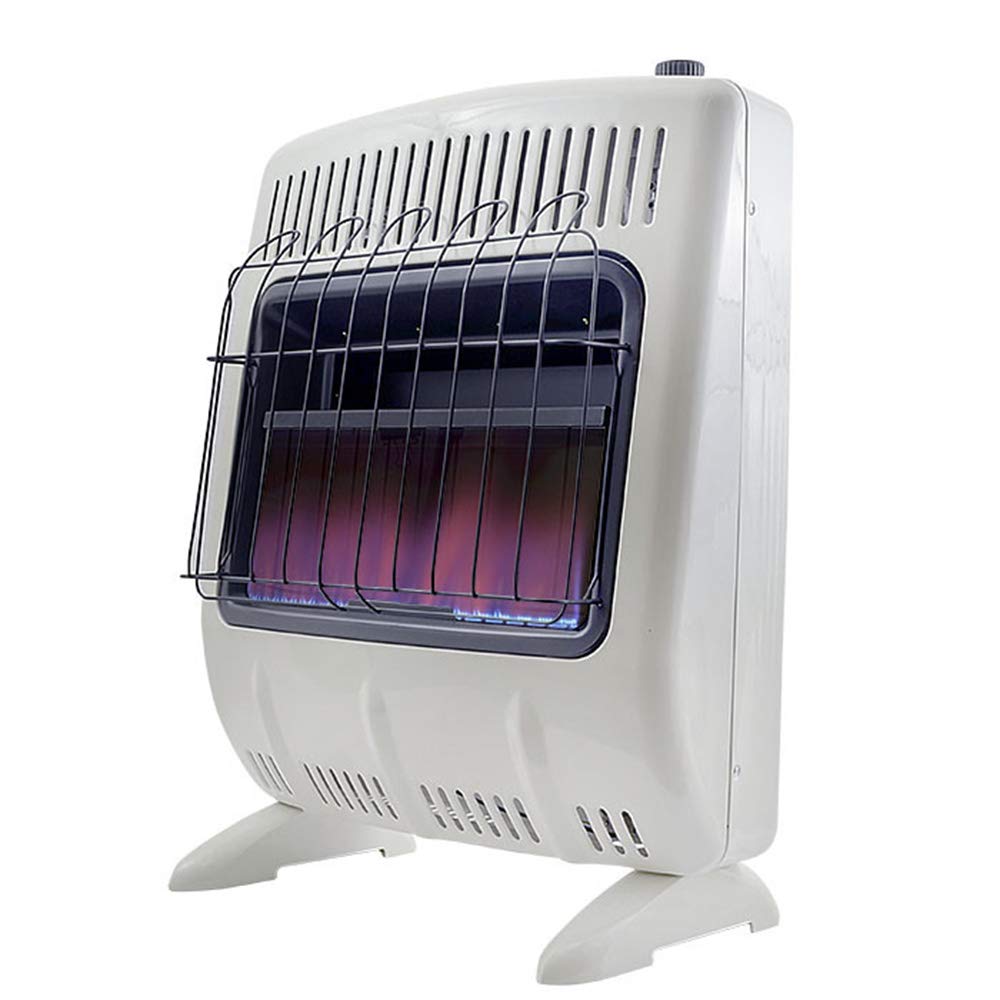
The Mr. Heater Blue Flame is a completely different type of propane heater — it is a vent-free convection unit designed for permanent indoor installation. It burns natural gas (not liquid propane) and requires no external venting because the combustion is clean enough for indoor air quality standards. The blue flame technology heats the air directly, similar to a central heating system, rather than blowing hot air across a burner. This makes it silent during operation.
Coverage is rated at 700 square feet, and real-world tests show it heats a 600-square-foot space from teens outside to the 70s without difficulty. The wall-mounted design saves floor space, and the battery-operated electronic ignition requires no electricity, so it still works during a blackout. The built-in adjustable thermostat cycles the burner automatically to maintain your set temperature, which is a luxury not found on any forced-air unit in this review.
Installation requires a permanent natural gas line connection, which means you will likely need a plumber unless you are comfortable with gas plumbing. The pilot light can be hard to see in bright conditions, and the heat vents upward rather than forward, which can leave the floor cold in an uninsulated garage. This unit is best suited for an attached, insulated garage where you want a permanent, thermostat-controlled heating solution without the fan noise.
Why it’s great
- Silent operation with no fan or motor
- Built-in thermostat for automatic temperature control
- No electricity needed, works during power outages
Good to know
- Requires permanent natural gas line installation
- Heat rises upward, not forward — cool floors possible
9. Dyna-Glo 20,000 BTU Natural Gas Blue Flame Vent Free Wall Heater

The Dyna-Glo BF20NMDG is another vent-free wall heater that runs on natural gas, but it offers a variable heat output from 10,000 to 20,000 BTUs via a simple control knob. This three-position manual control (low, medium, high) gives you more flexibility than the single-output Mr. Heater design. Coverage is rated at 700 square feet, and owners report that it warms a three-car garage quickly and heats a 900-square-foot cabin with ease during cold weather.
The blue flame technology is the same convection-based heating method that provides silent operation with no forced air. The safety oxygen depletion sensor (ODS) shuts the unit down if oxygen levels drop too low, and the unit requires no electricity to operate. Installation is straightforward for anyone comfortable with gas pipe connections, and the wall-mount form factor keeps the floor completely clear.
This is not a thermostatically controlled unit — you set the output manually and adjust as conditions change. Some buyers found the three settings limiting if they wanted precise temperature maintenance without periodic adjustment. The unit is also specifically designed for natural gas, and fuel conversion is not permitted by the manufacturer. For someone looking for a permanent, silent, wall-mounted backup heat source in an insulated garage, this is a clean and effective solution.
Why it’s great
- Variable heat output from 10K to 20K BTUs
- Silent convection heating with no fan noise
- No electricity required for reliable backup heat
Good to know
- Manual control only, no automatic thermostat
- Requires permanent natural gas line installation
FAQ
Can I use a propane garage heater in an attached garage with the house door open?
How long will a 20-pound propane tank last with a 60,000 BTU heater?
Final Thoughts: The Verdict
For most users, the best propane garage heater winner is the DEWALT 68,000 BTU Forced Air Heater because its dual-power battery-and-AC flexibility solves the biggest pain point of running extension cords across a crowded garage. If you want a silent permanent heating solution that requires no electricity, grab the Mr. Heater Blue Flame Vent Free Heater. And for the absolute highest raw heat output in an oversized shop or barn, nothing beats the GASLAND Flame Jet 125,000 BTU Heater.