
Picture this: It’s a freezing Tuesday morning in the dead of winter. You are the last person in your family to step into the shower. You finally get fully lathered up with soap, and suddenly—BAM. The water turns to pure, agonizing ice. Your massive, outdated 50-gallon storage tank has been drained of its reserves. If you are reading this, you are likely utterly exhausted from paying high utility bills to keep a giant tank of water hot while you sleep, and you are ready to reclaim your utility closet space.
You know it is time to upgrade, but navigating the world of on-demand water heating can feel like attempting to earn an engineering degree overnight. Condensing versus non-condensing? BTUs versus GPM? Concentric venting versus schedule 40 PVC? The frustrating reality is that most online buying guides simply rattle off the manufacturer’s spec sheets, inject some generic AI fluff, and leave you to fend for yourself in the plumbing aisle. We are going to completely skip that nonsense and go 1,000 miles deeper.
When you are ready to upgrade, finding the best tankless hot water heater- gas represents one of the smartest and most luxurious home improvements you can make. However, a unit that performs flawlessly in a 2-bedroom condo in sunny Florida might fail miserably in a 4-bathroom house in freezing Minnesota. The engineering nuances matter heavily. I have aggressively analyzed thousands of real homeowner reviews, professional plumbing feedback, and complex installation quirks to bring you this definitive masterclass.
Below, you will find 17 spectacular models meticulously ranked and reviewed. Whether you need a fire-breathing 199,000 BTU behemoth to power a sprawling luxury estate, or a hyper-compact, budget-friendly unit for an off-grid cabin, this guide will provide absolute clarity so you can make a purchase that leaves you completely satisfied for the next two decades. Let’s permanently end the era of cold showers.
How to Choose the Best Tankless Hot Water Heater- Gas
Buying a tankless heater is not like buying a microwave. If you choose a unit with the wrong venting requirements, your installation bill could instantly double. If you buy a unit that is too small for your climate’s groundwater temperature, you will suffer from weak, lukewarm showers. Here is the exact, expert-level framework to ensure you don’t make a costly plumbing mistake.
1. Understand the “GPM vs. Groundwater Temperature” Rule
Gallons Per Minute (GPM) is the golden metric of tankless heaters. It dictates how many plumbing fixtures you can run simultaneously. A standard modern showerhead uses about 2.0 to 2.5 GPM, while a kitchen sink uses about 1.5 GPM.
However, the “Maximum GPM” printed in massive letters on the box (e.g., “Up to 10.0 GPM”) is based on a highly idealized scenario where your incoming city groundwater is already relatively warm (like in Florida or Texas, where it might be 70°F). If you live in a northern state where groundwater can dip to a frigid 35°F in the winter, the heater has to work exponentially harder to raise that freezing water to a comfortable 115°F shower temperature. In cold climates, a unit rated for 10.0 GPM might physically restrict its flow to only 5.0 GPM to ensure the water gets fully hot.
2. Condensing vs. Non-Condensing: The Venting Trap
This is the single most important decision regarding your overall installation budget.
- Condensing Units: These are the pinnacle of heating efficiency (UEF 0.90 to 0.98). They capture their own exhaust gases, extract the residual heat, and use it to pre-heat your incoming cold water. Because the final exhaust leaving the house is remarkably cool, you can legally vent these units using inexpensive Schedule 40 PVC or CPVC pipes. They cost more upfront but save massive amounts of money on venting materials and long-term gas usage.
- Non-Condensing Units: These are the traditional, older-style workhorses. They are slightly less efficient (UEF around 0.81). Because they do not recycle their exhaust, the gases they produce are incredibly hot (often over 300°F). This means they absolutely require specialized Category III stainless steel venting. While the heater itself is cheaper at checkout, the stainless steel vent pipes can easily cost hundreds of dollars, quickly erasing your initial savings.
3. Gas Line Sizing: Can Your Home Handle the Power?
A traditional 50-gallon tank heater gently sips gas, typically pulling at about 40,000 BTUs. A whole-home tankless heater demands massive, explosive heat instantly, drawing up to 199,000 BTUs the second you turn on the tap. If you attempt to force that much gas through an old, long 1/2-inch gas pipe, the heater will literally starve for fuel, throw an ignition error code, and shut down.
While some modern units feature negative-pressure gas valves that allow them to run on a 1/2-inch line (under very short distances), you must often budget for upgrading your home’s gas pipe to 3/4-inch, and potentially calling your utility company to upgrade your main gas meter to handle the combined load of your furnace, stove, and new heater.
4. Indoor vs. Outdoor Installation Options
If you live in a mild climate (like the Sunbelt), an outdoor unit is a brilliant choice. It mounts directly to your exterior wall, freeing up indoor closet space, and completely eliminates the need for expensive exhaust venting pipes.
However, if you live in a region prone to hard freezes and blizzards, an outdoor unit is a massive liability. While they have internal ceramic anti-freeze heaters, a power outage during a deep freeze will cause the internal copper pipes to freeze, expand, and burst in a matter of hours. Indoor units require careful venting but offer ultimate, foolproof weather protection.
Quick Comparison: 17 Best Tankless Hot Water Heater- Gas Models
Use this table to quickly identify the model that fits your flow rate needs, BTU requirements, and installation type. Then, dive into the deep, comprehensive reviews below to see exactly how they perform when put to the test in the real world.
On smaller screens, swipe or scroll sideways to see the full table.
| Model | Type / Max GPM | Key Strength & BTUs | Best Match For | Amazon |
|---|---|---|---|---|
| Rheem RTGH-90DVLN-3 | Indoor Condensing / 9.0 | 180K BTU + Hot Start tech eliminates cold bursts | Best Overall for mid-to-large homes seeking high efficiency | Amazon |
| Rinnai RX199iN | In & Out Condensing / 11.1 | 199K BTU + Versa Vent flexibility & Dual Fuel | Luxury homes & large families in freezing climates | Amazon |
| Westinghouse 7.9 GPM | Indoor Smart / 7.9 | 180K BTU + Wi-Fi control & precise ±1°F holding | Tech-savvy families wanting modern app diagnostics | Amazon |
| Rinnai RX180iN | In & Out Condensing / 10.0 | 180K BTU + Smart Sense auto gas adaptation | Homes that may switch fuel sources (Nat/LP) in the future | Amazon |
| Rheem RTG-84XLN-3 | Outdoor Non-Condensing / 8.4 | 180K BTU + Zero interior venting required | Warm climate homes wanting to save big on venting costs | Amazon |
| Rheem RTG-70DVLN-3 | Indoor Non-Condensing / 7.0 | 160K BTU + LeakGuard detection peace of mind | Standard 2-3 bathroom homes upgrading from an old tank | Amazon |
| FOGATTI 170S Series | Indoor Non-Condensing / 7.5 | 170K BTU + Incredible BTU-to-price ratio | Budget-conscious buyers needing high whole-house flow | Amazon |
| Rheem RTG-70XLN-3 | Outdoor Non-Condensing / 7.0 | 160K BTU + Robust outdoor weather protection | Southern homes looking for a fast, reliable, vent-free upgrade | Amazon |
| APUS Smart Wi-Fi | Indoor Non-Condensing / 6.8 | 140K BTU + Built-in recirculation booster pump | Users prioritizing zero-cold-water tech and smart adjustments | Amazon |
| MIZUDO GEN 3 | Indoor/Outdoor / 5.1 | 120K BTU + Extremely flexible convertible installation | Homeowners who want installation options without luxury costs | Amazon |
| Rinnai V53DeN | Outdoor Non-Condensing / 5.3 | 81K BTU + Legendary Rinnai durability in a tiny package | Smaller households or empty nesters in warm climates | Amazon |
| ThermoMate CZ422NG | Indoor Non-Condensing / 5.0 | 113K BTU + 98% thermal efficiency & hurricane fan | Value seekers looking to cut gas bills efficiently in small spaces | Amazon |
| ORBEK 4.3 GPM | Indoor Non-Condensing / 4.3 | 100K BTU + Starts at just 0.53 GPM low-flow | Apartments or cabins with eco-friendly low-flow fixtures | Amazon |
| Novieex 4.3 GPM | Indoor Non-Condensing / 4.3 | 100K BTU + Simple touchscreen & wide temperature range | Emergency retrofits replacing a standard 40-gal tank | Amazon |
| Ranein 3.6 GPM | Indoor Non-Condensing / 3.6 | 80K BTU + Includes exhaust pipe directly in the box | Tiny homes, garage workshops, or single-occupancy setups | Amazon |
| Nessxa 18L Propane | Indoor Propane / 4.76 | 122K BTU + Dual Fahrenheit/Celsius display | Propane users wanting extra BTU punch for colder well water | Amazon |
| VELPAX 16L Propane | Indoor Propane / 4.21 | 68K BTU + Liquid Propane ready out of the box | Off-grid cabins or low-pressure homes relying on LP tanks | Amazon |
In‑Depth Reviews: 17 Heaters That Will Change Your Home
Here is where we strip away the marketing fluff. I am breaking down how these units actually perform when the pressure is on, what real homeowners are screaming about regarding installation quirks, and why some highly-rated units might completely fail in your specific home setup. Let’s find your best tankless hot water heater- gas solution.
1. Rheem RTGH-90DVLN-3 Condensing Indoor Natural Gas Water Heater
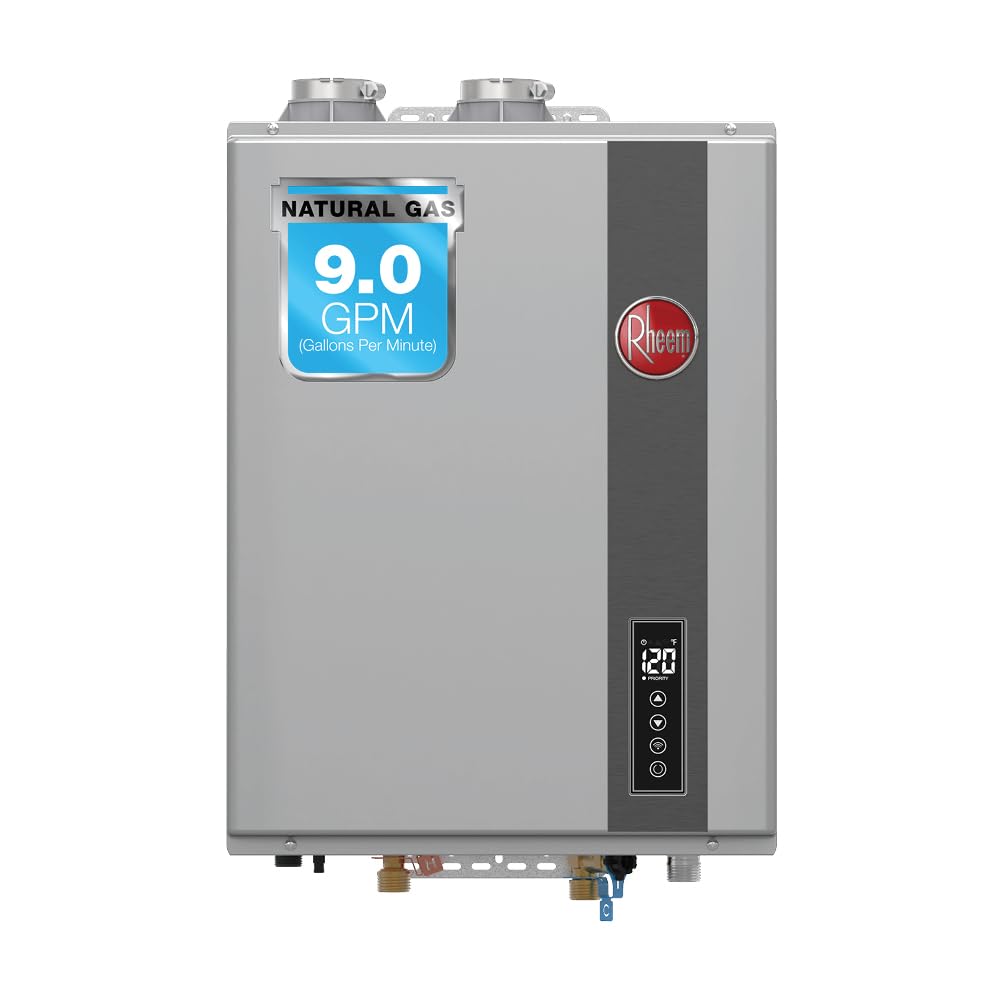
When you demand the absolute sweet spot of raw heating power, elite brand reliability, and long-term financial efficiency, the Rheem RTGH-90DVLN-3 commands the top spot. Delivering up to 9.0 GPM via a robust 180,000 BTU burner, this unit is perfectly scaled for a modern 3.5-bathroom home. What truly elevates this machine above its peers is its condensing technology. By capturing waste heat from its own exhaust to pre-heat the incoming water, it achieves a staggering 0.93 Uniform Energy Factor (UEF). For you, this means drastically lower gas bills and the ability to vent the unit using cheap, easily accessible PVC pipe instead of wildly expensive stainless steel.
In daily use, the most annoying aspect of tankless technology is the “cold water sandwich” (that brief blast of cold water if you turn the shower off to lather and back on again). Rheem solves this with their exclusive Hot Start Programming, which keeps the heat exchanger primed and ready, practically eliminating the shock. Real-world feedback from extensive DIYers notes that while the initial setup is meticulous—often taking 15 hours from unboxing to the final system flush—the payoff is immense. One homeowner specifically noted a 75% drop in their electric bill after swapping out an old electric tank, without seeing a massive spike in their natural gas usage.
Expert advice from the plumbing trenches: because this unit is so efficient, the exhaust contains a distinct, slightly sulfuric smell. You must plan your exterior vent termination carefully, keeping it far away from patios or open windows. Furthermore, to maintain optimal water pressure when running multiple showers, homeowners highly recommend pairing this unit with an expansion tank and pressure regulator on your main line to protect the machine’s intricate sensors from city pressure spikes.
Why it dominates the market
- PVC Venting Friendly: Condensing tech saves you hundreds of dollars on installation materials.
- Hot Start Tech: Virtually eliminates cold water bursts during back-to-back faucet usage.
- Incredible Efficiency: 0.93 UEF rating ensures maximum gas savings every single month.
- Overheat Film Wrap: State-of-the-art safety shutoff mechanism prevents heat exchanger burnout.
The harsh realities
- Condensing units create acidic runoff; you absolutely must install a condensate neutralizer and dedicated drain line.
- The high-efficiency exhaust can have a noticeable odor; avoid venting near outdoor seating areas.
- You must clean the internal filter and flush the unit with vinegar every 1-2 years to maintain the warranty.
Ideal for: Mid-to-large families seeking a massive efficiency upgrade who want a reliable, “set it and forget it” system from a top-tier plumbing ecosystem.
2. Rinnai RX199iN Condensing Smart Sense 11.1 GPM

When a massive 50-gallon tank fails in a house with five adults, you don’t replace it with a budget unit; you replace it with the Rinnai RX199iN. Peaking at an incredible 11.1 GPM and drawing the maximum residential limit of 199,000 BTUs, this is a commercial-grade beast wrapped in a consumer-friendly package. What makes it genuinely revolutionary is the “Smart Sense” dual-fuel system—it can adapt to run on either natural gas or propane with zero conversion kits needed.
The RX199iN features an ultra-high efficiency rating (0.98 UEF), making it one of the most efficient heaters on the planet. Real-world users marvel at its “smart learning” capability. It learns your household’s usage patterns, pre-heating the internal water so that your 6 AM shower is instantly hot. If you pair it with a recirculation line (using the cold water line as a return), you get hotel-level instant hot water anywhere in the house.
Installation Reality Check: This model features Rinnai’s new Versa Vent, allowing it to be installed indoors or outdoors (with a separately purchased RX-OVC cap). Because it is a condensing heater, the exhaust is highly corrosive, meaning you absolutely must use the correct PVC/CPVC venting. One homeowner noted a slight deep hum from the blower motor when mounted in an attic directly above a bedroom, so utilizing vibration-damping washers during mounting is a brilliant pro tip to keep the house completely silent.
Why it justifies the premium price
- Unmatched Flow Capacity: 11.1 GPM ensures nobody ever runs out of hot water, even during peak morning rushes.
- Extreme Efficiency: UEF .98 condensing technology maximizes energy use and significantly lowers monthly gas bills.
- Versatile Installation: Operates on Natural Gas or Propane, and can be installed indoors or outdoors.
- Usage Pattern Learning: Memorizes when you shower to ensure instant delivery.
Good to know
- Premium technology comes with a steeper upfront investment compared to standard models.
- Due to the massive 199K BTU draw, a 3/4-inch gas line upgrade is almost universally required; check your gas meter!
- The optional Rinnai Central App module can sometimes be finicky to pair with modern mesh Wi-Fi routers.
Ideal for: Large estates, luxury homes with massive soaking tubs, and multi-generational families who simply cannot tolerate a drop in water temperature, ever.
3. Westinghouse Indoor Natural Gas Tankless 7.9 GPM
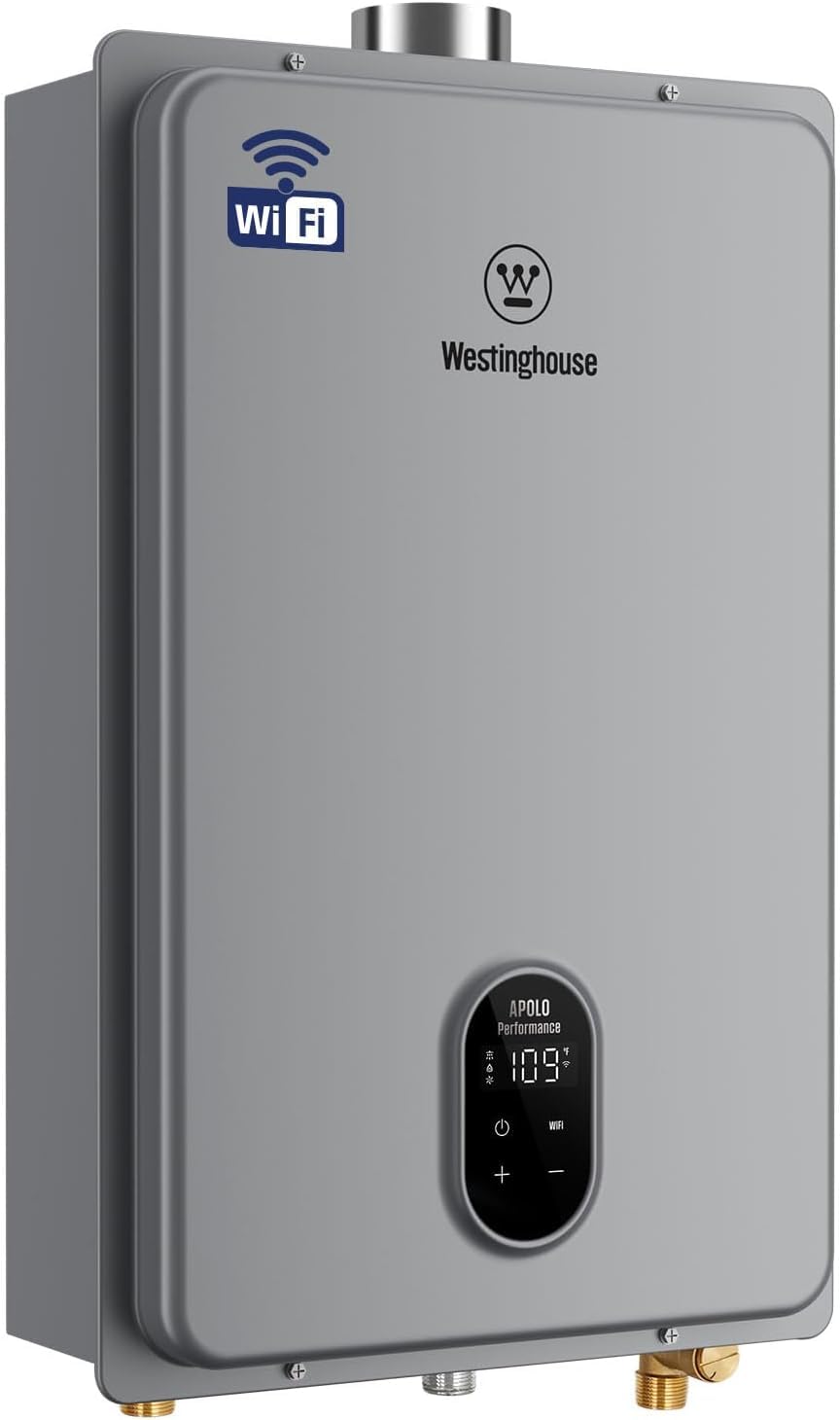
Westinghouse has thrown its hat into the ring with an aggressive, feature-packed unit that punches way above its weight class. Delivering 180,000 BTUs and 7.9 GPM, this non-condensing unit relies on advanced digital modulation. The secret weapon here is the ultra-precise water flow servo, which communicates with the logic board 20,000 times per second to physically adjust the gas valve. This results in a temperature fluctuation of less than ±1°F. No more shower shock when someone flushes a toilet downstairs.
Where Westinghouse truly shines is the user interface. While traditional units require you to walk to the basement with a flashlight to decipher blinking LED error codes, this unit boasts highly reliable smartphone app integration directly out of the box. You can dial your temperature up to 140°F for tough dishwasher loads, then drop it back to 110°F for a kid’s bath, all from your couch.
User feedback confirms that the build quality is stellar, but a critical piece of advice from a DIY reviewer stands out: “Do your homework and download the installation manual. It will help you buy what the manual suggests you should have.” Because it is non-condensing, remember that you will need Category III stainless steel venting. Another vital warning: if you live in an area that sees temperatures below 5℉ and you lose power, you must manually drain the system to prevent catastrophic freeze damage to the copper heat exchanger.
Why tech lovers want this
- Flawless App Integration: Built-in Wi-Fi allows instant temperature adjustments and error code diagnosis.
- Advanced Flow Servo: Eliminates temperature spiking, locking the heat to within ±1°F.
- Strong Output (7.9 GPM): Easily handles a large family’s morning routine with 3-5 fixtures.
- Robust Warranty: 5 years on the heat exchanger provides excellent peace of mind.
The harsh realities
- Non-condensing design requires costlier Category III stainless steel exhaust venting.
- Must be fully drained manually if the house loses power during deep freezes (below 5°F).
- Requires a solid, unwavering 120V AC power connection to keep the internal servos active.
Ideal for: Smart-home enthusiasts and medium-to-large families who want granular control over their water temps without walking down to the utility room.
4. Rinnai RX180iN Condensing Smart Sense 10.0 GPM
If the flagship 199k BTU Rinnai model feels like overkill for your home, but you desperately want the massive installation savings of PVC venting and premium Japanese engineering, the Rinnai RX180iN is your target. At 180,000 BTUs and 10.0 GPM, it is slightly scaled down from its big brother but retains the exact same industry-leading 0.98 UEF efficiency.
Because it is a Condensing unit, it wrings out so much thermal energy from the burner that the exhaust gas is cool enough to vent through standard, inexpensive Schedule 40 PVC. This is the unit you buy when you want to heavily offset a premium appliance price by saving a fortune on the venting materials. It also features the “Smart Sense” technology, meaning it detects and adjusts to either Natural Gas or Propane automatically—an incredible feature if you ever plan to move to a rural property.
User feedback from harsh alpine climates specifically highlights this unit’s winter resilience. It handles violently cold incoming groundwater with grace, ensuring that even when the flow rate has to slow down to achieve the desired temperature, the output heat is rock-solid. A crucial tip for those wanting instant hot water: if you set the unit’s recirculation pump to “always ready,” it will cycle on and off throughout the entire night. Setting it to learn your routine (or using an on-demand button) saves wear and tear on the pump and keeps your house silent at 3 AM.
Why it’s a brilliant compromise
- PVC Venting Approved: Condensing tech eliminates the need for $300+ stainless steel exhaust kits.
- Dual Fuel Capable: No complicated conversion kits if you switch from NG to LP later.
- High Cold-Weather Flow: 180k BTUs easily heats near-freezing groundwater in the Midwest.
- Quick Flush System: Makes yearly maintenance a 30-minute breeze instead of an afternoon chore.
The harsh realities
- If the recirculation pump runs 24/7, the mechanical hum can be noticeable through walls.
- Still carries a premium upfront price tag compared to non-condensing units.
- App connectivity requires the separate Control-R module, which has mixed software reviews.
Ideal for: Energy-conscious homeowners in cold climates who want elite Rinnai engineering and the cheap installation benefits of PVC venting, without paying for maxed-out BTUs.
5. Rheem RTG-84XLN-3 Non-Condensing Outdoor 8.4 GPM
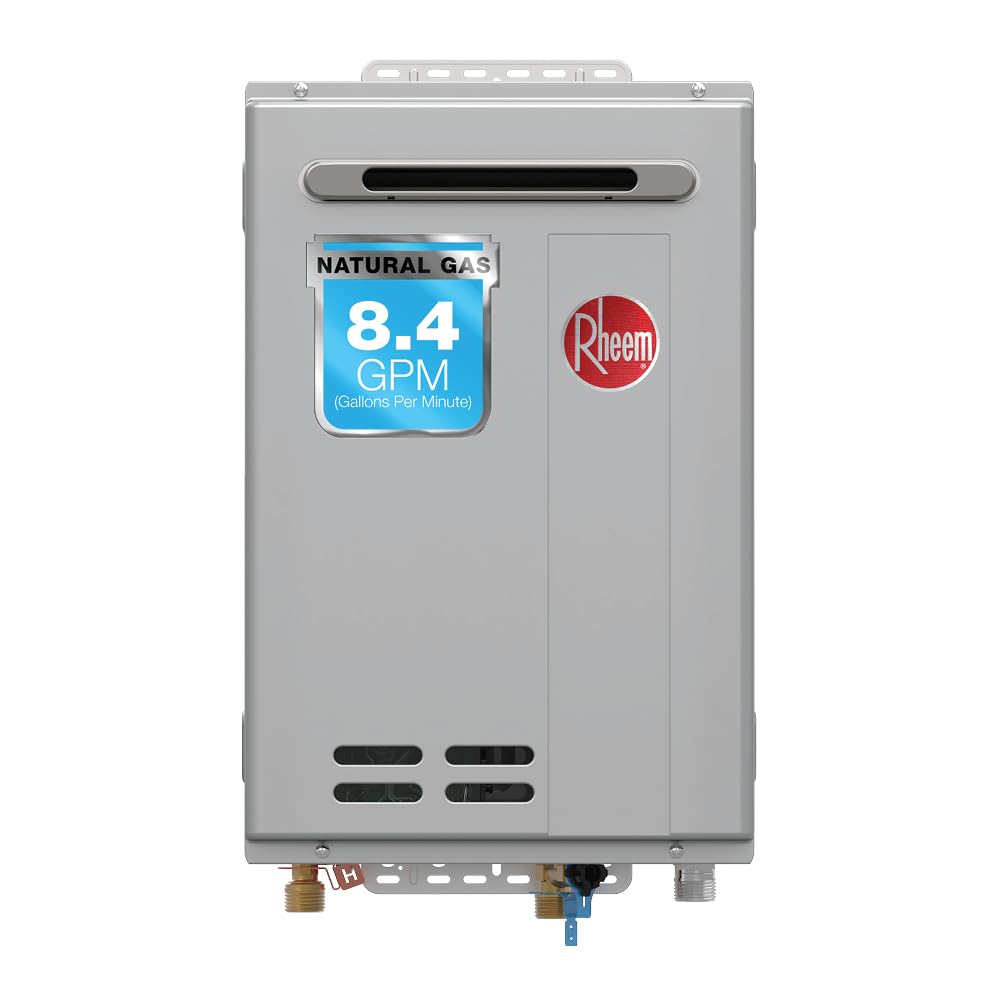
If you live in a climate where it rarely hard-freezes (think California, Texas, Florida, or the Carolinas), installing your water heater outdoors is a massive cheat code. The Rheem RTG-84XLN-3 is a non-condensing beast that mounts directly to the exterior wall of your house. The immediate benefit? You completely eliminate the need to drill massive holes in your roof or walls for exhaust venting, saving you hundreds of dollars in materials and labor. Furthermore, you gain back valuable square footage inside your home.
This model packs a massive 180,000 BTU punch, pushing 8.4 GPM. It is a workhorse explicitly designed for 3-bathroom homes. It features Rheem’s Overheat Film Wrap, which acts as a safety blanket to prevent heat exchanger damage, and utilizes “Hot Start Programming,” meaning if you turn the shower off to shave and back on again, you won’t get hit with a slug of cold water.
Installers absolutely love the 1/2-inch side-to-side clearance, meaning this unit can be tucked tightly against exterior corners or between electrical boxes. A real-world reality check: because the unit lives outside, the hot water often has a longer physical distance to travel through your pipes before reaching the master shower. To combat this water waste, many homeowners pair this exact model with an under-sink return pump that automatically shuts off once it senses hot water at the tap.
Why outdoor installs rule
- Zero Venting Costs: Because it vents straight outside, you save massive amounts of money and labor.
- High Capacity (8.4 GPM): 180,000 BTUs provides relentless hot water for large homes.
- Frees Up Indoor Space: Claim your utility closet back entirely without sacrificing performance.
- Hot Start Tech: Prevents cold water bursts during intermittent faucet use.
The harsh realities
- Only viable in mild-to-moderate climates; extreme freezing areas should avoid outdoor setups to prevent pipe bursting.
- The metal back mounting panel can feel slightly flimsy until it is firmly bolted to the wall studs.
- You must ensure outdoor water lines are heavily insulated to prevent winter pipe bursts.
Ideal for: Homeowners in warmer climates looking to save big on installation costs by moving their water heating outside the house while retaining 180k BTU performance.
6. Rheem RTG-70DVLN-3 Non-Condensing Indoor 7.0 GPM
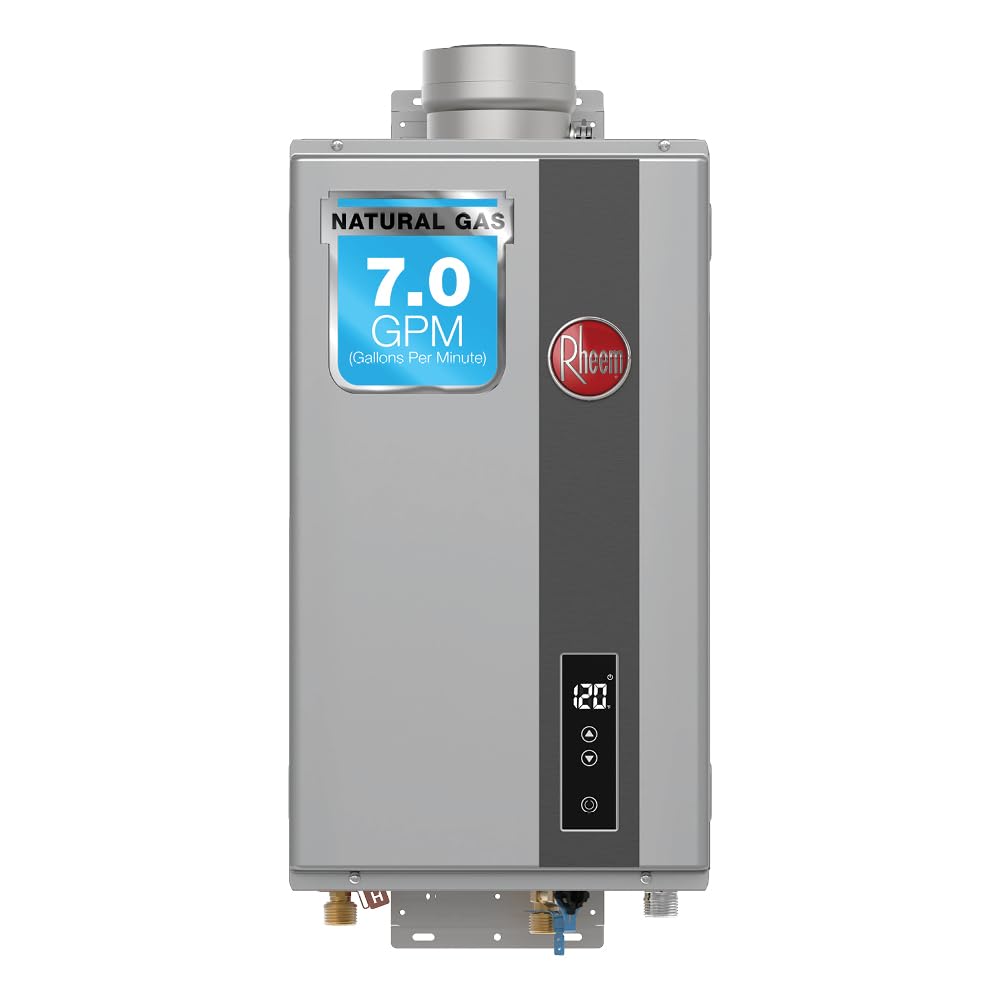
When replacing a traditional tank inside a basement or utility closet, the biggest hurdle is usually the gas line. Most old tanks run on a 1/2-inch line. Upgrading 40 feet of black iron pipe to 3/4-inch can cost thousands. The Rheem RTG-70DVLN-3 is engineered specifically to alleviate this pain. It is rated at 160,000 BTUs and 7.0 GPM, but features advanced gas-valve tech that often allows it to run perfectly on existing 1/2-inch gas lines (up to 24 feet), saving you massive retrofit headaches.
This indoor unit is an absolute workhorse for the standard 2.5 bathroom American home. It integrates LeakGuard Leak Detection, a critical feature for indoor units. If a pipe fitting ever drips inside the chassis, the unit shuts down and alerts you before your drywall is ruined. It also features the Hot Start Programming found in Rheem’s flagship models.
Real-world reviews consistently highlight how much floor space is reclaimed once the old 50-gallon metal cylinder is hauled away. Because it is non-condensing, it requires metal Category III venting, so be sure to purchase a concentric vent kit compatible with your wall thickness. One user noted it was the best peace-of-mind upgrade they made for their family, as guests could stay over without anyone running out of hot water after five consecutive showers.
Why remodelers love it
- 1/2-Inch Gas Compatible: Often eliminates the need to tear open walls to upgrade gas pipes.
- LeakGuard Technology: Unmatched peace of mind against internal water damage.
- Direct Venting: Preserves indoor air quality by drawing combustion air from outside.
- Space-Saver: Incredibly compact footprint reclaims utility room space permanently.
The harsh realities
- Requires expensive stainless steel venting due to the non-condensing design.
- 7.0 GPM might struggle if you try to run 3 showers and a washer simultaneously in cold winter states.
- Installing the concentric vent requires cutting a precise hole through your exterior wall or roof.
Ideal for: Standard 2-3 bathroom homes seeking a reliable, name-brand indoor upgrade with advanced leak protection features that avoids massive gas line upgrade fees.
7. FOGATTI 170S Series Indoor Natural Gas 7.5 GPM

FOGATTI is a brand making serious waves by offering massive performance numbers at aggressively low price points. The 170S Series boasts 170,000 BTUs and 7.5 GPM, placing it squarely in the heavyweight division, but priced like a featherweight. It utilizes a heavy-duty oxygen-free copper heat exchanger and a four-stage combustion system that dynamically scales the flame size depending on your demand, saving gas when you just need to wash your hands versus when you are filling a bathtub.
Because it is a budget powerhouse, you give up some premium polish, but the mechanicals are surprisingly sound. It operates reliably at an incredibly wide water pressure range (15 to 150 PSI), making it a lifesaver for older homes or rural areas with terrible city water pressure.
Here is an invaluable tip extracted directly from a real user review: If you install this with a 3-inch vent pipe and the unit suddenly throws an “E8” error code and shuts down mid-shower, it means the exhaust fan speed is exceeding its factory parameter. By entering the hidden service menu (unplug, replug, hold down arrow until ‘PP’, select ‘Hc’), you can raise the maximum fan speed from 74 to 95, permanently solving the issue. This level of granular control is rare at this price point, but customer service can be slow to respond, making DIY troubleshooting knowledge essential.
Why it’s a budget beast
- Massive BTU per Dollar Ratio: Unbeatable raw power (170k BTU) for the incredibly low price point.
- Low Water Pressure Friendly: Operates flawlessly even if your home pressure drops to a dismal 15 PSI.
- Active Freeze Protection: Built-in heaters protect the core if room temps drop to 5°F.
- Adjustable Service Menus: Allows tweaking of fan speeds for specific vent lengths to clear error codes.
The harsh realities
- Customer service can be notoriously slow or unresponsive compared to legacy legacy brands.
- Does not auto-restart after a power outage; you must physically push the button on the unit.
- Non-condensing, so you must factor in the high cost of stainless steel venting.
Ideal for: DIYers and homeowners on a strict budget who need the immense hot water capacity of a 170k BTU unit and are comfortable tweaking internal settings.
8. Rheem RTG-70XLN-3 Non-Condensing Outdoor 7.0 GPM
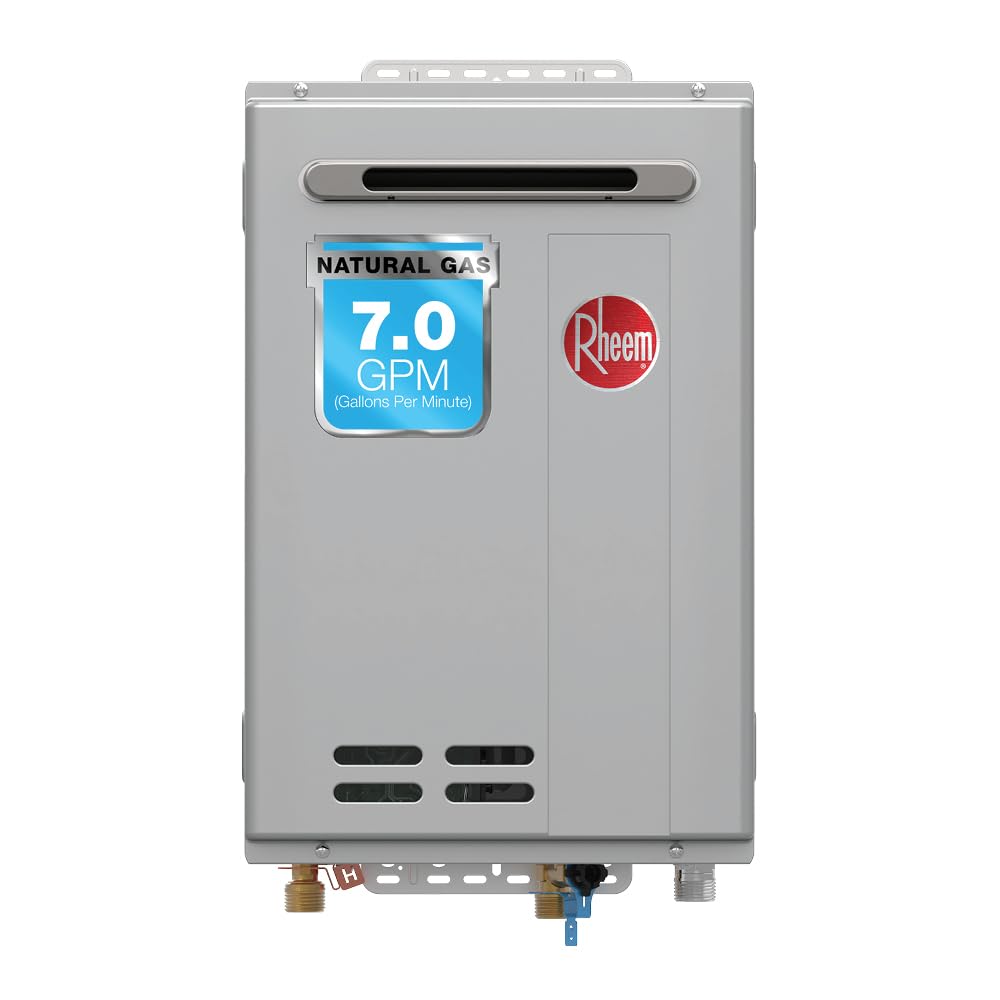
This is the outdoor twin to the indoor RTG-70 series, offering the exact same 160,000 BTU burner and 7.0 GPM capacity, but housed in a weather-resistant steel cabinet designed for exterior mounting. It hits a fantastic price-to-performance ratio for homeowners in moderate climates who want to bypass the nightmare of indoor venting entirely.
The engineering here is straightforward and robust. It relies on Rheem’s Overheat Film Wrap, which is essentially a protective thermal blanket around the heat exchanger that cuts the gas off immediately if temperatures exceed safe limits. This ensures the unit cannot destroy itself if a pipe scales up or water flow is restricted. Furthermore, it features an exceptionally low activation flow rate. Older tankless heaters required a lot of water pressure just to turn on; this unit fires up even for a trickling sink.
Reviewers frequently note that installation is shockingly fast for professionals since there is zero exhaust ducting required. However, a common tip from experienced owners is to ensure the back panel is bolted securely to a very flat, solid surface; if mounted unevenly on lap siding, the chassis can flex slightly, which might increase vibration noise during operation.
Why it’s highly rated
- Cost-Effective Exterior Install: No holes in your roof, no expensive stainless vent pipes.
- Overheat Protection: Safety film wrap protects the core components from hard water scaling damage.
- Low Activation Flow: Turns on even when you are just running a trickle of water to wash your face.
- EZ-Link Compatible: Can be wired to a second identical unit to double your capacity if your family grows.
The harsh realities
- The metal chassis back panel is slightly flimsy until fully torqued down against a flat exterior wall.
- Exposed exterior water pipes must be meticulously insulated to prevent freezing in winter.
- Will suffer significant flow drops if your groundwater is extremely cold in winter months.
Ideal for: Southern and coastal homes wanting a quick, vent-free installation from a premium brand with a low activation flow rate for standard daily use.
9. APUS Smart Wi-Fi Indoor Natural Gas 6.8 GPM
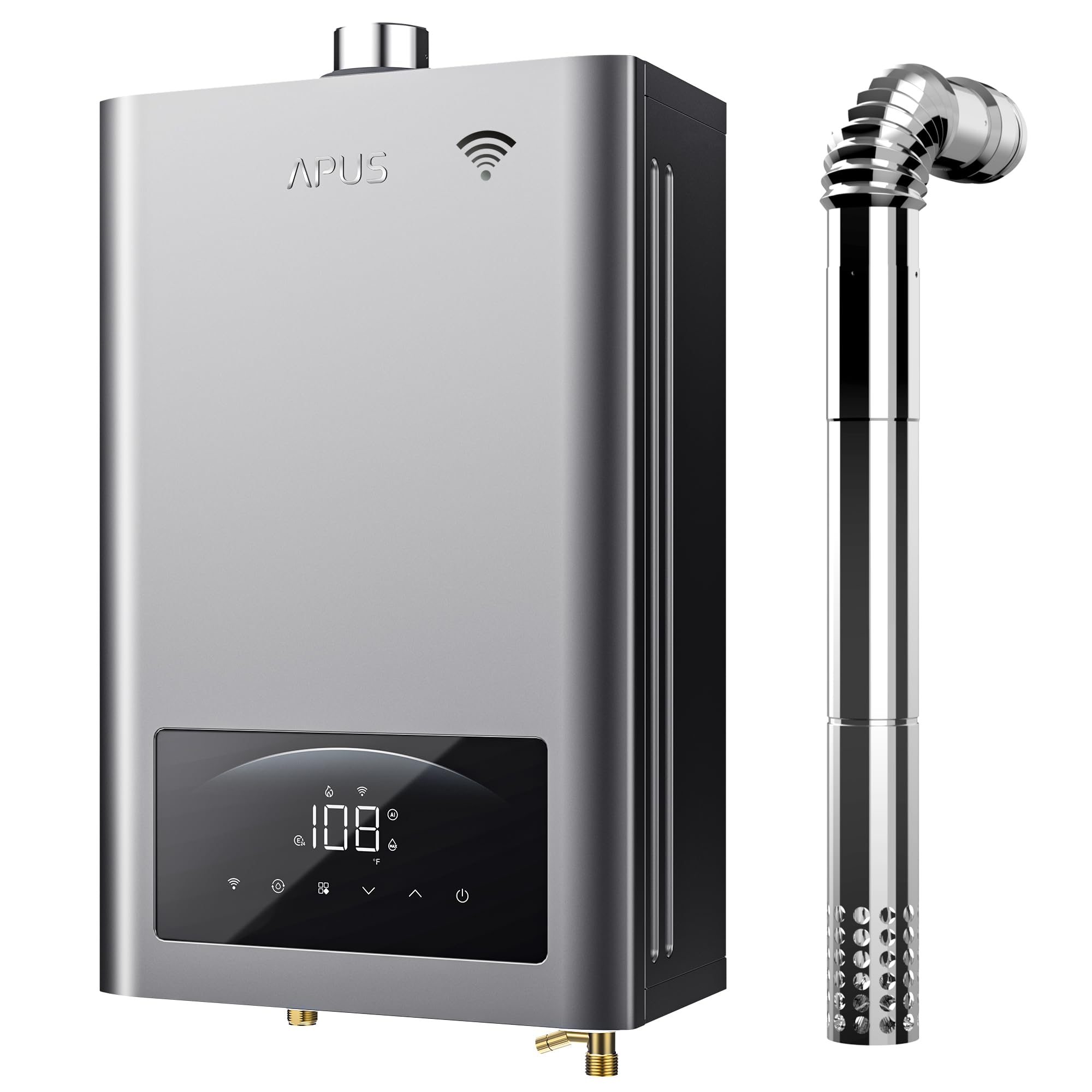
The APUS 6.8 GPM model directly attacks the biggest complaint about tankless heaters: the agonizing wait time for hot water to reach the tap. APUS engineered this unit with “Zero Cold Water Tech” via a built-in booster pump. This pump physically forces water through the lines 130% faster than standard pressure, dramatically cutting down the time you stand shivering in the shower waiting for the heat to arrive from the garage.
It also features Smart Season Comfort Mode, which automatically measures the incoming groundwater temperature and adjusts the flame output to ensure a perfect 120°F (or whatever you set it to), completely hands-free. Add in the Smart WiFi remote control, and you can literally command your heater to pre-heat the lines while you are driving home from work.
Installation Reality Check: The “Zero Cold Water” technology works best if your home has a dedicated hot water return line (or if you install a crossover valve under your furthest sink). Real users point out an important built-in safety feature: the unit has a strict 45-minute continuous run timer. If you have teenagers who take hour-long showers, or you are filling a massive hot tub, the unit will shut off exactly at the 45-minute mark. You simply turn the faucet off and back on to reset it, but it catches some users completely off guard initially!
Why the tech stands out
- Built-In Booster Pump: Aggressively pushes hot water to distant taps, practically eliminating wait times.
- Smart Season Mode: Auto-adjusts the flame based on winter/summer groundwater temps automatically.
- Smart WiFi App: Preheat your lines before you even step foot in the bathroom.
- Quiet Operation: Bottom turbo fan design is 30% quieter than standard high-pitch competitors.
The harsh realities
- 45-minute safety shutoff requires you to cycle the tap for extra-long continuous uses (like filling a hot tub).
- To get true “instant” hot water, a return line or crossover valve is required in your home’s plumbing.
- At 140,000 BTUs, it is great for 2 baths, but will struggle with 3 simultaneous heavy flows in winter.
Ideal for: Tech-lovers and busy professionals who despise waiting for hot water and want aggressive pump technology built directly into the unit.
10. MIZUDO GEN 3 Convertible Natural Gas 5.1 GPM
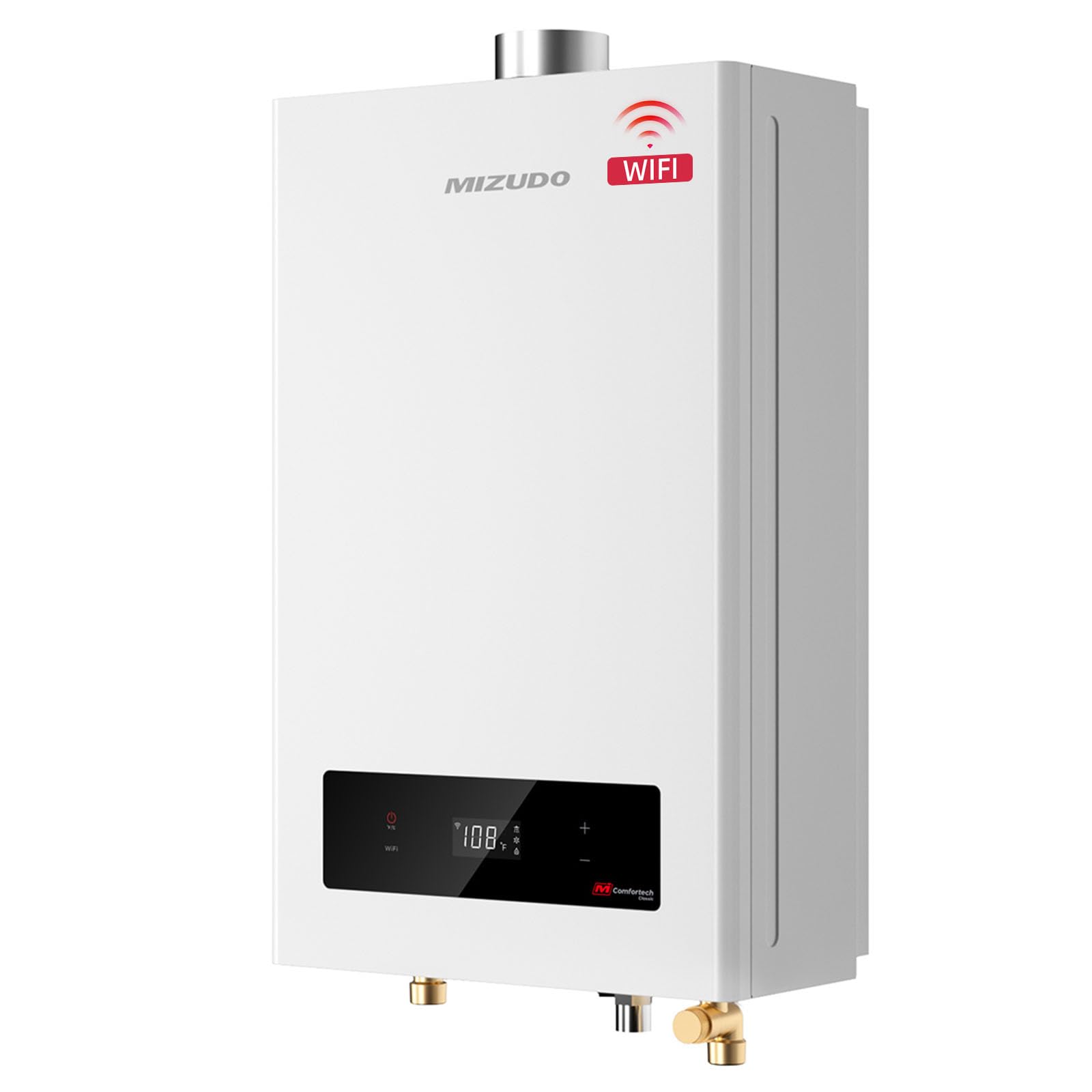
If you are torn between mounting your heater inside the utility room or outside on the wall, the MIZUDO 5.1 GPM completely removes the stress of deciding. It is a highly versatile unit that can be converted from an indoor vent setup to a purely outdoor setup simply by purchasing their specific outdoor vent cap (VP030AOS-G). This is brilliant for renovations where the final utility layout is still up in the air or for DIYers who want options.
With 120,000 BTUs, it is optimized for mid-sized homes and apartments. MIZUDO utilizes a phosphorous-deoxidized copper heat exchanger—an industrial-grade material known for surviving aggressive water conditions and preventing pinhole leaks over time. It is also an incredibly popular replacement for legacy Japanese brands; one user noted it had the exact same specs as their old $1500 unit but cost a third of the price and swapped out in 15 minutes because the pipe fittings matched perfectly.
Installation Reality Check: When installing any gas appliance, local codes matter heavily. A user shared a story where a home warranty company refused to cover a different brand because a $30 “sediment trap” (drip leg) was missing on the gas line. Always ensure your plumber installs a drip leg before the heater! For indoor use, this unit requires a 3″ OD vent pipe system. The WiFi app is a great modern touch, allowing you to monitor energy usage and receive real-time maintenance notifications before small issues become big problems.
Why it’s a smart buy
- Convertible Design: Gives you the ultimate freedom to install it indoors or outdoors depending on your changing needs.
- Industrial Copper: Phosphorous-deoxidized copper resists internal corrosion brilliantly over a decade of use.
- Direct Replacement King: Dimensions and hookups make it an incredibly easy swap for older, expensive brands.
- WiFi Monitoring: Get maintenance alerts and tweak settings without going to the basement.
The harsh realities
- Outdoor vent cap or indoor vent pipes must be purchased separately.
- 5.1 GPM is great for 2 bathrooms, but will absolutely struggle if you push it to 3 simultaneous showers.
- Grammar in the instruction manual can be a bit awkward, though the physical hookups are standard.
Ideal for: DIYers replacing an old unit who want the flexibility of choosing an indoor or outdoor setup without fully committing at the checkout screen.
11. Rinnai V53DeN Outdoor Natural Gas 5.3 GPM

If you live in a smaller home, condo, or are building an ADU (Accessory Dwelling Unit) in a warm climate, massive 199K BTU heaters are a total waste of money and resources. The Rinnai V53DeN is a masterclass in compact, efficient engineering. This outdoor unit draws a modest 81,000 BTUs to deliver 5.3 GPM of endless hot water. It is remarkably small, blending seamlessly into the exterior siding of your home without looking like an industrial eyesore.
Despite its smaller stature, it still boasts Rinnai’s legendary build quality, including an enhanced scale detection feature that warns you long before calcium buildup permanently damages the heat exchanger. The default temperature out of the box is a perfectly safe 120°F (perfect for preventing scalds with children), but a quick sequence of button presses on the control board allows you to unlock a 140°F maximum if you desire hotter water for heavy dishwashing or incredibly long pipe runs.
Installation Reality Check: User feedback reveals a very important installation reality: because it only draws 81,000 BTUs, many homeowners can actually use their existing 1/2-inch gas line without having to pay a plumber to upgrade the entire run to 3/4-inch (though you must still verify this with a manometer). One humorous (but highly dangerous) review noted a user tried to attach a 5-inch vent pipe to this outdoor unit, which caused the unit to backdraft and “blow up” internally. Always follow the manual—outdoor units do not need extra vent pipes attached to them!
Why small homes need it
- Gas Line Friendly: Low 81K BTU draw often allows use of existing 1/2-inch gas lines safely.
- Ultra Compact: Very small physical footprint; looks incredibly discreet on an exterior wall.
- Scale Detection: Smart sensors warn you when it’s time to flush the unit, extending its life massively.
- Rinnai Quality: Backed by a phenomenal 10-year heat exchanger warranty.
The harsh realities
- 5.3 GPM means you can only run one shower and maybe a sink simultaneously. Do not push it.
- Factory locked at 120°F; requires reading the manual to bypass the lock via dip switches for hotter water.
- Being an outdoor unit, it is strictly for non-freezing climates to prevent pipe bursts in winter.
Ideal for: Smaller homes, guest houses, or townhomes in warm climates that need legendary Rinnai reliability without the massive gas draw of a 199K BTU unit.
12. ThermoMate CZ422NG Indoor Natural Gas 5.0 GPM
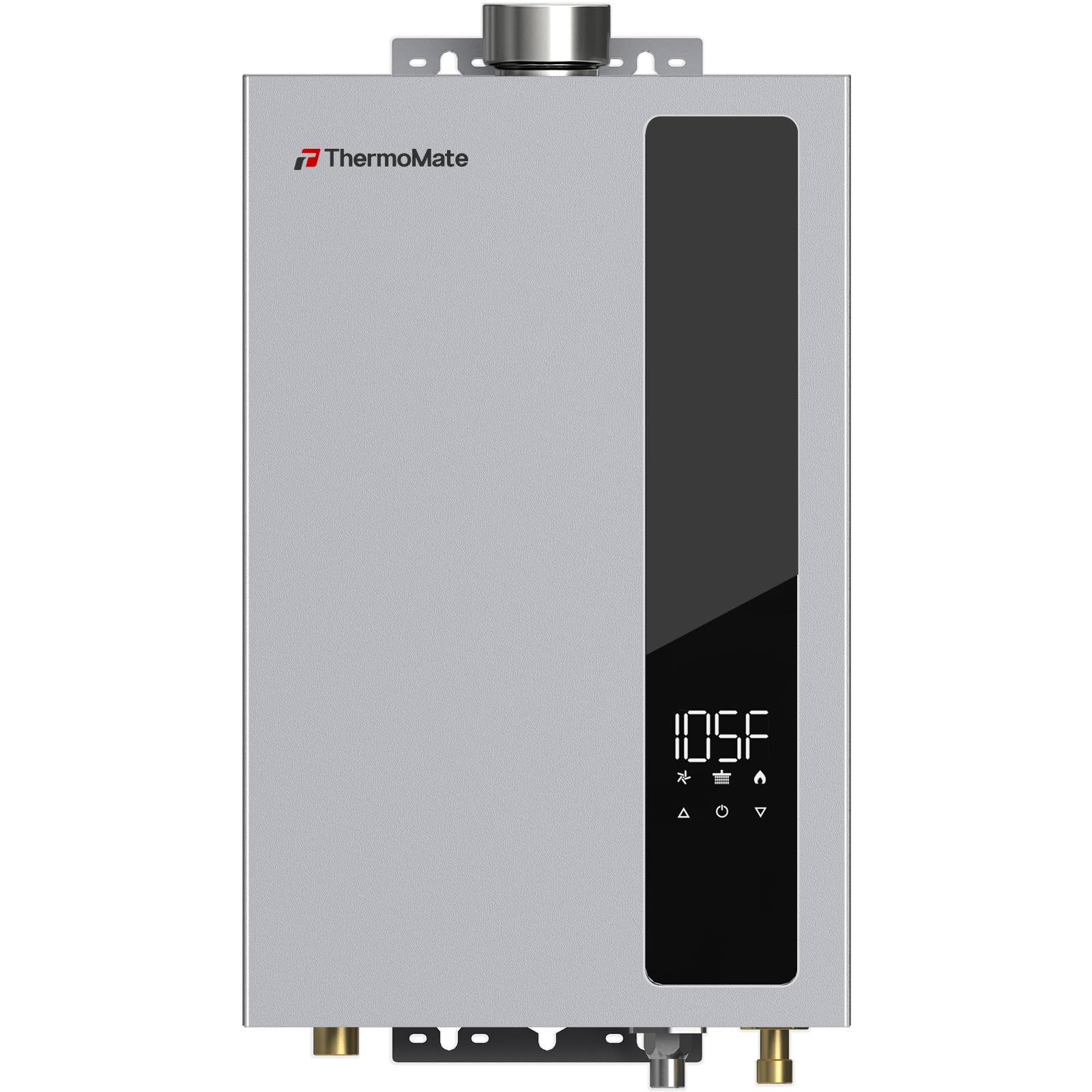
The ThermoMate CZ422NG sits perfectly in the middle of the pack for smaller homes, offering an incredible balance of efficiency and price. At 5.0 GPM and 113,000 BTUs, it is explicitly designed to run two showers simultaneously without breaking a sweat. It uses an advanced water flow sensor chip that adjusts the heating power 20,000 times per second to keep temperatures rock solid. Despite its highly affordable entry price, it utilizes an oxygen-free copper heat exchanger that achieves a shocking 98% thermal transfer efficiency.
But what makes this unit truly unique in its class is its exhaust system. It features a DC high-speed fan capable of 3000 RPM. Why does this matter? If you live in a high-wind area, a mobile home, or a coastal hurricane zone, extreme wind blowing against your exterior vent can cause a “backdraft,” literally blowing the flame out inside the heater. ThermoMate engineered this fan to withstand Category 3 hurricane winds (>111 mph), completely eliminating flameouts during severe storms.
Installation Reality Check: This unit is remarkably compact and uses a standard 1/2″ NPT gas inlet, meaning you rarely have to upgrade your home’s gas plumbing to make it work. A common observation from real users is that the large digital display might show internal temperature spikes (e.g., jumping from 113° to 134° internally as the chip calculates), but the physical water hitting your body in the shower feels perfectly stable. If you get an “E8” error code upon installation, it means you need to enter the digital menu and manually increase the fan speed parameter to match your vent length.
Why it’s highly rated
- Wind-Resistant Fan: High-speed 3000 RPM fan completely prevents backdrafts and flameouts during severe weather.
- 1/2-Inch Gas Line: Fits standard older home plumbing without expensive gas line upgrades.
- Rapid Micro-Adjustments: Chip adjusts 20,000 times/sec to prevent hot/cold flashes.
- Space Saver: Takes up 1/3 the space of a traditional 40-gallon tank.
The harsh realities
- The internal temperature display may fluctuate visually, even if water output feels stable.
- If you push it past 2 simultaneous showers, the flow rate will drop noticeably.
- Takes about 1-2 seconds longer to register flow and ignite than premium models due to safety checks.
Ideal for: Smaller homes, coastal properties, or mobile homes that need a reliable, storm-resistant heater that runs perfectly on older 1/2-inch gas lines.
13. ORBEK Indoor Natural Gas 4.3 GPM
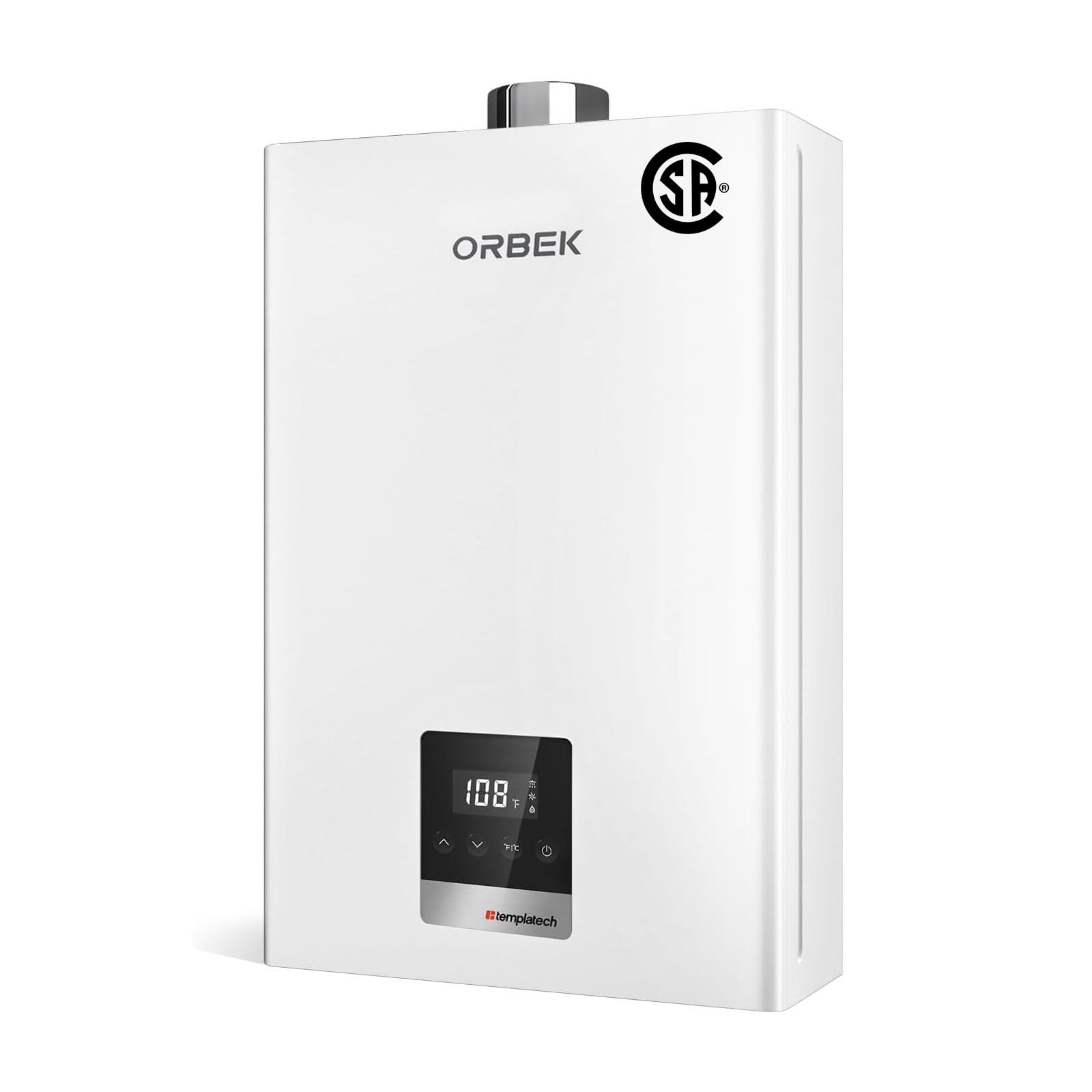
One of the most frustrating quirks of some older tankless heaters is that they require a heavy flow of water to actually trigger the burner. If you just want a tiny trickle of warm water to wash your hands or shave, older units might ignore you and stay cold. The ORBEK 4.3 GPM solves this brilliantly with an ultra-sensitive 0.53 GPM low-flow start technology. You can run a mere trickle of water, and it will still ignite and deliver consistent heat.
With 100,000 BTUs, it is a modest but mighty unit designed for apartments, small cabins, or 1-bathroom homes. The highly efficient oxygen-free copper heat exchanger ensures rapid heating. It also features a smart memory function—if the power goes out during a storm, it remembers your set temperature when the power returns, so you don’t have to stumble to the utility closet to reset the digital display.
Installation Reality Check: User feedback points out that it impressively comes equipped with 3/4″ NPT connectors, avoiding the flow restriction issues found on smaller 1/2″ units. A crucial piece of expert advice from real users: with on-demand heaters like this, set the digital thermostat to the exact temperature you want your shower to be (e.g., 110°F) and run pure hot water. If you set it to 140°F and try to mix in lots of cold water at the shower valve, the hot water flow rate drops below the 0.53 activation threshold, and the heater shuts off mid-shower!
Why it’s a brilliant small-home pick
- Low-Flow Activation: Burner triggers at just 0.53 GPM, so you don’t need to blast the faucet for hot water.
- Memory Function: Remembers your temperature settings after a total power outage.
- 3/4″ NPT Connectors: Allows for maximum water flow compared to 1/2″ water connectors on cheap units.
- Highly Stable Temps: Smart chip modulation prevents annoying temperature spikes.
The harsh realities
- If you mix too much cold water at the tap, the hot flow drops and the unit will shut off.
- 100,000 BTU / 4.3 GPM limit means it cannot support heavy, whole-house multi-tasking.
- Proper indoor exhaust venting is required, which may require structural adjustments to your walls.
Ideal for: Apartments, single-bathroom homes, and households with lower water pressure that struggle to trigger older tankless models.
14. NOVIEEX Indoor Natural Gas 4.3 GPM
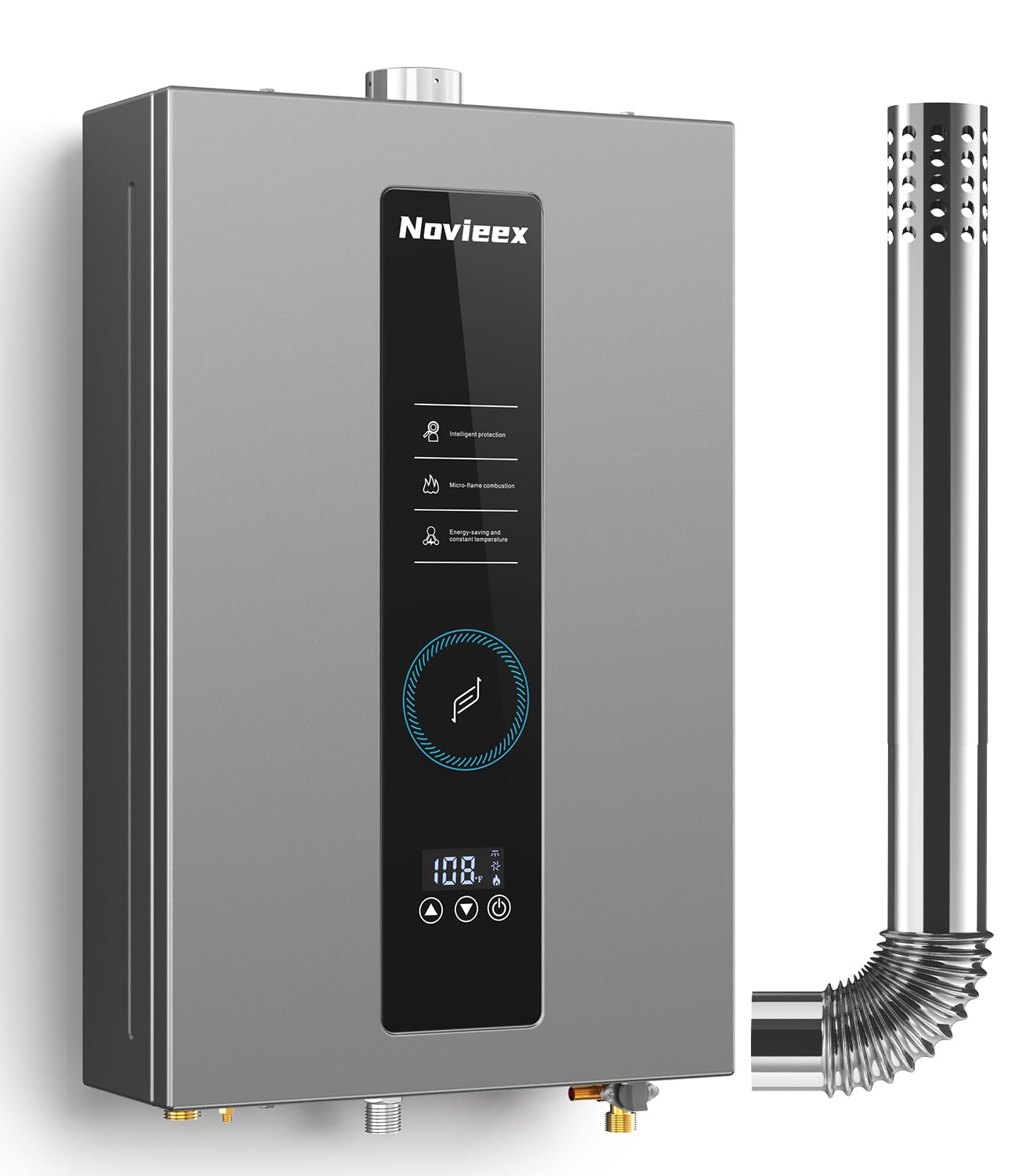
Water heaters love to die right before the holidays when plumbers charge triple the emergency rate. The NOVIEEX 4.3 GPM model is the ultimate emergency lifesaver. Priced incredibly aggressively, it allows homeowners to replace a dead tank heater quickly without taking out a small loan. Outputting 100,000 BTUs, it will comfortably run a shower and a sink at the same time in moderate climates.
Efficiency is the name of the game here. By leveraging a highly selective burner system, it adjusts the flame perfectly to the incoming water temperature, preventing the massive gas waste seen in storage tanks that constantly reheat themselves. It includes an all-around security system safeguarding against dry-firing, overheating, and freezing, making it very safe for households with small children.
Installation Reality Check: What makes this a great emergency buy for the DIYer is that it uses a standard 120V plug. It does not need to be hard-wired into your electrical panel like some older tank systems. It also comes with an exhaust pipe, saving you a frustrating trip to the hardware store for venting basics. It does use 1/2″ NPT fittings, so a slight flow restriction compared to 3/4″ plumbing is expected, and you might need reducers if your home uses wider pipes.
Why it saves the day
- Highly Affordable: One of the absolute cheapest ways to upgrade to endless hot water during an emergency.
- Standard 120V Plug: No complex electrical hardwiring required by an electrician.
- Selectional Burner: Modulates the flame for smooth, consistent water temps without wasting gas.
- Included Exhaust Pipe: Comes with the basic venting you need directly in the box.
The harsh realities
- It is a budget build; longevity past 5-7 years is a bonus rather than a guarantee.
- Uses 1/2″ connections, which can slightly limit maximum water flow compared to 3/4″ systems.
- 4.3 GPM capacity is ideal for 1-2 concurrent fixtures; definitely not suited for large houses.
Ideal for: Budget-strapped homeowners in older homes needing an immediate, highly functional replacement for a failed tank system without massive upfront costs.
15. Ranein Indoor Natural Gas 3.6 GPM

If you live by yourself, taking one shower at a time, why spend $1,500 on a massive heater? The Ranein 3.6 GPM is the ultimate ultra-budget pick for solo homeowners, small cabins, or as a dedicated point-of-use heater for a remote bathroom or workshop. Drawing just 80,000 BTUs, it absolutely sips natural gas. Many users report seeing their gas bills drop significantly in the very first month of use, effectively paying for the unit rapidly.
What makes the Ranein uniquely user-friendly is its pre-set modes on the digital LED display. Instead of guessing temperatures and constantly tapping arrows, you can select “Dish mode” (100℉), “Fruit washing mode” (95℉), “Elderly mode” (104℉), or “Infant mode” (107℉). This is a fantastic safety and convenience feature for households that just want quick, safe operation.
Installation Reality Check: It includes the exhaust pipe in the box, saving you an immediate trip to the hardware store. However, a crucial plumbing tip from successful installations: when attaching your water valves, use both Teflon tape AND Teflon pipe paste. The threads on budget units can be slightly unforgiving, and applying too much torque with a wrench can damage the connections. Critical warning: this unit is not recommended for altitudes over 2,000 feet, as the thin air will mess with the combustion mixture.
Why solo-dwellers love it
- Unbeatable Price: Pays for itself in gas savings incredibly fast compared to a tank.
- Smart Pre-sets: Convenient temperature modes for washing dishes, infants, or elderly safety.
- Exhaust Included: Saves you $50+ on venting materials right out of the box.
- Small Footprint: Takes up almost no space, making it ideal for tight laundry rooms.
The harsh realities
- Low output (3.6 GPM) means you absolutely cannot run a shower and a washer at the exact same time.
- Not recommended for installation at altitudes exceeding 2,000 feet.
- Fittings require delicate tightening; do not over-torque the water connections.
Ideal for: Single individuals, tiny homes, or small cabins that want endless hot water on a razor-thin budget.
16. Nessxa 18L Propane Indoor 4.76 GPM
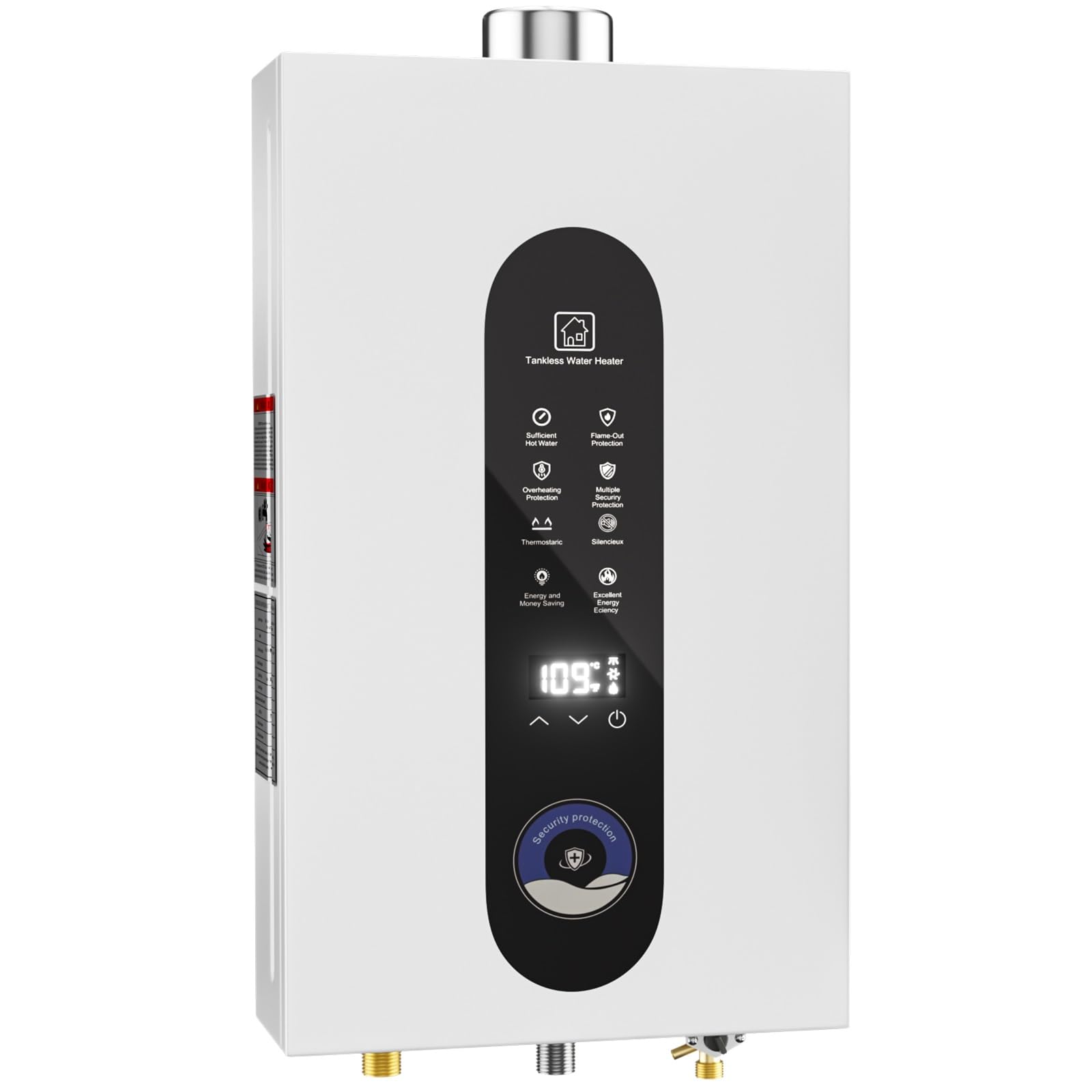
If you live off-grid, in a rural farmhouse, or run a detached workshop, natural gas is likely not an option. You need a dedicated Liquid Propane (LPG) heater. If the 68k BTUs of standard budget models isn’t quite enough muscle for your colder climate, the Nessxa steps up the game. Pumping out an incredibly specific 122,837 BTUs, it delivers a very respectable 4.76 GPM. This means it can actually raise the water temperature by 25°C rapidly, eliminating the wait time you usually experience with cheaper propane models.
Safety is paramount with indoor propane units, and the Nessxa shines here. It features an automatic overheat warning that activates if the water hits 125°F to prevent accidental scalding, making it incredibly safe for households. Furthermore, it has a 40-minute dry-burning timer. If the unit runs continuously for 40 minutes, it automatically shuts down to protect the heat exchanger from melting down. After you shut the water off, the internal fan continues to run for a few moments to cool the internal components, vastly extending the lifespan of the motherboard.
Installation Reality Check: Like many units in this price tier, it utilizes 1/2-inch water connections. If your home’s main plumbing is 3/4-inch, you will need to buy reducers at the hardware store (which takes a bit of extra plumbing work). The manufacturer requires the vent pipe to have a 3° downward slope towards the outside. Why? Because combustion creates condensation; if the pipe is angled up, acidic water will drip backward into the machine and destroy the metal housing. Angle it down so it drips outside!
Why it’s a high-output bargain
- High Propane Output: 122k BTUs delivers a solid 4.76 GPM for whole-house LPG use.
- Post-Shutdown Cooling: The fan continues to run after the water stops to cool internal components.
- Smart Safety Timers: A 40-minute auto-shutoff ensures the unit never runs uncontrollably.
- Dual Display: Easily switch between F° and C° for precise temperature monitoring.
The harsh realities
- 1/2-inch water connections require adapters if your house has 3/4-inch plumbing.
- Exhaust pipe MUST be angled 3° down to prevent acidic condensation damage.
- Manufacturer communication can be spotty for warranty claims.
Ideal for: Primary residences running on propane that need a powerful, safe, and easily monitored system with built-in overheat protections.
17. VELPAX 16L Propane Indoor 4.21 GPM
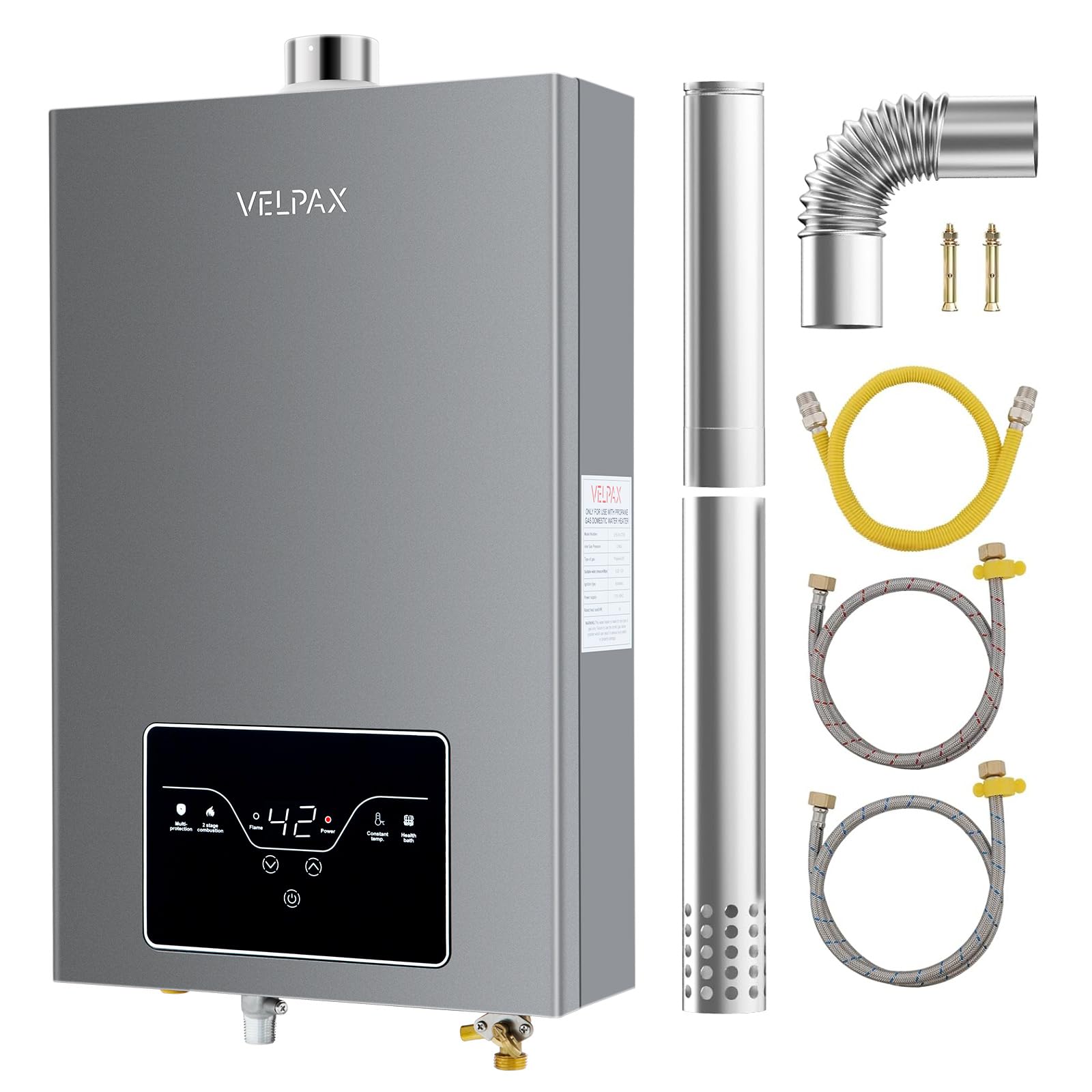
Rounding out our list is the VELPAX 16L. For rural homes, cabins, and off-grid setups running on Liquid Propane (LPG), the VELPAX is a fantastic, highly affordable solution. Operating at 68,000 BTUs, it provides on-demand hot water for 1 to 2 points of use.
What makes this unit a standout for off-grid living is that it operates on just 3.6 PSI of water pressure. If you are using a gravity-fed water system or a weak well pump, this heater will still ignite and function beautifully, whereas premium brands would throw a low-pressure error code and refuse to turn on. The build quality punches above its price class, utilizing a stainless steel body and an oxygen-free copper water tank.
Installation Reality Check: This is an indoor unit, and venting is required (it impressively includes a 2.5″ horizontal vent pipe). However, a stark warning from real-world users in freezing climates: cold winter air can travel down the exhaust stack and freeze the water resting inside the copper heat exchanger, bursting the pipes. If you install this in an unheated basement or cabin and temperatures drop below freezing, you MUST open the pressure relief valve and drain the residual water out of the unit if it sits unused.
Why it’s an off-grid hero
- Propane Powered: Perfect for rural properties with LPG tanks and no natural gas lines.
- Ultra-Low Pressure Start: Ignites with just 3.6 PSI of water pressure, perfect for well or gravity systems.
- Complete Kit: Comes with the gas pipe, water pipes, and horizontal vent pipe right out of the box.
- Durable Build: Stainless steel exterior and copper internals prevent rust and heat loss.
The harsh realities
- Highly susceptible to internal freezing from exhaust drafts; must be manually drained if left in unheated cabins in winter.
- Lower BTU output (68,000) means it will struggle to heat high-flow water in extremely cold climates.
- Ensure you have adequate ventilation; LPG exhaust requires careful routing.
Ideal for: Off-grid cabins, rural homes, and RVs running on propane that have lower water pressure from well systems and need a complete install kit.
The Harsh Reality: Installation, Venting, and Gas Lines
Upgrading to the best tankless hot water heater- gas is a phenomenal investment, but the installation is where 90% of homeowners get tripped up. Understanding exactly how these machines breathe, eat, and pump will save you thousands of dollars in plumbing mistakes. Let’s pull back the curtain on how they actually work.
The Gas Line Sizing Trap
- The 1/2-inch Myth: Many affordable heaters claim they work on a standard 1/2-inch gas line. While technically true, it only works if the distance from your gas meter to the heater is incredibly short (usually under 20 feet) and has minimal elbows.
- BTU Starvation: A standard 40-gallon tank uses 40,000 BTUs. A modern tankless can demand 199,000 BTUs. If your gas line is too small, the heater will literally suck the line dry, causing your furnace or stove to fail, and throwing an error code on the water heater.
- The Solution: Have a plumber check your gas meter capacity. You will likely need to run a dedicated 3/4-inch CSST or black iron gas pipe directly from the meter to the new heater. Factor this into your budget!
Venting: The Silent Dealbreaker
Venting is usually the most expensive part of an indoor installation. You cannot hook a tankless heater up to the old B-vent chimney from your 50-gallon tank.
- Non-Condensing (Category III): Exhaust gases are incredibly hot (over 300°F). You MUST use expensive, sealed stainless steel venting. If you use PVC, it will literally melt, release carbon monoxide, and catch your house on fire.
- Condensing (Category IV): Because the second heat exchanger absorbs the exhaust heat, the gases exiting the unit are cool (around 100°F). You can safely use cheap Schedule 40 PVC or CPVC pipe, saving you hundreds.
- Direct Vent (Concentric): A “pipe within a pipe” system. The outer pipe pulls fresh air from outside for combustion, while the inner pipe pushes exhaust out. This requires cutting only one hole in your wall!
FAQ: Buying and Living with a Tankless Gas Heater
Is a tankless water heater actually “instant”?
Will a gas tankless heater work during a power outage?
Why is my water turning cold in the middle of a shower?
What is the difference between Natural Gas and Propane models?
Can I install it myself to save money?
Final Thoughts: Choose the Best Tankless Hot Water Heater- Gas for Your Home
Transitioning to an on-demand system is one of the most satisfying home upgrades you can make. You reclaim valuable square footage, drastically reduce your monthly gas bill by eliminating standby heat loss, and most importantly, you guarantee that the last person to shower gets water just as hot as the first.
Here is the easiest way to translate this massive guide into the perfect purchase for your home:
- Want the best overall combination of high efficiency and power? Choose the Rheem RTGH-90DVLN-3 Condensing (9.0 GPM). Its condensing tech saves you a fortune on gas, and 9.0 GPM handles a busy family effortlessly.
- Need unstoppable capacity for a massive luxury home? The Rinnai RX199iN (11.1 GPM) is the dual-fuel king. It learns your routines and pushes a staggering 11.1 GPM.
- Want precise app control and zero temperature fluctuations? The Westinghouse APOLO (7.9 GPM) offers ±1°F temperature accuracy and complete smartphone app integration.
- Live in a mild climate and want a clean outdoor setup? Mount the Rheem RTG-84XLN-3 Outdoor (8.4 GPM) on the side of your house and completely bypass complex venting.
- Sick and tired of waiting for hot water to reach the tap? The APUS 6.8 GPM with its built-in booster pump and zero-cold-water tech will change how you view your morning shower.
- Replacing a tank in a small home using existing pipes? The NOVIEEX 4.3 GPM is a brilliant, highly affordable budget fix that gets the job done quickly.
- Living off-grid and running on Propane? The Nessxa 18L Propane (4.76 GPM) gives you the high propane output you need to survive winter without breaking the bank.
The true secret to a successful tankless install is understanding your home. Size the unit correctly based on your winter groundwater temperature, ensure your gas line can feed the beast, and commit to a simple yearly vinegar flush. Do that, and your new best tankless hot water heater- gas will deliver endless comfort for decades to come.