
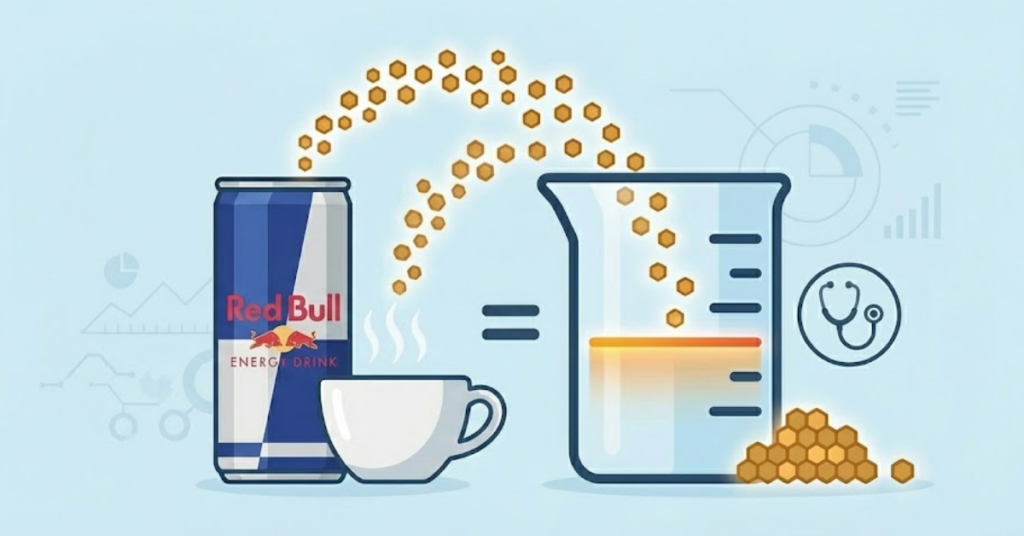
About one 8.4-oz Red Bull (80 mg caffeine) matches a small brewed coffee (~95 mg); brew strength and can size change the math.
People ask this because the two drinks feel similar, yet hit a bit differently. To answer how many red bulls equal a cup of coffee? with real numbers, we’ll anchor on labeled caffeine for Red Bull cans and typical ranges for brewed coffee, then show quick conversions you can use in the wild—at home, at a café, or at the gas station cooler.
How Many Red Bulls Equal A Cup Of Coffee? By Sizes And Brews
One small can of Red Bull (8.4 fl oz) contains 80 mg caffeine per the brand’s product info. A standard small brewed coffee (8 fl oz) lands around ~95 mg. That puts the 1:1 comparison just a touch in coffee’s favor. Scale the serving up, and the gap shifts: a 12-oz brewed coffee can push near ~140 mg, while a 12-oz Red Bull lists 114 mg. Move to 16-oz sizes and you’re often looking at ~190 mg for strong brewed coffee versus 151 mg for a 16-oz Red Bull. In short: the answer depends on the cup and the can.
Fast Equivalents You Can Trust
Use these practical rules when you’re choosing between coffee and energy drink cans on the go. The table below keeps it tight with common sizes, typical caffeine, and a “how many 8.4-oz cans” translation. It gets you from “hmm” to a clear call fast.
Caffeine Comparison And Red Bull Can Equivalents
| Drink / Serving | Approx Caffeine (mg) | Equals 8.4-oz Red Bulls |
|---|---|---|
| Brewed Coffee, 8 fl oz | ~95 | ~1.2 cans |
| Brewed Coffee, 12 fl oz | ~140 | ~1.8 cans |
| Brewed Coffee, 16 fl oz | ~190 | ~2.4 cans |
| Espresso, 1 shot (≈1 fl oz) | ~63 | ~0.8 can |
| Espresso, 2 shots | ~126 | ~1.6 cans |
| Red Bull, 8.4 fl oz | 80 | 1.0 can |
| Red Bull, 12 fl oz | 114 | ~1.4 cans |
| Red Bull, 16 fl oz | 151 | ~1.9 cans |
Those coffee values are averages; beans, grind, and brew method can swing the numbers. Red Bull’s labeled amounts are stable across cans of the same size. If you’re deciding based on caffeine alone, treat the chart as a working map, not a lab report.
Red Bull To Coffee Caffeine Equivalents (Real-World)
Let’s turn the chart into quick, plain guidance you can use when you’re choosing a drink:
- One small Red Bull vs small coffee: 80 mg vs ~95 mg. Coffee edges it. If you want the same pop as an 8-oz coffee, how many red bulls equal a cup of coffee? Roughly one small can gets you close.
- Two shots of espresso vs Red Bull small: ~126 mg vs 80 mg. Two shots pack more.
- 12-oz choices: Coffee ~140 mg vs Red Bull 114 mg. Coffee pulls ahead.
- 16-oz choices: Coffee ~190 mg vs Red Bull 151 mg. Still coffee by a margin.
Why The Numbers Vary
Coffee is an agricultural product. Bean variety, roast level, grind size, brew ratio, and contact time all move caffeine up or down. Drip coffee can be mellow or stout. Espresso can vary by basket size and recipe. Canned energy drinks lean on fixed recipes and labeled caffeine, so the variance can feel smaller.
Label Facts You Can Rely On
Red Bull publishes the caffeine for each can size. The 8.4-oz can lists 80 mg, the 12-oz can lists 114 mg, and the 16-oz can lists 151 mg. Brewed coffee isn’t labeled, so we lean on typical values shared by independent and government sources, which cluster near ~95 mg for 8 fl oz of drip coffee. You’ll see lower or higher cups in the wild, but that anchor works for most people shopping decisions.
Authoritative Sources, Linked
For official numbers and safe-use guidance, see the Red Bull caffeine amounts and the FDA’s consumer update on caffeine guidance. Both pages give clear, referenceable figures and limits you can use when you plan your day.
Pick The Right Serving For Your Goal
Sometimes the question isn’t “coffee or can?”, but “how much do I want right now?”. Use these prompts to size the pour:
If You Want A Gentle Lift
An 8.4-oz Red Bull (80 mg) or a small 8-oz drip (~95 mg) both fit. The can is consistent and portable; the coffee’s feel depends on brew strength.
If You Need A Midday Push
A 12-oz Red Bull (114 mg) is close to a strong single-serve brew pod. A 12-oz café coffee can be stronger (~140 mg). If you’re sensitive, start small and wait 20–30 minutes before adding more.
If You’re After A Bigger Hit
A 16-oz coffee can land near ~190 mg. A 16-oz Red Bull lists 151 mg. Another route is two espresso shots (~126 mg) topped with hot water (Americano) for a steady lift without milk.
Caffeine Safety At A Glance
Most healthy adults treat up to ~400 mg per day as a practical ceiling. That’s a common figure used by clinicians and U.S. regulators. Some people feel jittery at lower levels. People who are pregnant or trying to conceive usually aim lower around ~200 mg per day. Kids and teens need special caution. When in doubt, talk with a clinician who knows your health history.
What 400 mg Looks Like In Real Drinks
Here’s a simple way to see daily ceilings as cans and cups you know.
Daily Ceiling Scenarios In Cups And Cans
| Scenario | Rough Caffeine | What That Equals |
|---|---|---|
| Adult day ceiling | ~400 mg | ~5 small Red Bulls (8.4-oz) or ~4 small coffees (8-oz) |
| Pregnancy target | ~200 mg | ~2.5 small Red Bulls or ~2 small coffees |
| Two espresso shots | ~126 mg | ~1.6 small Red Bulls |
| One 12-oz Red Bull | 114 mg | Just under one 12-oz café coffee (~140 mg) |
| One 16-oz Red Bull | 151 mg | Less than a 16-oz strong drip (~190 mg) |
| “Half-caf” day | ~200 mg | One 8-oz coffee + one small Red Bull |
| Evening cutback | <100 mg | One espresso shot or a small weak brew |
How To Self-Calibrate
Your response to caffeine is personal. Two people can drink the same cup yet feel it differently. Track your sleep, midday slump, and any jitters. If you notice a wired edge, trim serving size or space your intake. Hydration, food, and timing all shape the ride.
Timing Tips That Help
- Morning only, when possible: Keep afternoons calmer by front-loading smaller servings early.
- Leave space between hits: Give each serving 20–45 minutes to peak before you add more.
- Respect bedtime: Many people benefit from a cut-off 6–8 hours before sleep.
Putting It All Together
If you’re eyeing the shelf and wondering, “How many Red Bulls equal a cup of coffee?”, think by size. A small can maps near a small drip. Larger coffees tend to outrun same-size cans. If you want repeatable results, cans win on consistency. If you like tuning strength, coffee wins on control.
Quick Reference Takeaways
- 8.4-oz Red Bull vs 8-oz coffee: ~80 mg vs ~95 mg.
- 12-oz choices: 114 mg (can) vs ~140 mg (coffee).
- 16-oz choices: 151 mg (can) vs ~190 mg (coffee).
- Daily ceiling guide: ~400 mg for most healthy adults; many pregnant people aim near ~200 mg.
Sources Used For The Numbers
Brand-posted caffeine amounts for each Red Bull can size are available here: Red Bull caffeine amounts. For overall caffeine safety and daily-limit context, see the FDA’s consumer update: FDA caffeine guidance. Typical brewed-coffee values used here (~95 mg per 8 oz) align with those resources and common clinical references.