
If you want the most “make-anything” flexibility for single pints, get the NC301; if the dream is real soft-serve swirls in cones (plus everything the classic CREAMi does), the NC701 is built for that life.
Full Technical Specs (Side-by-Side)
| Spec | Ninja CREAMi (NC301) — 7-in-1 | Ninja CREAMi Scoop & Swirl (NC701) — 13-in-1 |
|---|---|---|
| Core “job” |
Turns a fully frozen pint base into a creamy, scoopable texture via a shave + churn style process. Built for pint-by-pint variety and ingredient control. |
Everything the classic system does, plus a dispensing setup for swirled soft serve in cones/cups. Adds Swirl-mode programs designed for softer, lighter output and serving. |
| One-touch programs |
7 main programs: Ice Cream, Lite Ice Cream, Sorbet, Gelato, Milkshake, Smoothie Bowl, Mix-in + Re-Spin function for texture tuning |
13 automatic programs + 1 manual mode (machine-level spec). Programs include Classic (Ice Cream, Lite Ice Cream, Sorbet, Gelato*, Frozen Yogurt, Milkshake, Mix-in), Swirl (Soft Serve, Lite Soft Serve, Fruit Whip, Frozen Custard, Swirled Frozen Yogurt), plus CREAMiFit and Re-Spin. *Gelato availability can vary by model/version. |
| Pint capacity |
(2) 16 oz “pint” containers included Processes one pint at a time |
(2) 16 oz CREAMi 2-in-1 pints with nozzle + storage lids Processes one pint at a time; designed to dispense swirls after processing |
| Dimensions (L×W×H) | 12.07″ × 6.52″ × 15.95″ | 10.04″ × 15.16″ × 17.52″ |
| Weight | 13.6 lb | 20.8 lb |
| Power |
800W, 120V 7A (listed) |
800W, 120V 6.67A (listed) |
| Material & safety | Plastic body; BPA-free; dishwasher-safe parts (listed) | Plastic body; BPA-free; dishwasher-safe parts (listed) |
| Cord length | 31.5 in | 31.5 in |
| What’s in the box |
Motor base Creamerizer paddle Outer bowl + lid (2) 16 oz pints + storage lids Recipe inspiration guide (30 recipes listed) |
Motor base Creamerizer paddle Outer bowl + lid (2) 16 oz 2-in-1 pints (nozzle + storage lids) Dispense lid with swirl press installed |
| Warranty | 1 year (listed) | 1 year (listed) |
On smaller screens, swipe sideways to view the full table.
At A Glance: The Breakdown
Ninja NC301 CREAMi (7-in-1) — Classic Pint Machine
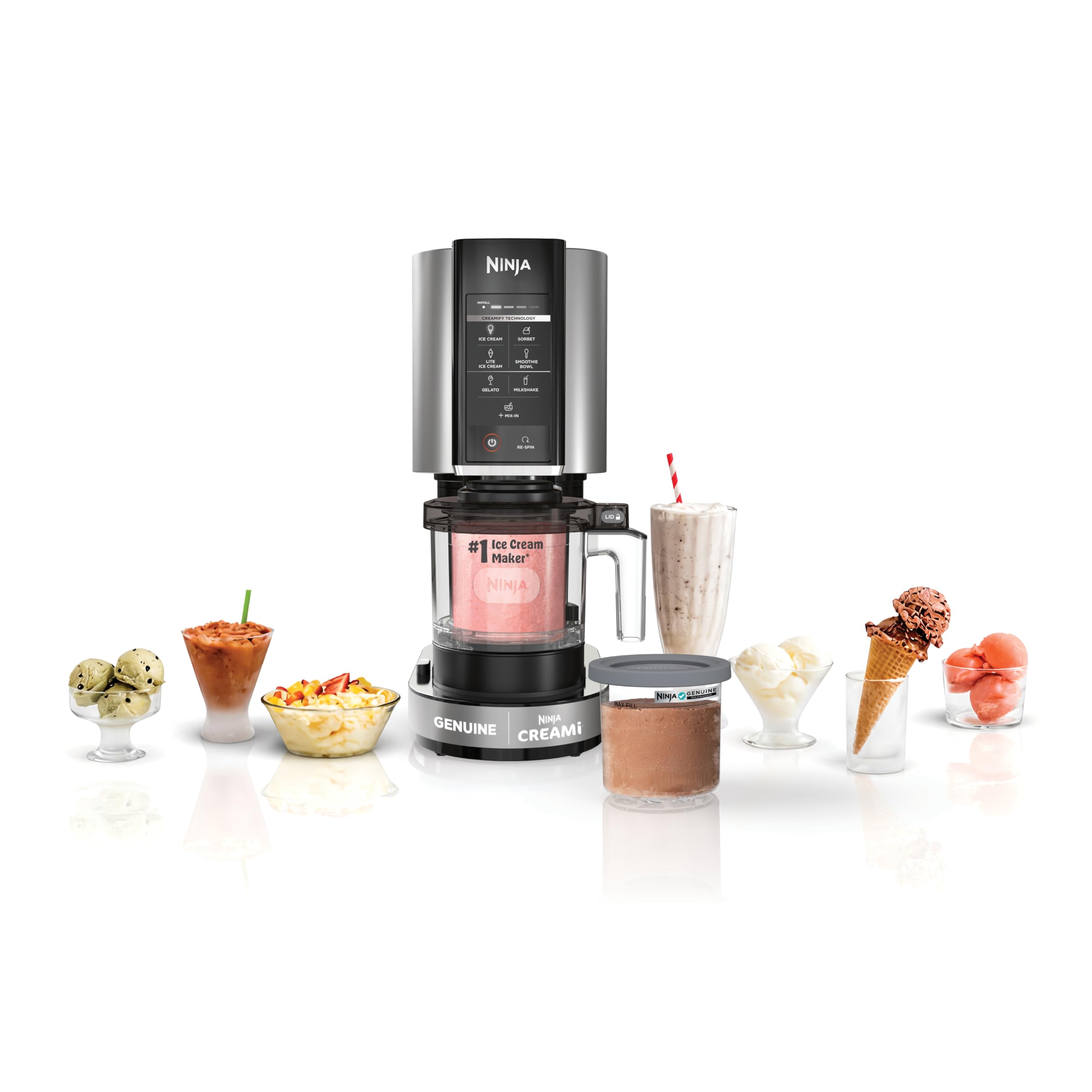
- Best For: People who want maximum recipe freedom, pint variety, and simple “spin & scoop” dessert nights
- Texture Personality: Dense-to-creamy scoopables; Re-Spin is your secret weapon for “powdery” bases
- Diet Flex: Great for high-protein, low-sugar, dairy-free, and fruit-only experiments (when the base is built right)
- Planning Reality: It rewards “prep pints in advance” people; spontaneity requires a workaround
- Noise Truth: Loud, but short cycles—more like a quick, intense appliance moment than a long churn
- Space & Storage: Small footprint on counter; pints take freezer space if you batch-prep
- The Catch: No cone swirl/dispense experience; it’s scoop-first, always
Ninja NC701 CREAMi Scoop & Swirl (13-in-1) — Soft Serve Upgrade
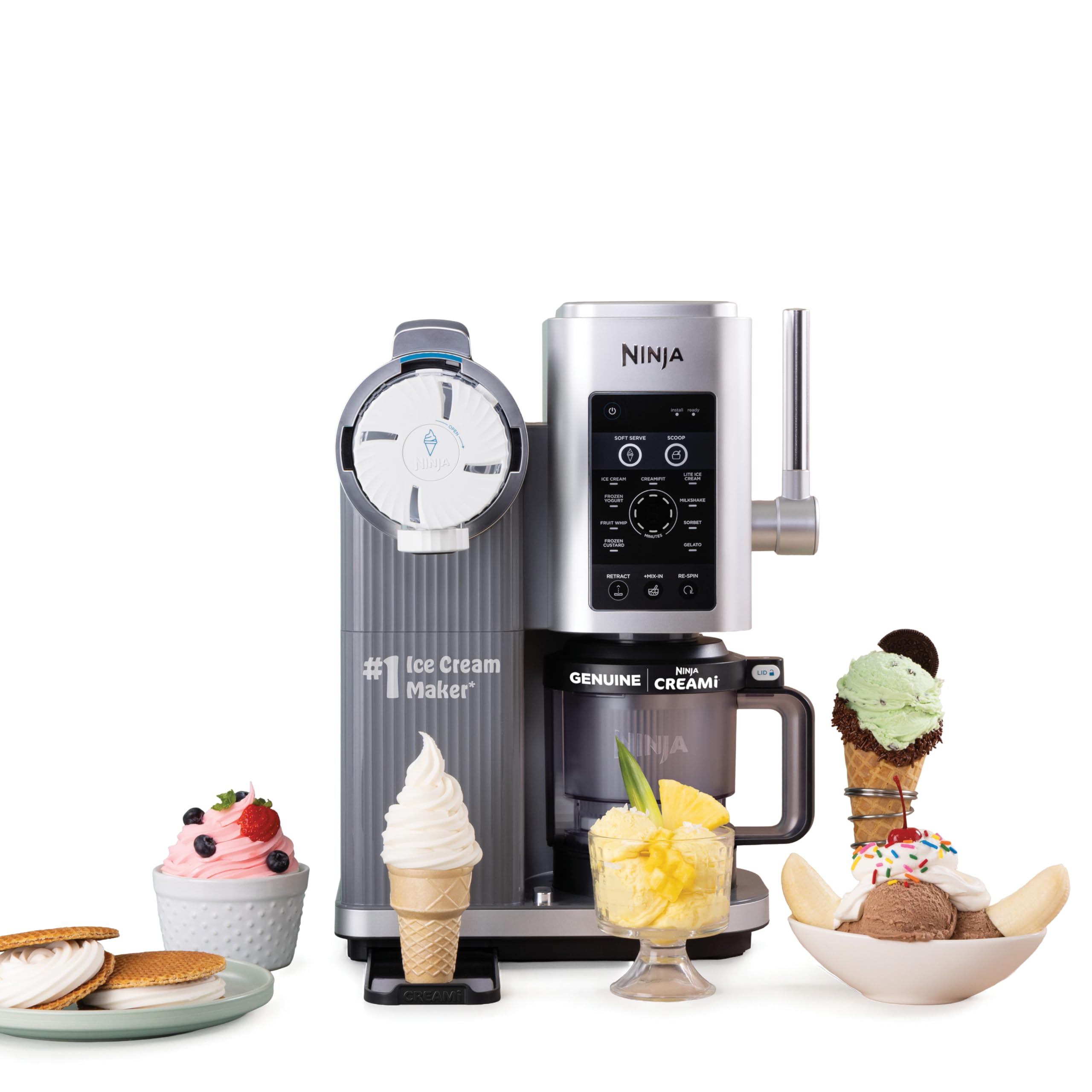
- Best For: Soft-serve people, cone nights, parties, families, and anyone who wants the “swirl handle moment”
- Texture Personality: Can do dense scoops or airy swirls depending on mode/program choice
- CreamiFit Angle: Built with a dedicated program for lower-calorie, higher-protein bases that often need extra help
- Planning Reality: Same freeze-first logic, but the payoff is faster “serve like a shop” fun
- Noise Truth: Still loud, sometimes described as vacuum/blender-level—but it’s minutes, not an hour
- Space & Weight: Noticeably bigger and heavier; not everyone wants to haul it in and out of a cabinet
- The Catch: More parts and a higher “mechanical complexity” vibe—great when you love the feature, pointless if you don’t
If you’re reading this, you’re not shopping for “an appliance.” You’re shopping for a routine. A habit. The kind of thing that either becomes a weekly ritual you love… or a bulky box you ignore after two weekends.
And because this is a comparison between two machines that look similar on paper, most guides get lazy. They’ll list the programs, say “both are customizable,” declare a winner, and call it a day. That’s not helpful. The real decision is about what happens after the novelty wears off—when it’s a random weeknight, you’ve got a craving, you’re tired, and you want dessert without turning your kitchen into a science fair.
So in this guide, I’m going to do what most reviews don’t: I’ll walk you through the behavior of these machines. What kind of bases they reward. What mistakes cause the infamous “crumbly/powdery” result. How the Re-Spin button actually changes your life. Why freezer temperature and a flat surface matter more than most people realize. And—most importantly—whether you’re actually the kind of person who will love a swirl handle… or get annoyed by it.
And yes, if you’re here for Ninja CREAMi vs Swirl Ice Cream Maker, you’re already doing the smartest thing a buyer can do: you’re trying to pick based on how you’ll use it, not how cool it looks in a 15-second video.
Quick Navigation
Ninja CREAMi vs Swirl Ice Cream Maker: The 60-Second Verdict
If you want the fastest path to the right decision, use this simple framework:
- Choose the NC301 if you want the classic CREAMi experience: pint-by-pint variety, maximum value, fewer parts, and the simplest “freeze → spin → scoop” routine.
- Choose the NC701 if soft serve is your love language: cones, swirls, party serving, and the ability to intentionally make a lighter/airier texture using Swirl-mode programs—without giving up the classic scoop options.
Now let’s go deeper—because the best pick depends less on “program count” and more on the kind of frozen treat person you are.
What You’re Really Buying: A Texture Engine + A Habit
Here’s the most important thing to understand about both machines:
Neither one “makes ice cream from scratch” in the way a compressor machine does. They don’t freeze liquid in real time. They transform a base that you’ve already frozen into a creamy texture. That’s not a downside—it’s the entire point. It’s why these machines can do things a traditional churner struggles with (like turning a rock-hard fruit base into something spoonable in minutes).
So the decision is really about which lifestyle you prefer:
- NC301 lifestyle: “I like experimenting. I want different flavors ready in the freezer. I’m happy scooping into bowls. I want fewer moving parts and a lower overall fuss factor.”
- NC701 lifestyle: “I want the cone experience. I want the drama of dispensing swirls. I host, I have kids, or I just love soft serve. I’m okay with a bigger machine if it delivers that ice-cream-shop moment.”
If you only remember one sentence from this whole article, make it this: the NC301 is the most straightforward way to live the CREAMi life; the NC701 is the CREAMi life with a soft-serve stage.
The hidden “cost” most people don’t calculate: freezer space + extra pints
Both machines are pint-based. That means the real power move is not running one pint and being done—it’s prepping multiple pints so dessert is always “ready tomorrow.” This is where a lot of owners become obsessed… and where some people quietly bounce off the product.
If you hate planning ahead, you can still enjoy these machines—but you’ll need a strategy. (I’ll show you exactly how in a minute.) If you love planning ahead, these machines feel like a cheat code: you’ll have a freezer stocked with your favorite flavors, and dessert becomes a two-minute event.
Also: yes, it’s loud… and that matters more than you think
Most owners describe both machines as loud during processing—often “blender/vacuum loud”—but for a short burst. This seems trivial until you realize when people actually want dessert: late at night, after kids are asleep, or when roommates are watching TV. If that’s your reality, you’ll want to decide now whether “loud for a few minutes” is fine… or a dealbreaker.
I’m not here to scare you—just to help you choose with eyes open. Loud is manageable. Surprise loud is annoying.
Ninja CREAMi vs Swirl Ice Cream Maker: Texture, Workflow, and the “Why”
This is where I earn your trust: I’m going to explain why the same machine can produce “silky, premium” one day and “crumbly, powdery” the next—without making you feel like you need a food science degree.
Step 1: Understand the “frozen block” rule
The CREAMi system works by shaving a fully frozen base into tiny ice particles and then whipping/churning those particles into a creamy texture. That means your starting point matters more than with many other appliances. When the base is properly frozen and properly built, the result is shockingly smooth. When the base is too cold, too dry, too low in sugar/fat, or frozen unevenly, you get the classic “crumbly” output.
Here’s the practical version:
- Fat + sugar (or alternatives) = creaminess. They lower the freezing point and reduce iciness.
- Water-heavy bases = more icy risk. Fruit-only sorbets can be amazing, but they’re less forgiving.
- Low-cal/high-protein bases need structure. Protein powders and low-fat liquids can freeze “chalky” if the recipe doesn’t include enough body.
- Flat + level matters. If a pint freezes at an angle or refreezes with a scoop-hole crater, texture suffers and you can stress the machine.
That’s why you see a pattern in experienced owner habits: they don’t just “make recipes.” They build a personal system that works for their freezer, their ingredients, and their preferred texture.
Step 2: The real magic button is Re-Spin (and it’s not optional for many recipes)
One of the biggest misunderstandings online is expecting a perfect, Instagram-soft result on the first cycle, every time, for every base. In real kitchens, lots of successful owners treat the first run like a “breakdown pass,” then use Re-Spin to finish the texture.
Think of it like this: the first spin creates the “ice cream gravel.” Re-Spin turns it into “ice cream silk.”
This matters for both models, but it matters even more if you like:
- low-fat recipes
- sugar-free or low-sugar recipes
- high-protein recipes
- fruit-only bases
- very cold freezers that freeze pints like bricks
If that list describes you, don’t fear the Re-Spin—embrace it. It’s the difference between “why is this powder?” and “how did skim milk turn creamy?”
Step 3: Why some people swear it’s “foolproof” and others return it
When someone says the machine is foolproof, what they usually mean is: it’s forgiving once you understand the rules. The core process is simple, but it’s not a blender. It won’t rescue a base that was frozen wrong or built with ingredients that freeze poorly.
When someone calls it a “glorified blender,” what they usually mean is: they expected instant frozen dessert without planning or recipe structure. And to be fair—marketing videos don’t always highlight the planning side clearly.
So here’s my honest take: if you want “dump random stuff in and get perfect ice cream,” you’ll sometimes be disappointed. If you want a machine that lets you control ingredients and create repeatable, high-quality results once you learn your winning bases, it’s genuinely addictive.
NC301 workflow: the cleanest, simplest rhythm
The NC301 wins on simplicity. It’s the classic workflow with fewer “extra moving pieces”:
- Make a base (or blend a fruit base).
- Freeze it solid (overnight to a full day is the real-world norm).
- Spin on the right program.
- Re-Spin if needed.
- Add mix-ins with the Mix-in program (after you’ve created a hole, not before freezing chunky chaos).
That’s it. And because it’s scoop-first, you’re not worrying about “cone-worthiness.” You’re aiming for a texture that feels great in a bowl—and bowls are forgiving.
NC701 workflow: you’re choosing between “Classic” and “Swirl” personality
The NC701 introduces a new decision: do you want your output denser and scoopable, or softer and swirlable?
That’s not just marketing. The NC701’s guide explicitly frames Classic-mode output as harder/denser and Swirl-mode output as softer/lighter depending on the program selection. In practice, that means you can aim for two different experiences from the same base:
- Classic mode: closer to traditional scoop texture, great for bowls, sundaes, and “pint in the freezer” habits.
- Swirl mode: built for dispensing, cones, and that airy “soft serve” feel.
But here’s the thing most people won’t tell you: the swirl experience isn’t just about the handle. It’s about timing and melt rate. Soft serve is meant to be eaten immediately. If you want “hard scoop that sits on the counter while you chat,” swirl-style output can feel too soft. If you want “fresh swirl that feels like a treat,” it’s a blast.
Recipe realism: what actually produces “wow” texture
I’m going to give you a high-value mental model here—one you can use with either machine.
There are three main base families:
- Indulgent dairy bases: naturally creamy, easiest to nail, most “premium store-bought” vibe.
- Structured “healthy” bases: lower sugar/fat or higher protein; can be amazing but often needs a stabilizing strategy (ingredient structure + Re-Spin).
- Fruit-forward bases: can be magical (think “Dole whip-ish” vibes), but sensitive to freezer temp and water content.
Most of the negative experiences I see cluster around structured healthy bases and fruit-only bases. Not because the machines can’t do them, but because those bases freeze more aggressively and need either (a) a smart recipe or (b) a Re-Spin mindset.
The “crumbly/powdery” problem: the real causes and the fixes that actually work
Let’s be blunt: if you’re buying either of these machines for high-protein, low-calorie, or sugar-substitute recipes, you will likely see a crumbly first spin sometimes. That doesn’t mean the machine failed. It usually means your base is freezing harder than an indulgent base would.
Common causes:
- Freezer too cold: a super-cold freezer can turn low-fat bases into “frozen sand.”
- Not enough dissolved solids: fat, sugar, fiber, and certain stabilizers help reduce iciness.
- Uneven freeze: angle-freezing or refreezing with an uneven surface can cause weird texture zones.
- Expecting “one spin perfection”: some recipes want two passes.
Fixes that consistently show up in successful owner routines:
- Re-Spin (often after scraping down the sides): this is the main fix, not a “hack.”
- Add a tiny splash of liquid before the second pass (for certain bases): especially protein mixes that freeze chalky.
- Let the pint sit for a short rest (for very cold freezers): not to melt it, just to take the edge off “deep freeze.”
- Use recipes that were designed for the machine: these products reward proportion and structure.
And here’s the expert-level truth: cold mutes sweetness. That’s why some people feel like their homemade bases taste less sweet than expected once frozen and processed. It’s not “you messed up.” It’s how your tongue works at very low temperatures. So a base that tastes “perfectly sweet” as a liquid can taste less sweet when it becomes a frozen dessert. This is why experienced users often adjust sweetness intentionally over time.
Mix-ins: when to add them (and why timing matters)
Both machines can do mix-ins, but you’ll have a better experience if you think like an ice cream shop:
Make the base creamy first. Then fold in chunks.
If you freeze big chunks inside your base and expect the machine to “blend them down,” you’re pushing it into blender territory. These machines are designed to process a frozen base—not pulverize a bag of frozen fruit like a smoothie.
The best mix-in strategy is simple:
- Process your base.
- Create a hole in the center.
- Add chopped mix-ins.
- Run Mix-in (or a short follow-up cycle if needed).
That’s how you keep Oreos chunky, chocolate chips intact, and candy from turning into dust.
Soft-Serve Reality Check: Is the Swirl Experience Worth It?
This is the part where the NC701 either becomes the most fun appliance in your kitchen… or the most unnecessary.
What “soft serve at home” really means
Soft serve isn’t just “ice cream, but softer.” It’s an experience: lighter texture, faster melt, and a serving ritual (cones, cups, swirls). The NC701 is built to deliver that ritual with specific Swirl programs and a dispensing setup.
But soft serve comes with natural constraints:
- It’s meant to be served and eaten right away. It’s not a “let it sit while everyone takes photos” dessert.
- It can feel “too soft” if you expected scoop firmness. That’s a preference mismatch, not a product failure.
- Recipes matter even more. A base that’s perfect in a bowl can feel too melty in a cone if it lacks structure.
So when people say “the swirl handle is a gimmick,” what they usually mean is: they didn’t actually crave soft serve in their daily life. They just liked the idea of it.
When people say “this is the most fun kitchen purchase I’ve made,” what they usually mean is: they love the ritual, they use it with family, and the swirl moment feels like a reward.
The portion-size truth (and why it can surprise people)
The NC701 uses 16 oz pints, and when you’re dispensing into cones, that 16 oz can feel like it goes faster than you expect—especially if you’re serving multiple people. A bowl can stretch a pint because everyone portions naturally. Cones make it easy to dispense generously, and suddenly you’re thinking, “Wait… that was only one pint?”
This is why extra pints become a practical add-on for a lot of households. If you’re buying the Swirl for entertaining, assume you’ll want multiple pints prepped and ready so you’re not stuck with a “freeze bottleneck.”
The best use-case for Swirl isn’t daily—it’s social
Here’s where the NC701 shines in a way the NC301 can’t: it turns dessert into an event. Kids love it. Guests love it. Even adults who “don’t need dessert” suddenly want to try a swirl.
If your ideal night is “quiet bowl on the couch,” the swirl feature might not matter. If your ideal night is “we’re making cones,” the swirl feature becomes the whole point.
The sneaky advantage: it can also make classic scoops
Some people assume the NC701 is only worth buying if you will swirl constantly. That’s not quite true. The NC701 still includes classic-style programs, so you can absolutely live in “scoop mode” most of the time and swirl when you feel like it.
So the real question becomes: are you okay paying more, giving more counter space, and managing a more complex machine… for a feature you’ll use sometimes?
If the answer is “yes, because soft serve makes me happy,” that’s a great reason.
Noise, Cleaning, and the Long-Term “Will I Use This?” Factor
Noise: short, intense, and predictable (once you accept it)
Both models are frequently described as loud, and the sound can be startling the first few times because it’s a powerful process: a motor driving a paddle through a frozen base. The good news is that cycles are short compared to traditional churners.
My practical advice: treat it like a blender moment. If you live with sleeping kids or noise-sensitive roommates, plan your spins earlier in the evening. If you live alone or don’t mind a few minutes of noise, it’s a non-issue after the first week.
Cleaning: NC301 is simpler; NC701 has more parts to love (or hate)
If you care about “friction,” cleaning matters. The difference is straightforward:
- NC301: you mainly clean the pint, lid, and paddle. It’s a manageable routine if you rinse right after use.
- NC701: you’re adding dispensing components (swirl press/dispense lid, drip tray). It can still be easy—but there’s simply more to rinse, inspect, and dry.
The biggest cleaning mistake people make is letting sweet dairy residue dry inside grooves and gaskets. Rinse immediately, and your life is easy. Wait “until later,” and you’ll understand why some reviewers say cleaning is a chore.
Counter space and cabinet reality
The NC301 is compact enough that many people happily keep it out or store it without drama. The NC701 is larger and heavier. That doesn’t mean it’s “too big”—it means it’s less likely you’ll want to haul it in and out daily.
Here’s my rule: if an appliance is annoying to put away, you either leave it out or you stop using it. So if your kitchen is already tight, the NC301 is naturally the easier long-term relationship. If you have a dedicated spot and you want soft serve, the NC701 earns its footprint.
Who Should Buy Which? Real-Life Matchups
1) The “I want healthy protein ice cream nightly” person
Either can work—but your satisfaction comes down to your willingness to dial in a base. High-protein recipes can be incredible, but they’re also the ones most likely to need Re-Spin (and sometimes a splash of liquid).
My lean: if protein is the primary mission and you love the idea of a dedicated program that targets lower-calorie, higher-protein bases, the NC701 becomes attractive. If you just want the simplest path to repeatable pints and don’t care about dispensing, the NC301 is the cleaner, cheaper path.
2) Families with kids who want the “cone night” ritual
This is where the NC701 is in its element. The swirl handle turns dessert into a moment. If you host, entertain, or want a fun activity that ends in a treat, the Swirl feature is not a gimmick—it’s the reason to buy the machine.
3) The “I want fruit-only sorbets and clean ingredients” person
Both machines can do fruit-forward bases beautifully, but fruit-only recipes can be more sensitive to freezer temp and often benefit from a second pass. If you love the idea of one-ingredient fruit sorbet, you’ll likely love either machine—as long as you accept the machine is a processor, not a blender.
4) The “I hate clutter and appliances on my counter” person
Go NC301. The NC701 can be worth it, but it’s larger and heavier. If you already know you won’t leave it out, choose the one that feels easiest to store and retrieve—because convenience determines usage.
5) The “I want store-bought convenience with homemade flexibility” person
This is a sneaky use-case: some people love using store-bought bases and customizing with mix-ins or turning them into milkshakes. Both machines support that lifestyle. If you want to take store-bought ice cream and create a soft-serve serving moment in a cone, that’s where the NC701 adds real value.
6) The “I’m sensitive to noise” person
Neither machine is whisper-quiet. The best strategy is scheduling: run it earlier, run it in a laundry room/pantry, or accept it as a short burst. If noise is a hard “no,” you might be happier with a different style of dessert-making (or a quieter appliance category entirely).
The Mistakes That Cause Regret (And How to Avoid Them)
Mistake #1: Buying for spontaneity
If you want dessert right now with no planning, these machines will frustrate you. They reward preparation. The “fix” is simple: keep multiple bases frozen so dessert is always ready to process. When you do that, it feels like instant gratification. When you don’t, it feels like waiting.
Mistake #2: Freezing at an angle or refreezing unevenly
These machines want a flat, level surface on the pint. Uneven freezing isn’t just a texture problem—it can create a rougher processing cycle. Treat your freezer shelf like part of the machine: level is love.
Mistake #3: Treating it like a blender
If you want smoothies, use a blender. If you want creamy frozen dessert from a frozen base, use this. When you treat it like a blender (big chunks, loose hard ingredients), you’re asking it to do the wrong job. That’s where people get frustration and sometimes mechanical issues.
Mistake #4: Expecting one-spin perfection for every “healthy” base
This is the number one reason people call it overhyped. Many healthy bases need Re-Spin. Once you accept that, the machine becomes consistent and satisfying.
So… Which One Should You Actually Buy?
I’m going to give you the clearest version of my recommendation, based on what actually produces long-term happiness—not what looks cool in a product listing.
Choose the NC301 if you want:
- The cleanest learning curve: fewer parts, fewer decisions, easiest daily routine.
- The best “value-to-joy” ratio: the classic CREAMi experience without paying extra for soft-serve hardware.
- Maximum pint variety: you want multiple flavors, often, with a simple scoop format.
- Less counter drama: smaller footprint, easier to live with in normal kitchens.
Choose the NC701 if you want:
- Soft serve as a feature, not a bonus: cones, swirls, party serving, and a more “ice cream shop” moment.
- Dual personality: dense scoops or airy swirls depending on how you run it.
- A household ritual: you want it to be fun, interactive, and family-friendly.
- You’re okay with bigger + pricier: you’re paying for the swirl experience and the extra system complexity.
And here’s the tie-breaker question that makes the decision obvious for most people:
Would you be happier eating from a bowl every time… or would you feel a little disappointed if you couldn’t swirl a cone when the mood hits?
Answer that honestly, and the winner usually becomes clear.
Because in the end, the best machine isn’t the one with more programs—it’s the one you’ll actually use when real life is busy. And that’s the real answer in the Ninja CREAMi vs Swirl Ice Cream Maker decision.
My Honest Recommendation
If you want the most straightforward path to incredible pint-based frozen treats with the least fuss, I’d lean toward the Ninja CREAMi NC301. It’s the classic “smart buy” because it’s simpler to live with, easier to store, and still delivers that shockingly creamy texture once you learn your favorite bases.
But if you know you’ll genuinely use the soft-serve swirl experience—cones, parties, family nights, and that ice-cream-shop feeling at home—the Ninja CREAMi Scoop & Swirl NC701 is the more joyful splurge. It’s bigger and more complex, yes—but when you actually love soft serve, it turns dessert into an event.