
A perfectly seasoned griddle surface isn’t a luxury — it’s the difference between eggs that slide off effortlessly and a sticky, rust-prone mess that ruins breakfast. The wrong oil leaves behind a gummy residue or burns into a brittle layer that flakes onto your food. You need a formulation that polymerizes evenly, resists high heat without smoking, and bonds to the metal pores for a durable, nonstick finish.
I’m Mohammad Maruf — the founder and writer behind Drink4Good. I analyze market data and third-party testing to identify which oils, wax blends, and hybrid conditioners deliver a true seasoning layer without the guesswork or trial-and-error.
Whether you’re restoring a vintage skillet or maintaining a flat-top griddle, the best griddle seasoning uses a high smoke point and clean polymerization to create a slick, protective barrier that lasts through dozens of cooks.
How To Choose The Best Griddle Seasoning
Not every bottle labeled “seasoning oil” performs the same way on a flat-top griddle. You need to look beyond marketing claims and focus on the chemistry of how the oil bonds to the metal under high heat.
Smoke Point and Polymerization Threshold
The smoke point of an oil determines how much heat it can endure before breaking down into carbon. For griddle seasoning, you want an oil that smokes above 450°F so it polymerizes — turning from a liquid into a hard, plastic-like film — instead of burning off. Safflower, avocado, and refined coconut oils hit this range reliably.
Ingredient Purity and Additives
Pure, single-ingredient oils leave the least residue and produce the most even seasoning layers. Blends that include petroleum distillates, silicones, or synthetic waxes can leave a sticky film or create an off-flavor on your next cook. Look for 100% food-grade plant oils or blends that use natural waxes like beeswax or rice bran wax to thicken the application without introducing chemicals.
Application Format: Liquid vs. Wax
Liquid oils are easy to spread thinly and penetrate deep into the metal pores, but they can drip and pool if you over-apply. Wax-based seasonings — often sold in tins or as a thick balm — let you control the layer more precisely and tend to polymerize into a harder, more scratch-resistant finish. Your choice depends on whether you prioritize convenience (liquid) or long-term durability (wax).
Quick Comparison
On smaller screens, swipe sideways to see the full table.
| Model | Category | Best For | Key Spec | Amazon |
|---|---|---|---|---|
| Crisbee Cream Iron | Wax-Based | Durable nonstick layering | Non-GMO Sunflower Oil + Beeswax | Amazon |
| Heritage Products | Pure Oil | Low-smoke high-heat griddles | Avocado Oil, Smoke Point 520°F | Amazon |
| CLARK’S Premium Oil | Pure Oil | Everyday maintenance & rust prevention | Refined Coconut Oil, 12 oz | Amazon |
| CARON & DOUCET | Hybrid Wax | Seasoning + conditioning in one step | Canola + Grapeseed + Rice Bran Wax | Amazon |
| WALRUS OIL | Pure Oil | Budget-friendly high-smoke seasoning | Safflower Oil, Smoke Point 450-500°F | Amazon |
In‑Depth Reviews
1. Crisbee Cream Iron Cast Iron and Carbon Steel Seasoning

Crisbee’s Cream Iron seasoning uses Non-GMO Sunflower Oil blended with beeswax to create a thick, spreadable balm that deposits a controlled, even layer on cast iron and carbon steel. Unlike thin liquid oils that can pool in corners, this wax-based formula lets you target exactly where the seasoning goes. The beeswax raises the melting point, so the coating doesn’t drip off vertical pan walls during the oven-cure process. Users consistently report a glass-like surface after just two or three coats, even on rusty vintage pans restored from the 1950s.
The polymerized finish from Crisbee is notably harder and more scratch-resistant than standard oil-only seasonings. When applied to a hot pan and then baked, the sunflower oil cross-links into a dense film that withstands metal spatulas and frequent scrubbing without flaking. Many reviewers mention that after a few weeks of daily use, the pan actually becomes more nonstick, not less. The 6-ounce tin provides enough material for initial seasoning plus many months of touch-ups.
A small drawback is that the balm must be applied to a warm surface to spread evenly — cold cast iron will cause it to clump. Also, the solid format takes slightly more effort to dip and spread than a squeeze bottle. But for anyone who wants a hard, long-lasting seasoning that doesn’t smoke during cooking, the extra step is worth it.
Why it’s great
- Beeswax base prevents dripping and pooling
- Produces a glass-hard, scratch-resistant finish
- Excellent for both initial seasoning and daily upkeep
Good to know
- Requires a warm pan to spread evenly
- Solid balm format less convenient than a liquid bottle
2. Heritage Products Cast Iron Seasoning Oil

Heritage Products leverages refined avocado oil as its sole base, which gives it one of the highest smoke points in this roundup — around 520°F. This means you can crank your griddle to searing temperatures without the oil smoking out your kitchen or leaving a burned carbon crust. The formula is labeled as low-smoke and solvent-free, making it an excellent choice for seasoning large flat-top griddles where ventilation may be limited. Users who restored a flooded Blackstone griddle reported that this oil brought the rusty surface back to a working nonstick state in a single afternoon.
Because avocado oil is monounsaturated, it polymerizes into a flexible seasoning layer that resists flaking under thermal expansion. Unlike polyunsaturated oils like flaxseed that can become brittle, this seasoning moves with the metal as it heats and cools. The non-rancid formula is a major practical advantage — a bottle can sit in your pantry for months without developing that stale oil smell. Reviewers note that it leaves zero sticky residue and does not impart any flavor to subsequent cooks.
The packaging is a standard squeeze bottle with a flip-top cap. A few users received units where the cap was not fully sealed during shipping, causing minor leakage. The bottle design could also benefit from a smaller nozzle tip for more precise application on small skillets.
Why it’s great
- Very high smoke point minimizes smoke and carbon buildup
- Flexible seasoning layer resists flaking from heat cycles
- Non-rancid formula stores well without spoiling
Good to know
- Bottle cap can loosen during shipping
- No nozzle tip for precise application
3. CLARK’S Cast Iron Seasoning Oil
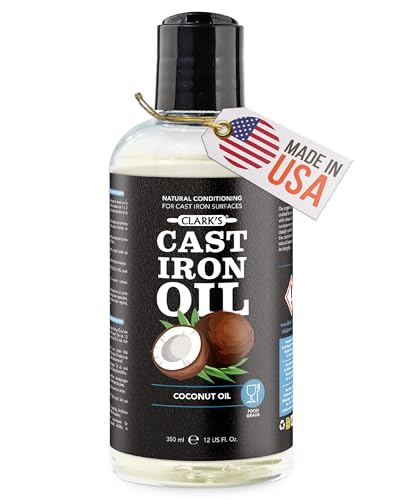
CLARK’S uses a single ingredient — highly refined food-grade coconut oil — and packages it in a generous 12-ounce bottle that offers more volume than any other product here. Refined coconut oil has a smoke point of approximately 400-450°F, which is slightly lower than avocado or safflower but still adequate for most griddle cooking. The oil is solid at room temperature, so you need to warm the bottle or the pan to get it to spread thinly. Once heated, it penetrates the metal surface quickly and dries to a clean, non-greasy finish.
The primary benefit of coconut oil for seasoning is its resistance to rancidity. Unlike flaxseed or grapeseed oils that can turn sour and sticky over time, CLARK’S oil stays stable at room temperature indefinitely. Users who inherited vintage cast iron report that a single treatment with this oil restored a smooth, food-release surface without any off-flavors. It also serves as an effective moisture barrier, preventing rust on carbon steel woks and griddles stored in humid environments.
The oil is fairly thin once melted, which means you need to wipe away excess thoroughly to avoid a sticky residue. Some users also note that the bottle’s nozzle can clog if the oil partially solidifies after use. For best results, apply to a hot pan and then place it in a 350°F oven to fully polymerize.
Why it’s great
- Large 12-ounce bottle offers the most volume per purchase
- Resists rancidity and stays stable at room temperature
- Excellent rust protection for stored cookware
Good to know
- Solid at room temperature requires pre-warming
- Thin oil needs thorough wiping to avoid stickiness
4. CARON & DOUCET Griddle Seasoning & Cast Iron Conditioner

CARON & DOUCET positions this product as a 2-in-1 seasoning and conditioner, using a blend of canola oil, grapeseed oil, and rice bran wax. The wax component gives the liquid a thicker consistency than pure oil, allowing it to stay on vertical griddle surfaces without running off. It is specifically designed for large flat-top grills, though it works on standard skillets, woks, and dutch ovens as well. Users who own Blackstone or Camp Chef griddles report that three thin coats produce a dark, even seasoning that holds up to multiple cooks without needing re-application.
The rice bran wax raises the overall smoke point of the blend, reducing the amount of smoke generated during the initial seasoning burn-in. The formula is 100% plant-based and petroleum-free, so there is no risk of chemical off-gassing or unpleasant odors during the curing process. Many users note that this product completely eliminated the sticky residue they had struggled with when using pure oils.
The bottle lacks any printed instructions, which can be frustrating for first-time users. You need to heat the griddle to open the metal pores, apply a thin layer, then wipe off the excess before allowing it to fully polymerize. A few users also mention that the price per ounce is higher than plain vegetable oil, though the convenience of a ready-to-use blend justifies the premium for most.
Why it’s great
- Rice bran wax prevents dripping and pooling on vertical surfaces
- Minimal smoke during initial burn-in
- Effective 2-in-1 seasoning and conditioning formula
Good to know
- No instructions included on the bottle
- Higher cost per ounce compared to simple oils
5. WALRUS OIL Cast Iron Oil

WALRUS OIL uses high-oleic safflower oil with a smoke point between 450°F and 500°F, making it one of the most heat-stable pure oil options on the market. It is NSF certified for food-contact safety, which provides an extra layer of confidence for those who cook directly on the seasoned surface. The 8-ounce bottle is compact and fits easily into a kitchen drawer. Users report that it restores old rusty pans to a smooth, non-stick condition after a few oven cycles without any sticky or tacky residue.
The oil is thin and spreads effortlessly across cast iron and carbon steel, requiring only a small amount to cover an entire skillet. Because it is 100% natural with no additives, it polymerizes cleanly without producing any off-gassing or unpleasant smells. Many repeat purchasers note that this is the only oil they trust for their daily-seasoned Blackstone griddle, as it does not leave a greasy film even after heavy use.
The bottle’s wide cap design has been criticized by multiple users for causing spillage during pouring. The opening is larger than necessary, making it easy to accidentally dump too much oil. You can mitigate this by transferring the oil to a smaller squeeze bottle with a narrow tip.
Why it’s great
- NSF certified for direct food-contact safety
- High smoke point 450-500°F for clean polymerization
- Thin, easy-spreading oil requires very small amounts
Good to know
- Wide cap design leads to spills and waste
- Small 8-ounce bottle may need frequent reordering
FAQ
Can I use olive oil to season my griddle?
How many coats of seasoning do I need on a new griddle?
Why does my seasoning flake off after cooking?
Final Thoughts: The Verdict
For most users, the best griddle seasoning winner is the Crisbee Cream Iron because its beeswax blend creates the hardest, most durable nonstick layer without pooling or smoking. If you want a low-smoke, high-heat pure oil that spreads easily and resists rancidity, grab the Heritage Products Avocado Oil. And for the biggest bottle on a budget that still delivers clean polymerization and excellent rust protection, nothing beats the CLARK’S Coconut Oil.