
Finding the perfect game for a girl means looking past the pink packaging to find something that truly engages her imagination, challenges her mind, and gets everyone laughing. Whether it’s a quiet afternoon tea party with princesses or a chaotic battle to keep a penguin from falling, the right game turns screen time into face-to-face fun.
I’m Mohammad Maruf — the founder and writer behind Drink4Good. I’ve spent years analyzing family game markets, tracking play-test data, and comparing build quality and replay value across hundreds of board games to understand what keeps kids coming back to the table.
This guide breaks down five fantastic options you can trust to deliver real playtime value, from classic dress-up races to modern stacking challenges. Here are the very best picks for your next game night with the best games for girls.
How To Choose The Best Games For Girls
The best game for a girl isn’t about a specific label — it’s about matching the activity to her personality and age. A preschooler’s tea party game won’t hold a tween’s attention, just as a truth-or-dare party game will overwhelm a five-year-old. Focus on three things: physical component quality, the balance of luck versus skill, and the social dynamic it creates.
Age Appropriateness and Attention Span
Games aimed at ages 3 to 6 rely heavily on simple rules, large pieces, and short play sessions of 15 to 20 minutes. For ages 7 to 10, you can introduce light strategy and set-collection mechanics. Teens (10+) are ready for conversational party games where the real fun comes from social interaction, not just rolling dice.
Component Quality and Durability
Kids are tough on game pieces. Look for thick cardboard game boards, sturdy plastic jewelry pieces, and cards printed on heavy cardstock. Games like the 64 Pcs Stacking Tower and Hasbro’s Don’t Break The Ice use plastic and wood composite pieces that survive repeated play. Thin paper cards or flimsy dice trays are red flags — they won’t last a single birthday party.
Replay Value and Group Size
A game that feels the same every time gets boring fast. Games with random elements (spinners, dice, card draws) or variable setups (stacking towers, different truth-or-dare prompts) naturally offer higher replay value. Also check the player count — many games list 2-4 players but become more chaotic and fun with the full group. For larger gatherings, aim for games supporting 4 to 10 players.
Quick Comparison
On smaller screens, swipe sideways to see the full table.
| Model | Category | Best For | Key Spec | Amazon |
|---|---|---|---|---|
| Pretty Pretty Princess | Dress-Up Race | Princess-themed playdates | 20+ jewelry pieces included | Amazon |
| Don’t Break The Ice | Action/Skill | Toddler & preschool fun | 32 small ice blocks to tap | Amazon |
| Girl Talk Truth or Dare | Party Game | Tween sleepovers & parties | 200 cards & giant spinner | Amazon |
| Disney Princess Treats Game | Memory/Matching | Preschool tea parties | 40 cupcake cards & teapot | Amazon |
| 64 Pcs Stacking Tower Game | Balance/Strategy | Family game nights | 64 blocks + 22 challenge cards | Amazon |
In‑Depth Reviews
1. Pretty Pretty Princess Board Game
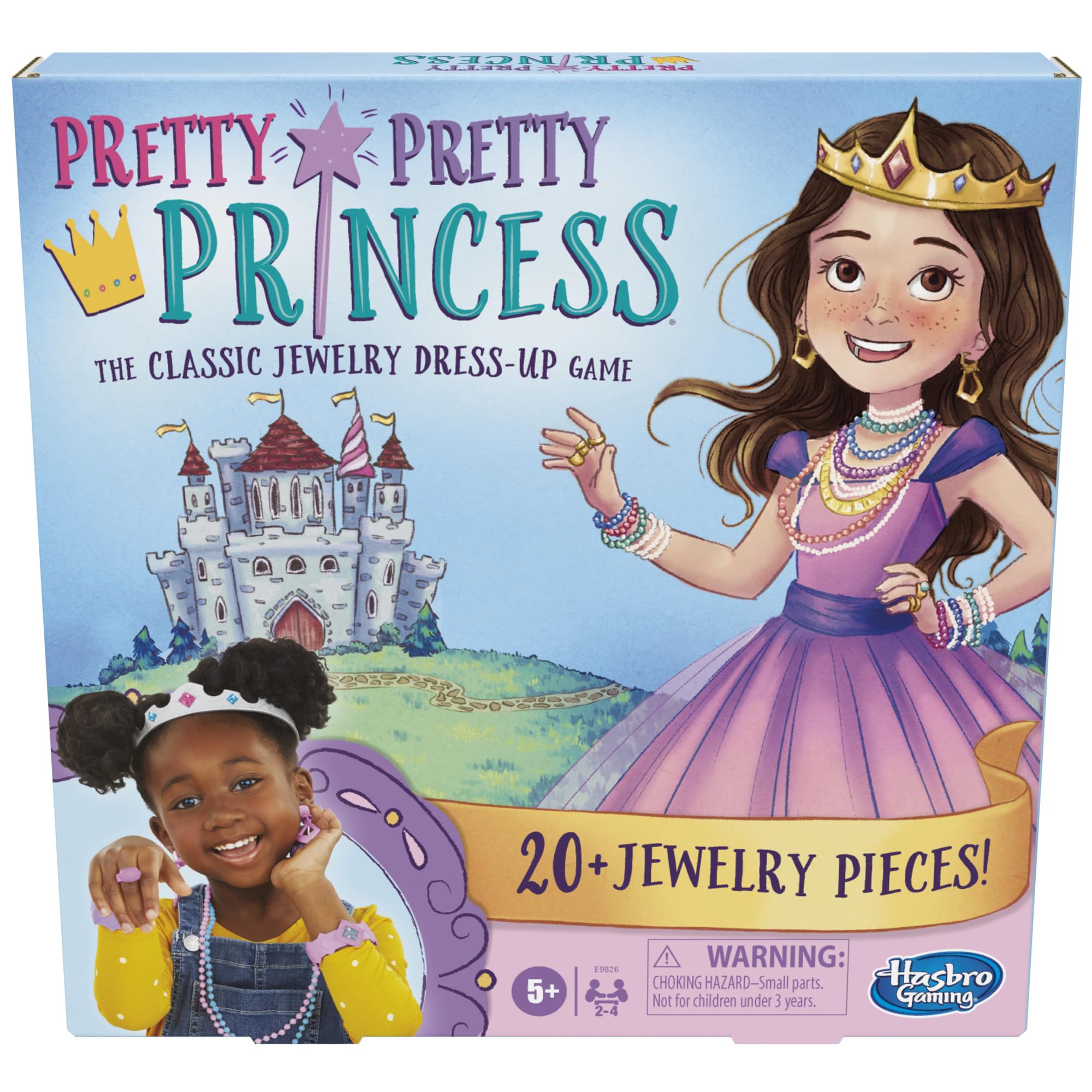
This Hasbro classic is the gold standard for dress-up board games. Players race to collect a complete set of color-coordinated jewelry — necklace, bracelet, earrings, and ring — and then grab the crown to win. The set includes over 20 plastic jewelry pieces, from bright bangles to clip-on earrings (no ear-piercing required), plus a spinner that determines your fate. The Cursed Ring mechanic adds a twist: if you’re wearing it when the game ends, you lose, which keeps everyone on their toes even after they’ve assembled their outfit.
The components are durable enough for repeated play by kids aged 5 and up. The game board splits into four corner pieces, each with a path of colored spaces that guide movement. A typical round lasts about 30 minutes, making it long enough to feel satisfying but short enough to hold a child’s attention. Parents report that both boys and girls enjoy the competitive “collect everything” structure, and the tactile joy of clicking on plastic jewelry is half the fun.
One practical note: the ring and bracelet pieces are small, so keep an eye on younger siblings who still mouth objects. The jewelry box included for storage helps keep everything organized between games. If you want a game that blends pretend-play with light strategy, this is it.
Why it’s great
- Teaches color matching and turn-taking naturally
- High replay value with randomized spinner outcomes
- Durable plastic pieces that survive rough play
Good to know
- Small jewelry pieces are a choking hazard for kids under 3
- Some parents wish the jewelry box included more storage dividers
2. Hasbro Don’t Break The Ice

Don’t Break The Ice brings pure physical tension to the table. Players take turns tapping out plastic ice blocks from a square frame using small mallets, trying to keep Phillip the Penguin balanced on top. One wrong tap and the penguin crashes down with a satisfying clatter. It’s a simple elimination game that builds anticipation with every turn — the kid equivalent of Jenga, but faster and less stressful for little hands.
The build quality here is classic Hasbro: a sturdy plastic frame, four legs, 32 small ice blocks, one large block, and two mallets. Setup takes about 30 seconds, and a full game runs under 10 minutes, which is perfect for the 3-to-6 age range where attention spans are short. The modular board means no two games play exactly the same, since ice blocks get rearranged every round. Kids learn cause-and-effect (“if I tap this block, will the penguin fall?”) and develop fine motor control through careful mallet strikes.
A few buyers note that the ice blocks can be a tight fit when first assembled, requiring an adult to adjust them. Also, the frame’s plastic feels slightly thinner than the 1990s original, though it still holds up well to weekly play. For a no-reading, no-battery game that has preschoolers howling with glee, this remains unmatched.
Why it’s great
- Instant setup and 10-minute play time
- Teaches fine motor skills and cause-and-effect
- Works for 2-4 players with zero reading required
Good to know
- Ice blocks may need sanding if they stick initially
- Frame feels slightly less robust than vintage editions
3. Hasbro Gaming Girl Talk Truth or Dare

This updated edition of the iconic 1980s board game brings truth-or-dare gameplay to a new generation. The centerpiece is a large, colorful spinner that players use to determine their fate: Truth, Dare, or Wild Card (which lets you choose a friend to do the card with you). The 200 cards include age-appropriate questions like “How many selfies do you take a day?” and dares such as “Announce that there’s a thunderstorm outside to the nearest adult.” The board game format adds scoring trackers for 10 players, making it ideal for sleepovers and birthday parties.
The recommended age is 10 and up, and real-world feedback confirms it hits best with 4th through 6th graders. The dares are silly and embarrassing but never mean-spirited or unsafe — a solid balance for parents. The portable case keeps everything organized, which is a lifesaver when bringing it to a friend’s house. Players report that the game gets louder and more hysterical as the night goes on, which is exactly what a party game should do.
Some buyers note that the cardstock quality is adequate but not premium — repeated shuffling may cause slight edge wear. And while the game is called “Girl Talk,” many families report that boys and adults happily join in. If you’re looking for a conversation-starter that gets tweens off their phones and interacting face-to-face, this delivers.
Why it’s great
- Encourages social interaction and laughter away from screens
- Large player count (up to 10) fits parties perfectly
- Age-appropriate cards keep content safe for tweens
Good to know
- Cards show slight wear after many shuffles
- Best for ages 10-14; older teens may find dares too tame
4. Disney Princess Treats & Sweets Party Board Game

This Spin Master game turns a tea party into a memory and matching challenge. Players pour dice from a three-piece plastic teapot — yes, it actually looks like a teapot — to determine where to move on the game board and how many Cupcake Cards to flip over. The goal is to be the first to collect five matching pairs of cupcake cards on your plate. The Disney Princess theme features Elsa, Ariel, Belle, Mulan, Tiana, and others, all illustrated in a cute, storybook style that appeals to preschoolers.
The components are the real highlight here: the teapot shaker is novel and satisfying for little hands, the cupcake cards are thick enough for repeated flipping, and the teacup movers are adorable. The game teaches basic counting, memory recall, and turn-taking in a context that feels like imaginative play rather than schoolwork. At 2-4 players, it works well for small playdates or sibling pairs. A full game takes about 15 to 20 minutes, which matches the 4-and-up attention sweet spot.
One minor complaint from buyers: the sugar cube tokens are thin punch-out pieces that can bend easily. Also, the box isn’t designed for easy card storage, so consider using a baggie to keep cards organized. But for a preschool tea-party game that actually functions as a real game (not just pretend), this is a charming find.
Why it’s great
- Teapot dice shaker is a unique, kid-friendly mechanic
- Memory matching builds cognitive skills naturally
- Disney Princess art is high-quality and engaging
Good to know
- Sugar cube tokens are flimsy and may need reinforcing
- Box lacks interior dividers for card storage
5. 64 Pcs Stacking Tower Game with 22 Cards

This Gdaytao stacking tower game takes the classic Jenga formula and adds 22 challenge cards that introduce new rules, like “remove a block with your non-dominant hand” or “stack two blocks on top instead of one.” The 64 blocks are made from brightly colored, eco-friendly materials with a smooth finish. The base game is straightforward: roll a die, remove a block of that color, and place it on top without toppling the tower. The cards add variety that keeps the game fresh even after the tenth round.
At this entry-level price point, the size is notably smaller than standard timber tower games — the blocks measure about 0.6 inches wide. Some buyers were surprised by the compact scale, but this actually makes it more portable for trips to grandparents’ houses or restaurant tables. Teachers have repurposed it for special education settings, using block removal to practice fine motor control and hand-eye coordination with students ages 6 through 17. The game supports any number of players, making it flexible for both small families and larger groups.
The main downside is the card quality: the included challenge cards are printed on thin paper that will need lamination or copying to survive heavy use. Several buyers solved this by enlarging and laminating the cards for durability. If you’re looking for a budget-friendly option that combines luck, strategy, and motor dexterity, this stacking tower delivers solid bang for the buck.
Why it’s great
- Challenge cards add variety beyond standard block removal
- Portable size fits in a backpack for travel
- Encourages focus, balance, and strategic thinking
Good to know
- Smaller than expected — check dimensions before buying
- Card stock is thin and may need home lamination
FAQ
What age is best for the Disney Princess Treats game?
Can boys enjoy the Pretty Pretty Princess game?
Which game is best for a sleepover party with 6 girls?
How durable are the jewelry pieces in Pretty Pretty Princess?
Final Thoughts: The Verdict
For most families, the best games for girls winner is the Pretty Pretty Princess because it combines dress-up fantasy with real game mechanics that teach turn-taking and color matching. If you want a game for toddlers and preschoolers who need fast-paced physical play, grab the Don’t Break The Ice. And for tweens craving social laughs at sleepovers, nothing beats the Girl Talk Truth or Dare.