
Nothing kills a quiet evening at the campsite faster than a loud, sputtering generator that struggles to start. For pop-up camper owners, the power source isn’t just about running an air conditioner or charging devices—it’s about balance. You need enough wattage to keep your 15,000 BTU AC humming, yet the unit must be compact enough to stow under the camper bunk and quiet enough to not disturb the neighbors at the next site.
I’m Mohammad Maruf — the founder and writer behind Drink4Good. I’ve spent years analyzing generator subcategories, from dual-fuel inverter platforms to ultra-light open-frame designs, studying how real-world specs like THD, engine displacement, and decibel ratings translate into reliable off-grid power.
Whether you’re looking for a budget-friendly option for weekend trips or a premium long-term investment, finding the right generator for pop up camper comes down to matching your specific power needs with the right balance of weight, noise, fuel type, and runtime.
How To Choose The Best Generator For Pop Up Camper
Pop-up campers sit in a unique power sweet spot. They’re larger than a tent setup, with an air conditioner, a small refrigerator, lights, and sometimes a microwave—but they lack the built-in generator and massive battery banks of full-size RVs. The right generator must be portable enough to lift into the tow vehicle, quiet enough for campground noise rules, and powerful enough to start a rooftop AC unit’s compressor surge. Here are the critical factors.
Inverter vs. Conventional: Clean Power Is Non-Negotiable
Pop-up campers today run laptops, smartphones, and often a television—electronics that hate dirty power. Inverter generators produce a stable sine wave with total harmonic distortion (THD) under 3%, while conventional generators can push 12% to 20% THD. For your camper’s converter/battery charger and any sensitive devices, an inverter generator is the only safe choice. The cleaner waveform also reduces engine strain, which directly extends the unit’s usable life.
Wattage: The Starting Surge Trap
The single biggest mistake pop-up camp owners make is buying a generator based on running watts alone. A 13,500 BTU rooftop AC unit may run at 1,300 watts, but it requires 2,000 to 3,000 surge watts for that first compressor kick. Add a refrigerator compressor cycling on and a converter charging the battery, and you realistically need 3,000 to 4,000 peak watts. A generator rated at 2,200 peak watts will likely trip its breaker the moment the AC starts on a hot afternoon.
Fuel Type: Storage and Runtime Considerations
Gasoline is the most available fuel, but it degrades after a few months and requires carburetor maintenance during off-season storage. Propane (dual-fuel) offers indefinite shelf life and cleaner combustion, though it delivers about 10% fewer watts. Some generators run only on propane for even simpler fueling. For pop-up campers that sit unused for weeks between trips, dual-fuel models eliminate the chore of draining a gas tank after every outing.
Weight and Physical Footprint
Pop-up campers have limited space. You’re likely storing the generator in the tow vehicle’s trunk, under the camper’s dinette seat, or in a front storage compartment. A 100-pound unit is unwieldy for one person to lift. Most pop-up campers pair best with generators between 42 and 62 pounds. Closed-frame “suitcase” inverters are easiest to handle, but even some open-frame models now dip under 50 pounds with the right engineering.
Noise Level and Campground Rules
Many public campgrounds enforce strict decibel limits—often around 60 to 65 dBA measured at 50 feet. An open-frame generator running at 72 dBA will get you complaints or a warning. Stick to inverter generators rated at 58 dBA or lower at 25% load. The quietest units, like the Honda EU2200i, hover around 48 to 52 dBA, which blends into normal conversation levels.
Runtime and Tank Size
A 1.3-gallon tank running at 50% load may last only 4 to 5 hours. That’s fine for sleeping through the night, but you’ll refuel awkwardly in the morning. For longer boondocking sessions, look for generators with at least 1.6-gallon tanks that push runtime past 10 hours at 25% load. Eco-mode or idle-down technology stretches runtime significantly when the AC compressor isn’t cycling.
Quick Comparison
On smaller screens, swipe sideways to see the full table.
| Model | Category | Best For | Key Spec | Amazon |
|---|---|---|---|---|
| Champion 4000W | Inverter | Lightest 4000W inverter | 48.1 lbs / 64 dBA | Amazon |
| Cummins Onan P4500I | Premium Inverter | Remote start comfort | 224cc / 4500W peak | Amazon |
| Honda EU2200i Companion | Compact Inverter | Ultra-quiet 50 dBA | 47 lbs / 0.95 gal | Amazon |
| Honda EU2200ITAN1 | Compact Inverter | Reliable deep-boondocking | 50 dBA / EU2200i core | Amazon |
| WEN DF360iX Dual Fuel | Dual Fuel | Propane flexibility | 49 lbs / CO Watchdog | Amazon |
| WEN 56360i | Lightweight Inverter | Pop-up bunk storage | 46 lbs / 18″ tall | Amazon |
| Westinghouse 2550W | Dual Fuel | Quiet dual-fuel compact | 52 dBA / 42.4 lbs | Amazon |
| PowerSmart 3600W | Mid-Range Inverter | RV 30A plug direct | 50.7 lbs / 4.75h run | Amazon |
| Aceup Energy 4000W | Value Inverter | Pop-up AC on a budget | 48 lbs / 60 dBA eco | Amazon |
| A-iPower 4600W | Lightweight Open | Home backup + pop-up | 56 lbs / 16h runtime | Amazon |
| PowerSmart 4400W Dual Fuel | Dual Fuel | Affordable dual-fuel backup | 61.3 lbs / 76 dBA | Amazon |
In‑Depth Reviews
1. Champion Power Equipment 4000-Watt Inverter Generator

The Champion 4000W inverter lands in a near-perfect sweet spot for pop-up campers: at under 49 pounds, it’s one of the lightest 4000-watt units on the market, yet it still delivers 3,000 running watts. That’s enough to handle a 15,000 BTU RV air conditioner plus lights and the refrigerator simultaneously, as long as you stagger the AC and microwave. The 64 dBA noise rating at 23 feet is quiet enough for most campgrounds, and the CO Shield carbon monoxide auto-shutoff adds a layer of safety when placed near the camper.
A 1.6-gallon fuel tank provides up to 10 hours of runtime at 25% load, meaning you can sleep through the night without refueling. User reports confirm roughly 5 gallons per 24 hours under continuous AC load, which is efficient for this power class. The parallel kit compatibility lets you pair two Champions for 8,000 peak watts if you upgrade to a larger RV later.
One practical detail is the TT-30R outlet, which plugs directly into most pop-up campers without needing a separate adapter. The recoil start is easy—many owners report first- or second-pull starts after break-in. The 3-year limited warranty and lifetime technical support from Champion backs this as a long-term investment.
Why it’s great
- Industry’s lightest 4000W inverter at 48.1 pounds
- Quiet 64 dBA operation fits campground rules
- Direct TT-30R RV outlet with clean power under 3% THD
Good to know
- No hour meter for tracking maintenance intervals
- Overload reset requires manual breaker flip at the panel
2. Cummins Onan P4500I Portable Inverter Generator
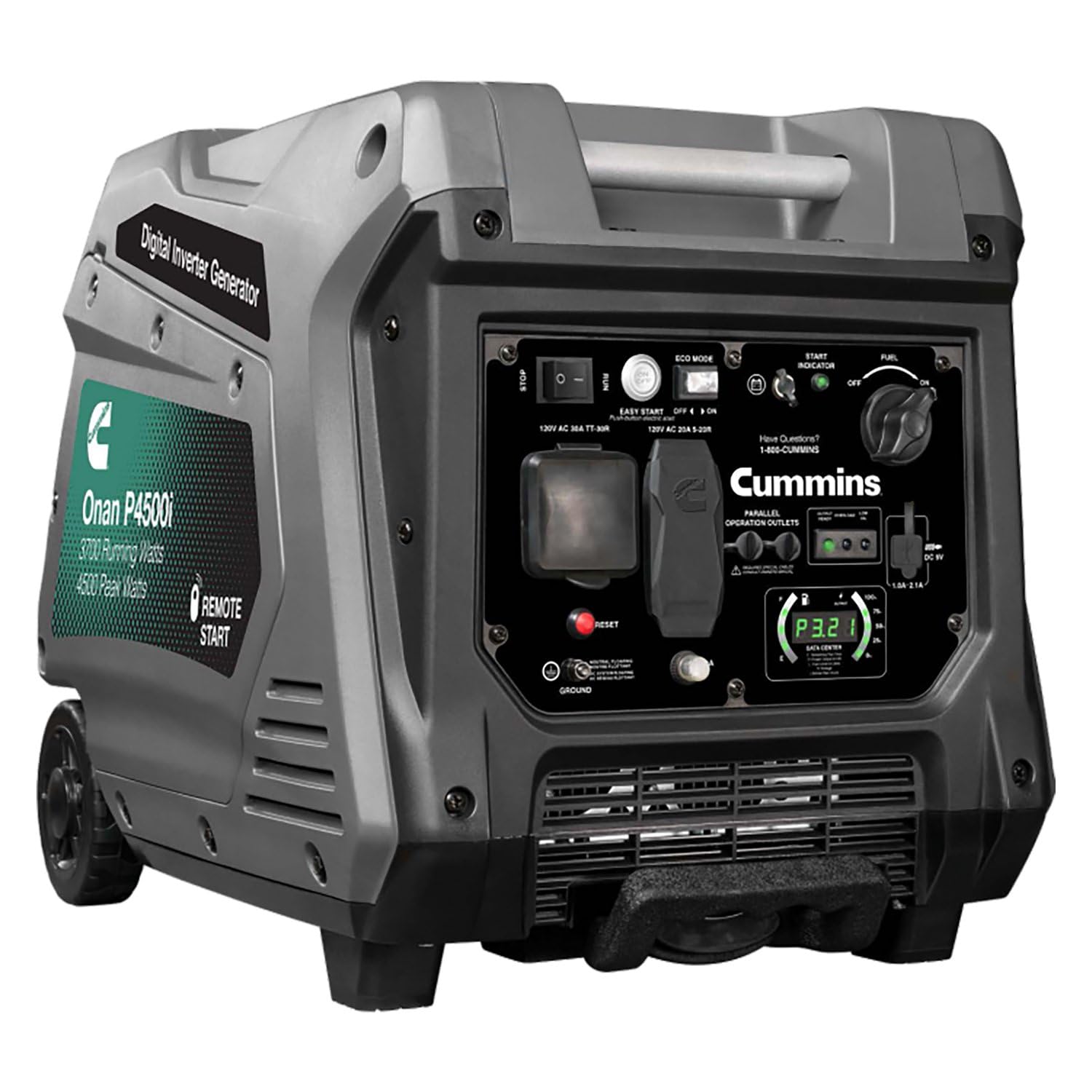
The Cummins Onan P4500I is a premium-tier generator that brings remote-start convenience to the pop-up camper world. Powered by a 224cc OHV 4-stroke engine producing 4500 peak watts and 3600 running watts, this unit laughs at a 15,000 BTU AC. The built-in TT-30R outlet connects directly to your camper’s shore power inlet, and the dual 5V USB ports handle device charging without a separate adapter.
What sets this generator apart is the remote start fob. On a cold, wet morning, you can fire it up from inside the camper without stepping outside. The luggage-style two-wheel dolly handle makes rolling the 98-pound unit across gravel sites manageable, though lifting it into a vehicle is a two-person job. Noise levels are impressively low for a generator this powerful—owners report it’s quieter than many 2,500-watt open-frame units.
Parallel capability with a second P4500I unlocks a 50-amp feed for full RV systems, but most pop-up owners will find the single unit more than sufficient. The voltage output stays rock-solid at 120V, which is better than some campground pedestal power. Oil changes are the only hassle: the drain plug sits in a tight space behind a misaligned body panel.
Why it’s great
- Remote start key fob for cold-morning convenience
- Large 224cc engine delivers 4500 peak watts
- Luggage-style wheels roll smoothly on gravel
Good to know
- At 98 pounds, it’s too heavy for casual lifting
- Oil drain location is awkward for DIY maintenance
3. Honda EU2200i Companion Inverter Generator
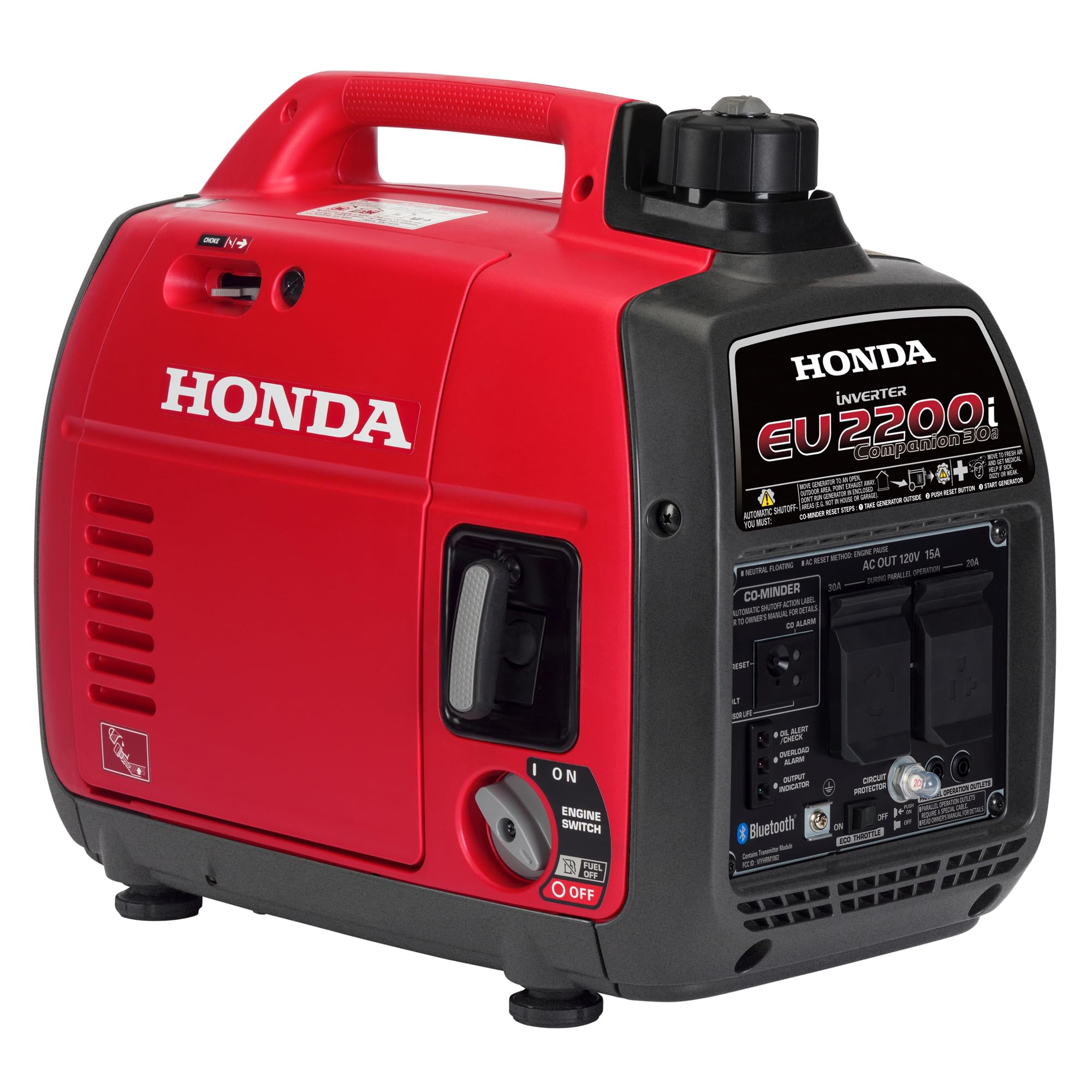
The Honda EU2200i Companion is the gold standard for suitcase inverter generators, and for good reason. It produces a maximum 2,200 watts and 1,800 running watts with a noise floor as low as 48 dBA on eco-throttle—quieter than a normal conversation. For pop-up campers running a smaller 10,000 BTU AC or just lights, fridge, and battery charging, this unit is nearly silent at the campsite.
The Companion variant includes a built-in 30-amp outlet for direct RV connection, which the standard EU2200i lacks. That detail alone makes the Companion the better choice for pop-up owners. The Eco Throttle system adjusts engine speed to the load, delivering up to 8.1 hours on a single 0.95-gallon tank. At 47 pounds, it’s light enough to carry in one hand and stow under a dinette seat.
The Bluetooth My Generator app adds remote monitoring and operation, but the real draw is decades-proven Honda reliability. Users report starting after six months of storage on the second pull. The CO-MINDER sensor automatically shuts down the generator if CO builds up near the camper. The trade-off is power output—2,200 watts is insufficient for a 15,000 BTU AC, so be sure to check your camper’s AC startup specs before buying.
Why it’s great
- Super quiet at 48-57 dBA for peaceful campsites
- Weighs only 47 pounds for easy one-hand carry
- Bluetooth app with remote stop and monitoring
Good to know
- 2,200 peak watts won’t start a 15,000 BTU AC
- No fuel gauge; hour meter uses a blinking light system
4. Honda EU2200ITAN1 2200-Watt Inverter Generator
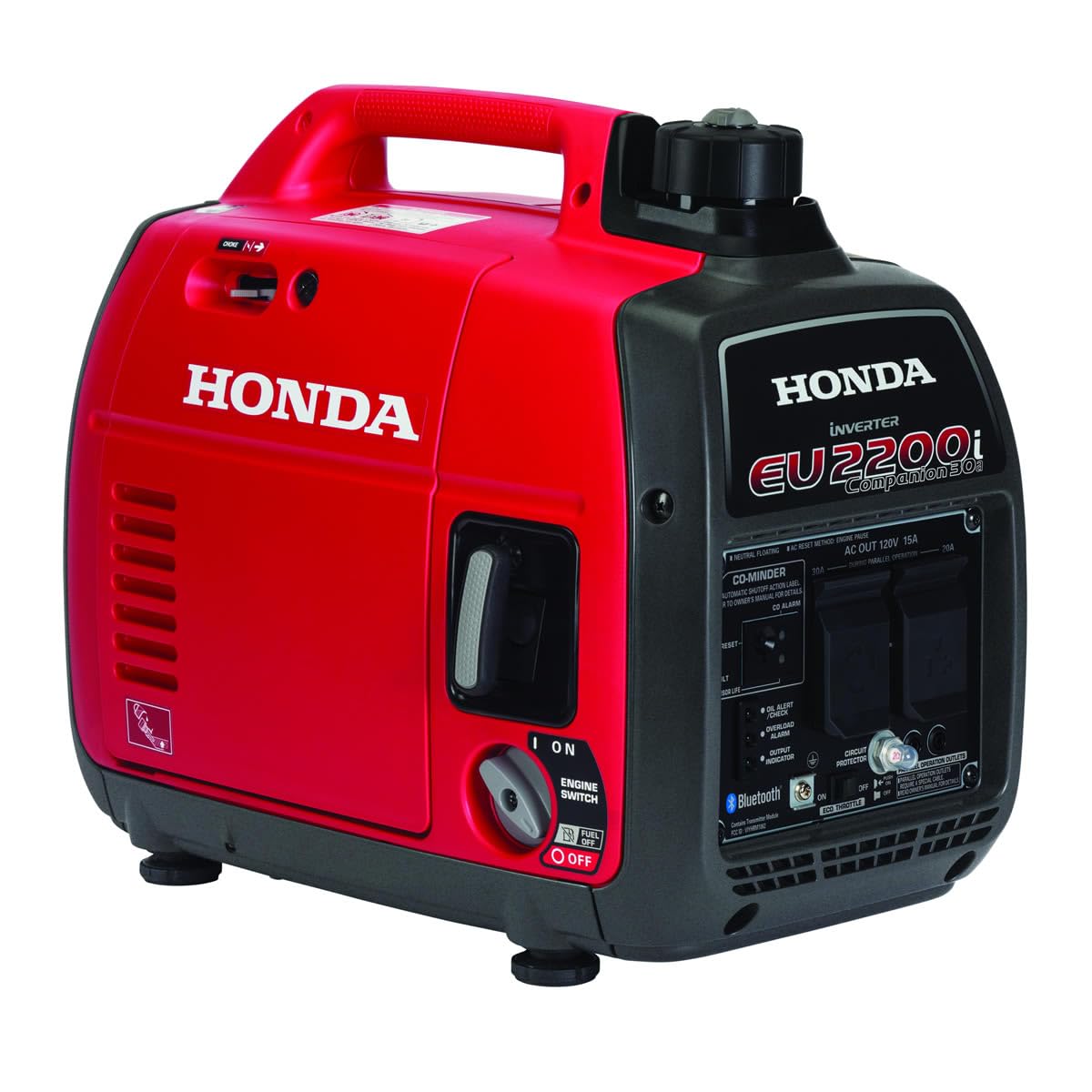
The Honda EU2200ITAN1 shares the same core engine and inverter platform as the Companion model but is designed for 49-state use. At 2,200 peak watts and 1,800 running watts, it’s a benchmark for reliability in the compact inverter class. The 208cc Honda GXR engine is famous for sipping fuel and starting immediately after long storage—user reports confirm six-month idle periods with second-pull restarts.
At 50 dBA at rated load, it’s barely audible from inside the pop-up camper. The Eco Throttle automatically reduces RPM when loads drop, which means the generator will idle down to a whisper when the refrigerator compressor is the only draw. Fuel consumption is remarkably low: a 0.95-gallon tank lasts between 3.2 hours at full load and 8.1 hours on eco-throttle.
One key difference from the Companion: this model lacks a built-in TT-30R RV outlet. You’ll need to use a parallel cord adapter or a separate RV adapter pigtail to connect directly to your pop-up camper. Given the weight of just over 50 pounds and the compact dimensions (22 x 13 x 18 inches), it tucks easily into the back of a SUV or under a camper bunk. For pop-ups with smaller AC units under 10,000 BTU, this is the most reliable option on the market.
Why it’s great
- Legendary Honda engine starts after months in storage
- Very quiet 50 dBA operation with Eco Throttle
- Excellent fuel efficiency extends camping trips
Good to know
- No built-in TT-30R RV outlet on this model
- Peak wattage insufficient for large rooftop AC units
5. WEN DF360iX Dual Fuel Portable Inverter Generator

The WEN DF360iX is a dual-fuel inverter generator that runs on gasoline (3,600 surge / 2,900 rated watts) or propane (3,500 surge / 2,600 rated watts), giving pop-up camper owners the flexibility to skip fuel stabilization worries during off-season storage. At 49 pounds, it’s light enough for one person to load into a tow vehicle, and the 149cc engine is quiet enough to hold a conversation next to it.
The WEN Watchdog CO Shutdown Sensor automatically kills the engine if dangerous carbon monoxide accumulates—a critical safety feature when the generator is placed near the camper’s entry point. The fuel shut-off valve lets you run the carburetor dry before storage, preventing the gummed-up jets that plague seasonal generators. The digital display shows voltage, frequency, runtime hours, and wattage draw, which helps you manage your pop-up’s power budget in real time.
On a 20-pound propane tank, users report the unit fires up immediately and runs smoothly. The included tool-free LPG quick-connector makes swapping tanks simple. The only quality issue reported is that the 20A household outlets hold plug prongs a bit loosely, which isn’t a deal-breaker but is worth noting for heavy-use scenarios.
Why it’s great
- Dual-fuel design with tool-free propane quick-connect
- CO Watchdog auto-shutoff for safe campsite placement
- Digital display with runtime hours, watts, and voltage
Good to know
- Standard 20A outlets have slightly loose plug grip
- Propane output drops 10% compared to gasoline specs
6. WEN 56360i 3600-Watt Portable Inverter Generator

The WEN 56360i is engineered for the storage constraints of pop-up campers. At 46 pounds and standing only 19.7 inches tall with a depth of 11.6 inches, it slides under the camper’s bunk or into a cramped vehicle compartment without squeezing. The 149cc engine delivers 3,600 surge watts and 2,900 rated watts, which is enough to run a 13,000 BTU AC and basic camper loads simultaneously.
The fuel shut-off feature is not just a convenience—it’s a preservation tool. By letting you run the carburetor dry before shutdown, it prevents the fuel residue buildup that causes starting problems next season. The runtime at 50% load is roughly 4 to 5 hours on the 1.32-gallon tank, which aligns with typical overnight AC operation. In eco-mode, the engine idles down and stretches fuel further during low-draw periods.
Real-world owners confirm it starts on the first or second pull even in cold weather (14°F reported). The noise level is quiet enough to use in residential campgrounds without complaints, and the power output is clean at under 3% THD, safe for laptop chargers and camper converter systems. The lack of dual-fuel is the only feature gap for those who prefer propane storage.
Why it’s great
- Ultra-compact 46-lb design fits under camper bunk
- Fuel shut-off prevents carburetor gumming during storage
- Reliable cold-weather starting down to 14°F
Good to know
- Gasoline-only; no propane compatibility
- No CO sensor for added safety margin
7. Westinghouse 2550W Dual Fuel Inverter Generator

The Westinghouse 2550W dual-fuel inverter generator is an unusually quiet option at just 52 dBA—quiet enough that neighbors may not realize you have a generator running. With 2,550 peak watts and 1,900 rated watts on gasoline (slightly less on propane), this unit is best suited for pop-up campers with smaller AC units or those who primarily need battery charging, lights, and device power.
Weighing only 42.4 pounds, it’s the lightest dual-fuel inverter in this comparison. That weight makes a real difference when you’re loading gear alone. The 1.16-gallon gas tank delivers up to 12 hours of runtime on eco-mode, which covers a full day of moderate camping without refueling. The TT-30R RV outlet is built in, so you can plug your camper’s shore power cord directly into the generator.
The included propane hose lets you switch fuels immediately out of the box, and the CO sensor provides automatic shutoff. Some owners have reported sporadic starting issues with the unit, though most find it starts reliably after break-in. The 3-year warranty is stronger than average for this price tier, adding peace of mind for weekend campers.
Why it’s great
- Remarkably quiet 52 dBA operation
- Lightest dual-fuel inverter at 42.4 pounds
- Up to 12 hours runtime on eco-mode
Good to know
- 1,900 running watts may not start a 15,000 BTU AC
- Occasional starting inconsistency reported by some users
8. PowerSmart 3600-Watt Portable Inverter Generator

The PowerSmart 3600W inverter targets the pop-up camper market with a direct 30-amp RV outlet and 27.6 amps of steady power output. The 149cc engine produces 3,600 starting watts and 3,200 rated watts, providing enough headroom for a 15,000 BTU AC plus the camper’s converter and a small microwave. At 50.7 pounds, it’s manageable for one person to load into the back of a truck.
Clean inverter power with less than 3% THD protects sensitive electronics, and the parallel capability lets you link two PowerSmart units for double the output if you eventually upgrade to a larger RV. The 1.3-gallon fuel tank provides up to 4.75 hours at 50% load, which is adequate for overnight AC runs but shorter than ideal for long boondocking trips.
Owners consistently praise the first-pull starting and quiet operation for its power class. The compact footprint (21.9 x 13.4 x 19.5 inches) fits into most pop-up camper storage compartments, and the integrated carry handle makes positioning easy. The lack of dual-fuel is the only trade-off for campers who prefer propane storage.
Why it’s great
- Direct TT-30R outlet with 30-amp RV compatibility
- First-pull starting and quiet operation
- Parallel capable for future power expansion
Good to know
- 4.75-hour runtime at 50% load is moderate
- Gasoline-only fuel system
9. Aceup Energy 4000-Watt Inverter Generator
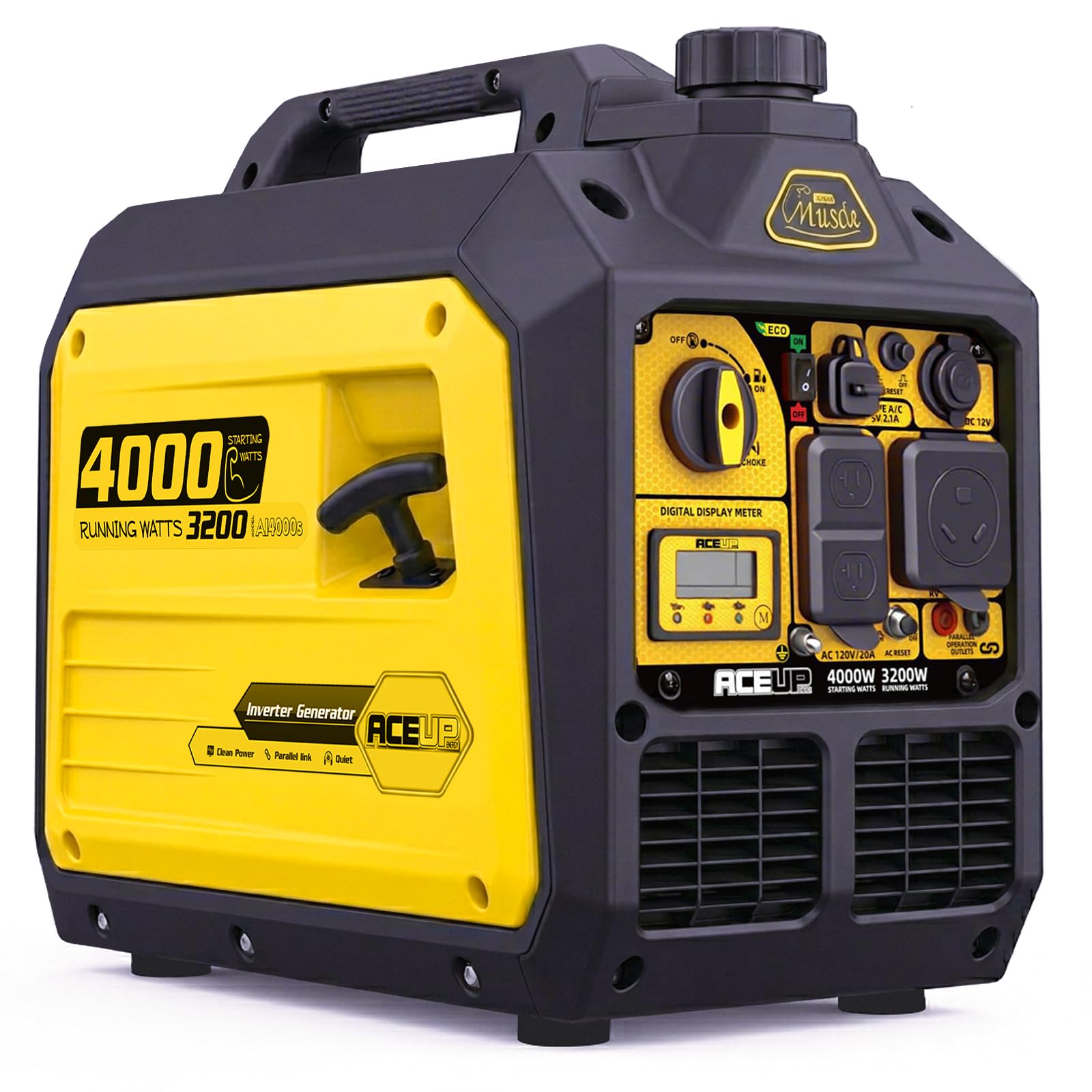
The Aceup Energy 4000W inverter is a budget-conscious option that doesn’t skimp on the specs that matter for pop-up campers. The 149cc engine delivers 4,000 peak watts and 3,200 rated watts, putting it in the same power bracket as units costing significantly more. At 48 pounds, it’s one of the lightest generators in the 4,000-watt class, making it easy to move around the campsite.
The intelligent gauge tracks voltage, runtime, fuel level, hertz, and current power output, giving you full visibility into your camper’s energy draw. Eco mode drops the noise to approximately 60 dBA at 23 feet—quiet enough for most private and state park campgrounds. The THD is under 1.5%, which is exceptionally clean power for sensitive electronics like laptops and camper converter systems.
Multiple owners report that it runs a 15,000 BTU RV air conditioner plus lights without breaking a sweat. The 1.32-gallon tank yields about 5 hours at half-load, which is on par with similarly sized units. The 2-year limited warranty and free lifetime technical support provide reassurance for a budget-tier purchase. The parallel-ready ports allow doubling the power later with a second unit.
Why it’s great
- Lightweight 48-lb frame for its power output
- Under 1.5% THD for ultra-clean inverter power
- Digital gauge shows voltage, runtime, and wattage
Good to know
- Gasoline-only fuel system
- 1.32-gallon tank limits runtime to ~5 hours at half load
10. A-iPower 4600W RV-Ready Portable Inverter Generator

The A-iPower 4600W open-frame inverter generator prioritizes runtime over compact size. With a 2.6-gallon fuel tank and low-idle technology, it delivers up to 16 hours of continuous operation at 25% load. That’s enough to run a pop-up camper’s essentials for an entire weekend without refueling—a serious advantage for remote campsites.
At 56 pounds, it’s heavier than a closed-frame inverter but still manageable for single-person lifting. The output is 4,600 starting watts and 3,600 running watts, providing comfortable headroom for a 15,000 BTU AC plus a microwave. The 3% THD rating keeps power clean enough for sensitive electronics, and the five outlets include a TT-30R RV adapter for direct camper connection.
The open-frame design means slightly higher noise than a fully enclosed inverter, but owners report it’s still quiet enough for campground use—particularly at low idle. The low oil shutdown and CO sensor add safety layers. The lack of an hour meter means you’ll need to track maintenance manually, and some users note the power switch can be temperamental in wet weather.
Why it’s great
- Massive 16-hour runtime at 25% load
- 4600 peak watts handles AC and microwave together
- TT-30R adapter included for direct RV connection
Good to know
- No hour meter for maintenance tracking
- Open-frame design is larger than suitcase inverters
11. PowerSmart 4400-Watt Dual Fuel Portable Inverter Generator
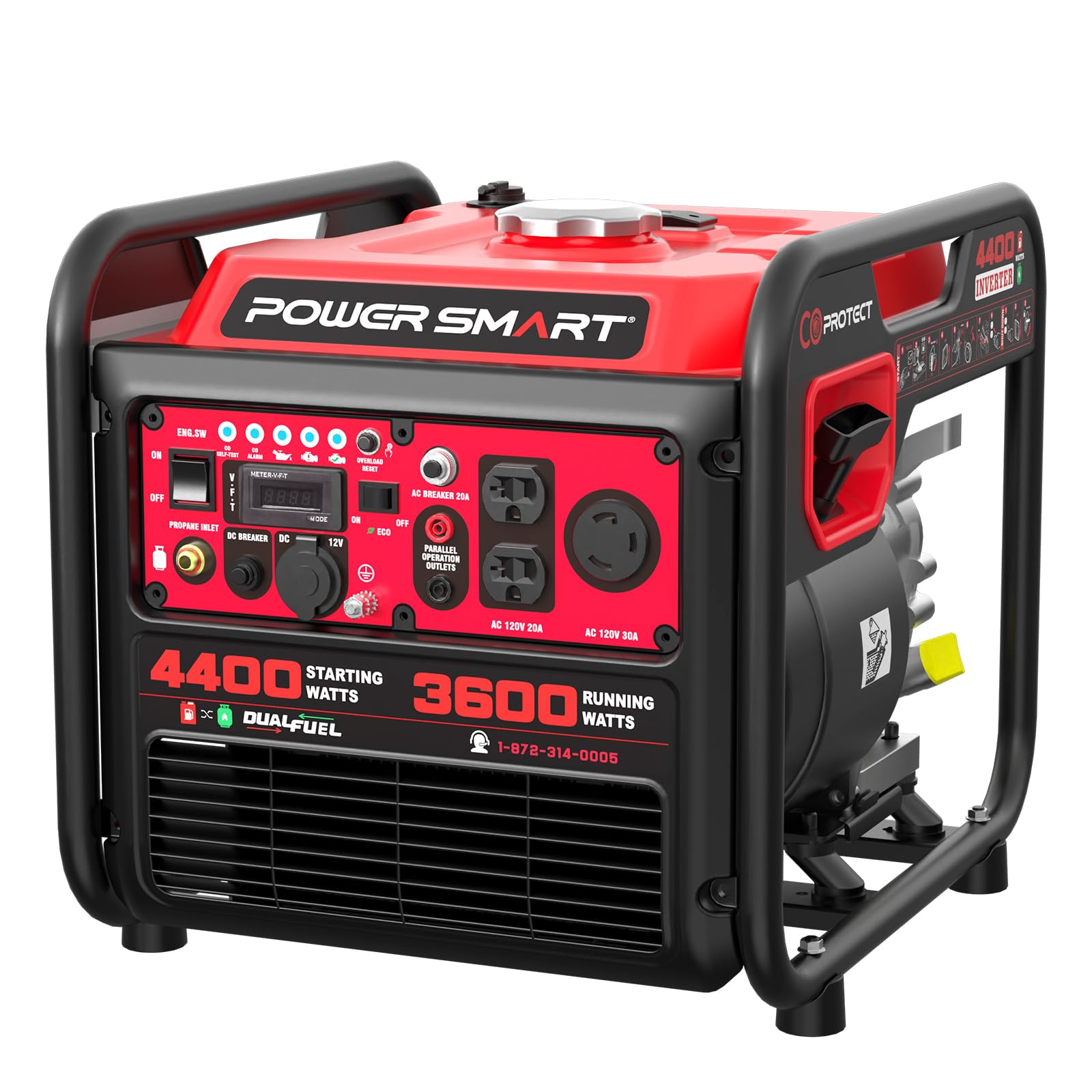
The PowerSmart 4400W dual-fuel inverter generator offers the fuel flexibility of propane and gasoline at a budget-friendly price point. The 223cc engine produces 4,400 starting watts and 3,600 rated watts, providing enough surge capacity for a pop-up camper’s AC while leaving headroom for lights, refrigerator, and device charging. The 1.6-gallon fuel tank delivers up to 11 hours of runtime at 25% load.
The CO sensor, low oil shutdown, and overload protection are all built into the control panel, making this a safety-conscious choice for campsite use. The unit weighs 61.3 pounds, which is heavier than closed-frame suitcase inverters but still manageable with the integrated handle. The dual-fuel capability means you can run on propane during storage-heavy periods and switch to gasoline when you need maximum power output.
Owners describe the unit as well-made and deliverable in perfect condition. The 76 dBA noise level at 23 feet is louder than premium inverters, so larger campgrounds with strict noise policies may require careful placement or use of the eco-mode setting. Some reliability concerns appear in user reviews, so attention to break-in procedure and maintenance is important.
Why it’s great
- Dual-fuel for fuel flexibility and storage ease
- 4400 peak watts covers AC, fridge, and lights
- CO sensor and low oil shutdown for safety
Good to know
- Noise level of 76 dBA may exceed quiet campground limits
- Some users report reliability issues after limited use
FAQ
Can a 2200-watt generator run a pop-up camper air conditioner?
Is propane better than gasoline for a pop-up camper generator?
How many watts do I need for my pop-up camper generator?
What is the quietest generator for a pop-up camper?
Do I need an inverter generator for my pop-up camper?
Final Thoughts: The Verdict
For most users, the best generator for pop up camper is the Champion 4000W Inverter because it delivers the power needed for a full pop-up camper load while weighing under 49 pounds and running quietly enough for campground rules. If you want the dual-fuel flexibility of propane storage, grab the WEN DF360iX for its CO Watchdog safety and tool-free LPG connection. And for pure whisper-quiet campsite operation with Honda-level reliability, the Honda EU2200i Companion is the ultimate choice for smaller pop-up loads. Each tier offers a clear path to the power solution that matches your camping style.