
Snapping off a trophy bass or walleye because your line frayed on a rock or split on a hook-set is a frustration every freshwater angler knows. The wrong spool can turn a perfect day on the lake into a constant retying session. That is why the core difference between landing a personal best and losing your favorite lure often comes down to one choice — the filament connecting you to the fish.
I’m Mohammad Maruf — the founder and writer behind Drink4Good. I’ve spent years analyzing tackle construction, breaking down tensile strength ratings, abrasion resistance claims, and memory characteristics across braid, mono, and fluorocarbon chemistries to match lines to real fishing conditions.
Whether you are flipping jigs in heavy cover or casting crankbaits over open water, the right spool determines sensitivity, castability, and knot reliability. This guide delivers a clear breakdown of the top contenders for the best freshwater fishing line on the market right now.
How To Choose The Best Freshwater Fishing Line
Freshwater fishing line selection comes down to three interlocking factors: the cover you fish in, the lures you throw, and the species you target. No single spool does everything well. Understanding the trade-offs between stretch, visibility, diameter, and abrasion resistance is the difference between a frustrating day of wind knots and a smooth session of solid hooksets.
Material Makes the Difference: Braid vs. Mono vs. Fluoro vs. Hybrid
Monofilament offers stretch and shock absorption, making it forgiving for beginners and ideal for topwater lures where some give is useful. Braid delivers zero stretch, maximum sensitivity, and a thin diameter for the same breaking strength, but its high visibility usually requires a leader. Fluorocarbon is nearly invisible underwater, sinks faster than mono, and has high abrasion resistance, but it is stiffer and retains more memory. A hybrid line blends nylon and fluorocarbon to balance stretch, invisibility, and durability into one spool.
Breaking Strength and Diameter Ratio: The Real Metric
The pound-test on a spool is only half the story. A 30-pound braid is roughly the same diameter as 8-pound mono, allowing you to pack more line on a reel and cast lighter lures. Conversely, a cheap 20-pound mono might be as thick as a reputable 30-pound mono from a premium brand. Always check the stated diameter in inches or millimeters — that number, not the pound rating, determines how the line handles on your spool and through your guides.
Match the Line to Your Water and Technique
Heavy cover like lily pads, wood laydowns, and thick hydrilla calls for braid in the 30- to 50-pound range with a short fluorocarbon leader for invisibility. Open water cranking or jerkbait fishing benefits from a low-stretch mono or hybrid in 10- to 17-pound test for controlled depth and good shock absorption. Finesse techniques like drop-shot or Ned rig demand a thin, sensitive braid (8- to 15-pound) or a direct fluorocarbon connection to feel the lightest bites through slack line.
Quick Comparison
On smaller screens, swipe sideways to see the full table.
| Model | Category | Best For | Key Spec | Amazon |
|---|---|---|---|---|
| PowerPro Spectra Fiber Braided | Braid | All-around sensitivity & durability | 0.005 in diameter at 8 lb | Amazon |
| Daiwa J-Braid 8-Strand | Braid | Finesse & spinning reels | 8-carrier Dyneema weave | Amazon |
| Yo-Zuri Hybrid 600-Yard | Hybrid | Multi-purpose value spool | Nylon-fluorocarbon molecular bond | Amazon |
| Seaguar STS Salmon Fluoro | Fluorocarbon | Abrasion-resistant leader material | 100% fluorocarbon with 30 lb test | Amazon |
| Sufix Siege 330-Yard | Mono | Low-memory monofilament casting | 15x abrasion resistance claim | Amazon |
In‑Depth Reviews
1. PowerPro Spectra Fiber Braided Fishing Line

The PowerPro Spectra Fiber line is the benchmark that other braids measure against. Its Enhanced Body Technology produces a round, smooth profile that slices through guide rings without friction and lays flat on the spool, making it equally effective on spinning reels and baitcasters. The high strength-to-diameter ratio — 8-pound test measures just 0.005 inches — lets you pack more line onto a reel for long casts on open water while maintaining the sensitivity to feel a bluegill exhale a worm on a drop-shot.
Abrasion resistance is the standout feature here. Anglers fishing rocky river shoals and fast current report the line takes abuse from submerged logs and riprap without fraying or weakening. The moss green color blends well with stained to moderately clear freshwater, reducing the need for a leader in many situations. The EZ Spool system on certain models simplifies spooling directly from the box and includes a built-in line cutter, a small convenience that saves time on the boat ramp.
One consistent note from experienced users: avoid overfilling the spool. Leaving about an eighth-inch of headroom on the reel prevents the wind knots that can occur with any zero-stretch braid when the line billows during a cast. A quality braid scissors is also recommended, as standard nail clippers struggle with Spectra fibers. For a balanced all-around braid that handles everything from deep cranking to flipping mats, this is the standard.
Why it’s great
- Round, smooth profile casts far through any guide type
- Exceptional abrasion resistance on rocks and wood
- Usable directly without a leader in many water clarities
Good to know
- Requires careful spool filling to avoid wind knots
- Needs a sharp braid cutter for clean line snips
2. Daiwa J-Braid 150M 8-Strand Woven Round Braid Line

Daiwa’s J-Braid uses 8 carrier strands of Dyneema fiber woven into a round, soft profile that handles like sewing thread on a spinning reel. That suppleness is the defining characteristic — it unspools with virtually no coil memory, meaning finesse presentations like a 1/16-ounce Ned rig or a shaky head get maximum distance with minimal thumbing effort on a baitcaster. The dark green color is subdued enough for direct-tie scenarios in clear-water lakes where a separate leader might spook wary bass.
Knot strength is a frequent point of praise from walleye and smallmouth anglers. The 8-strand weave cinches down evenly without bunching, holding a Palomar or improved clinch knot securely under heavy tension. At 30-pound test, the diameter is roughly equivalent to an 8- to 10-pound monofilament, giving you the thin profile needed for deep jigging while retaining enough margin to muscle a fish out of brush. Reviewers consistently note it holds up well against snakehead teeth and rocky bottom without visible fraying.
One trade-off is that the limpness that makes it cast beautifully can also cause the line to weave through the tip guide during a slack-line cast, creating a momentary loop that requires untangling. Spooling with consistent tension and using a mono backing to fill the arbor helps mitigate this. The 150-meter length is generous for one reel, but if you fish multiple setups, the 300-meter spool is a more economical choice for the second fill.
Why it’s great
- Exceptionally limp and supple for silky-smooth casting on spinning gear
- Holds knots securely without slipping or bunching
- Thin diameter relative to breaking strength for deep-water finesse
Good to know
- Soft weave can occasionally loop through tip guides
- 150-meter spool fills one reel; consider bulk for multiple rigs
3. Yo-Zuri Hybrid 600-Yard Fishing Line

Yo-Zuri Hybrid occupies a unique space on the shelf: a patented molecular bond of nylon and fluorocarbon that lands between a pure mono and a pure fluoro in performance. The result is a line that is noticeably clearer than standard nylon, sinks faster than mono for getting crankbaits to depth quickly, and retains less stretch than conventional mono for more direct hookset power. The 600-yard spool at 40-pound test is a lifetime supply for most anglers, making it the most economical per-yard choice on this list.
In real use, the hybrid character shows in its handling. The line has some memory — it will hold a coil shape if left on the reel for days — but a short stretch before casting works it out effectively. Anglers targeting steelhead in rivers report it rarely snaps on hookups, which speaks to the impact absorption that remains despite the reduced stretch. The clear color works well across a range of water clarities, and the UV and water resistance give it a longer usable life on the reel compared to budget monofilaments.
The weight of a 600-yard spool of 40-pound line may feel excessive if you fish only ultralight gear, but for the angler running multiple reels for bass, pike, or catfish, it allows you to spool two or three rigs from one purchase. Users consistently call it their go-to multi-purpose line because it ties well, resists abrasion reasonably well around docks and rocks, and sits at a price point that makes replacing it at season’s end painless.
Why it’s great
- Molecular blend reduces stretch compared to mono while retaining shock absorption
- Clear color near-invisible underwater for pressured fish
- 600-yard bulk spool delivers the best per-yard cost in the lineup
Good to know
- Some coil memory requires a gentle stretch before each trip
- 40-pound diameter is heavier than equivalent braid, limiting spool capacity
4. Seaguar STS Salmon 100% Fluorocarbon Fishing Line Leader

Seaguar’s STS Salmon is engineered specifically for leader duty in freshwater scenarios where abrasion resistance is non-negotiable. The 100 percent fluorocarbon construction gives it a refractive index extremely close to water, making it all but invisible in clear rivers and lakes. The 30-pound test on the reviewed spool is a sweet spot for salmon, steelhead, and large bass: stiff enough to resist abrasion from gill plates and log jams, yet supple enough to thread through lure eyes without kinking.
The real-world feedback from river anglers is emphatic. Fishermen pulling king salmon out of fast current around submerged timber report that STS outlasts other fluorocarbon leaders they have tested, with fewer break-offs at the knot and less fraying where the line contacts structure. The smaller diameter compared to equivalent mono means your crankbaits and spoons track true without the water resistance of a thicker leader pulling them off course. The 100-yard spool provides enough material for several seasons of leader changes, even for frequent anglers.
It is worth noting that this line is purpose-built as a leader material. It is stiffer than a braid or mono main line, so spooling a full reel with it is not the intended use — expect some memory if you try to use it as a main line on a spinning reel. The trade-off for that stiffness is the superior abrasion defense that earns its reputation on snag-heavy structure. For anglers who fish braid and tie on a leader, this is the premium choice for the connection.
Why it’s great
- Extreme abrasion resistance against gill plates, rocks, and wood
- Near-invisible underwater thanks to low refractive index
- Smaller diameter than mono for better lure action
Good to know
- Designed as a leader, not a main line — can be stiff on casting reels
- 100-yard spool is generous for leaders but not for full reels
5. Sufix Siege 330-Yards Spool Size Fishing Line
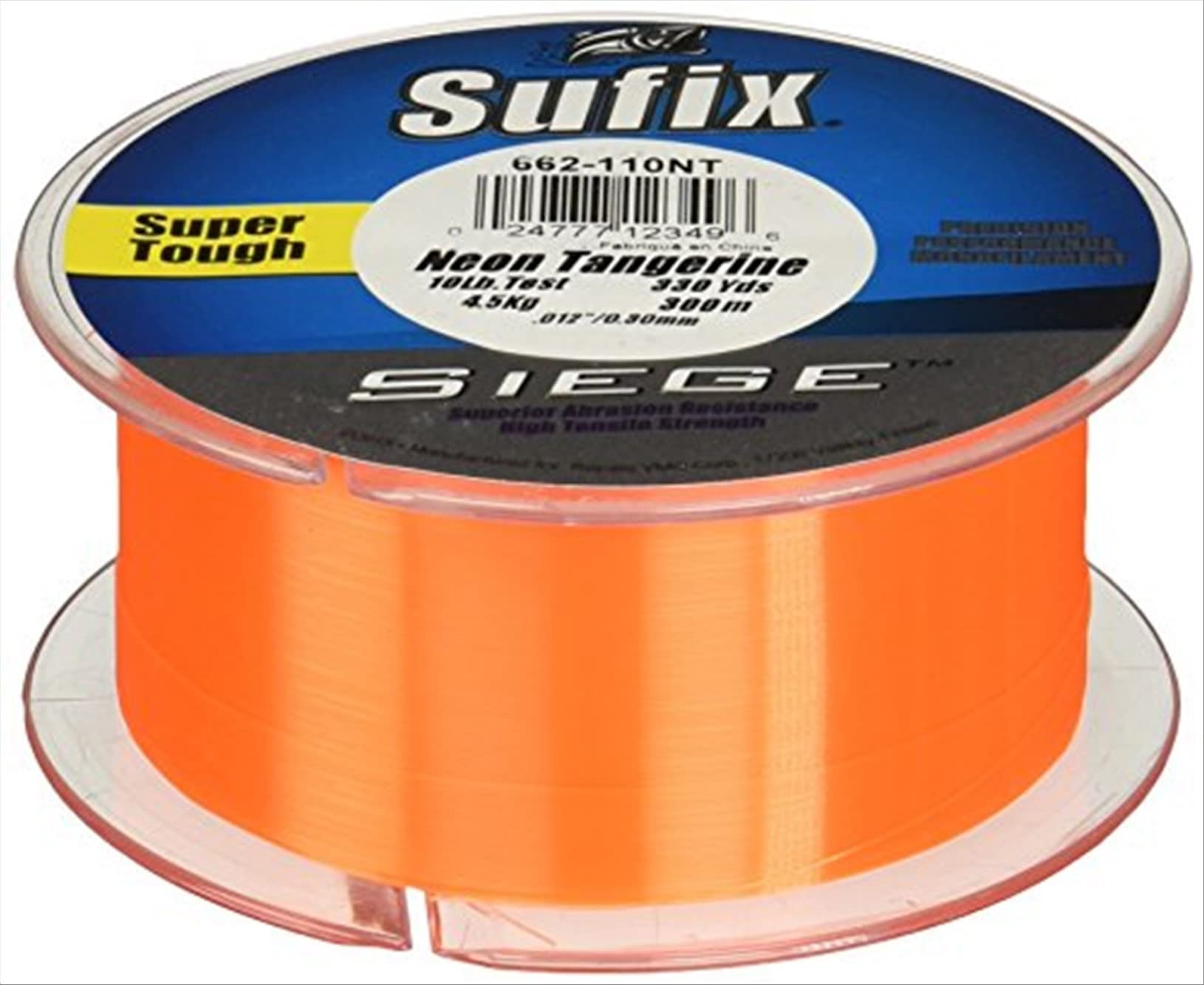
Sufix Siege is a monofilament that punches above its price tier by addressing the two biggest complaints about budget mono: memory and abrasion resistance. The proprietary extrusion process produces a line that has noticeably less coil memory than standard nylon, even after sitting on a baitcaster spool for weeks. This means fewer backlashes from line springing off the spool, particularly important for anglers fishing light lures in the 1/4- to 3/8-ounce range where cast control is critical.
The 15-times greater abrasion resistance claim, while hard to verify in absolute terms, holds up in real use around boat docks, riprap, and submerged stumps. The Neon Tangerine color is a specific advantage for strike detection — the high-vis hue makes it easy to track line movement against dark water or vegetation, giving you an extra split second to react to a subtle pickup. Users fishing swim jigs and Texas rigs in stained water report significantly higher hookup ratios because they can see the line twitch before they feel the thump.
The 20-pound breaking strength on the 330-yard spool is versatile for bass, pike, and walleye, offering enough backbone for flipping into cover while maintaining the suppleness needed for good casting loops. Like any monofilament, it is not immune to UV degradation over extended sun exposure, so storing reels out of direct sunlight will prolong its life. For anglers who prefer the stretch and forgiving nature of mono but want an upgrade in memory and durability, Sufix Siege delivers a tangible performance lift without a premium price.
Why it’s great
- Very low coil memory for a monofilament, reducing backlash
- High-vis Neon Tangerine color improves visual strike detection
- Abrasion resistance that outlasts standard mono around cover
Good to know
- Neon color is highly visible to fish; a leader may benefit in clear water
- UV exposure will weaken the line over time like all monofilaments
FAQ
Is braid better than fluorocarbon for freshwater bass fishing?
How often should I replace freshwater fishing line on my reel?
Final Thoughts: The Verdict
For most users, the best freshwater fishing line winner is the PowerPro Spectra Fiber Braided Fishing Line because it delivers unmatched strength-to-diameter ratio, proven abrasion resistance, and versatile performance across techniques. If you want a dedicated finesse-focused braid for spinning gear, grab the Daiwa J-Braid 8-Strand. And for bargain hunters covering multiple reels with one buy, nothing beats the value of the Yo-Zuri Hybrid 600-Yard spool.