
Nothing erodes a home inspection report’s credibility faster than a missed gas leak. Whether it’s a faint whiff of mercaptan near a furnace or a zero-reading on a pressure test, the difference between a safe home and a ticking liability often comes down to the sensor in your hand. A detector that false-alarms on every cleaning solvent or goes deaf to a 50 ppm methane leak wastes billable hours and erodes client trust.
I’m Mohammad Maruf — the founder and writer behind Drink4Good. My analysis of gas detection hardware focuses on sensor longevity, calibration traceability, and real-world response behavior across residential and light commercial environments.
After weighing sensor technology, build toughness, and detection range across nine models, I’ve narrowed the field to the most reliable tools for professional use. Here is my curated selection of the best gas detector for home inspectors that balances accuracy, durability, and practical field features.
How To Choose The Best Gas Detector For Home Inspectors
Home inspectors face a unique challenge: they need a device sensitive enough to catch a pinhole leak but selective enough to ignore background vapors like cleaning sprays or fresh paint. Choosing wrong means either chasing false positives or walking past a real hazard. Here are the specific factors that separate a field-worthy tool from a gadget.
Sensor Type: Catalytic vs. Electrochemical vs. Infrared
Catalytic bead sensors are the workhorses for combustible gases like methane and propane, but they require oxygen to function and can be poisoned by silicone vapors or high concentrations of certain compounds. Electrochemical sensors excel for toxic gases (CO, H₂S) and offer better specificity but have a finite electrolyte lifespan. Infrared sensors are immune to poisoning and last longer, but they cost more and are less common in handheld form factors for inspectors. For broad-spectrum combustible sniffing, a catalytic sensor with a field-replaceable cartridge is the pragmatic choice.
Detection Range and Resolution
Not all detectors display a numeric PPM reading — some simply increase a ticking sound or flashing light. For an inspector documenting a leak, a digital readout in parts per million (PPM) provides defensible evidence. A detector that reads down to 1 ppm for methane allows you to differentiate a trace background reading from a dangerous concentration above 10% LEL (roughly 50,000 ppm for methane). Make sure the device you choose offers a clear, real-time numeric display.
Probe Design and Reach
An 18-inch flexible gooseneck probe is worth its weight in lithium cells when you are reaching around a hot water heater or into a crawlspace void. A rigid probe limits access to valve stems and pipe junctions tucked behind drywall. Look for a probe that holds its position without drooping and includes a tip light for illuminating dark equipment alcoves.
Quick Comparison
On smaller screens, swipe sideways to see the full table.
| Model | Category | Best For | Key Spec | Amazon |
|---|---|---|---|---|
| Forensics FD-91-RED | Combustible | Single-gas pinpointing | Japan-made sensor, 7yr life | Amazon |
| TopTes Guard-101 | 4-Gas | Confined space entry | 0.5 sec response, 14hr runtime | Amazon |
| RIDGID 36163 CD-100 | Combustible | General inspection leak tracing | 16″ flexible probe, 3 alarms | Amazon |
| TopTes Guard-863Pro | 4-Gas | Multi-gas with data logging | O₂ sensor 5yr life, USB export | Amazon |
| UEi CD100A | Combustible | Probe-reach in tight spaces | 18″ gooseneck, tip light | Amazon |
| Forensics FD-4A | 4-Gas | NIST-traceable multi-gas work | NIST cal certificate included | Amazon |
| Fieldpiece DR58 | Refrigerant | HVAC refrigerant leak hunting | <0.03 oz/yr sensitivity | Amazon |
| BW MCXL-XWHM-Y-NA | 4-Gas | Ruggedized personal safety monitor | IntelliFlash, one-button operation | Amazon |
| Fieldpiece DR82 | Refrigerant | Precision infrared leak detection | 10yr sensor life, IR tech | Amazon |
In‑Depth Reviews
1. RIDGID 36163 CD-100 Micro Combustible Gas Detector

The RIDGID CD-100 is the tool most frequently spotted in a home inspector’s kit for good reason. It detects a wide range of combustible gases — methane, propane, butane, ethanol, ammonia, hydrogen — and uses a field-replaceable catalytic sensor to keep downtime minimal. The 16-inch flexible probe snakes around water heater exhaust vents and behind gas range connections with ease, and the tri-mode alarm (visual, audible, vibration) means you never miss a reading, even in a noisy mechanical room.
Users consistently report finding leaks down to single-digit PPM that other detectors and even utility technicians missed. The auto-calibration in fresh air is quick, and the adjustable sensitivity helps distinguish a tiny background trace from a dangerous leak. The ergonomic rubberized grip feels secure even with sweaty hands in a hot attic.
One common critique is the 10-minute auto-shutoff, which requires recalibration once you restart. And while the sensor is replaceable, the cost of a replacement cartridge is a factor over the long haul. For the working inspector, though, this is the most balanced package of sensitivity, build quality, and repair accessibility.
Why it’s great
- Field-replaceable sensor extends device lifespan
- Vibration alarm works well in loud environments
- Adjustable sensitivity minimizes false positives
Good to know
- Auto-shutoff after 10 minutes of inactivity
- No numeric PPM readout on base model
2. Fieldpiece DR82 Infrared Refrigerant Leak Detector

The Fieldpiece DR82 represents the pinnacle of refrigerant detection technology, using a non-dispersive infrared sensor that is immune to the poisoning and drift issues that plague heated diode and catalytic sensors. It detects micro-leaks down to less than 0.03 oz/year, which is 20 times more sensitive than traditional bubble testing. For an inspector dealing with modern A2L refrigerants or trying to find a slow HVAC leak, the DR82 is the gold standard.
The backlit LCD shows leak size and intensity, while a bright LED tip and adjustable beeper guide you directly to the source. The 10-year sensor lifespan dramatically reduces total cost of ownership compared to detectors that need annual sensor swaps. USB-C charging and a 10-plus hour battery life support full-day inspections.
The primary drawback is the price, which positions it as a specialist tool for inspectors who regularly encounter refrigerant systems. The included filter tips are effective but can feel restrictive — some users opt to slightly enlarge the pinhole for faster sampling. For pure combustible gas sniffing on natural gas lines, a less expensive catalytic detector makes more sense.
Why it’s great
- Infrared sensor won’t poison or drift like catalytic beads
- Finds leaks invisible to soap bubbles and cheaper sniffers
- Long 10-year sensor life reduces replacement costs
Good to know
- Premium price suitable only for frequent HVAC work
- Restrictive filter tip may slow response slightly
3. Forensics FD-4A 4-Gas Monitor

For inspectors who need documented proof of accuracy, the Forensics FD-4A arrives with a NIST-traceable calibration certificate in the box. This 4-gas monitor covers oxygen (O₂), carbon monoxide (CO), hydrogen sulfide (H₂S), and combustibles (LEL), using high-quality electrochemical sensors for the toxic gases and a catalytic bead for LEL. The detection error is specified at less than ±5% full scale.
The dual ABS and anti-slip rubber housing is waterproof, dustproof, and explosion-proof, making it suitable for crawlspaces and semi-confined areas. Adjustable audio, visual, and vibration alarms include a digital timestamp for logging exposure events. The device zeroes and spans for on-site calibration, though full recalibration requires bottled test gases.
Some users report initial concerns about the font quality on the monochrome display and minor grammatical errors in the manual, but customer service responded promptly to correct issues. For an inspector who wants a certifiable 4-gas monitor that won’t break the bank, this is a strong contender.
Why it’s great
- NIST-traceable certificate included for compliance
- Rugged, waterproof ABS housing survives drops
- Simultaneously monitors four critical gases
Good to know
- Annual recalibration with gas required
- Some units may need initial sensor QA
4. TopTes Guard-863Pro 4-Gas Monitor
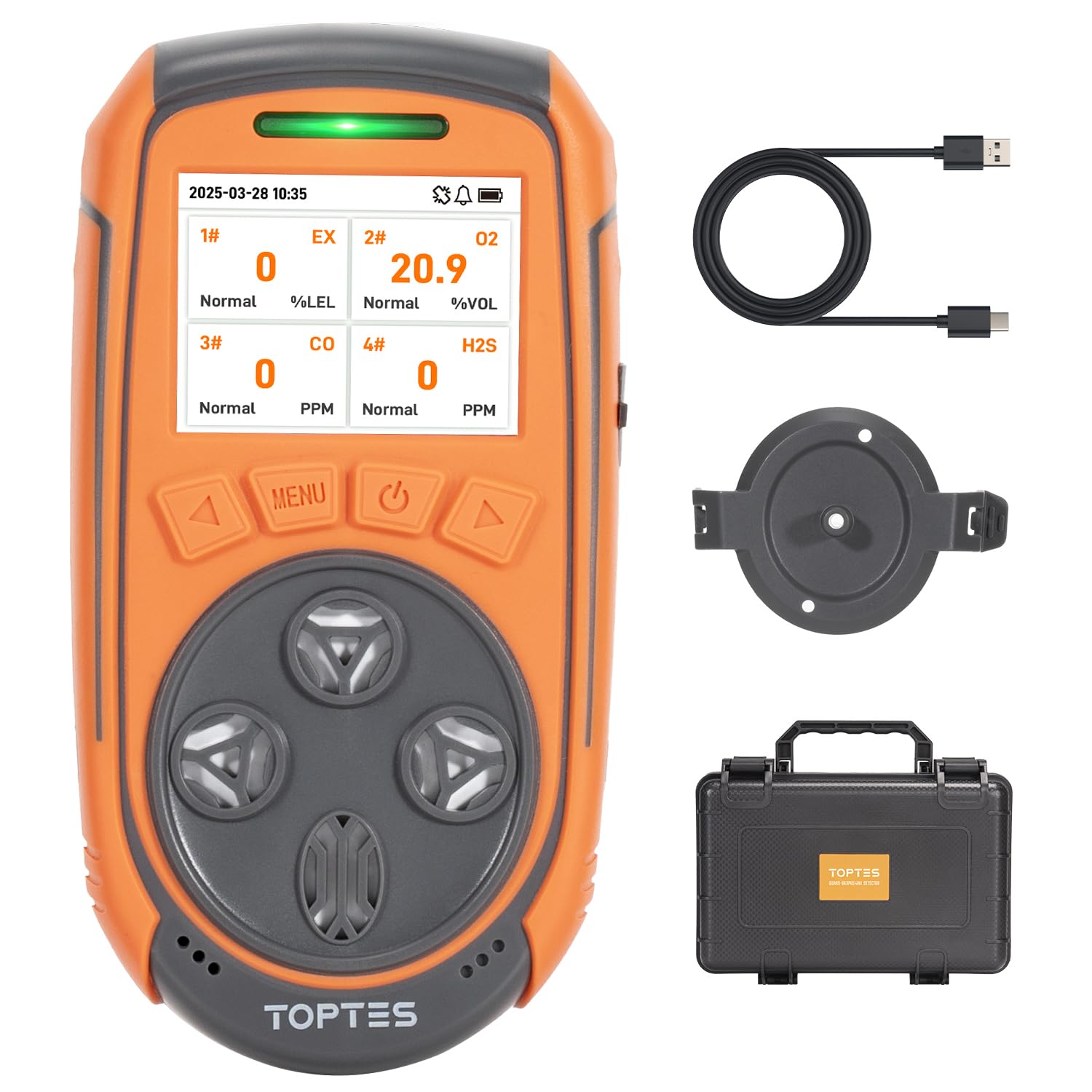
The TopTes Guard-863Pro is a modern 4-gas detector that trades the industrial monochrome display for a vibrant TFT color screen showing real-time gas concentration matrices and trend curves. It detects H₂S, CO, LEL, and O₂ with a 0.5-second response time, and the upgraded oxygen sensor boasts a 5-year lifespan — a significant improvement over the typical 2-year electrochemical sensor.
The USB data export function is a standout for inspectors who document readings: you can pull alarm records, fault logs, calibration history, and operation logs directly to a PC. The 18-hour battery life easily covers a full workday, and the 2.5-hour charge time means you can top it off during a lunch break. A password-protected menu prevents accidental setting changes in the field.
A few users reported charging issues with early units, though customer service addressed replacements. The PC software requires installation, and the manual could be clearer. For an inspector who values data logging and a bright, easy-to-read display, this is a compelling option.
Why it’s great
- TFT color screen shows gas trends and matrices
- USB data export for documentation
- 5-year O₂ sensor lifespan
Good to know
- PC software setup required for data export
- Charging reliability occasionally reported
5. UEi CD100A Combustible Gas Leak Detector

The UEi CD100A is a classic in the gas detection world, favored by HVAC techs and inspectors for its long 18-inch flexible gooseneck and bright tip light. It detects acetone, ammonia, butane, methane, natural gas, LPG, and jet fuel, making it versatile beyond just residential natural gas lines. The sensitivity dial allows you to manually adjust the tick rate to filter out background contaminants.
Unlike auto-zeroing detectors, the CD100A lets you set a baseline threshold manually, which experienced users prefer for distinguishing a small leak from normal ambient gas. It is faster than the traditional soap-bubble method and can detect concentrations as low as 50 ppm. The compact, lightweight design slips easily into a tool pouch.
The gooseneck is delicate — bending it too sharply can break the internal wire. It also lacks a numeric PPM display, so you rely on the increasing tick rate for leak severity. Some units ship with defective switches, so inspect promptly upon arrival. For the price and reach, it remains a solid secondary tool for inspectors.
Why it’s great
- Extra-long gooseneck reaches behind appliances
- Manual sensitivity adjustment prevents false alarms
- Lightweight and affordable
Good to know
- Gooseneck can break if bent too sharply
- No numeric PPM readout
6. Forensics FD-91-RED Gas Leak Detector

The Forensics FD-91 uses a catalytic sensor made in Japan and calibrated for methane, delivering reliable detection of natural gas, propane, alcohols, acetone, gasoline, diesel, and more. The ABS housing is rated to survive a 10-foot drop — a realistic test for an inspector working around ladders and roofs. The large color LCD includes a built-in thermometer, a helpful extra when checking appliance ambient conditions.
Users consistently praise its ability to detect leaks that were invisible to cheaper detectors or even to human smell, finding traces as low as single-digit PPM. The high/low sensitivity switch and mute button are useful in the field. It runs on 3 AAA batteries, which are included along with a cloth case.
The display can be dim in bright sunlight, and the battery compartment is secured by a screw — a minor inconvenience when swapping batteries quickly. The 7-year sensor life is excellent, but the 1-year warranty is shorter than some competitors. For inspectors focused on combustible gas pinpointing at a reasonable cost, the FD-91 is a strong performer.
Why it’s great
- 7-year sensor life with reliable Japan-made sensor
- Tough ABS housing survives 10ft drops
- Detects wide range of combustible gases
Good to know
- Display can be hard to read in direct sun
- Battery door requires screwdriver
7. TopTes Guard-101 4-Gas Monitor

The TopTes Guard-101 is an entry-priced 4-gas monitor that covers H₂S, CO, LEL, and O₂ with a fast 0.5-second response time. It uses three alarm modes (LED, vibration, and sound) that continue until gas levels normalize. The high-strength ABS housing is waterproof, dustproof, and explosion-proof, with a back clip for hands-free carrying in a crawlspace or attic.
Password protection with a default of “69” prevents accidental deactivation. The alarm record storage function lets you review monitoring data later. Users mention it works right out of the box, with one user successfully testing it on vehicle exhaust (CO alarm) and exhaled breath (O₂ alarm below 20%).
Reliability concerns surface in longer-term reviews — some units develop a continuous false low-oxygen alarm after a few months, even in fresh outdoor air. The sensitivity also appears less refined than premium monitors, potentially missing small leaks that a utility-grade detector catches. For the price, it is a useful budget-oriented backup or starter monitor.
Why it’s great
- 4-gas monitoring at a budget-friendly entry point
- Fast 0.5-second alarm response
- Includes password protection and data storage
Good to know
- Some units develop false low-O₂ alarms over time
- Sensitivity may miss very small leaks
8. BW Technologies MCXL-XWHM-Y-NA GasAlertMicroClip XL

The BW Technologies GasAlertMicroClip XL by Honeywell is a staple in industrial safety, and it translates well to demanding inspection environments. This 4-gas detector monitors H₂S, CO, O₂, and combustibles (LEL) with a simple one-button interface that minimizes training time. The green IntelliFlash LED provides at-a-glance compliance verification, and the rugged, impact-resistant composite case handles daily abuse.
The LCD simultaneously displays all four gas concentrations, battery level, and alarm status. The device is thin and lightweight, clipping comfortably to a belt or pocket. IntelliFlash also doubles as a visual operational check for safety managers.
A notable issue is sensor longevity — the O₂ sensor often needs replacement within 6-12 months, far short of the expected 5-year lifespan, and calibration failure rates of 40-50% have been reported in some batches. Repair costs can approach the replacement cost. The unit also requires bump testing and calibration gas for accurate operation, adding recurring expense. It is best for inspectors who already have a calibration station.
Why it’s great
- Extremely compact and lightweight
- IntelliFlash provides instant compliance check
- One-button operation is simple and intuitive
Good to know
- O₂ sensor may fail within 6-12 months
- Requires calibration gas and bump testing setup
9. Fieldpiece DR58 Heated Diode Refrigerant Leak Detector

The Fieldpiece DR58 uses a heated diode sensor to detect refrigerant micro-leaks as small as 0.03 oz/year, making it 20 times more sensitive than bubble testing. It works with all HFC, CFC, HCFC, HFO, and H₂N₂ (tracer gas) refrigerants and is A2L compatible. The IP54 rating resists moisture and oil ingress, a common issue when working around compressors.
The backlit LCD shows leak size and intensity, while the LED tip and beeping guide you directly to the source. The 17-inch flexible probe reaches into tight condenser coils. The 18-hour rechargeable battery via USB supports full workdays.
False positives can occur around strong odors like dryer sheets or soap, and the sensor is consumable. It is an excellent choice for HVAC-focused inspectors but overkill if you only inspect natural gas lines.
Why it’s great
- Detects microscopic refrigerant leaks
- IP54 rated for moisture and oil resistance
- Flexible 17-inch probe reaches tight spots
Good to know
- Sensor is consumable with 300-hour life
- Can false alarm on strong ambient odors
FAQ
How often should I bump test a gas detector for home inspection?
Can a single gas detector detect both natural gas and carbon monoxide?
What does a catalytic sensor poisoning mean and how to avoid it?
Final Thoughts: The Verdict
For most users, the best gas detector for home inspectors winner is the RIDGID 36163 CD-100 because it combines a field-replaceable sensor, flexible 16-inch probe, and tri-mode alarm in a package that handles the variety of leaks a home inspector encounters daily. If you want NIST-traceable certification and 4-gas coverage, grab the Forensics FD-4A. And for HVAC-focused inspectors hunting refrigerant micro-leaks, nothing beats the Fieldpiece DR82.