
A gas leak is a stealth threat — odorless, colorless, and potentially explosive. Relying on your nose or a cheap plug-in alarm leaves dangerous gaps in your home’s safety net. Whether you’re a homeowner, RV traveler, or service technician, the right tool means the difference between peace of mind and a catastrophic event.
I’m Mohammad Maruf — the founder and writer behind Drink4Good. I specialize in analyzing gas detection hardware, from sensor technology to alarm thresholds, filtering through years of market research to highlight detectors that actually perform when it counts.
This guide breaks down the top models for pinpointing combustible leaks, continuous home monitoring, and professional diagnostics to help you choose the best gas detector for your specific situation and budget.
How To Choose The Best Gas Detector
Selecting the right gas detector depends entirely on your environment — a homeowner checking a single gas stove has different needs than an RV technician hunting down a small propane leak inside a cabinet. You need to match the detector’s sensor type, alarm style, and detection range to the specific gases you face and the spaces you’re inspecting.
Handheld Sniffer vs. Plug-in Monitor
A handheld sniffer with a flexible probe is essential for pinpointing the exact location of a leak — think gas line connections, appliance fittings, or tight crawlspaces. A plug-in monitor, on the other hand, provides continuous 24/7 protection for an entire room, alerting you to dangerous buildup even while you sleep. Many households benefit from owning both: a monitor for constant awareness and a sniffer for troubleshooting and confirming repairs.
Sensor Technology: Catalytic vs. Semiconductor
Catalytic bead sensors are the gold standard for professional-grade detectors — they react to a wide range of combustible gases and offer better long-term stability and accuracy. Semiconductor sensors are more common in affordable consumer models; they are sensitive enough for most home applications but can drift over time and may give false positives from non-target vapors like alcohol or paint fumes. If you need precise %LEL readings for diagnostics, a catalytic sensor is the safer bet.
Detection Range and %LEL Readings
The Lower Explosive Limit (LEL) is the minimum gas concentration that can ignite. A detector that displays %LEL — showing you’re at 5% or 20% of that limit — gives you concrete data to assess risk and prioritize action. Basic models with only audible alarms force you to guess severity, while a digital %LEL readout lets you distinguish a minor fitting leak from a dangerous accumulation.
Quick Comparison
On smaller screens, swipe sideways to see the full table.
| Model | Category | Best For | Key Spec | Amazon |
|---|---|---|---|---|
| RIDGID CD-100 | Handheld Pro | Professional diagnostics | 16-inch flexible probe | Amazon |
| Kidde COPDLG | Plug-in Monitor | Whole-room safety | Low-level CO detection | Amazon |
| TopTes PT760 | Handheld Rechargeable | Hard-to-reach leak pinpointing | 12-inch extendable probe | Amazon |
| Kidde KN-COEG-3 | Plug-in Monitor | Budget whole-room protection | 9V battery backup | Amazon |
| Safe-T-Alert 35-742-BR | RV Monitor | 12V RV direct replacement | Flush mount, 12VDC | Amazon |
| TopTes PT205 | Handheld Pocket | Home DIY & RV use | %LEL digital readout | Amazon |
| TopTes PT299 | Handheld Extendable | Entry-level leak checking | Extendable rod, 6.3-inch | Amazon |
In‑Depth Reviews
1. RIDGID 36163 CD-100 Micro Combustible Gas Detector

This is the gold standard for anyone who needs serious diagnostic capability. The 16-inch flexible probe snakes into furnace compartments, behind stoves, and into crawlspaces that fixed-length sensors can’t reach. The catalytic bead sensor delivers reliable detection of methane, propane, butane, and more, with adjustable high/low sensitivity to distinguish between ambient background and a true leak.
Real-world feedback from homeowners and HVAC contractors confirms its ability to find leaks that even expensive utility equipment missed — one user tracked a 640+ ppm reading to a loose nut that soap spray confirmed instantly. The tri-mode alert system (visual, audible, and vibration) means you never miss a reading, even in noisy environments. The field-replaceable sensor also extends the tool’s lifespan well beyond cheaper units.
The only catch is the auto-shutoff after 10 minutes of inactivity, which requires a fresh calibration in clean air before each new search. But for professional-grade precision and build quality, this detector is in a league of its own.
Why it’s great
- Field-replaceable catalytic sensor for long service life
- 16-inch flexible probe reaches deep into tight spaces
- Vibration alert works where audible alarms can’t
Good to know
- Auto-shutoff after 10 minutes of inactivity
- Higher initial investment than consumer models
2. Kidde Carbon Monoxide + Explosive Gas Alarm, COPDLG (5th Edition)
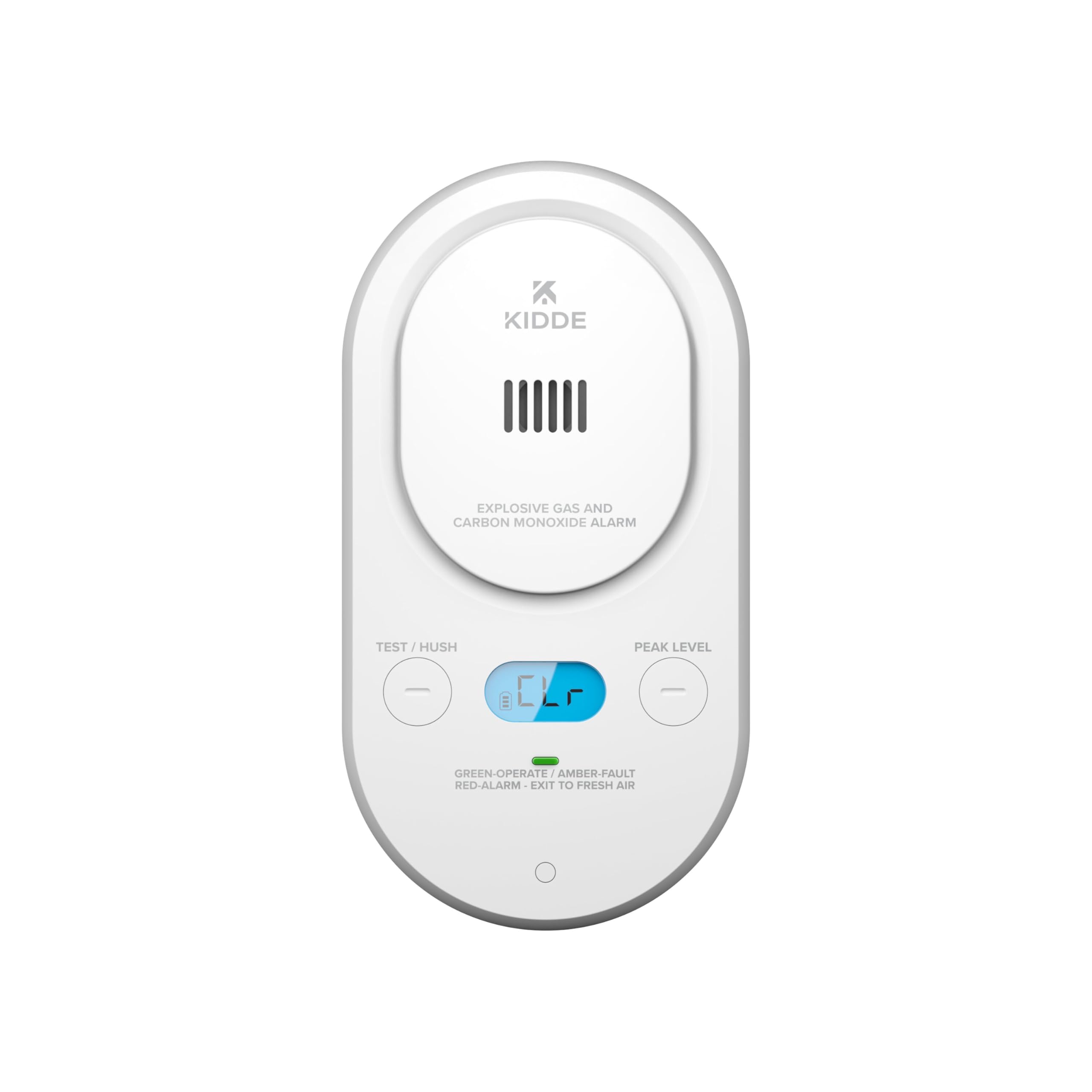
For continuous, around-the-clock protection, this plug-in monitor from Kidde is the clear choice. It detects both carbon monoxide and explosive gases (natural gas and propane) from a single wall outlet, with a backlit digital display that shows either CO concentration in ppm or the word “GAS” when a combustible leak is detected. The 5th Edition upgrade includes advanced low-level CO detection that alerts between 30–70 ppm — a critical feature for protecting young children, older adults, and pets who are more vulnerable to lower concentrations.
The rotating plug adapter fits both vertical and horizontal outlets, and the AA battery backup keeps the alarm active during power outages. At 85 dB, the alarm is loud enough to wake a household, and the peak-level memory records the last CO event for later reference. Multiple verified reviews confirm that this unit’s readings matched fire department equipment during real emergencies.
It’s worth noting that this is a fixed-position monitor, not a handheld sniffer — you can’t use it to trace a leak to its source. But for a permanent safety station in a hallway or near sleeping areas, this is the most versatile and future-proof option on the market.
Why it’s great
- Low-level CO detection alerts earlier than standard units
- Rotating plug fits any outlet orientation
- AA battery backup ensures 24/7 protection
Good to know
- Fixed location — cannot pinpoint leak source
- Requires an available wall outlet
3. TopTes PT760 Rechargeable Gas Detector

The PT760 strikes an excellent balance between professional features and a reasonable price. Its Type-C rechargeable battery eliminates the expense and waste of disposable cells — a single charge covers multiple inspection sessions. The 12-inch stainless steel telescopic probe extends to reach behind appliances, inside pipe chases, and into RV compartments, then retracts to a compact size for storage in the included protective case.
A catalytic sensor provides reliable %LEL readings from 1% to 20%, and the visual/audible alarm responds within 0.5 seconds. The built-in flashlight is a practical addition for dark crawlspaces and utility closets, and the automatic preheat in 30 seconds with a countdown timer keeps you informed. One experienced RV technician with 40 years in the field reported pinpointing a propane leak in under three minutes with this unit.
The ergonomic grip and durable build are clear upgrades over cheaper detectors, though the sensor is not field-replaceable like the RIDGID’s. For frequent home or RV use where rechargeability and probe reach matter most, this is a standout mid-range pick.
Why it’s great
- Type-C rechargeable — no battery waste
- 12-inch extendable probe for tight spaces
- Built-in flashlight for dark inspection areas
Good to know
- Sensor is not field-replaceable
- Upper detection limit is 20% LEL
4. Kidde KN-COEG-3 Carbon Monoxide & Explosive Gas Alarm

This is the proven workhorse for homeowners who want a straightforward, plug-in dual detector. The KN-COEG-3 monitors for both carbon monoxide and explosive gases (natural gas and propane) from a standard 120V outlet, with a 9V battery backup that keeps it running during blackouts. The digital LED display alternates between CO levels in ppm and the word “GAS” when a combustible leak is detected, giving you clear situational awareness at a glance.
The 85 dB alarm is loud enough to wake a household, and the peak-level memory function records the last CO reading so you can track events over time. Verified customers have reported life-saving scenarios where this unit’s readings matched fire department equipment exactly, confirming its accuracy. The compact 2.48-inch depth means it won’t block adjacent outlets, and installation is as simple as plugging it in.
The trade-off is the older sensor platform — the 5th Edition COPDLG offers low-level CO detection that this 3rd Edition model lacks. For typical home use in bedrooms or hallways, this is still a reliable and budget-conscious choice, but those with sensitive occupants should consider the upgraded version.
Why it’s great
- 9V battery backup for power outages
- Clear digital display shows CO or GAS status
- Simple plug-in installation
Good to know
- No low-level CO detection (only standard thresholds)
- Fixed location — not a handheld sniffer
5. Safe-T-Alert by MTI Industries 35-742-BR Dual LP/CO Alarm

If you own an RV or boat with a 12V electrical system, this flush-mount alarm is the ideal permanent monitor. The Safe-T-Alert 35 Series is purpose-built for recreational vehicles, detecting both propane and carbon monoxide from a single unit that runs directly off your 12V DC battery. The brown flush-mount design fits standard RV cutouts, and multiple customers confirm it’s a direct drop-in replacement for older MTI models with matching wire colors and screw hole locations.
The operational range of 12V ±15% and a wide temperature tolerance from -40°F to +158°F make it suitable for extreme climates. The low voltage power warning alerts you if the battery dips, which is critical for van-life and boondocking setups. The 108 mA current draw is minimal enough to leave on continuously without draining your house battery.
This detector is specifically designed for propane and CO — it won’t detect natural gas, so it’s not a universal home solution. It’s also battery-powered (12V system), not a handheld device. For RV owners needing a reliable, code-compliant replacement that fits existing cutouts, this is the right tool.
Why it’s great
- Direct replacement for older MTI RV alarms
- Runs on 12V with low power draw
- Wide temperature range for extreme environments
Good to know
- Detects LP and CO only — not natural gas
- Requires 12V system (not for standard homes)
6. TopTes PT205 Natural Gas Detector with %LEL Readout

The PT205 is a pocket-sized sniffer that packs a surprising amount of diagnostic capability for its size. It detects a wide range of combustible gases including methane, propane, butane, and natural gas, and its standout feature is the digital %LEL readout in a compact form factor. The adjustable alarm with a rising bar graph and red screen at high concentrations gives you real-time feedback on leak severity, not just a binary yes/no.
It runs on two AAA batteries (included), and the 30-second warm-up with a countdown timer is clearly displayed. The pen clip and non-slip texture make it easy to carry on a tool belt or pocket. A verified review from a professional user noted it found a tiny leak that expensive industrial detectors missed, saving thousands in unnecessary repairs. The 36-month manufacturer warranty also provides peace of mind that budget detectors rarely offer.
Like most handheld units, it’s a spot-check tool — not designed for continuous monitoring. Users also note it’s useless for sewer gas (hydrogen sulfide), so stick to what it’s built for: combustible gas leak location. For DIY homeowners and RV owners on a budget, this is a capable and compact choice.
Why it’s great
- %LEL readout in a pocket-sized device
- 36-month manufacturer warranty
- Pen clip for easy carry
Good to know
- Uses disposable AAA batteries
- Not effective for hydrogen sulfide (sewer gas)
7. TopTes PT299 Gas Leak Detector with Extendable Rod

The PT299 is a great entry-level sniffer that covers the basics without overwhelming the user. Its defining feature is the extendable rod that adjusts from 2.2 to 6.3 inches, giving you a little extra reach into tight spots around gas appliances, water heaters, and pipe joints. The visual alarm uses nine rising analog bars and a red screen to indicate gas concentration, paired with a 75 dB buzzer for audio confirmation.
It runs on two AAA batteries (included in the box) and comes with a storage bag and user manual. The 30-second warm-up and automatic power-off after 5 minutes help conserve battery life. Verified customer feedback is overwhelmingly positive, with multiple users confirming it detected real leaks in RV dryers, gas stoves, and pipe fittings that saved them from potential disasters. The non-slip grip texture also inspires confidence during use in awkward positions.
The trade-off for the low investment is a semiconductor sensor that may be less stable over years of use compared to catalytic models, and the lack of a %LEL numeric readout means you rely on a subjective bar graph. For a homeowner who wants an affordable way to check gas connections after DIY installations or annual maintenance, this is a solid starting point.
Why it’s great
- Extendable rod adds reach without extra bulk
- Visual bar graph is intuitive to read
- Includes batteries and storage bag
Good to know
- No %LEL numeric reading
- Semiconductor sensor may drift over time
FAQ
Can a gas detector distinguish between natural gas and propane?
How often should I replace a plug-in gas detector?
Final Thoughts: The Verdict
For most users, the best gas detector winner is the RIDGID CD-100 because its professional-grade catalytic sensor, flexible 16-inch probe, and tri-mode alarms make it the most capable leak finder available. If you want whole-room continuous protection, grab the Kidde COPDLG. And for an RV-specific permanent monitor, nothing beats the Safe-T-Alert 35-742-BR.