
Living off the grid demands a power solution that is as reliable as the sunrise. Whether you are powering a remote cabin, an RV, or a tiny home, the right generator separates a sustainable lifestyle from constant worry about running lights, well pumps, or medical devices.
I’m Mohammad Maruf — the founder and writer behind Drink4Good. My deep market research focuses on analyzing inverter topologies, battery cycle life, and fuel consumption metrics to match each generator to its intended real-world application.
This guide compares fuel-based and battery-based systems across wattage, runtime, and portability to help you find the right power partner. Here is the best generator for off grid living ranked by performance and value.
How To Choose The Best Generator For Off Grid Living
Choosing between a fuel-burning generator and a solar battery station starts with your daily energy draw. A gas inverter suits high-wattage needs like a well pump, while a LiFePO4 power station offers silent, zero-fume operation for overnight use. Consider your fuel supply chain and tolerance for noise.
Starting vs Running Watts
The single most important spec is starting wattage — many motors (pumps, fridges, A/C compressors) draw 3x their running wattage for a split second during startup. List your appliances’ starting watts (check the nameplate) and add a 20% safety margin.
Fuel Type and Storage
Gasoline degrades in 3-6 months, while propane stores indefinitely. Dual-fuel models like the WEN DF360iX let you switch between sources, giving you flexibility when resupply is uncertain. Battery stations like the BLUETTI AC200L require no fuel storage and can be recharged via solar panels.
THD and Clean Power
Total harmonic distortion under 3% is critical for running laptops, phones, and modern appliances with microprocessor controls. Inverter generators and battery power stations deliver clean sine wave output, while conventional open-frame units often exceed 5% THD, which can damage electronics over time.
Quick Comparison
On smaller screens, swipe sideways to see the full table.
| Model | Category | Best For | Key Spec | Amazon |
|---|---|---|---|---|
| Westinghouse 11000 Peak Watt | Dual Fuel Inverter | Whole-House Backup | 11000W peak / 9000W run (gas) | Amazon |
| Growatt Helios 3600 | Solar Power Station | Whole-Home Solar Backup | 3600Wh LFP, 3600W output | Amazon |
| EcoFlow DELTA Pro | Battery Power Station | High-Capacity Home Backup | 3600Wh LFP, 3600W output | Amazon |
| AFERIY 3840Wh Power Station | Solar Generator | Expandable Off-Grid Setup | 3840Wh LFP, expandable to 11.5kWh | Amazon |
| Jackery HomePower 3000 | Solar Generator | Lightweight 3kWh Setup | 3072Wh LFP, 3600W output | Amazon |
| BLUETTI Elite 200 V2 | Compact Power Station | Off-Grid RV & Cabin | 2074Wh LFP, 2600W output | Amazon |
| Anker SOLIX C2000 Gen 2 | Battery Power Station | Camping & Home Backup | 2048Wh LFP, 2400W output | Amazon |
| BLUETTI AC200L | Solar Generator | Expandable Mid-Size Power | 2048Wh LFP, 2400W output | Amazon |
| Jackery Explorer 2000 v2 | Portable Power Station | Ultralight 2kWh Travel | 2042Wh LFP, 2200W output | Amazon |
| WEN DF360iX | Dual Fuel Inverter | Budget Dual-Fuel Setup | 3600W peak / 2900W run (gas) | Amazon |
| Champion 4000-Watt Inverter | Lightweight Inverter | RV & Light Off-Grid | 4000W peak / 3000W run | Amazon |
In‑Depth Reviews
1. Westinghouse 11000 Peak Watt Dual Fuel Inverter Generator

For serious off-grid power, the Westinghouse delivers 11,000 peak watts on gasoline and 10,000 on propane, running your entire cabin including a well pump, heat pump, and dryer simultaneously. The remote electric start with a key fob saves you from pulling a cord in the rain, and the 9.8-gallon tank provides up to 17 hours of runtime under moderate loads.
The dual-fuel capability gives you fuel flexibility — propane stores indefinitely, while gas delivers full wattage. Power quality stays under 3% THD thanks to the inverter design, making it safe for sensitive electronics like a home server or medical equipment. The 240V 50A outlet is transfer switch ready, simplifying whole-house integration.
At 187 pounds with wheels and a foldable handle, it is movable but not portable for daily relocation. The CO sensor provides automatic shutdown for safety, and the 3-year warranty adds peace of mind for a long-term investment.
Why it’s great
- 11,000W peak powers an entire off-grid home
- Dual fuel with propane option for indefinite storage
- Remote start and 240V transfer switch ready
Good to know
- 187 pounds requires wheels and a flat path
- Included oil not rated below 23°F
2. Growatt Helios 3600 Portable Power Station
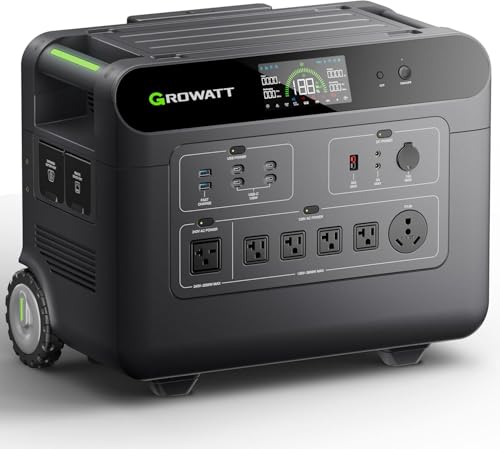
The Growatt Helios 3600 is a battery powerhouse designed for whole-home backup without fuel storage. Its 3600Wh LiFePO4 battery can be expanded up to 36kWh with additional units, and two units parallel for 240V/7200W output — enough to run an entire cabin through a transfer switch.
Fast 2000W solar charging refills the battery in under 2.8 hours, and the cold-start technology lets it operate down to -22°F, critical for winter off-grid living. The EPS switchover under 15ms ensures computers and medical devices stay on during grid blips. The Anderson port and NEMA TT-30 outlet make it RV-ready.
Weighing 51 pounds, it is surprisingly light for its capacity. The app provides TOU settings to prioritize solar charging and save on electricity costs. The 5-year service card and UL certification back its build quality for a decade of daily use.
Why it’s great
- Expandable up to 36kWh for whole-home backup
- Cold-start down to -22°F for winter use
- Fast 2000W solar charging in under 2.8 hours
Good to know
- Bluetooth/WiFi app reported finicky by some users
- 240V combiner disables EPS mode
3. EcoFlow DELTA Pro 3600Wh Power Station
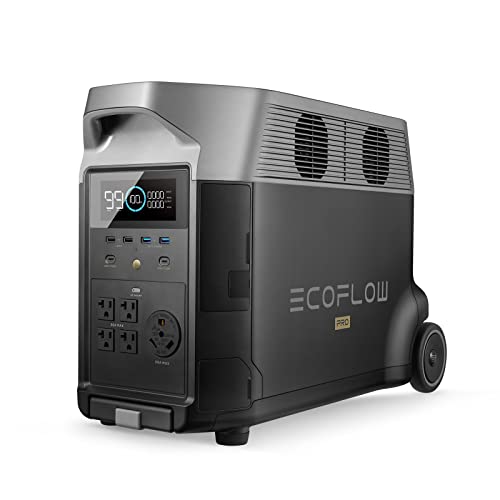
The DELTA Pro is the flagship battery station for high-wattage off-grid use. Its 3600W AC output can be boosted to 4500W via X-Boost, and pairing two units delivers 7200W for whole-home needs. The 3600Wh LFP battery lasts over 3,500 cycles to 80% capacity, giving you a decade of reliable service.
X-Stream fast charging replenishes the battery in 1.8 hours with a 240V outlet or 2.7 hours with a standard 120V wall outlet. Solar charging reaches 100% in 2.8 hours with four 400W panels. The 15 output ports include 5 AC outlets, USB-C 100W, and an Anderson port for flexible device charging.
At 99 pounds, it is best set up semi-permanently. The app provides full monitoring and scheduling. Users report flawless pass-through charging during outages, with quiet, fume-free operation that lets you run kitchen appliances for days with extra batteries.
Why it’s great
- 4500W X-Boost handles heavy tools and appliances
- Fast 1.8-hour recharge on 240V
- Expandable up to 25kWh with extra batteries
Good to know
- 99 pounds heavy for frequent moving
- Initial charge takes up to 7 hours on 120V
4. AFERIY 3840Wh Portable Power Station

The AFERIY packs 3840Wh of LFP capacity and 3600W continuous output in a wheeled cart with a pull handle, offering an excellent cost-per-watt-hour ratio for off-grid setups.
Recharging via AC reaches full capacity in about 1.5 hours, and the UPS under 10ms ensures seamless switchover during outages. The 15 output ports include AC outlets, USB-C PD, and an XT60 solar input. The dedicated app enables remote monitoring and scheduling.
At 80 pounds, the integrated wheels and handle make it surprisingly mobile. The 7-year support period and UL listing provide confidence for long-term ownership. Users praise the responsive customer support and value compared to comparable 10kWh systems from Jackery or EcoFlow.
Why it’s great
- Best price per Wh for large LFP capacity
- Expandable to 11.5kWh for extended off-grid
- Fast 1.5-hour AC recharge
Good to know
- 80 pounds with wheels still needs space
- Dust flap on outlets can be fiddly
5. Jackery HomePower 3000 Solar Generator
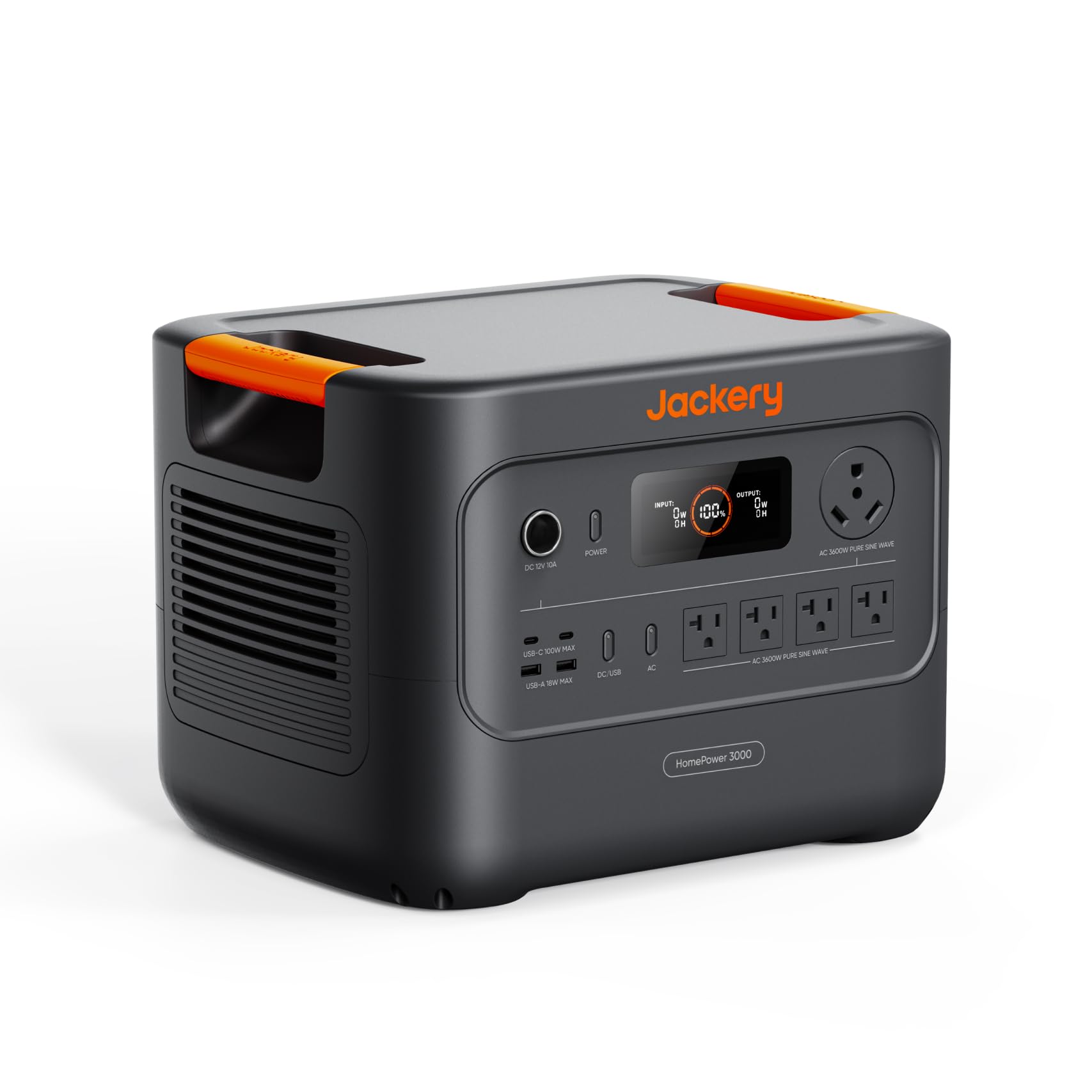
The Jackery HomePower 3000 uses proprietary CTB (Cell-to-Body) technology to achieve a 3kWh capacity in a frame that is 47% smaller and 43% lighter than competitors. At 59.5 pounds with a compact 16.4 x 12.8 x 12-inch footprint, it slides into an RV compartment or cabin corner easily.
With 3600W continuous output (7200W surge) and a built-in TT-30 RV port, it powers a 30-foot travel trailer’s AC, microwave, and fridge without breaking a sweat. The ChargeShield 2.0 AI algorithm extends the LFP battery to 4,000 cycles while retaining 70% capacity. Dual 100W USB-C PD ports charge laptops and drones at full speed.
Hybrid AC+DC charging refills in 1.7 hours. Users running 200W solar panels report 3+ days of dry camping power. The ≤20ms UPS certification keeps computers running through outages. Note that Jackery’s warranty only applies to units purchased directly from their website, not third-party sellers.
Why it’s great
- Lightest and smallest 3kWh power station available
- TT-30 RV port for plug-and-play camping
- 4,000 cycle lifespan with ChargeShield 2.0
Good to know
- Warranty limited to direct Jackery purchases
- Heavy enough to require two hands for carrying
6. BLUETTI Elite 200 V2 Portable Power Station

The Elite 200 V2 offers 2074Wh capacity and 2600W continuous output (3900W power lifting) in a compact body similar in size to the AC180 but with double the capacity. Its HyperWatt technology runs high-draw devices like hair dryers and coffee makers without tripping.
Standby power consumption is cut to just 10W — three times lower than similar stations — meaning less energy wasted when not under load. The LFP battery boasts over 6,000 cycles, giving a 17-year lifespan at daily use. Turbo Mode charges 0-80% in 50 minutes via dual AC+DC input.
At 53 pounds, it is portable enough for seasonal moves. The intuitive display and BLUETTI app control charging speed and noise. Users praise its ability to run mitre saws and shop vacs on job sites, and it serves as a quiet home backup compared to gas generators.
Why it’s great
- 3900W power lifting handles high-draw tools
- Ultra-low 10W standby power savings
- 6,000+ cycles for 17-year battery life
Good to know
- No 30A RV port
- Heavier than some 2kWh rivals
7. Anker SOLIX C2000 Gen 2 Power Station

The Anker SOLIX C2000 Gen 2 recharges from 0 to 100% in just 58 minutes — one of the fastest in its class. Its 2048Wh LFP battery and 2400W AC output (4000W peak) power a fridge, TV, and lights simultaneously, and standby drain is only 9W for extended runtime.
Add an expansion battery to reach 4kWh and run a fridge for 64 hours. The unit supports AC, solar, and car charging with an 800W alternator option that refills in 3 hours. At 41.7 pounds, it is 25% lighter than comparable 2kWh models.
The 15 ports include USB-C PD 100W and a 12V car outlet. Users report running a 30-quart fridge for 5-7 days on a single charge during camping trips. The sturdy build feels tank-like, and the app provides full system monitoring.
Why it’s great
- Full recharge in under 60 minutes
- 9W standby for longer real-world runtime
- 25% lighter than comparable 2kWh units
Good to know
- Expansion battery required for 4kWh capacity
- No hard-copy manual included
8. BLUETTI AC200L Portable Power Station

The AC200L is a mid-range beast that expands from 2048Wh to 8192Wh with BLUETTI B300 or B210 expansion batteries. Its 2400W AC output (3600W power lifting) runs an RV roof AC, fridge, and electronics simultaneously. The upgraded 2400W AC charging input hits 0-80% in just 45 minutes.
With 11 output ports including a 30A RV port and a 48V/8A DC port, it efficiently charges auxiliary batteries via the D40 voltage regulator. Solar input up to 1200W fully charges the unit in 1.7-2.2 hours. The ≤10ms UPS backup keeps security cameras and medical freezers online during outages.
At 61 pounds, it is best placed semi-permanently. Users praise the five-year warranty and 10+ year battery life. The proprietary AC charging cable is a minor inconvenience, but the versatile expansion options make it a favorite for growing off-grid setups.
Why it’s great
- Fast 45-minute 0-80% recharge
- 30A RV port for direct camper hookup
- Expandable to 8192Wh with multiple battery options
Good to know
- 61 pounds heavier than some competitors
- Proprietary AC charging cable
9. Jackery Explorer 2000 v2 Power Station

The Explorer 2000 v2 is the lightest 2kWh power station on the market at just 39.5 pounds, using CTB technology borrowed from EVs to shrink the footprint by 34% versus typical models. Its 2042Wh LFP battery and 2200W inverter (4400W surge) power a fridge, CPAP, and lights for a long weekend.
AC Fast Charging reaches 80% in 66 minutes, and Emergency Super Charging via the app fills the battery fully in 102 minutes. Solar charging with 400W panels completes in 6 hours. Silent Charging Mode operates below 30dB — ideal for overnight use in a camper van.
The 3 AC ports, USB-C 100W, and built-in flashlight with SOS mode make it a complete emergency companion. Users report powering a standard fridge for over 21 hours on a single charge, and the pass-through UPS switches in under 20ms without flickering connected devices.
Why it’s great
- Lightest 2kWh station at 39.5 pounds
- 34% smaller footprint than average
- 30dB Silent Mode for undisturbed sleep
Good to know
- Slow solar charge with small panels
- No TT-30 RV outlet
10. WEN DF360iX Dual Fuel Inverter Generator

The WEN DF360iX delivers 3600 surge watts (2900 rated) on gasoline and 3500 surge (2600 rated) on propane, offering dual-fuel flexibility at an entry-level price point. It runs a 15,000 BTU RV AC plus lights and fridge on propane, and the fuel shut-off simplifies carburetor maintenance.
At 49 pounds, it is one of the lightest dual-fuel inverters available, making it easy to load into a truck bed or RV storage compartment. The CO Watchdog sensor automatically shuts down the engine if dangerous carbon monoxide levels are detected, adding safety for enclosed camping setups.
The built-in display shows volts, frequency, runtime, and load percentage. It includes two USB ports for device charging and a TT-30R RV receptacle. Users note that the 20A outlets hold plug connectors a bit loosely, but praise its first-pull start and quiet 50-60 dBA operation.
Why it’s great
- Light dual-fuel at only 49 pounds
- CO Watchdog auto-shutdown for safety
- Fuel shut-off extends gas storage life
Good to know
- 20A outlets have loose plug retention
- Barely handles larger RV AC units
11. Champion 4000-Watt RV Ready Inverter Generator

The Champion 4000-Watt inverter is a petrol-only workhorse that delivers 4000 starting watts and 3000 running watts at under 49 pounds — making it one of the lightest full-size inverters available. It runs a 15,000 BTU RV AC plus lights and fridge for hours, though a microwave overloads it.
Noise output is a quiet 64 dBA from 23 feet, suitable for campgrounds or close neighbors. The parallel kit allows connecting with a second Champion unit to double output. CO Shield auto shutoff provides peace of mind, and clean power under 3% THD protects sensitive electronics.
The TT-30R outlet plus a 20A household duplex and 12V automotive outlet support diverse loads. The 3-year warranty and free lifetime technical support are industry-leading. Users report first-pull starts and no oil burn after a 55-hour break-in period, making it a dependable option for light off-grid and RV use.
Why it’s great
- Under 49 pounds for a 4000W inverter
- 64 dBA quiet enough for campgrounds
- Parallel capable for double output
Good to know
- Gasoline only, no propane option
- Will not run a microwave with RV AC running
FAQ
Can a generator run 24/7 for off-grid living?
What size generator do I need for a cabin?
Is dual fuel better than single fuel?
How long does a LiFePO4 battery last off-grid?
Final Thoughts: The Verdict
For most users, the best generator for off grid living winner is the Westinghouse 11000 Peak Watt because it delivers whole-house power with dual-fuel flexibility, remote start, and clean inverter output. If you want silent, zero-fume power without fuel storage, grab the Growatt Helios 3600. And for a budget-friendly entry into dual-fuel backup, nothing beats the WEN DF360iX for lightweight portability and propane option.