
Finding a generator that can reliably run a 15,000 BTU RV air conditioner without tripping the 30-amp breaker is the single most frustrating challenge for serious campers and boondockers. The market is flooded with units that claim “RV Ready” on the box but fail to sustain a steady 120-volt, 30-amp output under load. Without a dedicated TT-30R receptacle and a true continuous wattage rating above 3,000 watts, your afternoon siesta turns into a sweaty nightmare.
I’m Mohammad Maruf — the founder and writer behind Drink4Good. I’ve spent months analyzing inverter generator specs, load-test data, and customer reliability reports across budget, mid-range, and premium tiers to identify the models that deliver genuine 30-amp RV compatibility rather than marketing promises.
The right choice delivers clean sine-wave power below 3% THD, a dedicated TT-30R 30-amp outlet, and sustained runtime that matches your camping itinerary. After researching the entire market, I built this guide to help you find the best generator for 30 amp rv whether you are upgrading from a smaller unit or buying your first boondocking power station.
How To Choose The Best Generator For 30 Amp RV
Selecting the right generator for a 30-amp RV outlet involves more than just peak wattage numbers. You need a unit that can sustain a continuous 30-amp draw, produce clean power for sensitive electronics, and operate quietly enough for campground compliance. Here are the three critical factors that determine whether a generator will actually work with your rig.
Dedicated TT-30R Outlet vs. Adapting a 120V Household Plug
Many budget generators include a standard 5-20R household receptacle and expect you to use a “dogbone” adapter to connect to your RV’s 30-amp shore power cord. This approach works in a pinch, but the 20-amp breaker on that outlet will trip if you try to draw the full 30 amps your RV needs to run the air conditioner plus other loads. A generator with a factory-installed TT-30R outlet gives you the full 120-volt, 30-amp pass-through that matches your RV’s electrical system.
Surge vs. Running Wattage for RV Air Conditioners
A 13,500 BTU RV air conditioner typically needs around 2,800 to 3,200 surge watts to start the compressor, then drops to roughly 1,500 to 2,000 running watts. A 15,000 BTU unit requires even more. If the generator’s surge rating is too close to the AC’s startup draw, the overload protection will kick in and the generator will shut down. Look for a model with at least 3,600 surge watts and 3,000 running watts for reliable single-AC operation.
Fuel Type and Runtime Profile
Gasoline generators offer the lowest upfront cost and highest watt-per-pound ratio, but they require careful fuel storage and carburetor maintenance. Dual-fuel models let you switch to propane, which burns cleaner and stores indefinitely — a major advantage for infrequent campers. Battery power stations like the Jackery 2000 v2 provide silent, emission-free operation, but their 2,042 Wh capacity limits runtime to roughly 3-5 hours under a 30-amp AC load before needing a recharge. Match the fuel type to your typical camping duration and access to refueling.
Quick Comparison
On smaller screens, swipe sideways to see the full table.
| Model | Category | Best For | Key Spec | Amazon |
|---|---|---|---|---|
| Champion 4000W Inverter | Inverter | Lightweight AC reliability | 3,000W running / 48.1 lbs | Amazon |
| Westinghouse iGen8200TFc | Tri-Fuel Inverter | Whole-RV backup with 50A | 8,200W peak / 298cc engine | Amazon |
| Honda EU3000iS | Premium Inverter | Ultra-quiet extended stays | 50-57 dBA / 19.6h runtime | Amazon |
| Cummins Onan P4500I | Inverter | Dual parallel 50A setup | 4,500W peak / remote start | Amazon |
| Jackery Explorer 2000 v2 | Battery Station | Silent overnight CPAP & fans | 2,042Wh LiFePO4 / 39.5 lbs | Amazon |
| Generac GP3300i | Inverter | Household essentials + RV | 3,300W / 59.5 lbs | Amazon |
| WEN DF360iX | Dual-Fuel Inverter | Propane flexibility | 3,600W surge / 49 lbs | Amazon |
| Pulsar PGD40ISCO | Inverter | Budget-friendly AC power | 4,000W peak / 47.3 lbs | Amazon |
| Westinghouse 2550W Dual Fuel | Dual-Fuel Inverter | Lightweight propane runs | 2,550W peak / 42.4 lbs | Amazon |
| PowerSmart 3600W Inverter | Inverter | Balanced value for beginners | 3,600W surge / 50.7 lbs | Amazon |
| WEN 56360i | Inverter | Ultra-light weekend trips | 3,600W surge / 46 lbs | Amazon |
In‑Depth Reviews
1. Champion Power Equipment 4000-Watt RV Ready Inverter Generator

The Champion 4000-watt inverter generator hits the sweet spot between portability and raw AC-starting capability. Weighing just 48.1 pounds with 3,000 running watts, it is one of the lightest units in the 4,000-watt class — a critical advantage when you are loading it into an RV storage compartment or truck bed. The built-in TT-30R outlet delivers the full 30-amp capacity your RV expects, and the CO Shield auto-shutdown system adds safety peace of mind during long boondocking sessions.
Real-world owners report that this generator runs a 15,000 BTU RV air conditioner plus lights and a refrigerator without issue, though running the AC and microwave simultaneously will trigger the overload reset. At 64 dBA from 23 feet, it is quieter than an open-frame unit but not the quietest in this lineup — expect conversation-level noise at 10 feet. The parallel kit compatibility lets you double output with another Champion 4,000-watt inverter if you ever upgrade to a larger rig requiring 50 amps.
The 1.3-gallon fuel tank provides up to 10 hours of runtime at 25% load, which translates to roughly 5 hours of continuous AC operation. Owners consistently praise the first-pull start and the free three-year warranty with lifetime technical support. The 120V 25A TT-30R outlet combined with a 20-amp duplex outlet covers both the RV shore power cord and a separate extension cord for camp accessories.
Why it’s great
- Industry-leading 48.1-pound weight for 3,000 running watts
- Factory TT-30R outlet eliminates need for adapter cable
- CO Shield auto-shutdown rated for safety compliance
Good to know
- Cannot run AC and microwave simultaneously without tripping overload
- 64 dBA is audible from adjacent campsites in quiet hours
2. Westinghouse 8200 Peak Watt Tri-Fuel Inverter Generator
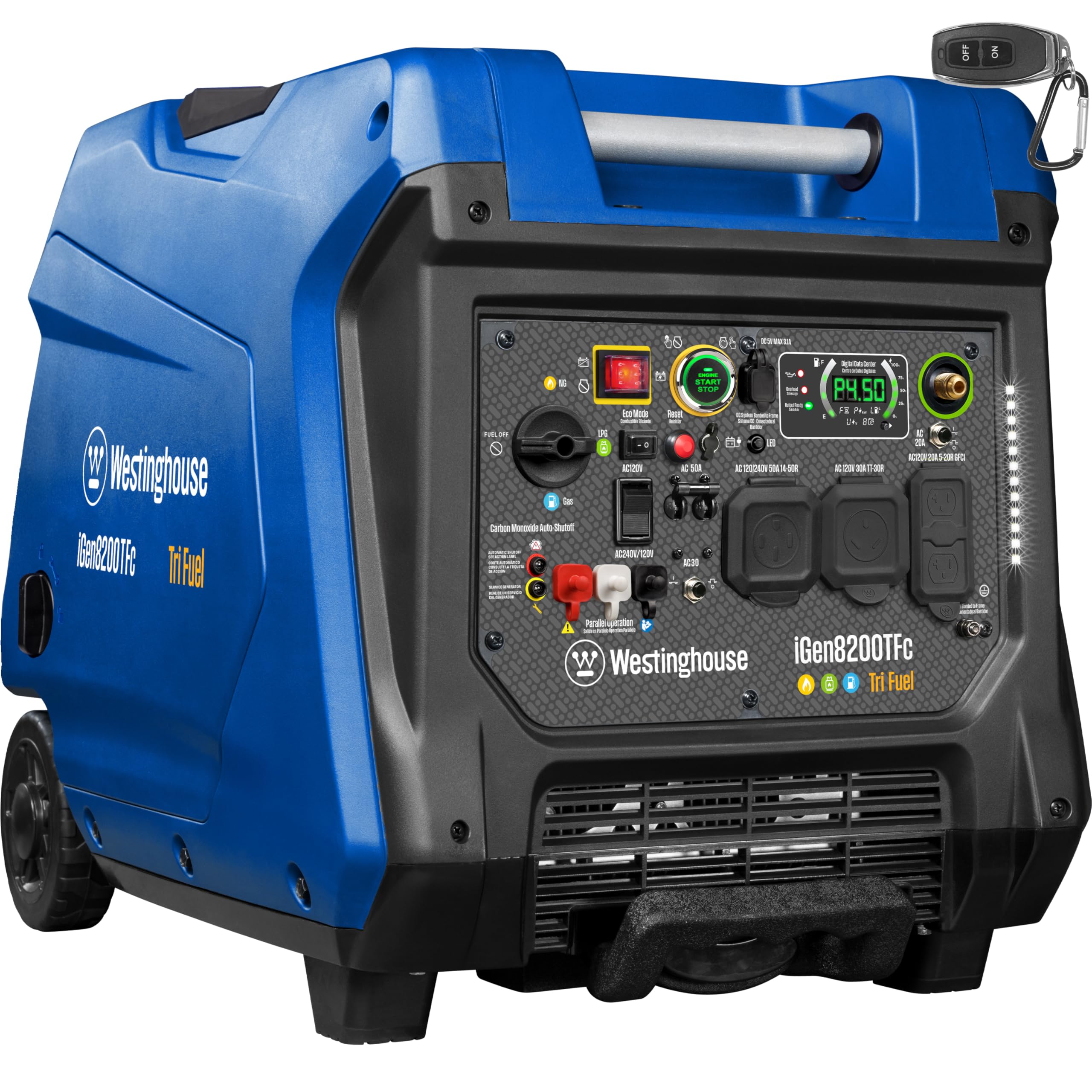
The Westinghouse iGen8200TFc is the most versatile high-output option in this guide, offering tri-fuel capability — gasoline, propane, and natural gas — plus a 14-50R 50-amp outlet for full RV or home backup power. With 8,200 peak watts on gasoline and a 298cc engine driving a pure copper-wound alternator, this inverter generator can run a 50-amp fifth wheel or an entire home’s essentials, including a 15,000 BTU air conditioner, refrigerator, furnace fan, and lights simultaneously.
At 134.5 pounds, this is not a unit you toss into a truck bed without help, but the wheel kit and fold-down handle make rolling it to the campsite manageable. The remote electric start via key fob means you can fire it up from inside the RV on cold mornings without braving the weather. Owners report instant start on propane, whisper-quiet 60 dBA operation at 25% load, and a comprehensive front panel that includes a 50A outlet, a 30A TT-30R outlet, and a duplex 20A GFCI outlet.
The 3.9-gallon fuel tank delivers up to 17 hours of runtime at 25% load on gasoline, dropping to roughly 12 hours on propane. Less than 3% THD keeps your RV’s electronics, TVs, and laptop chargers safe from voltage spikes. The CO sensor automatically shuts down the generator if dangerous levels accumulate, a critical feature when running it near the RV’s living compartment.
Why it’s great
- Tri-fuel flexibility for indefinite propane or natural gas run time
- 50-amp 14-50R outlet supports 50A RVs and transfer switches
- Remote electric start with key fob
Good to know
- Heavy at 134.5 pounds — mobility aids recommended
- Premium price positions it outside casual camper budgets
3. Honda EU3000iS 3000 Watt Inverter Generator
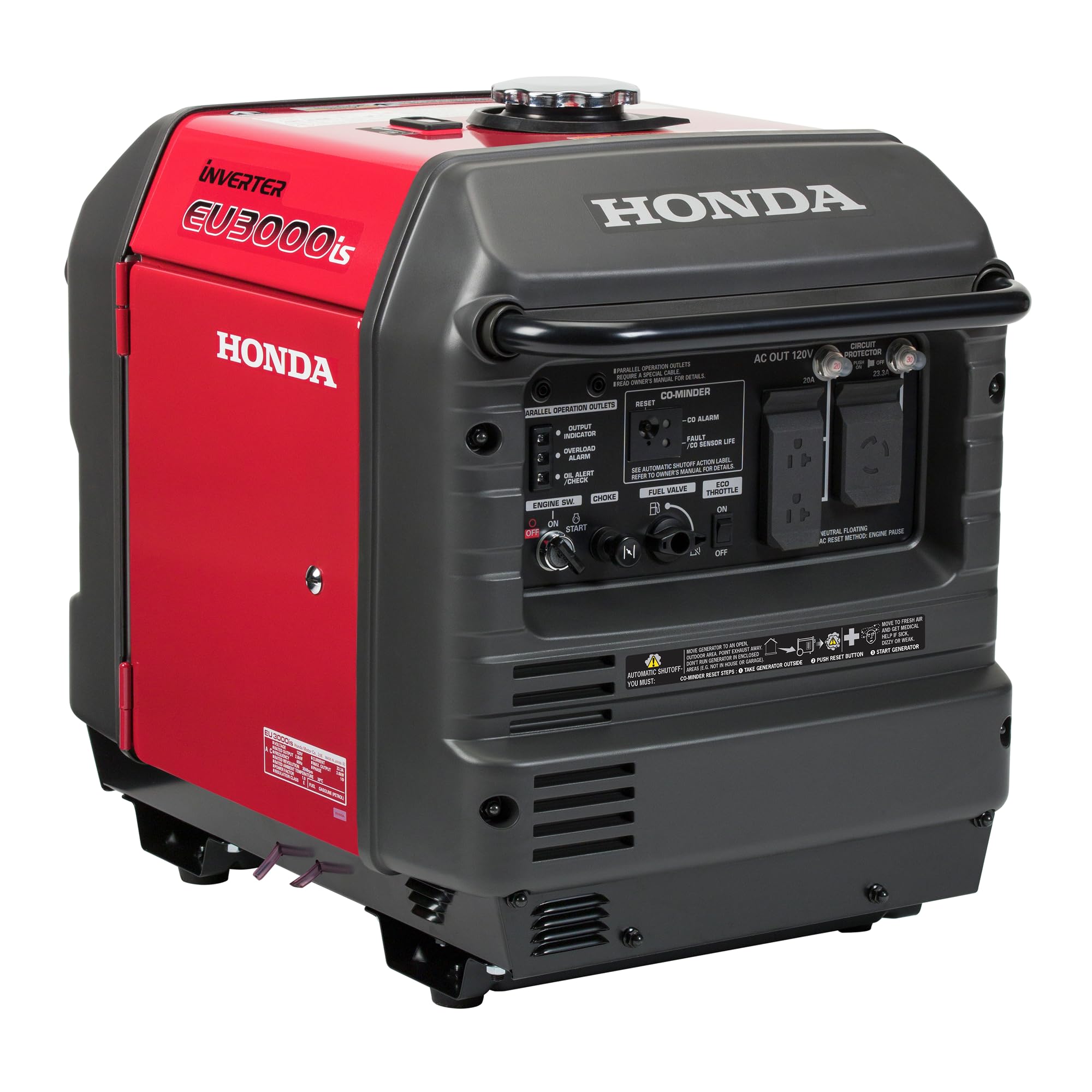
The Honda EU3000iS remains the gold standard for noise-sensitive RV camping. Operating at just 50 to 57 dBA — quieter than a normal conversation — this generator will not disturb neighboring campsites or violate quiet-hour restrictions in state parks. The 196cc Honda GX engine with Eco Throttle automatically adjusts engine speed to match the load, extending the 3.4-gallon fuel tank to a staggering 19.6 hours at 25% load, which covers a full overnight and most of the next day without refueling.
Despite its 3,000 rated watts, the EU3000iS reliably starts most 13,500 BTU RV air conditioners thanks to Honda’s advanced inverter technology delivering clean sine-wave power below 3% THD. The electric start with recoil backup ensures reliable starting in any weather. At 144 pounds, it is heavier than the Champion or Westinghouse inverter units, but the built-in handle and dolly-style wheels make rolling it to the RV storage compartment manageable on flat ground.
The CO-MINDER carbon monoxide detection system continuously monitors CO levels and shuts down the generator before dangerous concentrations accumulate. Owners consistently report 7,000+ hours of trouble-free operation with regular oil changes, making this the most durable generator in this guide. The TT-30R outlet is standard, though you will need to verify that your specific RV AC unit’s surge draw does not exceed the 3,000-watt surge ceiling — some 15,000 BTU units with hard-start capacitors may require a soft-start kit.
Why it’s great
- Best-in-class noise level at 50-57 dBA
- 19.6-hour runtime on a single tank in Eco Throttle mode
- Honda GX engine proven for thousands of hours
Good to know
- 144-pound weight requires wheels for any distance
- 3,000 surge watts may need a soft-start kit for 15,000 BTU ACs
4. Cummins Onan P4500I Portable Inverter Generator
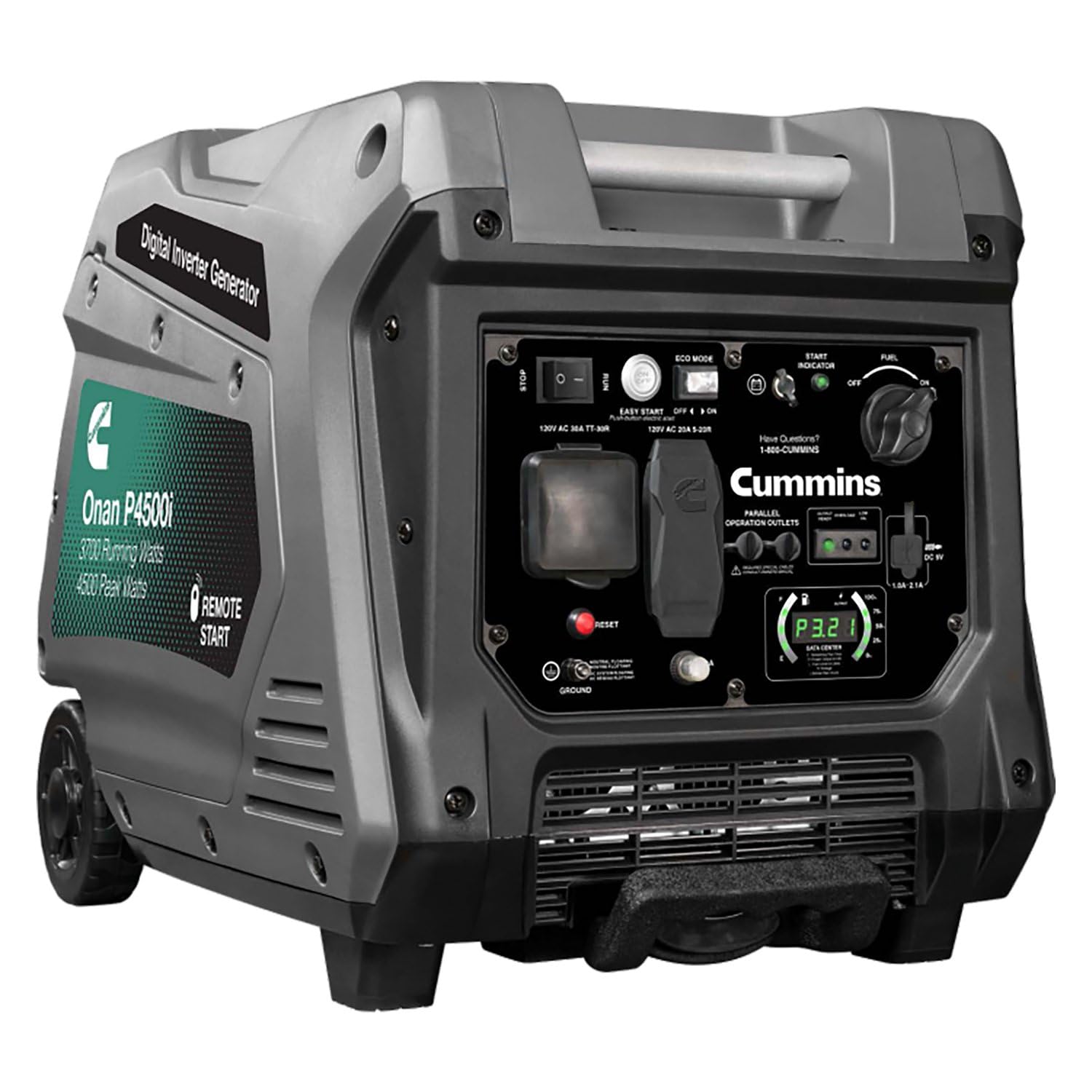
The Cummins Onan P4500I brings 4,500 peak watts and 3,500 running watts to the table, backed by a reliable 224cc OHV engine and a remote start feature that has become a fan favorite among RV owners. The push-button electric start with pull-cord backup makes cold-morning starts effortless, and the remote fob lets you fire up the generator from inside the RV without stepping outside — a game-changer during rain or cold weather.
At 98 pounds, the P4500I is substantially lighter than the Honda EU3000iS while offering 500 more running watts. The parallel capability allows you to connect a second P4500I to achieve up to 50 amps of combined output, suitable for larger RVs or simultaneous AC-plus-microwave operation. The built-in TT-30R outlet handles the 30-amp RV shore power connection directly, and the dual 5V USB ports keep mobile devices charged without dedicated power bricks.
Owners highlight the quiet operation — noticeably lower than open-frame units — and reliable starting even in sub-zero temperatures. The voltage stays rock-steady at 120V under varying loads, which protects your RV’s converter and sensitive electronics from brownout damage. The luggage-style handle glides smoothly over gravel and rough terrain, though the oil-change access panel alignment has been noted as slightly awkward on some units. Cummins backs this generator with solid support infrastructure, confirming its reputation as a workhorse for serious boondockers.
Why it’s great
- Remote start fob for easy cold-weather operation
- Parallel capable for 50-amp output with second unit
- 98-pound weight balances portability with 3,500 running watts
Good to know
- Oil-change panel alignment can be finicky
- Luggage handle less robust on rough terrain
5. Jackery Explorer 2000 v2 Portable Power Station

The Jackery Explorer 2000 v2 represents the battery-power alternative for RV owners who want absolutely silent, fume-free operation at night. With 2,042 watt-hours of LiFePO4 capacity and a 2,200-watt pure sine wave inverter, this power station can run a CPAP machine, RV furnace fan, lights, and a small refrigerator for 8–10 hours without needing a recharge. At just 39.5 pounds, it is the lightest “generator” in this guide by a wide margin, and the Car Trunk Body (CTB) technology makes it 34% smaller than typical 2kWh units.
The 20-millisecond uninterruptible power supply (UPS) switching means your RV’s converter and sensitive electronics never experience a brownout or flicker when transitioning from shore power to battery. Three AC outlets, two USB-C PD 100W ports, and a DC carport give you plenty of connectivity options. The silent charging mode operates below 30 dB, which is virtually inaudible at night — perfect for campsites with strict noise curfews or dispersed boondocking where generator noise would disturb wildlife.
Fast AC charging fills the battery from 0 to 100% in about 102 minutes in emergency super-charging mode, or you can solar charge with 400W panels in roughly 6 hours in direct sunlight. The Jackery app lets you monitor battery status, adjust charging speed, and see estimated runtime remaining. While you cannot run a 15,000 BTU air conditioner continuously on battery power alone — the 2,042Wh capacity would drain in about 90 minutes under a 1,500W AC load — the Explorer 2000 v2 excels as a silent companion for overnight essentials in combination with a gas generator for daytime AC use.
Why it’s great
- Zero emissions and silent operation — no noise complaints
- 39.5 pounds is the lightest power option available
- UPS switching protects RV electronics during transitions
Good to know
- Cannot run RV air conditioner for more than ~90 minutes
- Requires solar panels or shore power for recharging off-grid
6. Generac GP3300i Portable Inverter Generator

Generac’s GP3300i leverages the brand’s home standby generator engineering to deliver a portable inverter that feels built to last. The PowerRush Advance Technology provides over 50% more starting capacity than the generator’s rated output, meaning the unit can surge past its 3,300-watt peak to reliably start an RV air conditioner or a well pump without tripping. TruePower Technology ensures less than 3% THD, so your laptop, phone chargers, and RV entertainment system are safe from dirty power.
At 59.5 pounds, the GP3300i is heavier than the Champion 4,000-watt inverter but lighter than the Honda EU3000iS. The full enclosure design makes it notably quiet — owners consistently describe it as “whisper quiet” compared to open-frame generators. The COsense technology automatically shuts down the generator if carbon monoxide levels rise, adding a layer of safety when operating near RV windows or vents. The 1.3-gallon fuel tank provides roughly 7–9 hours of runtime under moderate loads, dropping to about 5 hours when running an AC continuously.
The front panel includes a TT-30R RV outlet, two USB ports for device charging, and LED indicators for low oil, overload, and ready-to-use status. Economy Mode automatically adjusts engine speed to reduce fuel consumption and noise when loads are light. While some owners report that the unit works better as a home backup than a daily RV generator due to the 3,300-watt peak being marginal for 15,000 BTU ACs at altitude, it remains a solid choice for smaller RVs or as a lightweight supplement to a larger unit.
Why it’s great
- PowerRush technology provides extra starting capacity for AC compressors
- Full enclosure design keeps noise levels impressively low
- Generac brand reliability for home and RV backup
Good to know
- 59.5 pounds is heavier than some competitors at similar power
- 3,300W peak may barely start some 15,000 BTU ACs at altitude
7. WEN DF360iX Dual Fuel Inverter Generator

The WEN DF360iX is the strongest dual-fuel entry in this guide, offering 3,600 surge watts on gasoline and 3,500 surge watts on propane with a 2,900/2,600 running watt split. The tool-free LPG quick-connector makes switching between fuel sources effortless — you can run on gasoline during the day and switch to propane overnight for cleaner, longer-lasting operation. The 149cc engine is quiet enough for normal conversation-level noise, as confirmed by the US Department of Health and Human Services standards.
At 49 pounds, the DF360iX is remarkably light for a dual-fuel inverter, easily portable between the truck bed and the campsite. The WEN Watchdog CO Shutdown Sensor automatically shuts off the generator if dangerous carbon monoxide levels are detected, which is critical when operating the unit near the RV’s living space. The front panel features a TT-30R RV receptacle, two three-prong 120V receptacles, one 12V DC receptacle, and two 5V USB ports — enough connectivity for AC power plus device charging simultaneously.
Owners consistently praise the digital display that shows volts, frequency, runtime hours, and load percentage in real time — a feature typically found on more expensive premium generators. The fuel shut-off valve lets you run the carburetor dry before storage, extending the engine’s life by preventing gumming. The 1.3-gallon fuel tank delivers about 5 hours runtime under heavy AC loads on gasoline, or roughly 4 hours on propane. The included three-year warranty adds confidence for long-term ownership.
Why it’s great
- Dual-fuel with tool-free LPG quick-connector for easy switching
- 49-pound weight is lightest among dual-fuel inverters
- Full digital display with voltage, load, and runtime data
Good to know
- 2,900W running on gas is marginal for larger 15,000 BTU ACs
- Some 20A outlets reported to hold plugs loosely
8. Pulsar PGD40ISCO 4000W Inverter Generator

The Pulsar PGD40ISCO punches above its weight class by delivering 4,000 peak watts and 3,200 running watts in a package that weighs only 47.3 pounds — making it one of the lightest 4,000-watt class generators available. The 145cc 4-stroke engine is parallel-ready, and the 59 dBA noise rating (at quarter-load) is competitive with models costing twice as much. The 1-gallon fuel tank provides roughly 4 hours of runtime at half load, which translates to about 2–3 hours of continuous AC operation.
Owners who have logged 300+ hours on this unit report reliable first-pull starts even at elevations up to 8,000 feet, though some note that the fuel cap can vapor-lock in direct sun — a simple quarter-turn crack resolves the issue. The 59 dBA noise level is noticeably louder than premium units like the Honda EU3000iS, but for an entry-level inverter generator, the sound profile is more of a low hum than the harsh rattling of open-frame units.
The front panel includes a TT-30R RV outlet, two 120V household outlets, and two USB ports. A soft-start kit is strongly recommended if you plan to run a 13,500 or 15,000 BTU AC unit, as some owners report the 4,000-watt surge is barely sufficient without one. The included three-year warranty is generous for this price tier, though Pulsar’s customer service response times have been mixed in user reports. Overall, the PGD40ISCO represents the most accessible entry point for RV owners who need 30-amp capability on a tight budget.
Why it’s great
- 47.3 pounds is remarkably light for 4,000 surge watts
- 59 dBA noise rating is quiet for the price tier
- Parallel-ready for doubling output with a second unit
Good to know
- 1-gallon tank limits continuous AC runtime to ~2–3 hours
- Soft-start kit recommended for reliable AC startup
9. Westinghouse 2550W Dual Fuel Inverter Generator

The Westinghouse 2550W Dual Fuel inverter is the lightest unit in this guide at just 42.4 pounds, making it the go-to choice for solo campers, motorcycle adventurers, or anyone who prioritizes packability above all else. With 2,550 peak watts on gasoline and 2,090 peak on propane, this generator is designed for smaller RVs, teardrop trailers, and van conversions rather than full-size 30-foot Class A motorhomes. The 52 dBA noise output is genuinely conversation-level, meeting the strictest campground quiet-hour requirements.
The 1.16-gallon fuel tank delivers up to 12 hours of runtime at 25% load in Economy Mode — enough to power lights, a refrigerator, and a furnace fan through an entire night without refueling. The dual-fuel capability lets you run on propane for indefinite storage and ethanol-free operation, then switch to gasoline when you need maximum wattage. The included propane hose and tool kit get you started right out of the box with minimal assembly.
Owners consistently praise the quiet operation and easy starting — typically two pulls on the first start, one pull thereafter. However, the 2,550-watt peak will struggle with a 13,500 BTU RV air conditioner unless you install a soft-start kit. One owner reported that starting the AC tripped the breaker and damaged their 30A cord terminals; after adding a soft start, the generator handled the load perfectly. This unit shines brightest as a lightweight companion for recharging batteries, running electronics, and powering small appliances — not as a primary AC-running generator for a large RV.
Why it’s great
- 42.4 pounds is the lightest weight of any unit in this guide
- 52 dBA is genuinely whisper-quiet for campground compliance
- 12-hour runtime in Economy Mode for overnight use
Good to know
- 2,550W peak requires a soft-start kit for most RV AC units
- Not suitable for running AC plus other loads simultaneously
10. PowerSmart 3600-Watt Portable Inverter Generator

PowerSmart’s 3600-watt inverter generator is a balanced entry-level option that delivers 3,600 surge watts and 3,200 rated watts from a robust 149cc 4-stroke engine. The clean sine-wave output (less than 3% THD) is safe for sensitive RV electronics, and the 26.7-amp steady output closely matches the 30-amp capacity of standard RV shore power. The TT-30R outlet is present and accounted for — no adapter needed — and the parallel connection capability lets you link two PowerSmart units to reach 50-amp output if your RV demands more power.
At 50.7 pounds, the PowerSmart is slightly heavier than the WEN 56360i but still categorically portable for one-person loading. The integrated carry handle and compact footprint (21.9″ x 13.4″ x 19.5″) fit into most RV storage compartments. The 1.3-gallon fuel tank delivers up to 8 hours of runtime at 25% load, which translates to roughly 4–5 hours of continuous AC operation. Owners consistently praise the first-pull start and quiet operation, describing it as “conversation-level” from 10 feet away.
Real-world user reports confirm the generator handles a 15,000 BTU RV air conditioner, refrigerator, lights, and TV simultaneously without tripping the overload. The two-year warranty is shorter than the industry average of three years, but the affordable price point compensates for the shorter coverage period. Some owners note that the parallel kit is sold separately, so budget an extra –100 if you plan to scale to 50 amps. Overall, the PowerSmart 3600W is a confident performer for RV owners who want reliable 30-amp power without overspending.
Why it’s great
- 3,200 running watts comfortably handles 15,000 BTU ACs
- Parallel capable for future 50-amp upgrade path
- Consistent first-pull start reported by hundreds of owners
Good to know
- Two-year warranty is shorter than some competitors
- Parallel kit purchased separately
11. WEN 56360i 3600-Watt Inverter Generator

The WEN 56360i is the lightest 3,600-watt-class inverter generator in this guide at just 46 pounds, making it the ideal choice for RV owners who want maximum portability without sacrificing the ability to run a 13,000 BTU air conditioner. The 149cc engine delivers 3,600 surge watts and 2,900 rated watts, and the clean sine-wave output (less than 3% THD) protects laptops, smartphones, and the RV’s built-in converter from voltage spikes. The TT-30R RV receptacle is built directly into the front panel — no adapter required.
Owners consistently report that the 56360i starts on the first or second pull even in cold weather, and the fuel shut-off feature lets you drain the carburetor before storage, significantly extending the engine’s lifespan. The quiet operation — described as a “gentle purr” by multiple reviewers — makes it suitable for campground use without disturbing neighbors. The runtime of approximately 4 hours at full load drops to about 7–8 hours under light load, so expect to refuel during a full day of AC operation.
The three-year warranty from WEN provides solid protection for a generator in this price tier. The 56360i includes two three-prong 120V outlets, one 12V DC receptacle, and two 5V USB ports. While the 2,900 running watts are slightly below the 3,000-watt threshold preferred for 15,000 BTU ACs, the unit powers 13,500 BTU units effortlessly. Owners who have run 40+ hours report zero issues, praising the reliability and easy maintenance. The 56360i is the best value-oriented 30-amp RV generator for lightweight campers who prioritize portability over absolute peak wattage.
Why it’s great
- 46 pounds is the lightest among 3,600-watt inverter generators
- Fuel shut-off system extends engine life during storage
- Three-year warranty adds peace of mind
Good to know
- 2,900 running watts may not start a 15,000 BTU AC at altitude
- 4-hour runtime at full load requires midday refueling
FAQ
Can I run a 15,000 BTU RV air conditioner on a 3,000-watt generator?
Is a dual-fuel generator better than a gasoline-only model for an RV?
How long can I run a generator for my RV air conditioner continuously?
Final Thoughts: The Verdict
For most users, the best generator for 30 amp rv winner is the Champion Power Equipment 4000W Inverter because it balances the lowest weight in its class, a dedicated TT-30R outlet, reliable AC startup, and a free three-year warranty at a mid-range price point. If you want silent, emission-free overnight operation, grab the Jackery Explorer 2000 v2. And for whole-RV power including 50-amp capability and tri-fuel flexibility, nothing beats the Westinghouse iGen8200TFc.