
Repairing a glass to metal joint presents a unique challenge — the two materials expand and contract at different rates under heat, and their smooth surfaces offer little for most adhesives to grip. A glued joint that looks perfect today can shatter tomorrow when the oven door heats up or a rearview mirror vibrates loose on the highway. The right formula must bridge that thermal and mechanical gap without becoming brittle or letting go under stress.
I’m Mohammad Maruf — the founder and writer behind Drink4Good. I have spent years analyzing dozens of adhesive formulations, studying their tensile strength data, impact resistance curves, and cure chemistries to understand exactly which compounds hold glass to metal under real-world loads.
Whether you are repairing an oven handle, reattaching a mirror, or fixing a broken tool, finding the right glue for glass to metal means choosing between instant-bond cyanoacrylates, slower-curing structural epoxies, and cold-weld systems — each designed for a specific window of stress, temperature, and movement.
How To Choose The Best Glue For Glass To Metal
Not all adhesives sold as “all-purpose” can handle the specific demands of a glass-to-metal bond. The glass side is non-porous and chemically inert, while the metal side conducts heat and expands with temperature changes — the adhesive must manage both. Three factors decide success: bond flexibility, cure speed, and the temperature range the joint will experience.
Flexibility versus Brittle Strength
A rigid epoxy with 5,000 PSI sounds ideal, but if it cannot flex slightly when the metal expands under heat, the glass will stress-crack at the bond line. Cyanoacrylate gels offer impact resistance through a rubber-toughened formulation, while cold-weld epoxies rely on built-in elasticity in the cured polymer. For applications like appliance handles or mirror mounts that face daily temperature swings, a semi-flexible bond outlasts a purely hard one.
Cure Speed and Working Time
Fast-setting gels cure in 30 seconds to 5 minutes, which is perfect for small repairs where you can hold the parts in place. Slower epoxies with 15 to 30-minute working times allow you to position and clamp large panels or complex assemblies before the adhesive hardens. Choose speed for quick fixes; choose longer working time for alignment-critical jobs like hanging a large mirror or rebuilding a broken frame.
Temperature and Chemical Resistance
Glass-to-metal joints near ovens, engines, or outdoor fixtures need an adhesive rated for sustained heat. Standard cyanoacrylates soften above 180°F, while specialty epoxies withstand up to 550°F. If the repair will contact moisture or oil — such as a leaky pipe fitting or a marine fixture — look for a waterproof formula with chemical resistance in the spec sheet.
Quick Comparison
On smaller screens, swipe sideways to see the full table.
| Model | Category | Best For | Key Spec | Amazon |
|---|---|---|---|---|
| J-B Weld Steel Reinforced Epoxy | Cold Weld Epoxy | High-temp structural repairs | 5,020 PSI tensile strength | Amazon |
| AOJEL S300 Metal Epoxy | Cold Weld Epoxy | Load-bearing metal repairs | 30-min working time | Amazon |
| Bob Smith Industries Quik-Cure Epoxy | Fast Epoxy | Crafts and visible joints | 5-minute set, clear cure | Amazon |
| J-B Weld Superglue Gel | Cyanoacrylate Gel | Quick impact-resistant fixes | 3,000 PSI, 30-sec set | Amazon |
| Seal Bond CS-4300 Mirror Adhesive | Construction Adhesive | Large mirror mounting | Low-odor, VOC compliant | Amazon |
In‑Depth Reviews
1. J-B Weld 8281 Professional Steel Reinforced Epoxy

J-B Weld Original is the standard against which all other cold-weld epoxies are measured for glass-to-metal repairs that face extreme heat or structural load. Its steel-reinforced formulation delivers 5,020 PSI tensile strength — among the highest in its category — and withstands continuous temperatures up to 550°F. That makes it the go-to choice for bonding metal brackets to glass oven doors or repairing engine components where lesser epoxies would soften and creep.
The 1:1 mix ratio produces a dark grey paste that requires 4-6 hours to set and a full 15-24 hours to cure before you can drill, sand, or load it. Unlike fast-setting gels, this system gives you enough time to clamp large assemblies and adjust alignment. Reviews confirm it bonds metal to glass, plastic, ceramic, and concrete with a waterproof, chemical-resistant hold that lasts for years. The air pockets sometimes found in the tubes reduce usable volume, but the bond quality remains consistent across batches.
For heavy glass-to-metal repairs that must survive thermal cycling, vibration, and moisture without failing, the 24-hour cure is a small price for a bond that genuinely outlasts the surrounding material.
Why it’s great
- 5,020 PSI tensile strength creates a bond stronger than most metal substrates
- Handles 550°F continuous heat, ideal for oven and engine repairs
- Waterproof and resistant to petroleum, acid, and chemicals
Good to know
- Full cure takes 15-24 hours, not suitable for same-day use
- Tubes can contain air pockets, reducing the advertised 10 oz volume
- Requires clean, roughened surfaces for maximum adhesion
2. AOJEL S300 Metal Epoxy for Aluminum & Metal Repair
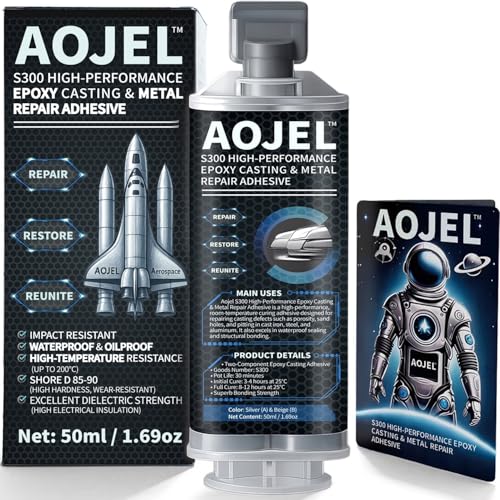
The AOJEL S300 stands apart because of its deliberate 30-minute working time at 77°F — nearly six times longer than typical 5-minute epoxies. For glass-to-metal repairs that require precision alignment, clamping, and bulk build-up before the cure starts, this extended window is a genuine advantage. The two-part cold-weld system forms a rigid, load-bearing repair body that reaches full hardness after 24 hours, handling loads up to 392°F without softening.
Unlike thin-coat adhesives, the S300 is designed to build a repair body 0.5 to 1 inch beyond the damaged area, creating a structural patch that can be drilled, sanded, filed, and painted after cure. Reviewers have successfully used it on cast iron patio table legs, aluminum chair frames, and even cracked crankcases where heat and vibration destroy standard epoxy. The one consistent complaint involves the plunger mechanism — the dual-syringe design makes it difficult to achieve a perfect 1:1 ratio, especially for small batches.
If your glass-to-metal project involves repairing a cast aluminum frame or building up a missing chunk of metal where the glass mounts, the S300 gives you the time and the structural thickness to get it right.
Why it’s great
- 30-minute working time allows careful positioning and clamping of large repairs
- Builds a thick repair body that can be drilled, sanded, and painted
- Heat resistant to 392°F, suitable for engine and outdoor metal repairs
Good to know
- Dual-syringe plunger makes consistent 1:1 mixing difficult at small volumes
- Requires 24-hour full cure before any load is applied
- Designed for rigid metal surfaces, not flexible joints or soft plastics
3. Bob Smith Industries BSI-201 Quik-Cure Epoxy

Bob Smith Industries Quik-Cure epoxy fills a specific niche that other glass-to-metal adhesives cannot match: visible joints where a clear finish matters. The two-part system cures crystal-clear, blending seamlessly with glass edges and polished metal surfaces. With a 5-minute working time and full cure in 15 minutes, it bridges the gap between instant cyanoacrylate gels and slow-curing structural epoxies — fast enough for a quick repair, slow enough to adjust the alignment once.
This formula bonds effectively to glass, metal, wood, ceramics, and fiberglass, making it a versatile option for craft projects and hobby repairs. Reviewers have used it to reattach automotive tail lights, repair costume pieces, and create custom handles for old tools. The squeeze-tube dispenser makes small-batch mixing straightforward, and the included inner caps prevent evaporation between uses. The bond is impact-resistant and rigid once fully cured, though it cannot match the sheer tensile strength or heat tolerance of steel-reinforced epoxies.
If your glass-to-metal repair is a craft piece, a decorative fixture, or a visible joint where the glue line must disappear, Quik-Cure delivers cosmetic quality without sacrificing bond reliability.
Why it’s great
- Cures crystal-clear, invisible on glass and polished metal surfaces
- Fast 5-minute set with 15-minute full cure for same-day results
- Impact-resistant bond suitable for crafts, models, and household repairs
Good to know
- Lower tensile strength than steel-reinforced epoxies, not for heavy loads
- Heat tolerance is limited, unsuitable for oven or engine repairs
- Requires clean surfaces and scuffing for maximum adhesion to smooth metal
4. J-B Weld Superglue Gel 15g 2 Pack

When you need a glass-to-metal bond that holds in seconds and flexes under vibration, J-B Weld SuperWeld Extreme Gel delivers a 3,000 PSI tensile strength in a 30-second set time — performance that rivals many two-part epoxies in a single-component formula. The gel consistency is the critical differentiator here: it stays exactly where you place it without running down the glass or pooling in gaps, allowing precise application on vertical surfaces like oven handle trim or mirror edge repairs.
The rubber-toughened formulation provides impact resistance that standard cyanoacrylate gels lack, absorbing the shock when a metal part bumps against glass. Reviewers have used it to reattach microwave handles that survived three months of daily opening and closing, repair metal glasses arms into hollow plastic sockets, and bond heavy-duty vinyl to itself for automotive convertible tops. The 2-pack gives you two 15-gram tubes, which is generous for small repairs but means the glue can cure in the nozzle tip between uses if not stored upright.
For quick, invisible repairs where you cannot wait 24 hours for an epoxy to cure and need a bond that handles thermal movement without shattering, this gel is the fastest path to a permanent fix.
Why it’s great
- 3,000 PSI tensile strength with 30-second set time for instant holding
- Gel consistency prevents drips and allows precise vertical application
- Impact-resistant formulation handles vibration and thermal expansion
Good to know
- Low heat tolerance compared to epoxy; not for oven or engine use
- Can cure inside the nozzle tip if the tube is stored without cap
- Requires clean, close-fitting surfaces for maximum bond strength
5. Seal Bond CS-4300 Mirror Adhesive
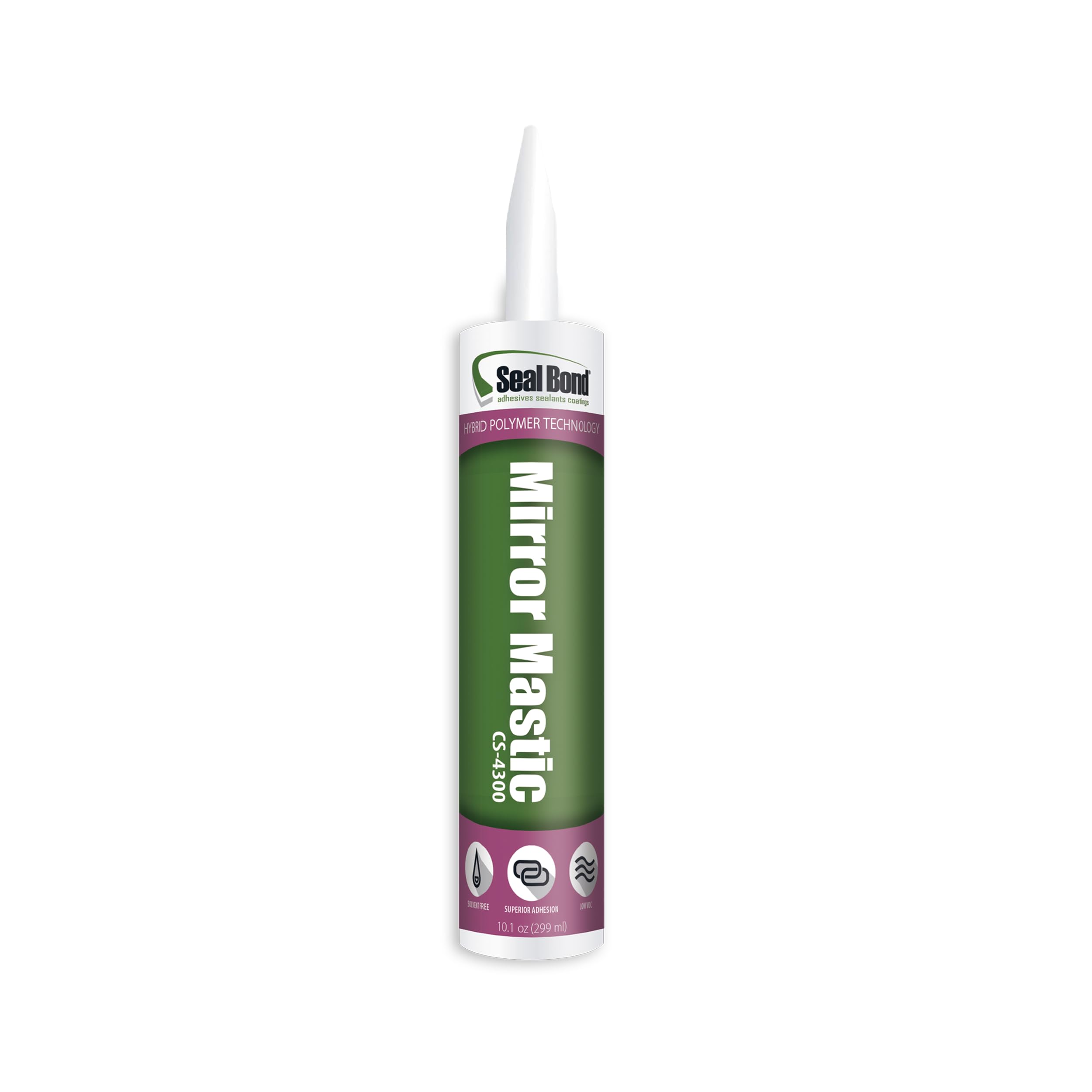
The Seal Bond CS-4300 is a specialized mirror adhesive that solves a problem general-purpose epoxies cannot: bonding large glass mirrors to metal or painted surfaces without damaging the mirror’s reflective backing. The low-odor, solvent-free formula is SCAQMD and CDPH compliant, making it safe for indoor use in bedrooms and bathrooms where conventional adhesives release harmful VOCs. It bonds equally well to conventional and acrylic mirrors, and its excellent build-out properties fill gaps between uneven surfaces.
Reviewers have used the CS-4300 to hang mirrors as large as 30×50 inches and 16×58 inches on painted doors without mechanical fasteners — the adhesive held the full weight after 48 hours of cure. The cartridge format works with a standard caulking gun, and the adhesive has a minimal repositioning time of about 1/16 of an inch before initial grab. For glass-to-metal applications like mounting a mirror onto a metal door frame or attaching a metal bracket to the back of a glass panel, this adhesive provides the long-term reliability that cyanoacrylates cannot match.
If your project is a mirror that needs to stay flat and secure on a metal surface for years, the CS-4300 offers the precise combination of gap-filling strength and chemical safety that general-purpose adhesives lack.
Why it’s great
- Low-odor, solvent-free formula safe for indoor mirror installation
- Holds large heavy mirrors up to 30×50 inches without mechanical fasteners
- Compatible with both conventional and acrylic mirrors, with gap-filling build-out
Good to know
- Requires a caulking gun for application, not a squeeze tube
- Adhesive quantity is excessive for single small mirror repairs
- Extended repositioning time is very limited — about 1/16 inch
FAQ
Can cyanoacrylate gel bond glass to metal for outdoor use?
How do I prepare the glass surface for maximum bond strength?
Will a cold-weld epoxy damage the glass during thermal cycling?
Final Thoughts: The Verdict
For most users, the glue for glass to metal winner is the J-B Weld 8281 Professional Steel Reinforced Epoxy because it delivers the highest tensile strength at 5,020 PSI and withstands 550°F heat, making it the most versatile option for oven handles, engine brackets, and structural repairs. If you need a 30-minute working time to build up thick repairs on aluminum or cast iron frames, grab the AOJEL S300 Metal Epoxy. And for quick, invisible fixes on small household items where a clear, fast-curing bond matters, nothing beats the Bob Smith Industries Quik-Cure Epoxy.