
Wood glue shouldn’t be an afterthought. The wrong formula means joints that creep apart under clamp pressure, brittle failure on a chair leg, or a cutting board that splits after its first wash. The right one bonds deeper than the wood itself — and that line between success and frustration comes down to the specific polymer chemistry and moisture resistance you choose.
I’m Mohammad Maruf — the founder and writer behind Drink4Good. I’ve spent hours cross-referencing industry standards, real-world application notes, and user failure reports to sort which glue formulas actually deliver on their promises for furniture and woodworking projects.
Whether you are repairing an heirloom chair or building a cutting board from scratch, choosing the right adhesive means understanding open time, water resistance, and clamp duration. This guide breaks down the best furniture wood glue options on the market and explains exactly when each formula earns its place in your shop.
How To Choose The Best Furniture Wood Glue
Choosing the right adhesive starts with knowing your project’s exposure to moisture and stress. Standard PVA glues work fine for indoor, low-moisture furniture, but outdoor chairs, cutting boards, and bathroom cabinets demand a waterproof formula with a longer open time. The three most important factors are water resistance classification, open time window, and whether the glue sands clean without gumming up your abrasives.
Water Resistance Classification
Standard yellow wood glue (Type II) resists occasional moisture but will fail under sustained wet conditions. Waterproof glues (Type I/ANSI Type I) pass boil-test cycles and can handle outdoor furniture, tabletops near sinks, and cutting boards. If the glue label says “water-resistant” rather than “waterproof,” assume it’s not suitable for exterior or food-contact projects that see regular washing.
Open Time and Clamp Time
Open time is the window you have to position pieces after applying glue — standard PVA gives 5–10 minutes, while extended-open-time formulas offer 15–20 minutes for complex assemblies. Clamp time is the minimum period under pressure before the joint can handle light handling. Faster clamp times speed up production but leave less room for adjustment. For furniture work, an open time of 10 minutes with a 30-minute clamp time covers most repair and build scenarios.
Dry Characteristics
Some glues dry crystal clear, which matters for visible joints, exposed dovetails, or repairs on finished surfaces. Others dry a tan or yellow line that can be sanded flush. If you plan to stain the piece, check whether the glue absorbs stain differently than the surrounding wood — some aliphatic resins create a visible blotch under stain if not fully sanded. A glue that sands easily and doesn’t clog paper saves significant finishing time.
Quick Comparison
On smaller screens, swipe sideways to see the full table.
| Model | Category | Best For | Key Spec | Amazon |
|---|---|---|---|---|
| Titebond III Ultimate 32oz 2-Pack | Waterproof PVA | Outdoor furniture, cutting boards | ANSI Type I waterproof rating | Amazon |
| Rockler Applicator Kit | Precision System | Edge joints, mortise work, cleanup | Includes centering attachment | Amazon |
| Weldbond Multi-Surface | Multi-Material PVA | Crafts, mosaic, wood-to-fabric | Full cure in 20 minutes | Amazon |
| Titebond Tongue & Groove | Flooring Adhesive | Laminate/LVP floating floors | FloorScore certified, Type II water-resistant | Amazon |
| DAP Weldwood Original Yellow | Aliphatic Resin | Cabinet making, edge bonding | 24-hour full cure, shock resistant | Amazon |
In‑Depth Reviews
1. Titebond 1415 III Ultimate Wood Glue, 32-Ounce Bottle, 2 Pack

Titebond III is the gold standard for any project where water will meet wood. Its ANSI Type I waterproof rating means it survives boiling water tests, making it the correct choice for outdoor furniture, cutting boards, and bathroom vanities. The gel-based formula grabs quickly without running down vertical surfaces, and the 24-hour full cure yields a bond stronger than the wood fibers themselves — many users report the wood splitting before the glue joint fails.
The 32-ounce two-pack gives you enough volume for several large assemblies without needing to reorder mid-project. Open time runs around 10 to 15 minutes, which is comfortable for most furniture builds, and cleanup is straightforward with water before the glue sets. Professionals note that the extended open time makes it easier to align complex miters and multi-board glue-ups compared to faster-setting alternatives.
One practical consideration: Titebond III dries to a tan color, not clear, so it can show on exposed joints if you don’t plan for a sanding pass. The gel consistency requires slightly more squeeze force from standard bottles, but the included applicator tip gives reasonable control. For any project that demands waterproof performance, this is the reference formula.
Why it’s great
- ANSI Type I waterproof rating withstands outdoor exposure and washing
- Bond strength exceeds wood fiber integrity in destructive testing
- 10–15 minute open time suits complex furniture assemblies
Good to know
- Dries tan rather than clear — needs sanding on visible joints
- Gel consistency can be thick in cold temperatures
2. Rockler Wood Glue Applicator Set – 8oz Bottle with Tips & Brush

This kit solves the messiest part of wood gluing: getting adhesive exactly where you need it with zero runoff. The centering attachment locks the glue bead dead center on boards up to 3/4-inch wide — crucial for edge-gluing panels where an off-center bead means weak joints and wasted squeeze-out. Alongside the centering spout, you get a silicone brush applicator for spreading glue over wide surfaces, a roller for very wide panels, and a mortise tip that reaches the bottom of biscuit slots and domino mortises without smearing.
The 8-ounce bottle fills easily from gallon jugs using the included funnel, and all attachments are made from silicone, HDPE, or polypropylene — materials that let dried glue peel off rather than requiring aggressive scrubbing. Users consistently note that the silicone brush doesn’t clog overnight if left wet under a rag, a major convenience for multi-day projects. The kit fits Titebond 16 and 32-ounce bottles as well, extending its usefulness beyond the included container.
The trade-off is that the 8-ounce bottle is small, so heavy users will refill frequently during large glue-ups. The roller attachment works well for panels up to about 6 inches wide but feels undersized for tabletops. Still, for anyone who struggles with glue migrating into clamped joints or dripping onto finished surfaces, these applicators pay for themselves in reduced cleanup time and stronger glue lines.
Why it’s great
- Centering attachment keeps glue bead dead center on boards up to 3/4-inch
- Silicone brushes and HDPE parts allow dried glue to peel off cleanly
- Compatible with standard Titebond 16 and 32 oz bottles for extended use
Good to know
- 8-ounce bottle is small and requires frequent refills for large projects
- Roller attachment too narrow for full-size tabletops
3. Weldbond Multi-Surface Adhesive 14.2oz
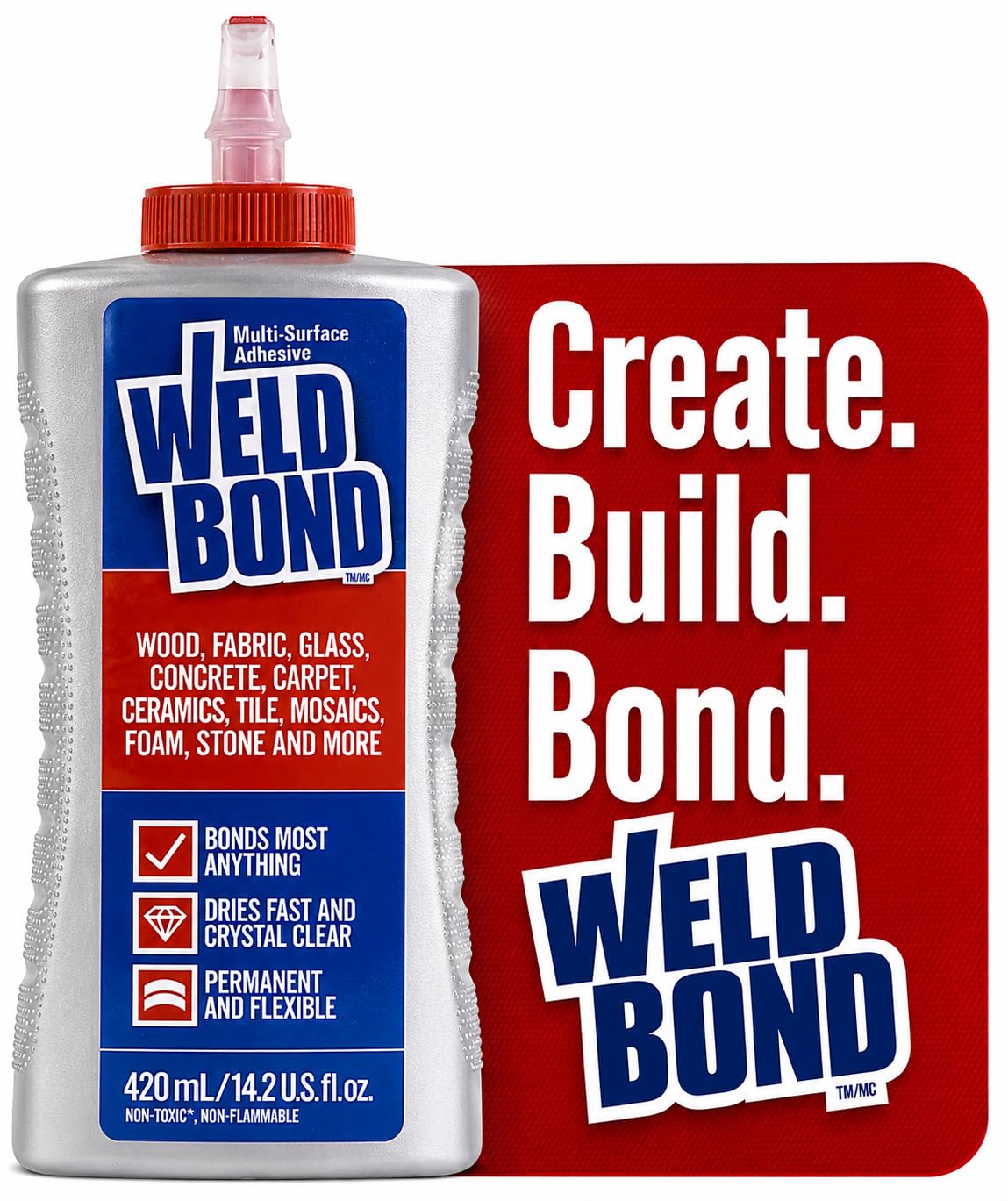
Weldbond bridges a gap that most wood glues ignore: it bonds wood strongly but also adheres to glass, ceramic, tile, stone, and fabric with the same strength. For furniture projects that incorporate non-wood elements — mosaic table tops, glass-paneled cabinets, stone inlays — this single bottle eliminates the need for multiple adhesives. It dries crystal clear, which is a major advantage for visible repairs on finished furniture where a yellow or tan glue line would ruin the look.
The 20-minute full cure time is exceptionally fast compared to standard 24-hour wood glues, meaning you can handle the piece within the same work session. Users report that it grabs quickly and resists the shifting that plagues slower-setting formulas during complicated assemblies. The water-resistant and weatherproof bond holds up in outdoor applications, though it does not carry an ANSI Type I waterproof rating like Titebond III, so it is best suited for covered outdoor furniture rather than direct ground contact.
The main limitation is that Weldbond is not a direct replacement for traditional yellow PVA in high-stress wood-only joints. Its longer-term performance in heavy structural joints—like chair leg joinery or load-bearing table frames—is less proven than aliphatic resin or dedicated waterproof PVA. For mixed-material projects, craft repairs, and mosaic work, however, it is remarkably reliable.
Why it’s great
- Crystal-clear dry line disappears on visible furniture joints
- Fast 20-minute cure shortens project turnaround significantly
- Bonds wood to glass, stone, ceramic, and fabric without separate glues
Good to know
- Not ANSI Type I waterproof — avoid direct ground contact outdoors
- Less proven for heavy structural joints than dedicated wood glues
4. Titebond 2104 Tongue and Groove Glue, 16 oz

Titebond 2104 is formulated specifically for tongue-and-groove flooring, which means its viscosity and grab are calibrated to prevent boards from separating during expansion and contraction cycles. It passes Type II water-resistance testing and is FloorScore certified for low emissions, making it suitable for use over radiant heat systems and in enclosed living spaces. The formula resists solvents when dry, which is critical for floors exposed to cleaning chemicals and occasional moisture from shoes or spills.
The ergonomic bottle design and angled applicator tip make it easy to run a bead into the groove channel without over-applying — overuse is the most common error with T&G glue, and reviews consistently warn that excess squeeze-out inside the joint prevents the boards from seating fully. One bottle covers roughly 100 square feet of 3-inch wide boards, and the lower chalk temperature means it stays pliable in cooler work environments compared to standard PVA.
This glue is engineered strictly for flooring. It is not the right choice for general furniture joinery, edge-gluing panels, or structural repairs because its open time and bond characteristics are tuned to the unique movement dynamics of floating and nailed floor installations. For its intended narrow use case, though, it performs flawlessly and eliminates the creaks and gaps that plague floor installations done with inferior adhesives.
Why it’s great
- FloorScore certified for low emissions and radiant heat compatibility
- Type II water-resistant formula withstands cleaning chemicals and moisture
- Angled tip and viscosity reduce over-application in groove channels
Good to know
- Designed exclusively for tongue-and-groove flooring — not for general furniture
- Excess squeeze-out inside joints prevents proper board seating
5. DAP Weldwood Original Wood Glue, Yellow, 1 Gal

DAP Weldwood Original is an aliphatic resin formula — the traditional yellow wood glue that has been a staple in cabinet shops and woodworking classrooms for decades. Its main advantage over standard PVA is superior shock and impact resistance when fully cured at 24 hours, which makes it a good choice for chairs, table legs, and any joint that will see repeated stress or vibration. The paste-like consistency stays put on vertical surfaces without dripping, and the glue sands easily once dry without gumming up 120-grit paper.
The gallon jug is the most economical option for high-volume users who go through multiple bottles per project. The bottle cap design seals well between uses, preventing the clogs that plague many economy jugs. Users report reliable performance on cabinet making, edge bonding, and general furniture repair, with the caveat that the 24-hour full cure means you need patience before de-clamping or moving the assembly. The yellow color can show on light woods if the glue isn’t completely sanded off, so plan for a cleanup pass before finishing.
Weldwood is heat, water, and solvent resistant, but it is not waterproof in the ANSI Type I sense — it will degrade under prolonged outdoor exposure or repeated washing. Its strengths are entirely in interior furniture and cabinetry where moisture is not a primary concern. For a shop on a budget that needs reliable interior-grade holding power by the gallon, this formula is tough to beat.
Why it’s great
- Aliphatic resin delivers superior shock resistance for high-stress joints
- Gallon jug provides the lowest cost-per-ounce for high-volume use
- Sands cleanly without gumming abrasives, simplifying finishing work
Good to know
- Not waterproof — unsuitable for outdoor or frequent-wash projects
- 24-hour full cure limits fast turnaround on multi-step builds
FAQ
Can I use standard yellow wood glue on outdoor furniture?
How long should I clamp wood glue before moving the piece?
Is Titebond III safe for cutting boards?
Final Thoughts: The Verdict
For most users, the furniture wood glue winner is the Titebond III 32oz 2-Pack because its ANSI Type I waterproof rating and bond strength cover indoor and outdoor projects without compromise. If you want precision application that minimizes squeeze-out and cleanup, grab the Rockler Applicator Set. And for mixed-material furniture repairs or craft projects that need a clear drying line, nothing beats the Weldbond Multi-Surface.