
Few things are more frustrating than cutting down a stubborn tree only to watch it sprout back from the stump weeks later. A targeted systemic herbicide is the only reliable way to stop that regrowth at the source, killing the root system completely so you don’t have to repeat the same backbreaking work season after season.
I’m Mohammad Maruf — the founder and writer behind Drink4Good. For this guide I analyzed the active ingredient concentrations, application methods, and real-world stump-killing results across five of the most reviewed glyphosate-based and triclopyr-based tree killers on the market.
Whether you’re clearing invasive brush, removing unwanted saplings, or finally tackling that resprouting stump in the backyard, choosing the right glyphosate tree killer comes down to matching the active ingredient and concentration to the specific woody species and application method you plan to use.
How To Choose The Best Glyphosate Tree Killer
Picking the right herbicide for killing trees and brush isn’t about grabbing the first bottle on the shelf. The key variables are the active ingredient, its concentration, the application method you plan to use, and whether the formula is designed for cut-stump treatment or foliar spraying on leaves and stems.
Active Ingredient: Glyphosate vs Triclopyr
Glyphosate is a non-selective systemic herbicide that is absorbed through green tissue and transported to the roots, making it ideal for killing the entire plant. Triclopyr is another systemic option that is especially effective on woody vines, brush, and tough perennial weeds like poison ivy and blackberry. For tree stumps, both work well when applied to a freshly cut surface, but triclopyr often delivers faster visible results on woody species.
Concentration and Application Method
Ready-to-use formulas require no mixing but are typically less concentrated and better suited for small jobs or spot treatments. Concentrates allow you to mix a stronger solution for tough stumps and large brush — a 41% glyphosate concentrate mixed at 6 to 8 ounces per gallon is standard for woody vegetation. For cut-stump treatment, apply undiluted concentrate or a strong mix directly to the cambium layer of the freshly cut stump within minutes of cutting.
Coverage Area and Volume
A 32-ounce bottle of concentrate can treat hundreds of stumps or several thousand square feet of brush when diluted properly. Check the label for recommended dilution rates for the specific target species. For large-scale clearing, a higher unit count or a gallon-sized jug may be more economical than repeatedly buying quart bottles.
Quick Comparison
On smaller screens, swipe sideways to see the full table.
| Model | Category | Best For | Key Spec | Amazon |
|---|---|---|---|---|
| Tordon RTU Brush Killer | Ready-to-Use | Fresh cut stumps | Broad-spectrum triclopyr | Amazon |
| Hi-Yield Killzall 365 | Concentrate | Large-area brush control | 41% glyphosate concentrate | Amazon |
| Bonide Poison Ivy & Brush Killer | Concentrate | Poison ivy & woody vines | Triclopyr-based concentrate | Amazon |
| Control Solutions Eraser | Concentrate | Budget-friendly general use | 41% glyphosate concentrate | Amazon |
| Southern Ag Brush Weed Killer | Concentrate | General brush & vines | Triclopyr concentrate | Amazon |
In‑Depth Reviews
1. Tordon RTU Brush Killer

Tordon RTU is formulated specifically for cut-stump application and delivered as a ready-to-use liquid, meaning no mixing, no measuring, and no guesswork. Its triclopyr active ingredient penetrates the freshly cut cambium layer and translocates to the entire root system, making it lethal to even the most stubborn resprouting species like mulberry, buckthorn, and honeysuckle.
Users consistently report that a very sparing application to a fresh-cut stump — applied within seconds or minutes of cutting — is enough to kill the root system entirely with zero regrowth. The squeeze-bottle design allows precise application directly to the stump surface, minimizing waste and preventing overspray onto desirable vegetation nearby. Many reviewers note that this is the only product that successfully killed aggressive “hydra-like” weed trees that had survived other treatments.
Because it is ready-to-use, the Tordon RTU is pricier per ounce than concentrates, but for small-to-medium jobs where convenience and reliability matter most, the cost is justified by the guaranteed result. Wear nitrile gloves during application and avoid dripping onto the soil, as the product is non-selective and can damage the roots of nearby plants.
Why it’s great
- Zero mixing required — apply straight from the bottle to fresh-cut stumps
- Extremely effective on invasive root systems like buckthorn and mulberry
- Precise squeeze-bottle application reduces waste and overspray risk
Good to know
- More expensive per ounce than concentrate alternatives
- Must be applied within minutes of cutting for full effectiveness
2. Hi-Yield Killzall 365

Hi-Yield Killzall 365 packs a 41% glyphosate concentrate into a 32-ounce bottle that treats up to 4,300 square feet when mixed at the recommended rate. For general brush, vines, and tree stumps, mixing 6 ounces per gallon of water provides a potent systemic solution that kills roots on contact after translocation through green tissue.
The label explicitly states this product is for non-crop areas and should not be used on lawns, making it a straightforward choice for clearing fence lines, roadsides, rangeland, and patches of invasive brush. Users appreciate that it performs identically to national-brand glyphosate concentrates sold at big-box stores but at a lower per-ounce cost, especially when bought in this 32-ounce size.
It is worth noting that this is a non-selective herbicide, so overspray on desirable plants will kill them too. Some users mention that moss was unaffected by the formula, confirming that glyphosate targets broadleaf and grassy vegetation rather than non-vascular plants. For most stump-killing and brush-clearing scenarios, this concentrate delivers excellent value and reliable performance.
Why it’s great
- High 41% glyphosate concentration covers up to 4,300 sq ft per bottle
- Cost-effective alternative to big-box retail brands for brush control
- Simple mixing ratio for spot treatment or bare-ground sterilization
Good to know
- Non-selective — will damage or kill any vegetation it contacts
- Does not affect moss or non-vascular plants
3. Bonide Poison Ivy & Brush Killer BK-32

Bonide BK-32 is a triclopyr-based concentrate that targets over 240 tough weed and brush species, including poison ivy, poison oak, kudzu, wild blackberries, and trumpet vine. Its systemic action travels from the sprayed foliage down to the root system, killing the entire plant permanently without harming lawn grasses like bluegrass, fescue, and Bermuda when used according to the label directions.
A standout feature is its dual-purpose capability: it works as a foliar spray for brush and vines, and it can be applied undiluted directly to a freshly cut stump for stump removal. The cut-stump method requires painting the undiluted product onto the entire exposed surface of the fresh cut, which is more labor-intensive than spraying but ensures the chemical reaches the roots efficiently. Users who followed the temperature and weather conditions precisely reported complete kill on first attempt, while those who applied during cooler weather or without full leaf coverage needed a second treatment.
Safety precautions are important here — the product has a strong odor and can cause dizziness if inhaled in enclosed spaces. Full protective gear including an N-95 mask and nitrile gloves is recommended. For homeowners dealing with persistent woody vines that have choked fences or trees, this concentrate offers a versatile and effective tool at a reasonable price point.
Why it’s great
- Effective on over 240 species including poison ivy, kudzu, and wild blackberries
- Safe for use on most lawn grasses when applied as directed
- Can be used as both foliar spray and cut-stump concentrate
Good to know
- Strong chemical odor requires proper ventilation and PPE
- Tough species like ground ivy may need 2-3 applications
4. Control Solutions Eraser Concentrate
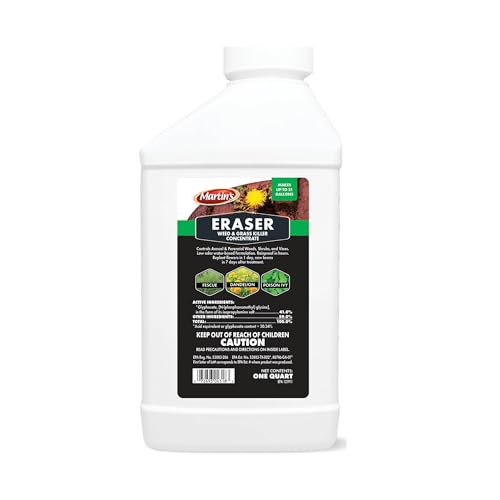
Control Solutions Eraser is a 41% glyphosate concentrate that offers the same active ingredient percentage as leading national brands at a significantly lower per-ounce cost. The water-based formula has a low odor and no residual soil activity, meaning it breaks down after binding to the soil and won’t prevent future planting in the treated area.
Users who have relied on this product for nearly two decades report consistent results against annual and perennial weeds, grasses, vines, and trees. The recommended mixing rate for woody vegetation is 8 ounces per gallon, with visible yellowing appearing within 4 to 7 days and complete death occurring within 7 to 14 days. Adding a surfactant improves leaf adhesion and speeds uptake, especially on waxy or hairy leaves common to poison ivy and brush species.
One important distinction: this is a glyphosate product, not triclopyr. For extremely woody species like strangler fig or mature brush, a triclopyr-based product may deliver faster or more complete control. However, for general stump treatment, clearing annual weeds and grasses, and controlling invasive vines, the Eraser concentrate provides proven performance at a price that makes large-scale applications economical.
Why it’s great
- High 41% glyphosate concentration at a budget-friendly price point
- Low-odor formula with no residual soil activity
- Rainproof within hours of application
Good to know
- May require a surfactant for optimal adhesion on waxy leaves
- Slower acting on heavier woody species compared to triclopyr alternatives
5. Southern Ag Brush Weed Killer

Southern Ag Brush Weed Killer is a triclopyr concentrate formulated specifically for tough brush, vines, and hard-to-control woody plants. Unlike glyphosate, triclopyr is particularly effective on perennial woody species like wild blackberries, poison ivy, and scrub brush found along fence lines, roadsides, pastures, and other non-crop areas.
The product can be used both as a foliar spray on actively growing leaves and as a cut-stump treatment to prevent sprouting. Users who had previously failed with big-box store weed killers reported that Southern Ag’s high triclopyr concentration tackled weeds growing through weed block and rock, killing them to the root with a single application. The 32-ounce concentrate covers 512 to 1,024 square feet per gallon when mixed at the recommended rate, making it ideal for spot treatments and small-to-medium brush patches.
It is worth noting that extremely aggressive species like strangler fig may survive the initial application, as one user reported. For the majority of common brush, vines, and invasive woody weeds, this triclopyr concentrate delivers fast, reliable results. If you have a particularly stubborn invasive species that has survived glyphosate treatments, switching to this triclopyr formula may solve the problem.
Why it’s great
- Triclopyr formula excels on woody brush and vines resistant to glyphosate
- Effective as both foliar spray and cut-stump treatment
- High concentration relative to competing triclopyr brands for the price
Good to know
- Not effective on all aggressive species (e.g., strangler fig)
- Limited coverage area per bottle compared to glyphosate concentrates
FAQ
How long does glyphosate take to kill a tree stump?
What is the best concentration of glyphosate for killing large trees?
Can I spray glyphosate on the leaves of a tree I want to kill?
Final Thoughts: The Verdict
For most users, the glyphosate tree killer winner is the Tordon RTU Brush Killer because its ready-to-use triclopyr formula eliminates mixing errors and delivers near-100% root kill on fresh-cut stumps of invasive woody species. If you need to cover a large area on a budget, grab the Hi-Yield Killzall 365 for its high glyphosate concentration and extensive coverage. And for targeting poison ivy and woody vines without harming your lawn, nothing beats the Bonide Poison Ivy & Brush Killer.