
Finding a retro handheld gaming device that balances screen quality, emulation power, and true portability is tougher than it looks. Many lower-priced units come packed with thousands of games you’ve never heard of, while premium models leave you to source everything yourself—so you need to know where your priorities lie before you buy.
I’m Mohammad Maruf — the founder and writer behind Drink4Good. I’ve spent hundreds of hours cross-referencing screen types, processor capabilities, operating system flexibility, and battery life figures across the current handheld emulator market to build this guide around what actually matters during play.
Whether you are after a cheap, ready-to-play console or a high-end Android machine powerful enough for PlayStation 2 emulation, the right game emulator handheld comes down to three hard choices: screen quality, chipset muscle, and how much setup you are willing to do.
How to choose the best game emulator handheld
The market splits cleanly into two camps: plug-and-play Linux devices with thousands of pre-loaded games, and Android-powered handhelds that demand you supply your own BIOS files and ROMs. Your choice depends on whether you value instant start-up time or future-proof emulation capability.
Screen technology: IPS vs. OLED
Standard 3.5-inch IPS panels at 640×480 pixels look sharp for Game Boy Advance and SNES games, but they cannot match the contrast and color depth of an OLED display. Handhelds like the Retroid Pocket Classic use a 3.92-inch AMOLED panel at 1240×1080, which makes shader effects and pixel-art games genuinely pop. If you play primarily in low light or care about deep blacks, an OLED screen is the single biggest visual upgrade you can buy.
Operating system: Android versus Linux
Linux-based systems (EmuELEC, ArkOS) boot directly into a game launcher and run pre-configured emulators, so you never see a desktop interface. Android handhelds, by contrast, boot like a smartphone—you install emulators from the Play Store, configure each one, and add your own ROMs. Android gives you access to higher-end emulators like AetherSX2 (PS2) and Dolphin (GameCube/Wii), but it demands more time upfront. Linux handhelds are simpler; Android handhelds are more capable.
Processor and RAM: what can it actually play?
Entry-level RK chips (Rockchip RK3326) handle 16-bit consoles and early 32-bit systems like PlayStation 1 with no issues. Mid-range Unisoc or T618 chips stretch into N64 and Dreamcast territory. The premium Snapdragon 865 inside the Retroid Pocket 5 is powerful enough to run PlayStation 2, GameCube, and even some lighter Switch titles at playable frame rates. Match the chipset to the console generation you actually want to replay—don’t overpay for PS2 power if you only want Pokemon.
Quick comparison
On smaller screens, swipe sideways to see the full table.
| Model | Category | Best For | Key Spec | Amazon |
|---|---|---|---|---|
| Retroid Pocket 5 | Android Premium | PS2 / GameCube | Snapdragon 865 8+128GB | Amazon |
| Retroid Pocket Classic | Android Mid | OLED + PS1 / GBA | 3.92″ AMOLED 1240×1080 | Amazon |
| R36MAX | Linux Mid | 2D retro family play | 4.0″ IPS 720×720 | Amazon |
| Flip RG34XXSP | Linux Clamshell | GBA SP nostalgia | 3.5″ IPS 720×480 clamshell | Amazon |
| R36T | Linux Budget | Budget starter | 3.5″ IPS CRT filter | Amazon |
In‑depth reviews
1. Retroid Pocket 5

The Retroid Pocket 5 is the most powerful handheld on this list thanks to its Snapdragon 865 processor, 8GB of RAM, and a 5.5-inch 1080p OLED touchscreen. It handles PlayStation 2, GameCube, and even lighter Switch ports at smooth frame rates—something no other device here can claim. The 5000mAh battery delivers several full days of casual play, and hall-effect analog sticks eliminate the dreaded drift issue.
Android 13 plus WiFi 6 and Bluetooth 5.1 mean cloud gaming services like Xbox Remote Play and Steam Link run well, and the 128GB internal storage leaves generous room for ROMs before you even insert a microSD card. Bear in mind that no games are pre-loaded: you set up emulators manually, and the device can enter a deep-discharge protection mode after long storage that requires an 8-hour charge to wake.
The ergonomics are good for medium hands, though taller players may want a separate grip case. Reviewers consistently call it the strongest value in high-end retro gaming because the price stays under premium territory while the performance reaches true last-gen console power.
Why it’s great
- Unlocks PS2, GameCube, and 3DS emulation
- Stunning 5.5-inch 1080p OLED display
- 5,000mAh battery lasts days in standby
Good to know
- No pre-loaded games or BIOS files
- May need a grip case for large hands
- Requires 8-hour charge if battery protection mode activates
2. Retroid Pocket Classic

The Retroid Pocket Classic is built around a 3.92-inch AMOLED panel at 1240×1080—a resolution that makes pixel grids, shaders, and scanline effects look genuinely authentic rather than aliased. It runs Android 14 with full Play Store access, so you load your own emulators through a familiar interface. The 5000mAh battery is identical in capacity to the Pocket 5, and the build quality is excellent for a handheld in this segment.
That screen is the real reason to buy this model. Colors saturate beautifully on OLED, and the 60 Hz touch response keeps menu navigation snappy. The device comfortably emulates everything through PlayStation 1 and handles many Dreamcast and N64 titles, though it lacks the raw power for heavy GameCube or PS2 games. Its small footprint makes it one of the most pocketable options among Android handhelds.
The power button protrudes slightly and can turn the device on in a bag, so you may want to use the auto-sleep setting or toggle airplane mode during transport. No games are pre-loaded, which will frustrate absolute beginners, but the mid-range price buys you a premium screen that makes every retro game look genuinely better.
Why it’s great
- Brilliant 3.92-inch AMOLED display
- Android 14 with Play Store flexibility
- Lightweight and genuinely pocketable
Good to know
- No pre-loaded games or BIOS files
- Power button can trigger accidentally in a bag
- Not powerful enough for PS2 or heavy GameCube
3. R36MAX
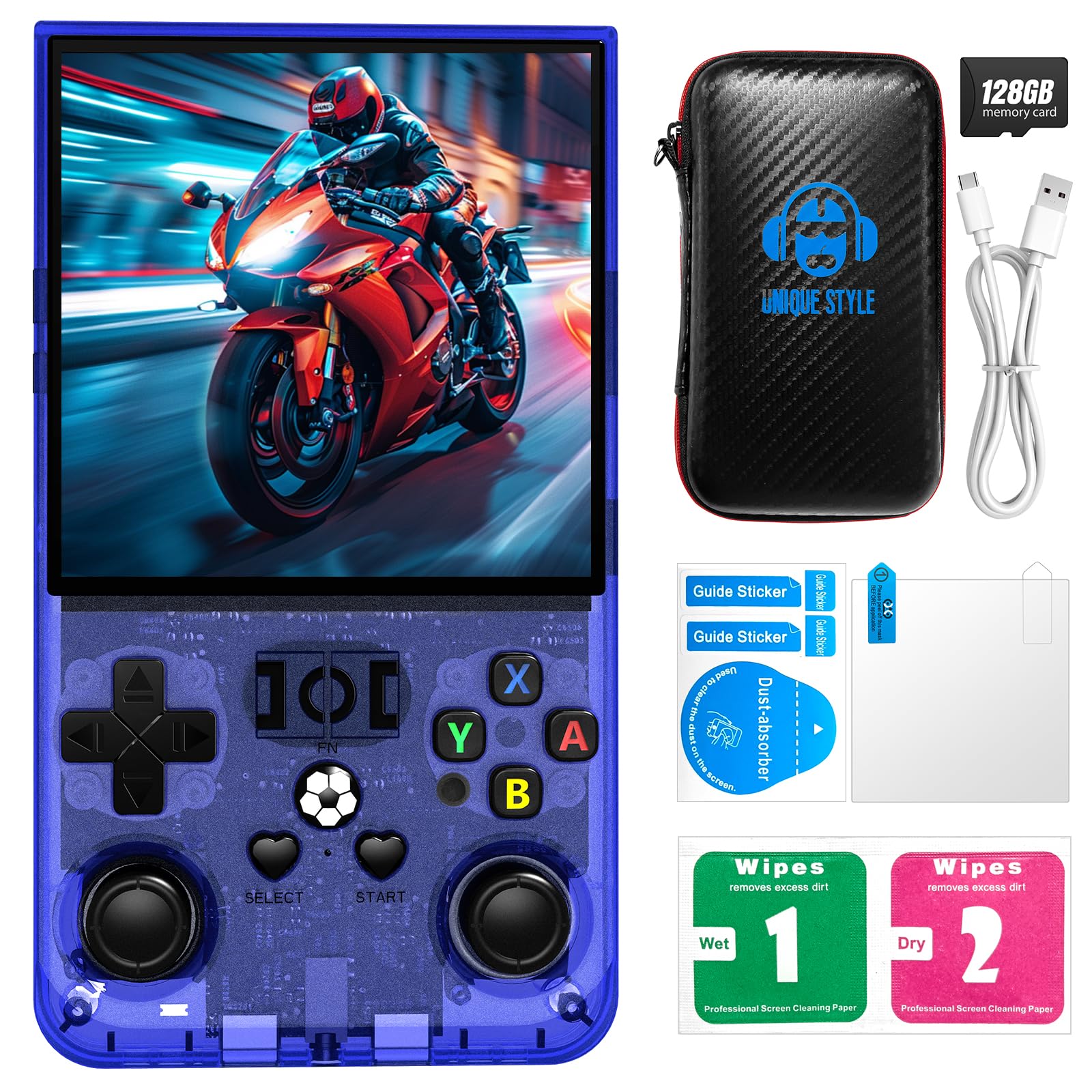
The R36MAX uses a 4.0-inch IPS display at 720×720, a square aspect ratio that works wonderfully for 4:3 retro games and does not stretch them awkwardly. The OCA full-lamination gives the glass a flush feel and reduces internal glare, while the 4000mAh battery runs between 6 and 8 hours of actual playtime. It runs the EmuELEC Linux system, so it boots straight into a curated game launcher with 18,000+ pre-loaded ROMs.
Performance is smooth for every 16-bit console and most PlayStation 1 titles. The RK chipset handles 2D action games, JRPGs, and puzzle classics with no slowdown, and the 64GB storage is enough to keep the entire collection without needing an external card immediately. The build is all plastic, but the blue color variant and included carry case make it feel more polished than the budget-tier R36T.
Customer reviews highlight how frequently the screen and ergonomics impress buyers who are new to emulation. The interface is simple enough for children to navigate, and the 720×720 resolution avoids the blur you see on cheaper 480p screens. Just note that this handheld stalls on N64 and Dreamcast titles—keep your expectations at 16-bit or early 32-bit.
Why it’s great
- Sharp 4.0-inch 720×720 IPS screen
- 18,000+ pre-loaded games ready out of the box
- Long 6-8 hour battery life
Good to know
- Struggles with N64, Dreamcast, and PSP
- Plastic build does not feel premium
- Not Android—no Play Store access
4. Flip RG34XXSP
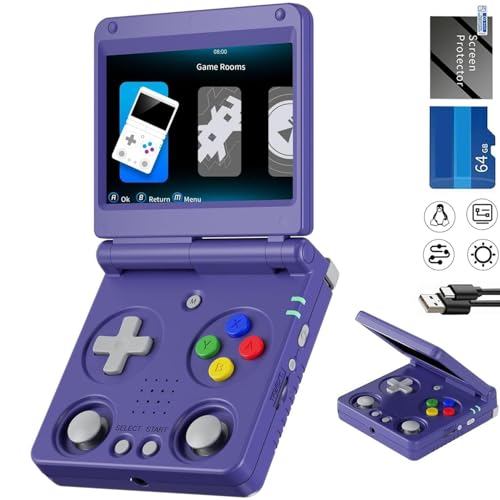
The Flip RG34XXSP is a rebadged Anbernic RG34XXSP running Knulli firmware, and it replicates the iconic Game Boy Advance SP clamshell form factor almost perfectly. The 3.5-inch IPS OCA display at 720×480 looks crisp for GBA and SNES games, and the magnetic lid with hall-effect sleep/wake sensing makes it the most portable option here—you flip it closed and it sleeps instantly. The 3300mAh battery provides 7–8 hours of play.
Pre-loaded with 5,532 games across 30+ emulators, it covers NES through PlayStation 1 without any stutter. WiFi 5G and Bluetooth 5.0 enable online multiplayer and controller pairing, and the HDMI output lets you play on a TV. The analog sticks are present but feel somewhat gimmicky for the 2D titles the device is designed for.
Battery drain in standby is faster than it should be, so power the device off rather than sleeping it between sessions. A few buyers have reported units that stopped charging entirely after weeks of use. Despite that reliability concern, the form factor and Knulli firmware create the closest emotional experience to actually holding a GBA SP, which matters for nostalgic buyers.
Why it’s great
- Authentic GBA SP clamshell design
- Magnetic lid with hall-effect wake/sleep
- 5,500+ pre-loaded games with HDMI out
Good to know
- Battery drains quickly when idle
- Documented charging failure in some units
- Analog sticks are decorative for most games
5. R36T
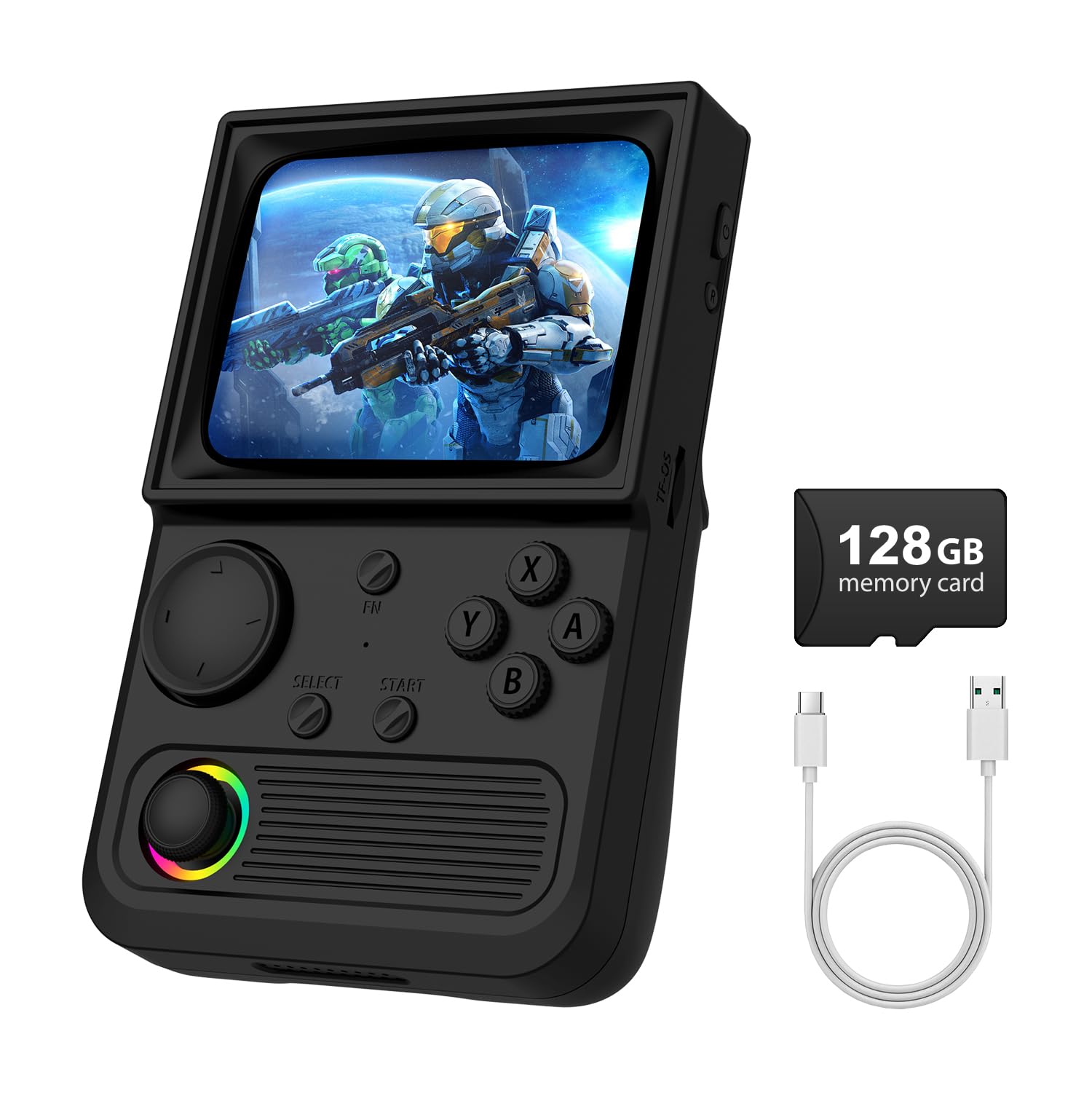
The R36T is the most wallet-friendly gateway into retro handheld emulation. It sports a 3.5-inch IPS screen with a CRT-inspired bezel overlay that gives classic games the rounded-corner, glass-curve look of an old television. With 22,000+ pre-loaded games and a 64GB card, you get an enormous library straight away. The 3500mAh battery runs for 6–8 hours, and it ships with a hard-shell case.
The EmuELEC Linux system boots fast and presents everything in a clean grid. WiFi 5G and OTG support let you play online multiplayer or connect a wired controller. The customizable RGB joystick lights are a nice touch for younger gamers, though the D-pad and buttons are slightly mushy compared to pricier devices.
The most common complaint across reviews is reliability: multiple buyers reported units that stopped powering on after a few weeks. This is a budget device with budget quality assurance. If you just want to test whether retro emulation is for you without spending much, the R36T gives you a functional taste—but do not count on it as a long-term daily driver.
Why it’s great
- Lowest buy-in price for a full retro library
- CRT-inspired bezel looks authentic on old games
- Includes a protective case and RGB lighting
Good to know
- Reported failures after short ownership periods
- Buttons feel mushy compared to mid-range units
- No parental controls available
FAQ
Can a game emulator handheld play PlayStation 2 games?
Do I need to provide my own games or do these ship with ROMs?
Which handheld has the best screen for retro gaming?
How do I add more games to these devices?
Is the Flip RG34XXSP actually a good daily driver?
Final thoughts: the verdict
For most users, the best game emulator handheld winner is the Retroid Pocket 5 because it packs enough Snapdragon 865 power to run PlayStation 2, GameCube, and modern Android games while maintaining a crisp OLED screen and all-day battery life. If you want the best visual experience for PS1 and below without the setup hassle, grab the Retroid Pocket Classic for its gorgeous AMOLED panel. And for the easiest entry point into retro gaming on a tight budget, nothing beats the sheer pre-loaded library and low commitment of the R36T—just keep your expectations for longevity realistic.