
Chasing more distance off the tee means little if your swing sequence collapses under pressure. The right training aid doesn’t just add MPH—it rewires your transition, lag, and release so that speed becomes repeatable. This guide cuts through the gimmicks to find the tools that actually deliver measurable gains without ruining your rhythm.
I’m Mohammad Maruf — the founder and writer behind Drink4Good. This guide is the result of dozens of hours comparing shaft weights, radar accuracy, resistance profiles, and real user feedback to separate the swing speed builders from the shelf clutter.
Whether you’re battling an over-the-top move or simply want to squeeze every yard from your driver, the best golf swing speed trainer must improve tempo, path, or impact—and these seven finalists do exactly that, proven by user data and professional validation.
How To Choose The Best Golf Swing Speed Trainer
Not every training stick or radar unit actually builds speed. The wrong choice can grove bad timing or give you inflated readings that vanish on the course. Focus on these three factors to pick the tool that matches your swing flaw.
Feedback Type: Radar vs. Mechanical vs. Impact
Doppler radar units provide objective speed and tempo numbers, which is essential for tracking progress over weeks. Mechanical devices like weighted sticks or whippy shafts force your body to feel proper lag and transition, but they don’t output data. Impact trainers (mats with groove guides or tethered balls) show path and low-point flaws in real time. Serious speed builders often combine radar data with a mechanical lag trainer—feedback plus feel closes the loop faster than either alone.
Lag Resistance vs. Overload Training
Overload training uses a club that is heavier than your driver to build raw muscle speed through progressive resistance. Lag training, on the other hand, focuses on maintaining wrist hinge in the downswing so the clubhead releases at impact rather than at the top. Many budget sticks market themselves as speed trainers but are simply weighted clubs with no lag-specific design. Look for a whippy shaft, a hinge mechanism, or a resistance band system that specifically challenges wrist set and release timing if you want a true lag trainer.
Measurement Accuracy and Reading Distance
If you buy a radar unit, its reading accuracy and the required distance between the unit and the swing matter enormously. Entry-level units often need the clubhead to pass within 8-12 inches and at a precise angle, producing wild outliers if you waggle or stand too close. Premium units offer broader measurement zones and automatically filter false triggers. For indoor training, smaller measurement distances are fine, but outdoor range use demands a unit that can read from at least 4 feet away to avoid clubhead interference from your bag or body.
Quick Comparison
On smaller screens, swipe sideways to see the full table.
| Model | Category | Best For | Key Spec | Amazon |
|---|---|---|---|---|
| GolfForever Swing Trainer | Resistance System | Full-body strength & flexibility | Asymmetric nylon resistance bands | Amazon |
| Swing Speed Radar SSRTT364 | Radar Unit | Tracking speed & tempo gains | ±1% accuracy, 40-200+ mph range | Amazon |
| EyeLine Golf Speed Trap 2.0 | Path Trainer | Swing plane & impact feedback | Polycarbonate base, 17.5″ width | Amazon |
| Ripcoil RP6 | Whippy Shaft | Lag & transition timing | 42.5″ graphite shaft, driver head | Amazon |
| Tour Striker Smart Ball | Connectedness Aid | Arm-body connection & rotation | 6″ diameter inflatable ABS ball | Amazon |
| Callaway Lag Trainer | Weighted Stick | Pre-round warmup & tempo feel | 37.5″ length, flexible plastic | Amazon |
| WINNER SPIRIT Real Swing 300 | Hitting Trainer | Indoor ball striking & path check | 3 adjustable height levels, plastic balls | Amazon |
In‑Depth Reviews
1. GolfForever Swing Trainer

The GolfForever system takes a unique approach by targeting the mobility and stability deficits that limit swing speed, rather than just adding resistance. The kit includes a 45-inch nylon training bar with asymmetric resistance bands that challenge your core rotation and wrist hinge in specific golf positions. Users report measurable improvements in swing accuracy and power after just two weeks of the guided workouts.
What sets this apart from a simple weighted club is the 30-day digital membership ( value) that offers expert-led routines designed by PGA fitness professionals. The exercises directly translate to better transition mechanics and a more powerful ground-force sequence, which is the foundation of true swing speed gains. Multiple reviews from golf instructors confirm its effectiveness for clients across all handicap levels.
The subscription cost for continued access is notable—memberships auto-renew at roughly per year unless you switch to the monthly plan before the trial ends. The plastic components on the resistance bands also have unknown long-term durability under heavy use. However, for a golfer who wants to build swing-specific strength and flexibility alongside speed, this system offers a complete training ecosystem that no other single device in this guide can match.
Why it’s great
- Asymmetric resistance trains golf-specific muscle groups
- Includes structured, expert-led workout routines
- Trusted and used by PGA Tour professionals like Scottie Scheffler
Good to know
- Subscription cost is ongoing after the trial period
- Durability of plastic band components is questionable under frequent use
2. Swing Speed Radar SSRTT364

The Swing Speed Radar is a dedicated Doppler radar unit that measures clubhead speed and tempo without needing a ball strike. It reads from 40 mph up to over 200 mph, making it suitable for everyone from juniors to elite players, with a claimed accuracy within 1%. One reviewer in his late 50s (14 handicap) used it to reduce his swing tempo and increase his clubhead speed from 88-90 mph to 98-100 mph, adding 30-40 yards to his drives.
This unit works with any swing speed trainer, including the Stack System, RypStick, and SuperSpeed sticks, giving you hard data on whether your training program is producing results. The integrated tempo timer lets you dial in your ideal swing ratio, promoting consistency rather than just raw power. Users who cross-referenced it with professional launch monitors (ARCCOS, Shot Tracker) found the speed readings to be identical within 1-2 mph.
Placement is more finicky than some alternatives—the unit requires being positioned 8-10 inches behind the ball and angled correctly, or it will produce wild readings like 142 mph from a normal swing. The manual does not explain false triggers, and the tempo timer is of limited value for some. It also runs on 3 AA batteries (not included). For data-driven golfers who want objective speed feedback during every training session, this is the most cost-effective radar solution available.
Why it’s great
- Proven ±1% accuracy matching high-end launch monitors
- Works with any swing speed trainer for data-driven progress
- Tempo timer helps build consistent swing rhythm
Good to know
- Requires precise placement 8-10 inches behind the ball for accurate readings
- Batteries not included; occasional false triggers from wide waggles
3. EyeLine Golf Speed Trap 2.0

The Speed Trap 2.0 is a plane-and-path training aid built around a polycarbonate base with foam positioning rods. You place it behind the ball, and your club must swing between the rods to stay on plane—hit a rod and you know your path is off. The wider 17.5-inch base accommodates driver swings, and the brighter alignment stripe helps you set up correctly. Users report it effectively stops the too-far-inside takeaway and the over-the-top downswing that kill speed.
This tool provides immediate tactile and visual feedback, which is more instructive than a radar number for players whose speed is already decent but whose direction is inconsistent. The rod tethers keep the foam pieces close after a hit, and the sturdy base resists cracking from normal use. Multiple reviewers mention fixing their negative attack angle and out-to-in swing path, leading to straight, long drives they hadn’t hit before.
The base is still made of plastic, and a severe miss-hit can crack it, especially if you are a high-speed player with a steep attack angle. Experienced golfers with a semi-grooved swing will find it most useful, while beginners may struggle to interpret the feedback without coaching. It does not measure speed directly—it is a path trainer, so you will need a separate radar unit if you want quantitative speed data.
Why it’s great
- Instant plane and path feedback eliminates guesswork
- Works for both full swings and chip shots
- Rod tethers prevent constant re-adjustment after mis-hits
Good to know
- Plastic base can crack on extreme miss-hits
- Does not provide quantitative speed or tempo data
4. Ripcoil RP6
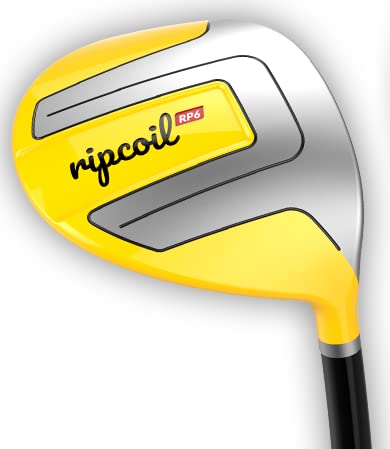
The Ripcoil RP6 is a unique training aid that features a whippy, heavyweight graphite shaft paired with an actual driver head that you can hit real golf balls with. At 42.5 inches, it is slightly shorter than a standard driver, encouraging a better strike pattern while forcing your hands to maintain lag and delay the release. One reviewer (age 62) reported drives over 250 yards after one month of use, with noticeable improvements in wrist action, pause at the top, and rotation.
The core design teaches you the correct swing sequence led by the big muscles—shoulders, torso, hips—rather than letting your hands and wrists dominate the downswing. The whippy feel punishes early casting immediately because the head lags behind, so you learn to maintain the angle until the last possible moment. Users mention that the natural lag sensation teaches shoulder rotation and tempo better than any rigid weighted stick.
Some buyers feel the RP6 is not whippy enough to really distinguish itself from a regular driver, especially if you have a smooth tempo. The included instructions contain contradictory drills and link to clickbait sites, leaving you to figure out the best use case on your own. It is also only available in right hand orientation, which limits left-handed players. For those committed to fixing their release timing, this is one of the few devices that actually lets you hit balls while grooving the lag.
Why it’s great
- Whippy shaft provides instant feedback on casting and early release
- You can hit real golf balls for authentic impact feel
- Proven distance gains of 30+ yards for some users
Good to know
- Not whippy enough for some players to feel a difference
- Right-hand orientation only; poor instructional materials included
5. Tour Striker Smart Ball

The Tour Striker Smart Ball is a deceptively simple tool: an inflatable 6-inch ABS ball that you hold between your forearms during practice swings. It forces your arms and torso to move as a connected unit throughout the takeaway, transition, and follow-through, eliminating the disconnected arm motion that robs speed and consistency. Reviewers call it the best training aid they have ever used for teaching a connected swing and increasing rotation.
This trainer works with every club in the bag, from wedges to driver, and even for putting and chipping. The lanyard is high-quality and less prone to breaking than cheaper imitations. The soft inflatable ball is comfortable against your arms and shows no air leakage issues even after weeks of use. Multiple users confirm it helped them develop a better feel for how the body and arms should move together, which directly translates to more efficient speed transfer.
Some buyers feel the build quality is underwhelming for its price point—the ball and lanyard feel like they should cost much less. One reviewer described it as “extremely cheap build quality” and returned it. It does not provide any quantitative feedback or speed data, relying entirely on physical feel. For players who already have decent speed but struggle with inconsistent contact due to a disconnected swing, this is a low-risk addition to a training routine.
Why it’s great
- Forces connected arm-body motion for better swing sequencing
- Works with all clubs, including chipping and putting
- Comfortable, durable construction with no air leakage
Good to know
- Build quality feels cheap relative to the price
- No quantitative feedback or speed measurement
6. Callaway Lag Trainer

The Callaway Swing Stick is a flexible plastic training aid designed primarily as a warmup and rhythm tool. At 37.5 inches, it mimics the length of a 6-iron and has a slight flex that rewards smooth, tempo-driven swings while punishing jerky transitions. Users appreciate it as a pre-round warmup device that loosens up the back, shoulders, and hips without needing a full club swing.
Beyond warming up, it serves as a general flexibility and mobility tool—swinging it slowly in controlled stretches can improve posture and reduce tightness. The rubber grip fits comfortably in both hands (ambidextrous design), and the stick fits easily in any standard golf bag. It is also notably affordable compared to the dedicated lag and radar trainers in this guide, making it a low-commitment entry point for players curious about tempo training.
This is not a true speed trainer—it lacks the weight, whippiness, or feedback mechanisms of more specialized tools. Some users note that it feels too similar to a standard club to create meaningful lag training, and it cannot be used to hit balls. For golfers who simply want to shake off stiffness before a round and practice a smooth tempo swing, it is a solid choice, but those chasing 10+ mph gains should look at the Ripcoil or a radar system.
Why it’s great
- Excellent pre-round warmup tool that improves mobility
- Ambidextrous rubber grip fits all hand sizes
- Fits easily in a golf bag for everyday carry
Good to know
- Not designed for true lag training or speed building
- Flexible plastic only provides limited feedback
7. WINNER SPIRIT Real Swing 300

The Real Swing 300 is a complete hitting station that allows you to take full swings indoors with plastic practice balls while tracking your swing path. It features a tethered ball on an arm that returns to position after each strike, plus a groove mat that shows you the quality of your low point. The unit has three adjustable height settings to simulate different lies and clubs, from wedges to driver.
Users report that it is durable enough to survive heavy use by multiple family members, including erratic beginner swings. The setup is straightforward; the unit folds up for compact storage, and the included shock-absorbing floor mat protects surfaces from the tethered ball’s swing path. The immediate feedback of seeing where the ball goes relative to your stance helps you identify path and impact issues without needing a launch monitor.
The ball rotation angle is too subtle to clearly show slice or hook correction as advertised, so its path feedback is limited compared to the EyeLine Speed Trap. The turf mat sheds over time, and the adhesive fails, requiring super glue repairs. It is also priced higher than many dedicated speed trainers, and it does not provide quantitative speed data. For golfers who want to practice at home and feel a real ball impact, this is a niche solution, but speed hunters will still need a radar unit to track their MPH gains.
Why it’s great
- Full-swing hitting trainer for indoor or outdoor use
- 3 adjustable heights simulate different clubs and lies
- Foldable design fits in smaller spaces like a foyer
Good to know
- Ball rotation too subtle for clear slice/hook feedback
- Turf mat adhesive fails over time; needs maintenance
FAQ
Can I use a swing speed trainer without a radar?
How many times per week should I swing a speed trainer?
Will a swing speed trainer fix my slice?
Final Thoughts: The Verdict
For most users, the best golf swing speed trainer winner is the GolfForever Swing Trainer because it builds the foundational strength, flexibility, and stability that enable genuine speed gains without reinforcing bad swing mechanics. If you want precise quantitative feedback you can track over weeks, grab the Swing Speed Radar SSRTT364. And for fixing a path issue while still grooving lag, nothing beats the EyeLine Golf Speed Trap 2.0.