
Finding a gift for an 18-month-old is less about the toy itself and more about what it unlocks — the first moments of focused concentration, the delighted surprise when a ball rolls down a ramp, or the satisfying *thunk* of a wooden hammer. At this age, the world is a laboratory of cause and effect, and the best gifts are the experiments.
I’m Mohammad Maruf — the founder and writer behind Drink4Good. I’ve spent dozens of hours analyzing the design, material safety, and developmental alignment of toys for this specific age group to separate the ones that hold a toddler’s attention from those that get tossed aside in minutes.
This buying guide narrows the field to the most well-constructed, skill-targeted options available now, helping you confidently choose the right gifts for 1.5 year olds that will actually support their growth and curiosity.
How To Choose The Best Gifts For 1.5 Year Olds
The toy aisle can be overwhelming at this age. Children are transitioning from simple cause-and-effect play to more complex problem-solving, but they still explore primarily with their hands and mouths. The best toys bridge this gap, offering a satisfying physical action (pounding, pulling, sorting) while introducing a simple cognitive challenge (matching shapes, recognizing colors).
Prioritize Fine Motor Development
At 18 months, the pincer grasp is still developing, and any toy that requires a precise finger movement — inserting a coin into a slot, picking up a small wooden peg, or rotating a wrist to fit a popsicle stick — directly strengthens those crucial hand muscles. Look for toys with multiple, graduated challenges that start easy and become more difficult, keeping a toddler engaged over months.
Material Safety and Durability
Toddlers this age still mouth objects, use them as teethers, and test their structural integrity by throwing them across the room. Uncoated or low-quality wood can splinter; cheap plastic can crack into sharp edges. Prioritize toys made from solid rubberwood or beechwood coated with non-toxic, water-based paint, or smooth, high-grade ABS plastic free from BPA and phthalates. The toy should feel substantial enough to survive a drop without breaking into small, dangerous parts.
Open-Ended Play Value vs. Single Function
A toy with just one button that plays a single sound has a very short shelf life. The best gifts offer multiple modes of play — a pounding bench that also works as a shape sorter, a block set that also teaches colors and counting, or a walker with a detachable activity panel. This “replayability” ensures the toy remains interesting for longer stretches and grows with the child’s changing skills.
Quick Comparison
On smaller screens, swipe sideways to see the full table.
| Model | Category | Best For | Key Spec | Amazon |
|---|---|---|---|---|
| VTech Sit-to-Stand Learning Walker | Walker & Panel | Developing gross motor skills | Detachable activity panel | Amazon |
| Stay Fun 2-in-1 Rolling Ball & Car Ramp | Track & Ramp | Cause and effect learning | 3 light-up balls & 3 cars | Amazon |
| SMALL FISH 3-in-1 Montessori Toy | Fine Motor | Precision finger exercises | 40-piece stick & coin set | Amazon |
| KMTJT Wooden Farm Toy | Montessori Farm | Sorting & imaginative play | Rounded rubberwood pieces | Amazon |
| Joyreal Hammering & Xylophone Toy | Multi-Activity | Sensory & music stimulation | 4 activities in neutral wood | Amazon |
In‑Depth Reviews
1. VTech Sit-to-Stand Learning Walker (Pink)

The VTech Sit-to-Stand Learning Walker is a cornerstone toy for the 12- to 24-month stage because it transitions seamlessly from a floor-based activity center to a supportive walker. The detachable panel clicks off for seated play, giving a child access to five piano keys, light-up buttons, three shape sorters, and a spinning roller — all of which reward tactile exploration with sound and light. The built-in two-speed control switch on the wheels prevents the walker from rolling too fast on bare floors, a crucial safety detail for new walkers working on balance.
Parents report this walker holds up through multiple children, a testament to its durable plastic construction and the strength of its support frame. The inclusion of a telephone handset and musical note keys encourages early role-play and auditory discrimination, adding cognitive value beyond pure gross motor work. The panel is also large enough to be used separately as a take-along toy for car rides, making it one of the most versatile options in this roundup.
One aspect to note is that the walker is designed for children up to about 35 pounds, so it won’t serve beyond the early walking phase, but its primary function — supporting the transition from sitting to walking — is executed flawlessly. For the caregiver who wants a single, long-lasting gift that addresses both fine and gross motor milestones, this is the definitive choice.
Why it’s great
- Detachable activity panel offers two toys in one (floor + walker).
- Two-speed wheel control prevents accidents on hard floors.
- Promotes both fine motor (sorters, buttons) and gross motor (walking) skills.
Good to know
- Plastic construction, may not appeal to families preferring all-wood toys.
- Music and sounds cannot be turned off completely (volume control only).
- Weight limit of 35 pounds limits use beyond early toddlerhood.
2. Stay Fun 2-in-1 Rolling Ball & Car Ramp
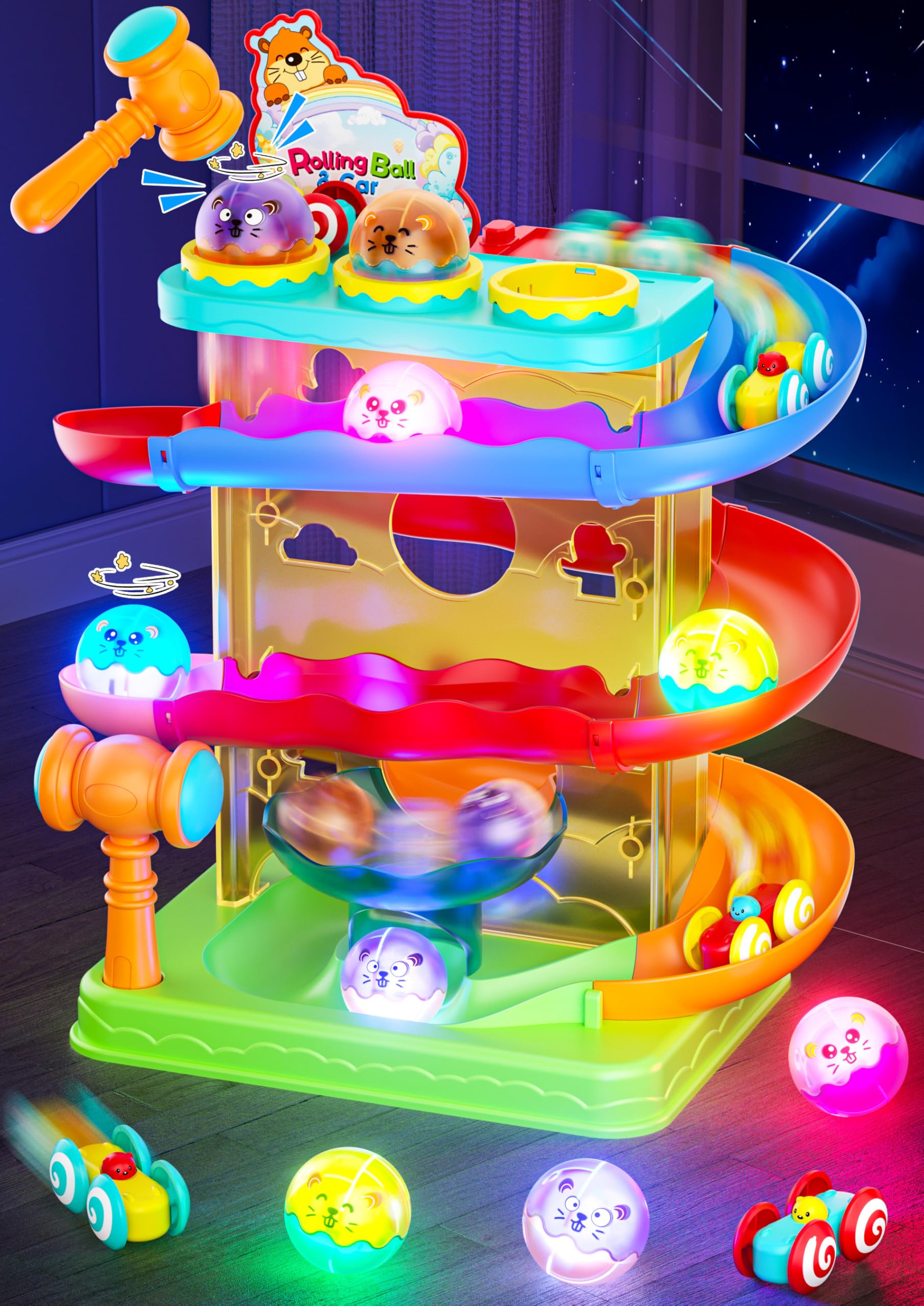
The Stay Fun 2-in-1 ramp is engineered to exploit a toddler’s favorite discovery: cause and effect. Place a ball or car at the top, push it, and watch it bounce and roll down three brightly colored tracks. The real magic comes from the motion-activated LED balls that light up as they roll, visually reinforcing the path of descent and helping to train a child’s visual tracking — a foundational skill for reading. The set also includes a hammer for pounding the ball into the top slot, adding a satisfying physical launch mechanism.
Assembly is quick and tool-free, and the smooth, rounded plastic edges meet rigorous ASTM safety standards, a non-negotiable for this age group. The track pieces clip together securely to prevent collapse during enthusiastic play, and the inclusion of both balls and mini cars doubles the entertainment by letting the child switch between rolling objects of different weights. The motion-sensor lights on the balls are especially helpful for finding them when they inevitably disappear under a couch.
One nuance to consider: the LED lights in the balls are powered by small batteries that customers note may not be user-replaceable once they die. This doesn’t affect the core rolling play, but if the lights fade, the sensory punch diminishes slightly. Even without the lights, however, the physical ramp and car action remains deeply captivating for 18-month-olds who are obsessed with watching objects move.
Why it’s great
- Motion-activated LED balls provide strong visual feedback for cause-and-effect learning.
- Dual-purpose set includes both balls and cars for varied rolling play.
- Tool-free assembly with durable, child-safe plastic and rounded edges.
Good to know
- Ball LED batteries may not be replaceable; lights will eventually fade.
- Plastic material, not suitable for older children beyond 3–4 years.
- Requires supervision to ensure cars are launched correctly into the track.
3. SMALL FISH 3-in-1 Montessori Toy

This SMALL FISH set is a pure fine-motor workout. It includes a wooden tube with three different lid types, 16 colorful sticks, 14 slotted popsicle sticks, and 10 coin-like discs. Each piece must be inserted into a specific slot — round sticks through round holes, flat sticks through the slit, and discs through a coin bank opening — forcing the child to rotate their wrist, adjust their grip, and problem-solve the correct orientation. It is an ideal “quiet time” activity that can be packed in the included canvas bag for restaurants or church.
The construction uses natural beechwood sourced from Romania and Germany, polished smooth and coated with a food-grade, non-toxic finish. This is a key detail for parents concerned about safety given that children will inevitably chew the edges of the popsicle sticks. The separate lids unscrew easily, allowing the child to practice object permanence by retrieving the pieces. The toy also earned a Best Sellers Rank of #3,687 in Toys & Games and a strong 4.5-star average from nearly 500 reviews, reflecting genuine satisfaction from families.
A small but notable criticism from some users is that the popsicle stick slot lid is quite tight, requiring a bit more force to push the flat sticks through than some toddlers can muster independently. The canvas storage bag is also slightly undersized for all 40 pieces unless they are arranged perfectly. Still, for a budget-friendly entry point into Montessori-style learning, this set delivers exceptional developmental value in a compact, portable package.
Why it’s great
- Pure Montessori fine-motor drill: color sorting, wrist rotation, and object permanence.
- Made from solid beechwood with food-grade, non-toxic finish.
- Compact and portable; comes with a canvas bag for on-the-go play.
Good to know
- Popsicle stick slot is tight; some toddlers may need help inserting.
- Canvas bag is small; fitting all pieces is finicky.
- Lids are not totally secure; can be popped off by a determined child.
4. KMTJT Wooden Farm Toy

The KMTJT Wooden Farm Toy brings a classic wooden play set to life with a multi-sensory approach. It includes a wooden base tray, eight pull-out carrots, ten animal blocks, a game map, and a cute farmer block. The core mechanic is simple: the child plants the carrots into holes, places the animals into their wooden slots, and uses the map to match animals to their farm locations. This combination of vertical pull (carrots) and horizontal slot (animals) provides two distinct fine-motor muscle groups to exercise.
The toy is made from solid rubberwood with polished, rounded edges, and users consistently praise its heft and durability — it feels like a heirloom piece rather than a disposable mass-market toy. The carrots are sized for small hands to grip and pull, while the animal blocks are chunky enough to be held and mouthed without being a choking hazard. The included game map adds a visual matching layer that older toddlers (18–24 months) will start to understand, extending the toy’s useful life well past the first birthday.
One thing to be aware of: the side puzzle pieces are quite challenging for a 1-year-old to push into their slots, and the worm pieces on the carrot tops are glued in place, not removable, which disappoints some children who want to pull them off. However, the sheer number of independent activities — vegetable planting, animal sorting, shape matching, and open-ended storytelling — makes this a rich, screen-free option that encourages focused, imaginative play during quiet afternoons.
Why it’s great
- Solid rubberwood construction with polished edges feels durable and safe.
- Two distinct fine-motor challenges: vertical pull (carrots) and horizontal slot (animals).
- Game map adds a visual matching component that grows with the child.
Good to know
- Side puzzle slots are too tight for most 1-year-olds to operate alone.
- Worm pieces on carrot tops are glued in place, not removable.
- Farm base is smaller than expected; some users wanted a larger playscape.
5. Joyreal Hammering & Xylophone Toy
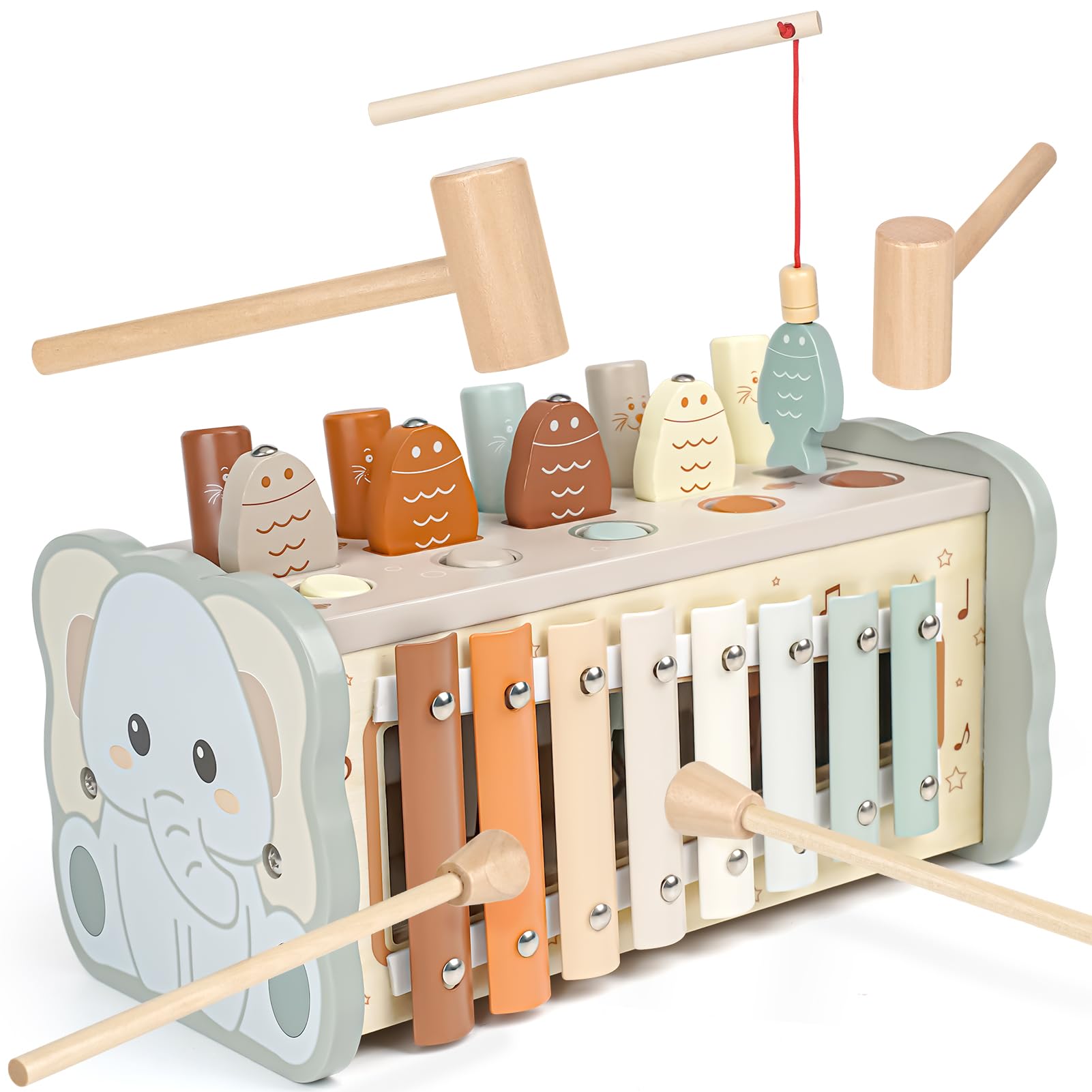
The Joyreal set bundles four distinct activities into a single neutral-colored wooden base: a classic pounding bench with two hammers, a removable xylophone, a magnetic fishing game, and a gear-spinning panel. The pounding bench works by tapping the wooden pegs, which pop the smiling hamsters up on the opposite side — a cause-and-effect loop that toddlers find endlessly satisfying. The xylophone detaches for independent play, while the fishing game introduces a magnetic element that requires precise hand control.
The standout design choice here is the neutral color palette — soft beiges, muted greens, and warm browns instead of the blinding primary colors common in toddler toys. This creates a calmer visual environment that helps children focus on the task rather than being overstimulated by bright flashes. The wood is coated with non-toxic water-based paint, and the edges are meticulously polished. The inclusion of two hammers and two mallets means two children can play simultaneously, encouraging early social turn-taking.
A minor practical note: the pounding bench is smaller than many parents expect from the product photos, but its 10.4-by-5.9-inch footprint is actually more appropriate for toddler-sized hands and a small playroom. The xylophone’s sound is more gentle “clink” than a full musical tone, which is fine for sensory play but won’t replace a proper instrument. For a low-cost, multi-activity wooden toy that covers hammering, music, fishing, and gears, this is a smart, space-conscious choice.
Why it’s great
- Neutral color palette reduces visual overstimulation and promotes focus.
- Four distinct activities (pounding, music, fishing, gears) in one compact unit.
- Two hammers and mallets allow for cooperative, turn-taking play.
Good to know
- Smaller than expected; check dimensions for your play space.
- Xylophone sound is more “plink” than a true musical tone.
- Fishing game magnets are small; supervision required to keep pieces together.
FAQ
Why are Montessori-style toys recommended for 18-month-olds?
At what age do children stop needing walkers like the VTech?
How can I tell if a wooden toy is truly non-toxic?
Are light-up balls and sounds overwhelming for a 1.5-year-old?
Final Thoughts: The Verdict
For most users, the gifts for 1.5 year olds winner is the VTech Sit-to-Stand Learning Walker because it actively bridges the gap between floor play and walking, offering the highest replay value across motor skill domains. If you want a mesmerizing cause-and-effect sensory experience, grab the Stay Fun 2-in-1 Rolling Ball & Car Ramp. And for a pure, quiet-time fine motor drill that fits in a diaper bag, nothing beats the SMALL FISH 3-in-1 Montessori Toy.