
A slice that sneaks in on the back nine. A putt that lips out from three feet. A swing that feels disconnected from memory when you finally step onto the first tee. The gap between range practice and on-course performance is where most golf training tools fail — they deliver data without feel, or feel without structure. The right training tool bridges that gap by giving you a repeatable physical cue you can take directly to the course.
I’m Mohammad Maruf — the founder and writer behind Drink4Good. I’ve spent hundreds of hours analyzing the mechanical specifications, build tolerances, and real-world feedback patterns of over seventy golf training aids to understand why some produce lasting improvement while others end up in a garage bin after two sessions.
This guide isolates the seven models that hold up under scrutiny — from putting mats that simulate actual green speeds to swing trainers that give you the shock of real impact. Mastering the best golf training tools means understanding whether you need path correction, distance control, or tempo work before you spend a single dollar.
How To Choose The Best Golf Training Tools
A golf training tool is only useful if it targets your specific weakness — and if you’ll actually use it three times a week. Here are the key considerations that separate effective aids from dust collectors.
Surface Material and Ball Roll Fidelity
The putting mat surface determines whether your practice translates to a real green. High-density velvet and nylon surfaces produce a roll speed between 9 and 14 on the Stimpmeter, which matches typical course conditions. Thin plastic or low-pile polyester surfaces create erratic roll and teach you to compensate for a mat, not a green. Look for mats with a rubber or foam backing that resists wrinkles — any surface imperfection trains a bad stroke.
Swing Feedback Mechanism
Swing trainers fall into two camps: tempo trainers that rely on weight distribution (like a weighted stick) and path trainers that give you physical resistance or impact feedback (like a hitting trainer with a ball on a tether). If your problem is early extension or an over-the-top move, you need a tool that produces a concrete sensation when you hit the correct slot. If your issue is rhythm, a weighted swing stick alone may suffice. Know which feedback type addresses your fault before buying.
Ball Return and Practice Density
In a 20-minute putting session, you can take 60 strokes if you have a magnetic track return, or 25 strokes if you’re walking to retrieve each ball. The ball return system directly dictates how much deliberate practice you fit into a session. Magnetic tracks and built-in ramps dramatically increase practice density. For swing trainers, look for a tether system that returns the ball to the same spot — it keeps your setup consistent between reps.
Quick Comparison
On smaller screens, swipe sideways to see the full table.
| Model | Category | Best For | Key Spec | Amazon |
|---|---|---|---|---|
| WINNER SPIRIT Real Swing 300 | Swing Trainer | Full-swing path correction | 3 height adjustments; tethered ball | Amazon |
| SAPLIZE Putting Mat with Alignment Mirror | Putting Mat | Alignment and dual-speed practice | 20 in x 10 ft; dual-speed surface | Amazon |
| Dachenus Putting Green Mat | Putting Mat | Premium indoor putting with magnetic return | Solid wood frame; 10–14 Stimpmeter speed | Amazon |
| CHAMPKEY Putting Green with Hazards | Putting Mat | Improving accuracy with hazard challenges | 8.9 ft x 1.28 ft; 3 gate sizes | Amazon |
| YOUCZON Putting Green Indoor | Putting Mat | Beginner-friendly with solid wood base | Crystal velvet surface; wooden base | Amazon |
| LYDARZ Golf Hitting Mat Set | Hitting Mat | Swing path feedback with interchangeable surfaces | 3 turf types; non-slip rubber base | Amazon |
| Callaway Golf Swing Stick | Swing Trainer | Warmup and tempo training | 37.5 inches; weighted stick | Amazon |
In‑Depth Reviews
1. WINNER SPIRIT Real Swing 300

The WINNER SPIRIT Real Swing 300 bridges the gap between a weighted stick and a full simulator by letting you actually hit a ball anchored to a tethered pivot. The three adjustable height levels let you work through every club from a wedge to a driver, and the special bearing system absorbs the rotational force of a full swing without twisting the base — a common failure point on cheaper swing trainers. Reviewers consistently report that the 6-by-4-foot footprint fits comfortably in a garage or living room, and the included shock-absorbing floor mat protects both the unit and your flooring from repeated use.
The critical advantage here is the tactile feedback loop. Because the ball is attached, you can see exactly where your club face was at impact by watching the trajectory of the tethered ball. This makes it far more instructive than a swing stick, which tells you nothing about path or face angle. The unit uses safe plastic practice balls, so you can train indoors without worrying about breaking a window or denting a wall. Some users with overly aggressive swings have reported the tether needing occasional straightening, but the overall build quality holds up well after a full season of regular use.
For the golfer whose primary fault is an over-the-top move or early extension, this tool delivers the most direct path correction of anything in this guide. The height adjustability means you can groove a repeatable swing plane with every iron in the bag, and the feedback is instant and honest. If you want to feel what a good swing actually does to a ball — without walking to the range — this is the tool to own.
Why it’s great
- Three height settings cover all clubs from wedge to driver.
- Tethered ball gives real impact feedback, not just air swings.
- Base and bearing system handle high swing speeds without wobble.
Good to know
- Plastic practice balls feel slightly softer than real golf balls — acceptable for training.
- Turf on the base can shed adhesive after extended use; replacement turf is available.
2. SAPLIZE Golf Putting Mat with Alignment Mirror
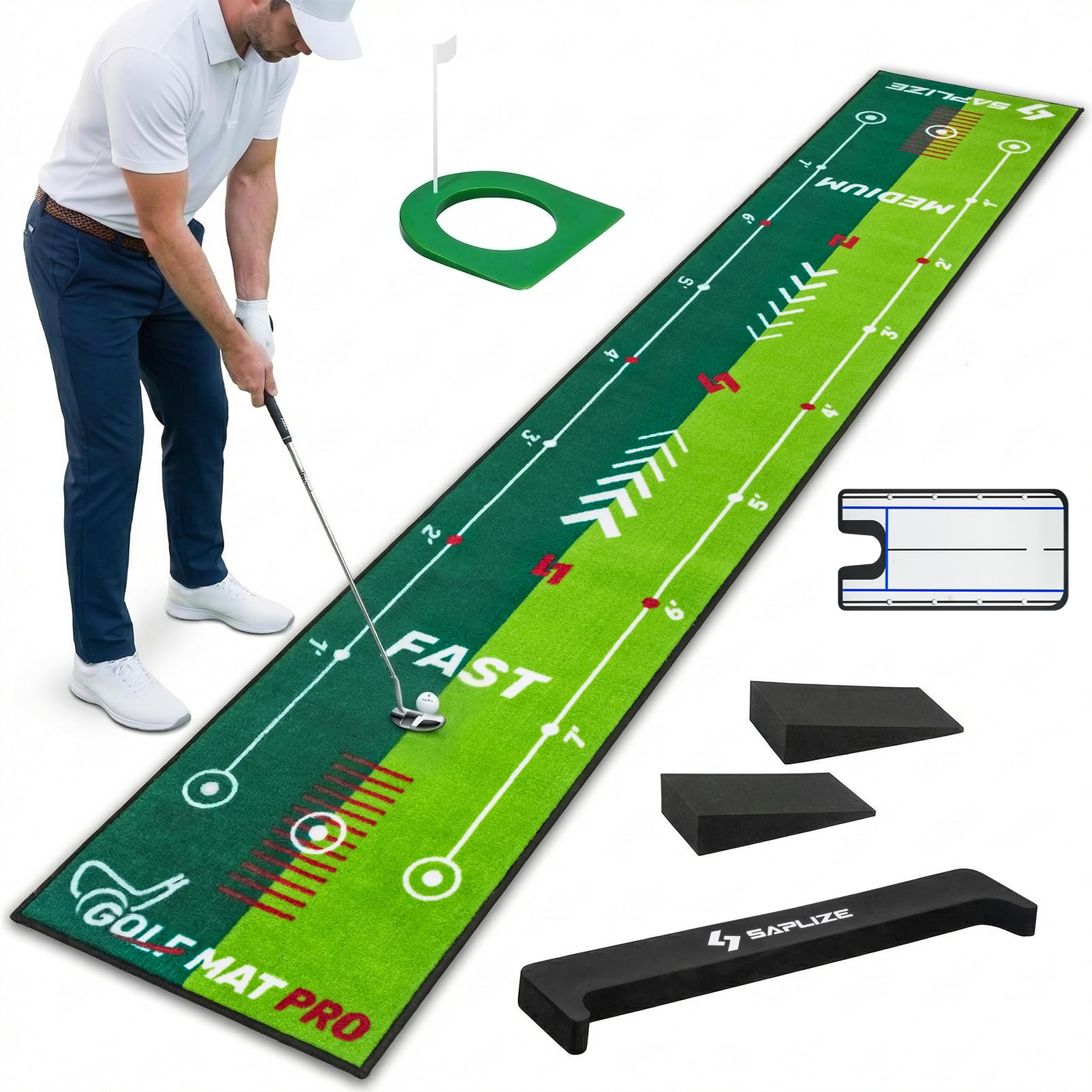
The SAPLIZE putting mat stands out because it offers two distinct speed surfaces on a single 20-inch-wide by 10-foot-long mat: one side rolls at approximately 11 on the Stimpmeter (fast) and the other at around 9 (medium). This means you can practice both a quick, firm putt and a slower, more delicate stroke without buying a second mat. The built-in alignment mirror gives you immediate visual feedback on your eye position and shoulder alignment — a feature that alone can fix a setup that drifts over time.
The mat uses an ethylene vinyl acetate (EVA) base with a TPR rubber backing that stays put on hardwood and tile floors. It ships rolled up, and most users report it flattens out quickly with minimal memory creases. The included foam wedges let you create a custom slope to simulate breaking putts, which transforms a straight-line practice mat into a tool for reading and playing breaks. The ball bumper along the edges stops putts from rolling off, saving time collecting stray balls.
Where this mat excels is in structured practice sessions. The printed distance markers (in feet) let you systematically work through 3-, 6-, and 9-foot putts while the alignment mirror ensures your setup stays consistent. The dual-speed design also forces you to adjust your stroke pace depending on which side you’re using — a skill gap that many improving players overlook. For a golfer who wants to refine both distance control and setup accuracy in one compact package, this mat is a standout.
Why it’s great
- Two-speed surface (fast and medium) lets you train for different green conditions.
- Alignment mirror corrects setup drift — eyes over the ball, shoulders square.
- Foam wedges create realistic slopes for break practice.
Good to know
- Mat can shift slightly on thick carpet; works best on hard floors.
- Some units may have slight surface undulations that affect straight putts.
3. Dachenus Putting Green Indoor Mat

The Dachenus putting green represents a notable step up in materials and finish. The frame is solid F-grade wood (not composite or plastic), and the putting surface uses a high-density velvet layer over a natural rubber base that delivers a roll speed in the 10-to-14 Stimpmeter range — comparable to a well-maintained public or private course green. The mat measures 100 inches long by 8.66 inches wide, offering a realistic feel for putts up to 7.5 feet, and the wooden magnetic ball return track saves you from constantly bending over.
Assembly is straightforward: the wooden track sections snap together via strong magnets, and the mat itself unrolls without the memory creases that plague rolled synthetic mats. The ball return uses a gentle incline ramp rather than a forced V-groove, so the ball returns smoothly without bouncing or catching. The surface has a subtle grain that doesn’t affect ball roll, and the edge chamfer design keeps the frame from scuffing walls or furniture — a practical touch for home use.
This is the right choice for the golfer who plans to use the mat daily and wants a premium look and feel that won’t degrade after a few months. The solid wood construction gives it a weight and presence that cheaper plastic mats lack, and the velvet surface provides a consistent, true roll that replicates the sensory feedback of a real green. If you spend most of your practice time on the putting surface, this mat will reward you with predictable, reliable feedback.
Why it’s great
- Solid F-grade wood frame resists warping — outlasts plastic alternatives.
- High-density velvet surface provides true, predictable ball roll at course-level speed.
- Magnetic ball return track is quick to assemble and delivers smooth, consistent return.
Good to know
- Mat is narrower (8.66 in) than some competitors — less room for off-center putts.
- No putter included; you must supply your own club.
4. CHAMPKEY Golf Putting Green Indoor
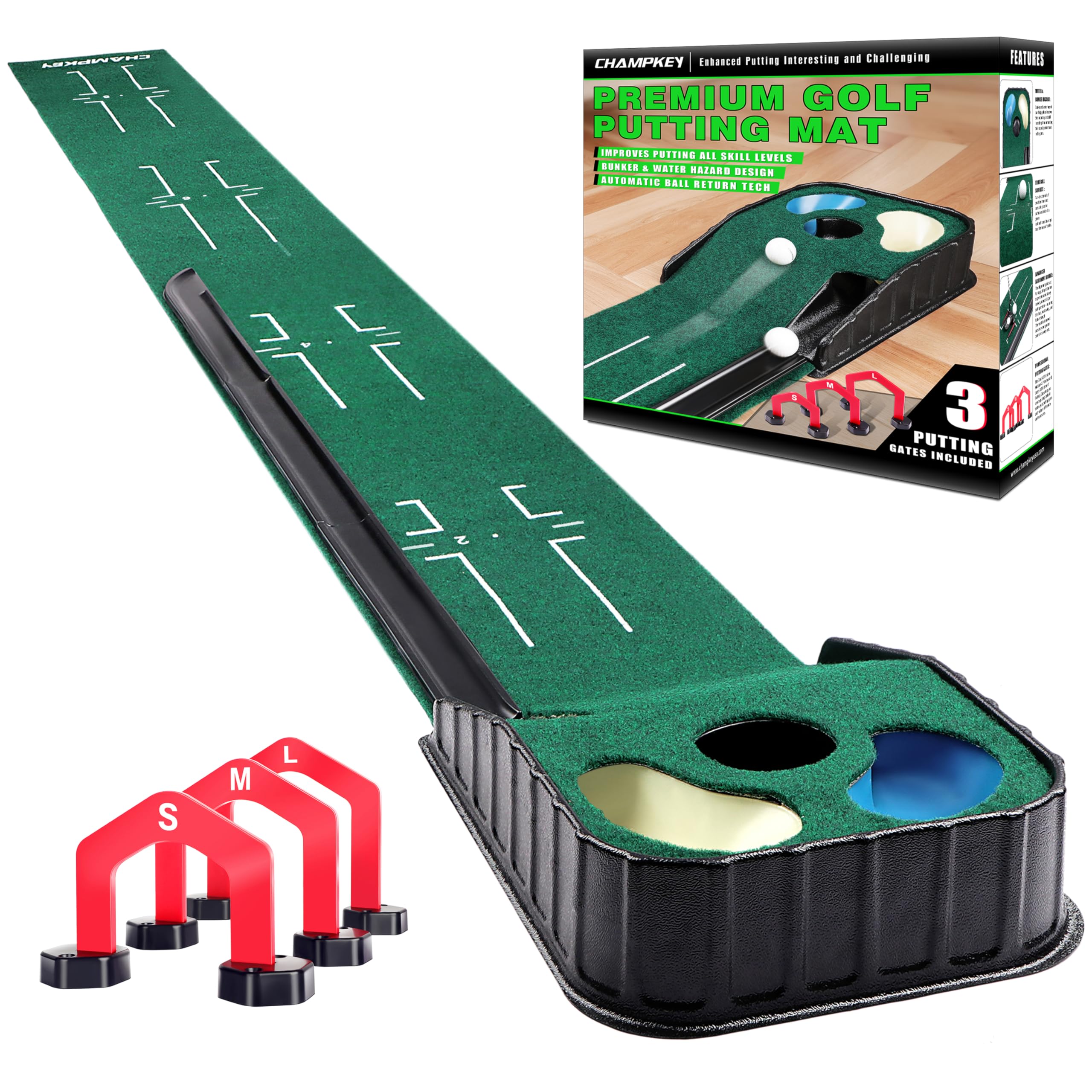
The CHAMPKEY putting green focuses on one metric: accuracy. It includes three putting gates sized at 2.1 inches (small), 2.7 inches (medium), and 3.3 inches (large), allowing you to progressively tighten your target as your stroke improves. The 8.9-foot-long polyester mat has a non-directional turf surface that rolls consistently regardless of which way it faces, and the inclined ramp at the cup end forces you to strike the ball with enough pace to clear the ramp — a subtle but effective way to train distance control.
The built-in automatic ball return system uses manual troughs that fit together and channel the ball back toward you. Quiet operation means you can practice early in the morning without disturbing anyone, and the lightweight construction makes it easy to roll up and store between sessions. The rubber backing material keeps the mat from sliding around on hard floors, though some users note that placing it on low-pile carpet can reduce the effective practice area.
Where the CHAMPKEY shines is in creating a structured putting drill that gamifies improvement. Working through the three gate sizes gives you clear progression goals — hit the ball through the large gate ten times in a row, then move to medium. This type of deliberate practice is exactly what separates players who stagnate from those who drop strokes. For the budget-conscious golfer who wants a no-nonsense accuracy training system, this mat delivers disproportionate value for its price category.
Why it’s great
- Three gate sizes (2.1 to 3.3 inches) create a clear progression for accuracy training.
- Non-directional turf rolls consistently regardless of mat orientation.
- Quiet ball return system allows practice without disturbing others.
Good to know
- Packaging lacks a storage box — mat arrives in a plastic bag.
- No practice ball included; you’ll need to supply your own.
5. YOUCZON Putting Green Indoor

The YOUCZON putting mat uses a crystal velvet surface backed by a solid wood base, which gives it a premium heft and a smooth, true roll that outperforms many mats at its tier. The velvet material produces a quiet putt with minimal skid — the ball starts rolling end-over-end quickly, which is critical for training distance control on short putts. The included four magnetic ball return tracks connect easily and create a channel that funnels the ball back to a storage box, keeping your practice area tidy.
Setup is straightforward: lay the mat flat, clip the magnetic tracks to the end, and you’re ready. The mat lies flat out of the box with minimal wrinkles, though a few users have noted small surface humps that resist flattening over time. The practice distance ranges from 2 feet up to about 7.5 feet, which covers the majority of putts you’ll face on the course. The wooden base adds enough weight that the mat stays put during putting strokes, even on tile floors.
This mat is ideal for beginners or intermediate golfers who want a clean, attractive training tool that won’t intimidate. The crystal velvet surface is forgiving — it doesn’t punish slight mishits the way a fast, firm surface would — so you can focus on feel and tempo without worrying about perfect contact. The one-year return policy adds confidence, and the solid construction means it can survive being rolled up and stored under a bed or behind a couch without losing its shape.
Why it’s great
- Crystal velvet surface provides a quiet, true roll with minimal skid.
- Solid wood base adds weight and prevents mat movement during strokes.
- Magnetic return tracks are easy to assemble and keep the ball returning smoothly.
Good to know
- Small surface humps may appear and resist full flattening.
- Velvet surface can show wear with very heavy daily use.
6. LYDARZ Golf Hitting Mat Set
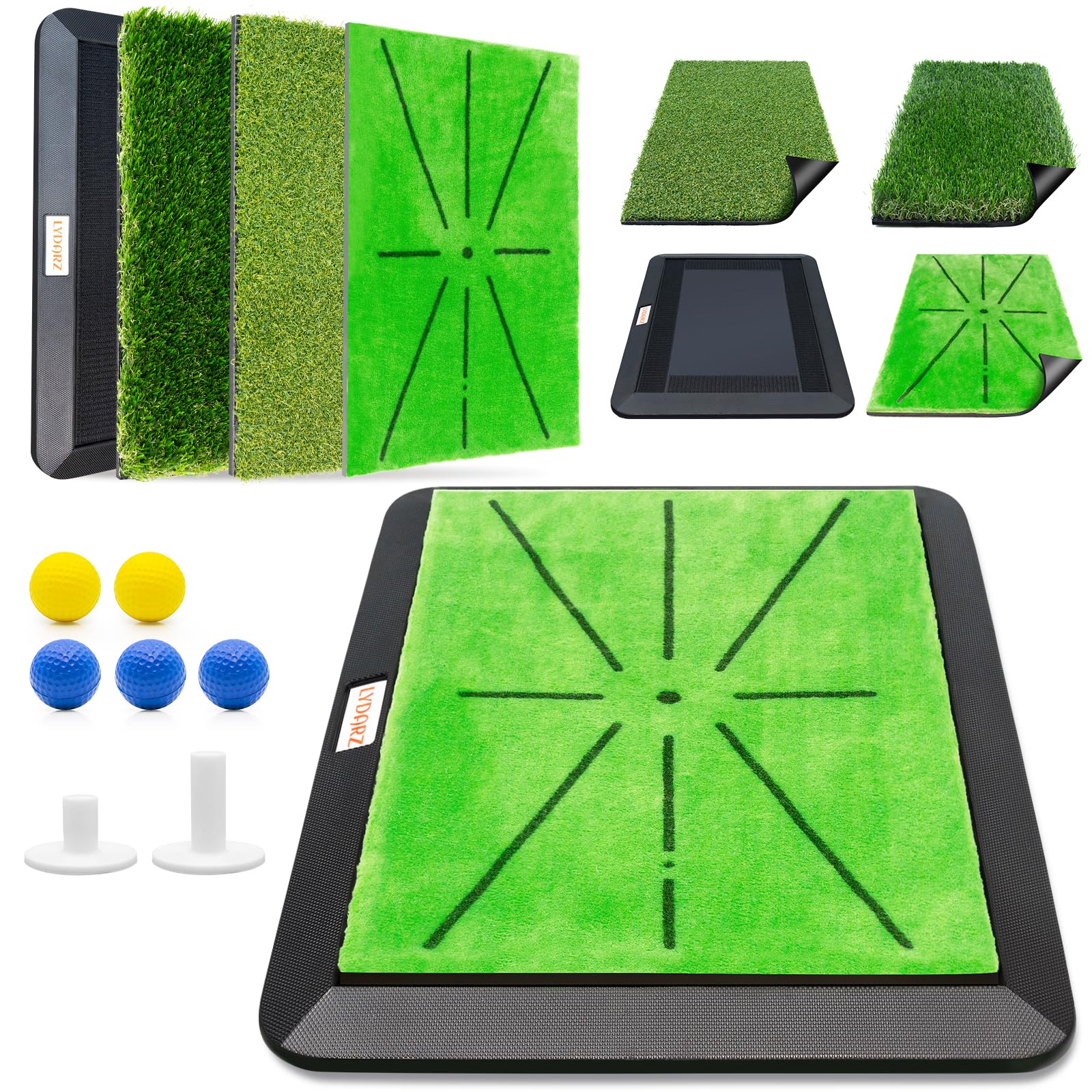
The LYDARZ hitting mat set tackles a different problem than putting mats: swing path. It includes three interchangeable surfaces — rough turf, fairway turf, and a divot board mat — that simulate different lies. Each mat measures about 16 by 12 inches, and they swap in and out of a heavy-duty rubber base that stays planted even during full-swing hits with real golf balls. The real draw here is the instant swing path feedback: the design of the fairway mat leaves visible marks or resistance patterns that show you whether your club is coming from the inside or crossing over the top.
The non-slip rubber base is thick enough to absorb shock and protect your floor or carpet, making it safe for indoor use with a practice net. The three surfaces give you variety — you can practice punch shots from rough, clean strikes from a tight fairway lie, and divot-conscious swings from the divot board. This variety prevents your practice from becoming repetitive and helps you adjust to different on-course conditions without leaving your home.
Where this mat falls short for some is the level of feedback granularity. The swing path indicators are visual (you see the pattern on the mat) rather than tactile, so you need to look down after each swing to check. That said, for a golfer who wants a simple, durable, and portable system to groove a proper swing plane with all clubs, this set is a smart mid-range option. The compact size means it packs into a bag easily for trips to the office or the range.
Why it’s great
- Three interchangeable turfs (rough, fairway, divot board) simulate real-course lies.
- Heavy-duty rubber base stays secure during powerful swings.
- Instant swing path feedback helps correct over-the-top moves.
Good to know
- Feedback is visual rather than tactile — requires you to check the mat after each swing.
- Compact mat size may not suit full driver swings; best for irons and wedges.
7. Callaway Golf Swing Stick Lag Trainer

The Callaway Swing Stick is a purpose-built tempo and warmup tool that fits in your golf bag like a regular club. At 37.5 inches — the length of a standard 6-iron — the weighted stick forces you to swing with controlled rhythm because any jerk or acceleration is immediately felt through the shaft. It’s not designed to correct your swing path; its job is to ingrain the feeling of a smooth, balanced transition from the top of the backswing into the downswing.
Construction is simple: a plastic shaft with a built-in weight at the head and a comfortable rubber grip that matches the diameter of a standard golf grip. The ambidextrous design means lefties and righties can both use it, and the compact size stores easily in your bag’s umbrella slot. Reviewers consistently mention using it for 30 to 60 seconds before a round to loosen the back, hips, and shoulders — the swinging motion warms up the muscles without the fatigue of hitting actual balls.
It’s not a substitute for a path-training tool, and it won’t tell you if your club face is open at impact. But if your issue is rushing the transition or losing posture during the swing, this stick will give you the physical sensation of what a patient, connected swing feels like.
Why it’s great
- Weighted design rewards smooth tempo and exposes rushed transitions.
- Fits directly into a golf bag — always available for pre-round warmup.
- Comfortable rubber grip and ambidextrous design suit all players.
Good to know
- Provides no swing path or face-angle feedback — it’s a tempo tool only.
- Plastic construction, while durable, doesn’t simulate the feel of a steel shaft.
FAQ
How long should a putting mat be for effective practice?
Can I use a swing trainer indoors without breaking anything?
Do golf training tools work better for putting or for full swing practice?
Final Thoughts: The Verdict
For most users, the best golf training tools winner is the WINNER SPIRIT Real Swing 300 because it gives full-swing path correction through actual impact feedback — the most direct mechanical feedback you can get without a launch monitor. If you want to sharpen your putting setup and adapt to changing green speeds, grab the SAPLIZE Putting Mat with Alignment Mirror. And for a brilliant entry-level putting solution that gamifies accuracy improvement, nothing beats the CHAMPKEY Golf Putting Green with Hazards.