
The right set of strings is the single most transformative upgrade you can make to your electric guitar’s voice and feel, yet most players grab whatever is cheapest or closest on the shelf. Choosing between coated longevity, pure-nickel warmth, or hybrid gauges directly shapes your bending ease, sustain, and how your axe cuts through a mix. A poor match not only dulls your tone but can introduce fret buzz, tuning instability, and premature breakage that kills your flow mid-solo.
I’m Mohammad Maruf — the founder and writer behind Drink4Good. Over the past decade, I’ve analyzed tension charts, coating technologies, and core-wire geometries across hundreds of sets to identify which string families deliver consistent intonation and lasting playability.
Whether you break high Es constantly, crave a vintage-correct mellow tone, or want one set that just refuses to corrode, the right best electric guitar strings feel like a custom setup tailored to your hands and style.
How To Choose The Best Electric Guitar Strings
Choosing strings isn’t just about brand loyalty — it’s about matching wrap wire material, coating, and gauge to your guitar’s scale length and your playing style. The wrong combo can mute your natural tone or make bending feel like a workout.
Wrap Wire Material: Nickel Plated vs Pure Nickel
Nickel-plated steel wrap wire delivers a bright, articulate attack that cuts through a dense band mix — it’s the standard for modern rock, blues, and metal. Pure nickel wrap wire produces a warmer, rounder tone with softer highs, favored by vintage purists and jazz players seeking smoother dynamics. Each material also affects string squeak and magnetic pickup response differently.
Coating Technology: Longevity vs Natural Feel
Coated strings like Elixir’s Optiweb wrap a thin polymer layer around the winding to block sweat and humidity, extending usable life three to five times longer than uncoated sets. The trade-off is a slightly slicker feel under the fingers and a marginally less bright top end. Uncoated strings deliver raw, uncompromised vibration but require more frequent changes if your hands sweat heavily.
Gauge Selection: Light, Medium, and Hybrid Sets
Light gauges (9-42 or 9-46) make string bending and vibrato easy on the fingers but can feel floppy for heavy riffing or drop tunings. Medium sets (10-46 or 11-49) provide balanced tension for standard tuning and punchy rhythm playing. Hybrid sets like 9-46 use lighter treble strings for easy bending and heavier bass strings for tight chording — a popular middle ground.
Quick Comparison
On smaller screens, swipe sideways to see the full table.
| Model | Category | Best For | Key Spec | Amazon |
|---|---|---|---|---|
| Elixir Optiweb 11-49 | Coated | Longest-lasting crisp tone | 0.02 kg set weight | Amazon |
| Ernie Ball Regular Slinky 3-Pack | Nickel Plated | Bright, balanced value pack | Hex-shaped steel core | Amazon |
| D’Addario XL Nickel 10-46 | Nickel Plated | Consistent intonation | Double ball end | Amazon |
| Ernie Ball Hybrid Slinky 9-46 3-Pack | Hybrid | Easy bends, tight bottom | 3.52 oz pack weight | Amazon |
| Fender Original 150 10-46 3-Pack | Pure Nickel | Warm vintage tone | Pure nickel wrap wire | Amazon |
In‑Depth Reviews
1. Elixir Strings, Electric Guitar Strings, Nickel Plated Steel with OPTIWEB Technology (Medium 11-49)
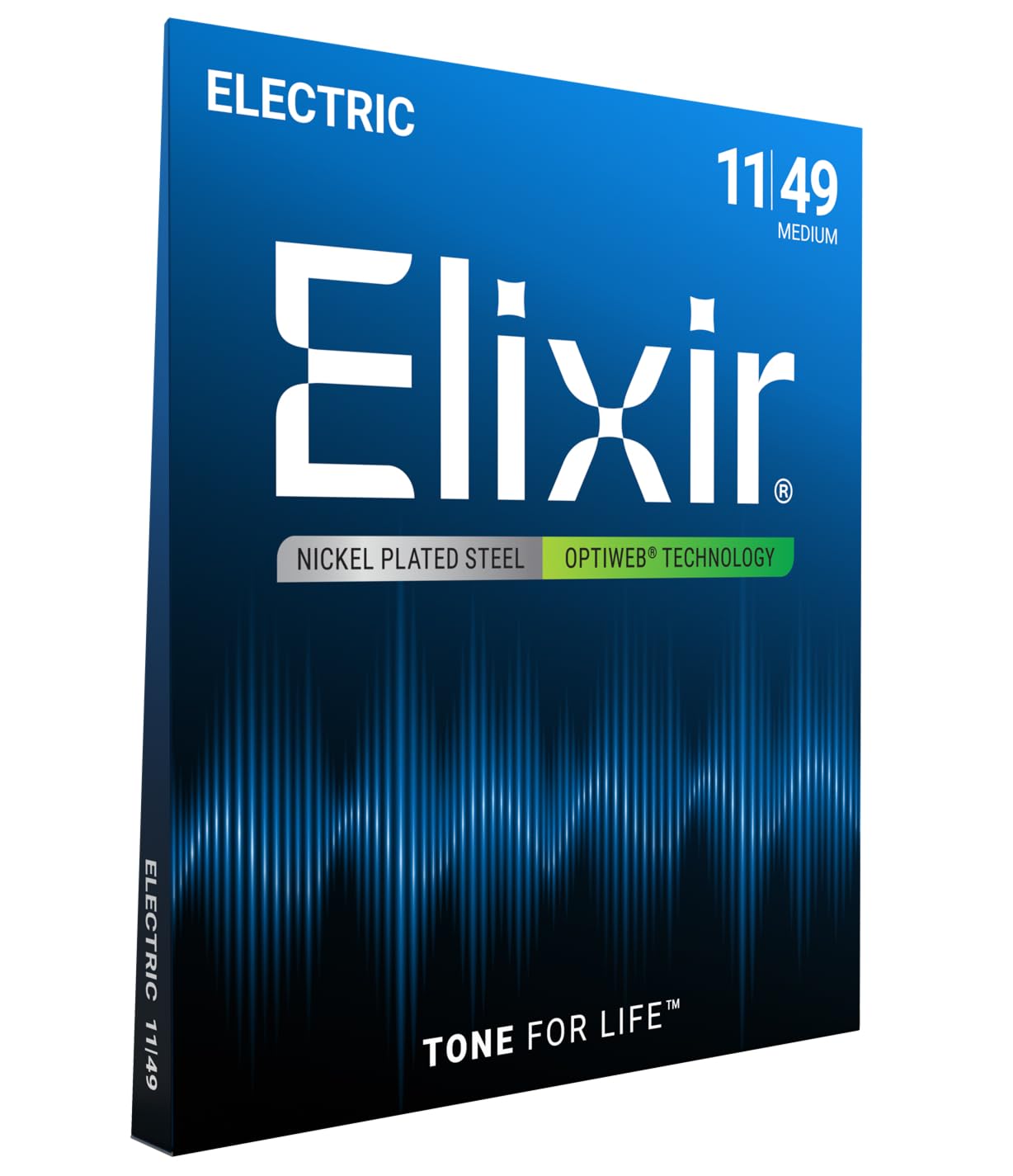
Elixir’s Optiweb coating represents a meaningful evolution from the Nanoweb line — reviewers consistently note a brighter, sharper attack both unplugged and amplified, with less of the slick, plasticky feel that earlier coated strings had. The nickel-plated steel wrap wire retains its out-of-the-box zing far longer than uncoated sets, making these ideal for players who gig regularly or simply hate changing strings every two weeks. At a medium 11-49 gauge, they offer substantial tension for down-tuned riffing while still bending smoother than typical uncoated sets of the same gauge.
The proprietary Optiweb technology reduces the coating’s thickness compared to earlier generations, which translates to better fretboard feedback and a more natural tactile sensation under the fingers. One reviewer captured the consensus perfectly: “coating is not as slippery as the nanoweb coating,” making the switch from uncoated strings less jarring. Tuning stability is excellent after a single stretch — noticeably faster than the two-to-three stretches required by many premiums sets.
No string is perfect, and a recurring note among longer-term users involves the high E being prone to breakage, especially on guitars with aggressive tremolo usage. Keeping a spare single E string in your case is a low-cost insurance policy. For players who prioritize longevity and a crisp, jangly tone that doesn’t degrade after a sweaty set, this is the set to beat.
Why it’s great
- Optiweb coating extends usable life 3-5x vs uncoated strings
- Brighter, sharper high-end compared to Nanoweb predecessors
- Fast tuning stability after just one stretch
Good to know
- High E string has a slightly higher reported breakage rate
- Medium 11-49 gauge feels stiffer for light-touch players
2. Ernie Ball 2221 Nickel Regular Slinky Electric Guitar Strings 3 Pack (10-46)

The Ernie Ball Regular Slinky has been a backline staple for decades, and the 3-pack makes it an even smarter buy for active players who burn through sets quickly. Built with a tin-plated, hex-shaped steel core wrapped in nickel-plated steel wire, these strings offer a balanced, bright tone that sits well across rock, blues, and pop. The 10-46 gauge is the most versatile middle-ground on the market — light enough in the treble for comfortable bends but with enough bottom end for punchy rhythm chording.
Multiple five-star reviews spanning 40 years of use confirm a simple truth: these strings stay in tune and sound good until you decide to swap them. The hex-core design increases grip between the core and wrap wire, which helps maintain tuning stability even under heavy vibrato bar work. As a three-pack, the per-set cost drops significantly, making this the most budget-friendly option for players who want a known quantity without fancy packaging.
There are no coating or anti-corrosion treatments here — these are traditional uncoated strings, so their lifespan depends on your hand chemistry and storage environment. For a player who changes strings every few weeks anyway, the uncoated design yields the most authentic, uncompromised vibration transfer. If you need sweat-proof longevity, look at the coated alternatives, but for raw tone and proven reliability, this pack is hard to beat.
Why it’s great
- Three-pack format offers exceptional value per string set
- Hex-core design enhances tuning stability and core-to-wrap grip
- Balanced 10-46 gauge suits nearly every playing style
Good to know
- Uncoated — shorter lifespan for sweaty hands
- Brightness fades faster than coated premium sets
3. D’Addario Guitar Strings – XL Nickel Electric Guitar Strings – ESXL110 – Regular Light 10-46 Double Ball End

D’Addario’s XL Nickel series has been a benchmark for consistent quality since 1974, and the ESXL110 set with double ball ends is specifically designed for headless guitars like Steinberger and Hohner models. The proprietary Hex-Core design — where the core wire is drawn into a hexagonal shape before the wrap wire is applied — creates a mechanical lock that prevents the wrap wire from loosening over time, preserving perfect intonation and a consistent feel across the fretboard. The nickel-plated steel wrap wire delivers a bright, versatile tone suited to metal, rock, and fusion.
Long-term users who switched from Dean Markley and Ernie Ball report that D’Addario’s double-ball construction withstands heavy tremolo bar use and aggressive string bending without breaking, even on shorter-scale headless guitars. The double-ball end eliminates the need for a traditional ball-end anchor, which makes installation on locking tremolos faster and more secure. The set’s consistent tension profile also produces crisper articulation during fast alternate picking passages.
The biggest practical limitation is availability — these double-ball sets are harder to find in local music stores compared to standard single-ball sets. If your guitar has a standard tailpiece or stop-tail bridge, you need the regular ball-end version (EXL110). One reviewer noted that seating the ball end on the tremolo side can require a bit of extra pressure with a car key until the ball slides fully under the lock, but once seated, the tuning stability is excellent.
Why it’s great
- Hex-Core prevents wrap wire slippage for long-term intonation
- Double-ball design ideal for headless guitars and locking trems
- Bright, punchy tone with excellent note articulation
Good to know
- Compatible only with double-ball end guitars (Steinberger, Hohner, etc.)
- Limited local availability compared to standard ball-end strings
4. Ernie Ball 2222×3 Hybrid Slinky Nickel Wound Sets 3-Pack (9-46)

The Hybrid Slinky set solves a common tension dilemma: players who want thin, easy-bending treble strings (9-gauge high E) but heavier, punchier bass strings (46-gauge low E) for tight rhythm work. By combining the top three strings from Ernie Ball’s Super Slinky (.009, .011, .016) with the bottom three from the Regular Slinky (.026, .036, .046), this set delivers a feel that leans modern without sounding thin. The polymer coating provides a slight layer of corrosion resistance, though it is not as heavy-duty as Elixir’s Optiweb.
Reviewers consistently praise the balance this set offers for lead guitarists who do not want to sacrifice a thick low-end during chugging palm-muted sections when they switch to solos. The 9-46 hybrid is especially popular on Fender Stratocasters and Telecasters, because the lighter treble strings allow those famous single-coil bends to sing without fighting against heavy gauge resistance. The three-pack format ensures you have backup sets ready for gigging without an extra trip to the store.
The polymer coating is thinner and more subtle than full-coating options, so while it does add some protection against tarnishing, it will not dramatically extend string life compared to uncoated sets — expect similar longevity to standard nickel-plated strings. Players who prefer an entirely raw, uncoated feel may find the surface slightly slick. For anyone who wants the bending ease of super lights with the tonal authority of regulars, this hybrid is a smart compromise.
Why it’s great
- Light top strings make bending effortless during solos
- Heavy bottom strings provide tight, punchy rhythm tone
- Three-pack value reduces cost per string change
Good to know
- Polymer coating is thin — corrosion resistance is modest
- Not ideal for players wanting a completely uncoated feel
5. Fender Original 150 Electric Guitar Strings, Pure Nickel Wound, 150L 10-46, 3-Pack

Fender’s Original 150 set uses pure nickel wrap wire rather than the more common nickel-plated steel, which fundamentally changes the harmonic profile — expect less aggressive highs and a warm, round, vintage-correct tone that cleans up beautifully when you roll back the volume. This is the string spec that defined the sound of rockabilly, surf, and early blues-rock through Fender amps. The ball-end design is standard for vintage-style tremolo bridges and stop-tail pieces, and the roundwound construction provides enough texture for articulate fingerpicking without excessive string noise.
Multiple long-term users report that pure nickel strings offer superior clarity and resonance compared to nickel-plated alternatives, with less unwanted squeak during position shifts. The 10-46 gauge feels balanced across the fretboard, offering a medium tension that responds predictably to both heavy strumming and delicate bends. One reviewer noted that these strings “stay in tune and are not prone to breaking,” a consistent theme across users who rely on them for decades of stage use.
The trade-off with pure nickel is slightly lower output and a softer attack compared to nickel-plated steel, which some modern rock and metal players may find lacking in cut. Additionally, pure nickel strings lose their bloom slightly faster than coated alternatives, so players performing multiple sets per week may need to swap more frequently. If your goal is to coax the most musical, vintage-inspired voice from your Strat or Tele, this is the reference standard.
Why it’s great
- Pure nickel wrap wire delivers warm, round vintage tone
- Less string squeak than nickel-plated steel
- Balanced 10-46 gauge for versatile medium tension
Good to know
- Softer attack with lower output than nickel-plated steel
- No coating — tone degrades faster in humid conditions
FAQ
What gauge should a beginner start with on an electric guitar?
How often should I change electric guitar strings?
Does pure nickel sound different from nickel-plated steel?
Final Thoughts: The Verdict
For most users, the best electric guitar strings winner is the Elixir Optiweb 11-49 because it delivers a crisp, fresh tone that lasts six to eight times longer than typical uncoated strings without the slick feel of older coatings. If you want a warm vintage voice reminiscent of a 1959 tweed amp, grab the Fender Original 150 pure nickel 3-pack. And for a budget-conscious player who wants reliable, balanced tone in a convenient three-pack, nothing beats the Ernie Ball Regular Slinky 3-pack.