
A five-year-old’s mind is a whirlwind of letters, patterns, and make-believe — and the right game turns that energy into a shared family moment without a screen in sight. The challenge is finding something that holds their attention, teaches a real skill, and doesn’t frustrate parents with overly complex rules. Board games at this age need to balance luck, mild strategy, and tactile fun to keep everyone at the table engaged.
I’m Mohammad Maruf — the founder and writer behind Drink4Good. I spend countless hours analyzing toy catalogs, classroom feedback, and play-testing data to separate the short-lived fads from the games that genuinely support early development.
These recommendations focus on titles that encourage turn-taking, fine motor control, and early academic concepts without feeling like homework. Whether you’re shopping for a birthday, a holiday, or just a rainy afternoon, you’ll find reliable options in this guide to the best games for 5 year olds that actually hold up to repeat play.
How To Choose The Best Games For 5 Year Olds
Five-year-olds sit right at the sweet spot where simple rules still make sense but they’re ready for a bit more complexity than a basic matching game. The key is finding a game that challenges without overwhelming — too many rules and they’ll wander off, too few and they’re bored in ten minutes.
Prioritize Physical Interaction
At age five, children learn through touch and movement. Games that involve flipping cards, stacking pieces, launching a dice popper, or using tongs to pick up bugs hold attention far longer than purely visual or discussion-based games. Look for components that are chunky enough for small hands to grasp easily.
Verify the Skill-Building Angle
The best games for this age group target specific developmental milestones — letter-sound recognition, color matching, pattern duplication, or fine motor precision. A game like Spelligator explicitly builds phonemic awareness, while Numberblocks Race to Pattern Palace focuses on visual pattern logic. Choose the skill gap most relevant to your child’s current stage.
Check the Round Length
A five-year-old’s attention span typically maxes out around 15-20 minutes per sitting. Games with a 20-minute estimated playtime are ideal. Avoid titles that require long setup or have multi-stage win conditions. The best games let you finish a full round before attention drifts, keeping the experience positive and frustration-free.
Quick Comparison
On smaller screens, swipe sideways to see the full table.
| Model | Category | Best For | Key Spec | Amazon |
|---|---|---|---|---|
| Snack-O-Saurus Rex | Action / Dexterity | High-energy dino fans | Magnetic tongue mechanism | Amazon |
| Numberblocks Race to Pattern Palace | Educational / Pattern | Preschool math skills | 40 pattern cards (2 levels) | Amazon |
| Wooden CVC Word Spelling Game | Phonics / Literacy | Early reading practice | 50 double-sided flash cards | Amazon |
| Bed Bugs Board Game | Classic Action | Hand-eye coordination | Vibrating motorized bed | Amazon |
| Junior Learning Spelligator | Word Building | Advanced phonics learners | 75 color-coded letter tiles | Amazon |
In‑Depth Reviews
1. Snack-O-Saurus Rex

The Snack-O-Saurus Rex takes the crown because it nails the perfect balance of silly, active play and subtle educational value. In this game, players guide cavepeople to collect snacks while a T-Rex with a magnetic tongue attempts to snatch them away. The tongue mechanism is surprisingly durable — you pull it back and release it to launch toward snack pieces or opponent pawns, sending them back to start. Speech-language pathologists have flagged this as a top pick because it naturally encourages turn-taking, vocabulary building, and fine motor control without feeling like therapy.
The bidirectional movement — you can move forward or backward on the board — keeps even advanced players engaged, and the 20-minute round length is ideal for a five-year-old’s attention span. The dinosaur figure and colorful snack pieces (taco-dactyl, anyone?) immediately hook kids who love dinosaurs and imaginative scenarios. Assembly is straightforward, and the board folds away neatly.
The only consistent note from owners is that the tongue can occasionally fail to retract fully if pulled too hard. A quick check before each game solves this, and most families report dozens of plays without issue. For a mid-range investment, this delivers more repeat play than almost any other game on this list.
Why it’s great
- Magnetic tongue mechanism is tactile and engaging.
- Bidirectional movement extends replay value.
- Endorsed by SLPs for speech and fine motor goals.
Good to know
- Tongue may not retract if pulled too aggressively.
- No batteries required, but voice activation is limited to physical mechanics.
2. Numberblocks Race to Pattern Palace

For families with a Numberblocks fan, this board game is an instant win. Officially licensed from the hit TV series, Race to Pattern Palace transforms pattern recognition into a race across a colorful board. Players move Numberblocks One through Four over bridges and around twists, using colored tiles to copy, extend, or create the pattern shown on their card. The inclusion of two difficulty levels (introductory and challenge card decks) means it scales from a 3-year-old learning basic AB patterns to a 5-year-old tackling ABC patterns.
The dice popper is a standout component — kids love the tactile pop and it eliminates arguments over whose turn it is. The bridge tiles and pawns are chunky enough for small hands, and the board is thick, laminated cardboard that survives spills and rough handling. Parents report that children often continue playing with the figures and tiles after the official game ends, using them for imaginative play.
At roughly 20 minutes per game, it’s perfectly timed for a preschooler’s attention window. The focus on pattern logic directly supports early math skills, but the game never feels like a workbook. The only minor criticism is that older siblings (7+) may find the beginner deck too simple, though the challenge deck holds their interest longer.
Why it’s great
- Two difficulty levels extend the game’s lifespan.
- Dice popper adds sensory fun and fairness.
- Officially licensed Numberblocks theme is a huge draw for fans.
Good to know
- Beginner deck may be too easy for advanced 5-year-olds.
- Game board is 10×10 inches, suitable for small tables.
3. Wooden CVC Word Spelling Game

This isn’t a board game in the traditional sense, but it functions as a hands-on learning activity that many families treat as a game. The set includes 50 double-sided CVC (consonant-vowel-consonant) flash cards, 53 wooden letter blocks with red vowels and blue consonants, and five wooden spelling boards. The self-checking design — picture on one side, word on the other — lets children verify their work independently, building confidence without constant adult supervision.
The wooden tiles are thick and sanded smooth, a genuine plus for small hands still developing fine motor control. Cards are laminated and heavy enough to resist bending, and the included storage box keeps everything organized. Educators frequently use this set in kindergarten classrooms because it directly targets blending and segmenting skills, which are foundational for reading. The phonetic focus is strong — all words are regular CVC patterns (cat, dog, hut) that encourage sounding out.
A few owners note that the pictures can occasionally be confusing (e.g., “bag” shows a purse, “hut” shows a shed), which may trip up absolute beginners. For a 5-year-old already learning letter sounds, though, this is a minor issue. At an entry-level price point, this set offers tremendous educational density per dollar.
Why it’s great
- Self-checking design promotes independent play.
- Wooden letter tiles are durable and tactile.
- Directly teaches blending and segmenting skills.
Good to know
- Some card pictures may confuse new readers.
- Not a competitive board game — more of a structured activity.
4. Bed Bugs Board Game
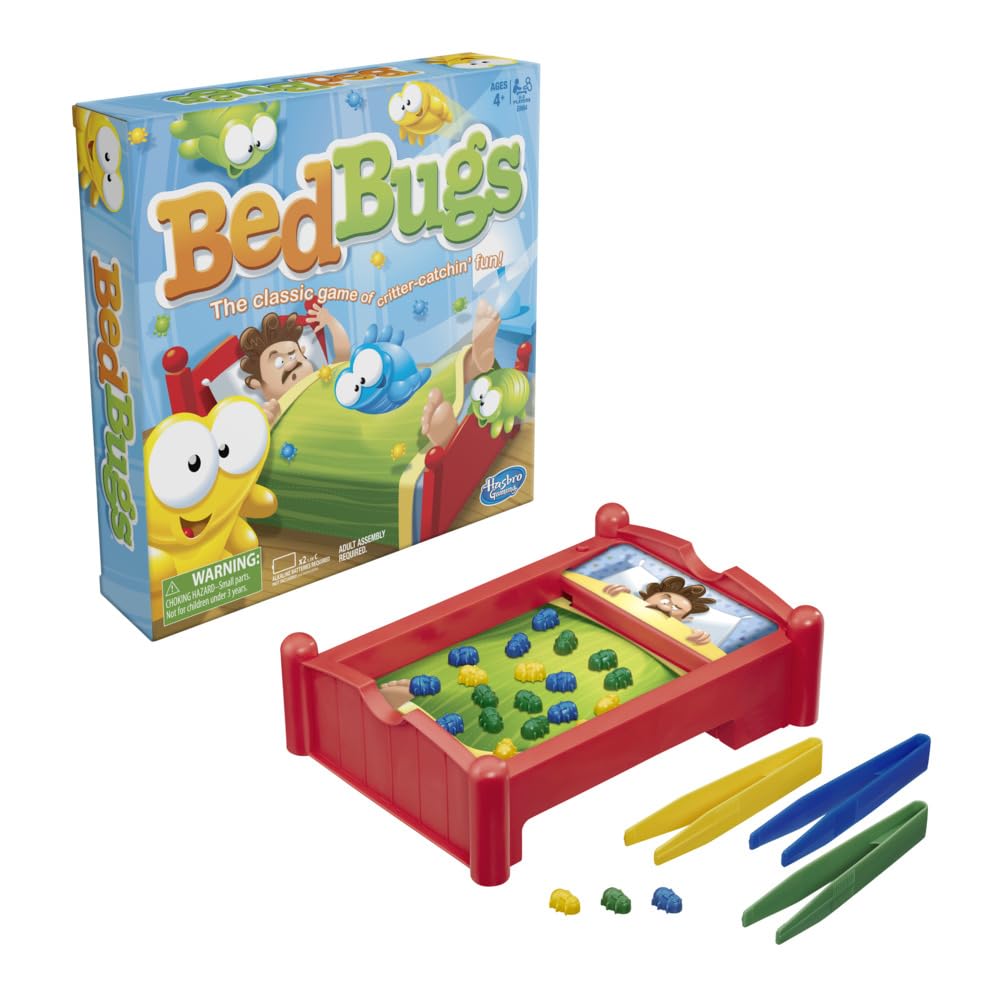
The Bed Bugs board game is a pure-action classic that has been entertaining preschoolers for years. The premise is simple: a motorized “bed” vibrates, causing plastic bugs to bounce around. Players use colored tongs — blue, yellow, or green — to snatch up bugs matching their tong color. The first to catch all their bugs wins. It’s a riot of giggles, especially when bugs fly off the bed entirely.
This game excels at developing hand-eye coordination and fine motor skills because the tongs require a precise pinch-and-grasp motion. The vibrating bed adds an unpredictable element that keeps kids on their toes — no two rounds play the same. Setup takes under a minute, and the 20-minute playtime is spot-on for this age group. Parents report that the game is durable enough for the enthusiastic grabbing and occasional dropping that comes with five-year-old play.
The main limitation is player count: only 2-3 players can participate. If you have four children, someone will need to wait. Also, if the bugs are pressed too hard during play, the vibration can stall momentarily. For structured family game night or a playdate, though, this remains a reliably hilarious option.
Why it’s great
- Vibrating bed creates unpredictable, laugh-out-loud gameplay.
- Tongs develop essential fine motor skills.
- Quick setup and cleanup for busy parents.
Good to know
- Only supports 2-3 players.
- Vibration can pause if bugs are pressed too hard.
5. Junior Learning Spelligator

Spelligator is a word-building game that uses 75 color-coded letter tiles and an alligator-shaped game board. Players take turns placing tiles to build new words from the letter tiles already on the board, earning points for creating valid words. The self-correcting tile shapes ensure that only correctly oriented letters fit, preventing frustration during play. Two difficulty levels — Rookie and Expert — allow the game to grow with the child.
This game targets phonemic awareness more explicitly than any other on this list. The color-coded system distinguishes vowels, consonants, digraphs, and blends, making it a valuable tool for children who are starting to blend sounds into words. Homeschoolers and teachers particularly love it because it reinforces spelling rules (like the floss rule and vowel teams) without feeling like a lesson.
However, many parents note that the base rules can allow one player to dominate if they’re a much stronger speller — modifying the rules to cap word length or award bonus points for less common tiles helps balance things. Additionally, the recommended age range starts at 5, but several reviews suggest it works best for children 6 or 7 who already have basic decoding skills. For a 5-year-old who is already blending CVC words confidently, this is a fantastic next step.
Why it’s great
- Explicitly teaches phonemic awareness and spelling rules.
- Color-coded tiles help visual learners identify patterns.
- Self-correcting design builds independent confidence.
Good to know
- Base rules can let stronger spellers dominate.
- Best suited for children already blending words.
FAQ
What is the most important skill a game should target for a 5 year old?
Are electronic games better than traditional board games for this age group?
How many players should a game support for a 5 year old’s playdate?
Final Thoughts: The Verdict
For most families, the top pick among the best games for 5 year olds is the Snack-O-Saurus Rex because it combines active, giggle-inducing play with subtle fine motor and turn-taking practice. If you want a game that directly supports early math skills, grab the Numberblocks Race to Pattern Palace. And for a child who already loves letters and needs a structured phonics boost, nothing beats the Junior Learning Spelligator.