
A four-year-old’s attention span is a fleeting thing — one minute they’re deep in pretend play, the next they’re stacking blocks or asking “why?” for the hundredth time. Finding a game that holds that focus, builds a real skill, and doesn’t end in a meltdown over complicated rules is the real challenge parents face. The best options for this age balance simple turn-taking, physical interaction, and a learning payoff that feels like play.
I’m Mohammad Maruf — the founder and writer behind Drink4Good. I’ve spent years analyzing early childhood development products, digging into how game mechanics, material quality, and educational scaffolding align with what actually works for a preschooler’s growing brain.
Whether you are shopping for a birthday gift, a rainy-day activity, or a tool to reinforce letter sounds and patterns at home, this guide covers the top games for 4 year olds that deliver real engagement without the frustration.
How To Choose The Best Games For 4 Year Olds
A four-year-old is in a sweet spot — they can follow a simple sequence of actions, recognize letters and numbers, and start to understand turn-taking, but they still need hands-on, sensory-rich play. The wrong game either bores them with passive content or frustrates them with multi-step procedures. Here is what actually matters when picking one.
Prioritize Fine Motor Engagement
At age four, hands are still developing dexterity. Games that involve picking up small pieces with tweezers, placing tiles, or manipulating chunky blocks build finger strength and coordination. Avoid games where everything is static or solely card-based — physical interaction keeps a short attention span anchored.
Look for Open-Ended or Adaptive Rules
The best games for this age group let you scale difficulty. A set of flash cards can be used for matching, spelling, or memory; a board game with two difficulty levels grows with the child. Rigid games with only one way to play often gather dust after the second session.
Check Material Durability and Safety
Preschoolers are not gentle. Laminated card stock, thick wooden tiles, and sturdy plastic components survive drops, spills, and aggressive play. Also verify that pieces are large enough to avoid choking hazards — small parts are a red flag for the 3-to-4 transition.
Quick Comparison
On smaller screens, swipe sideways to see the full table.
| Model | Category | Best For | Key Spec | Amazon |
|---|---|---|---|---|
| hand2mind Numberblocks Race to Pattern Palace | Board Game | Pattern recognition & counting | 40 pattern cards with 2 levels | Amazon |
| Educational Insights Frida’s Fruit Fiesta | Board Game | Letter recognition & fine motor | Triple spinner + Frida Squeezer | Amazon |
| Hasbro Bed Bugs Board Game | Action Game | Hand-eye coordination & color matching | Motorized vibrating bed | Amazon |
| Gojmzo Wooden CVC Word Spelling Game | Learning Toy | Phonics & early spelling | 53 wooden letter blocks | Amazon |
| Gojmzo CVC Word Writing & Spelling Flash Cards | Flash Cards | Writing practice & sight words | 100 double-sided laminated cards | Amazon |
In‑Depth Reviews
1. hand2mind Numberblocks Race to Pattern Palace

This officially licensed Numberblocks game brings the beloved TV episode “Pattern Palace” to your tabletop, and it nails the balance between education and pure fun. Children move Numberblocks One through Four around the board, copying and extending patterns using colored bridge tiles. The game includes two levels of play — an introductory deck and a challenge deck — so it adapts as your child’s pattern recognition improves.
The dice popper adds a delightful surprise element that keeps four-year-olds engaged without relying on complex rules. The board is vibrant and sturdy, and the chunky pawns are easy for small hands to grip. Unlike many preschool games that feel like chores, this one genuinely excites kids who already love the show and gently teaches pattern logic to newcomers.
Parents report that siblings aged three to seven enjoy playing together, and the game naturally encourages counting, color matching, and turn-taking. The only caveat is that the Six’s Tricks cards can occasionally feel random, but for this age group, unpredictability is part of the fun.
Why it’s great
- Two difficulty levels grow with the child
- Sturdy, vibrant components that withstand play
- Teaches pattern logic through a beloved show character
Good to know
- Some Six’s Tricks cards add unpredictable outcomes
- Requires basic knowledge of Numberblocks for full immersion
2. Educational Insights Frida’s Fruit Fiesta

Frida’s Fruit Fiesta combines alphabet bingo with a fine-motor challenge that four-year-olds find irresistible. Players spin the triple spinner, identify a letter, then use the Frida Squeezer — a toucan-shaped tong — to pick up the matching fruit bowl and place it on their nest card. The first to fill four spots in a row wins, which keeps the game moving at a brisk pace.
The squeezer is a genius addition: it forces kids to coordinate their grip and precision, building hand strength while they learn letter recognition. The game also introduces a light strategic element — players can steal a fruit bowl from another nest, which adds tension without cruelty. The box doubles as the game board, making setup and cleanup effortless.
Reviewers consistently highlight how the bright colors and tactile pieces hold attention, and the game works well for two to four players. Some children may need initial help with the spinner, but once they get the hang of it, they play independently. It is a smart pick for families looking to blend pre-reading skills with physical play.
Why it’s great
- Frida Squeezer develops fine motor control
- Stealing mechanic adds strategic depth without being mean
- Box-as-board design simplifies storage
Good to know
- Spinner can be stiff for very small fingers
- Limited to letter matching — not for advanced phonics
3. Hasbro Bed Bugs Board Game
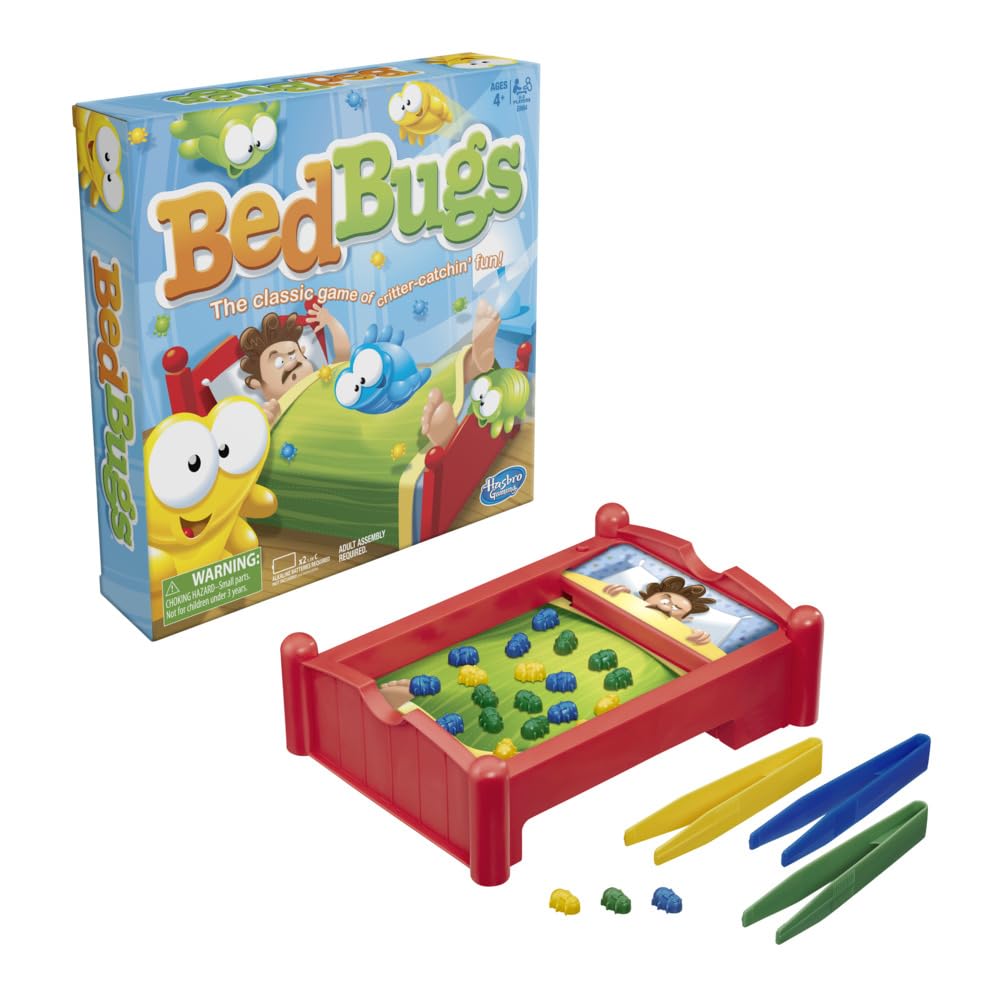
Bed Bugs is pure kinetic chaos in the best way. A motorized game board shaped like a bed vibrates, making plastic bugs bounce and jump across the surface. Players use colored tongs to catch bugs matching their assigned color, racing to clear the bed first. The game is simple to learn — spin, match, catch — but the unpredictable movement keeps every round fresh.
The physicality is what sets this apart from sit-down board games. Kids develop hand-eye coordination and quick reaction time as they chase hopping bugs, and the competitive edge stays lighthearted. It plays best with two or three players (the recommended range), and each round lasts about 15 to 20 minutes, which is ideal for a four-year-old’s stamina.
Long-time fans of the classic game appreciate that this Amazon Exclusive edition retains the original charm. The plastic bugs are durable, and the tongs are easy to operate. A small quirk: if you press down too hard on the bed, the vibration stops, so kids learn to use a lighter touch. It is a fantastic choice for active playdates or family game nights.
Why it’s great
- Motorized bed creates unpredictable, hilarious action
- Builds hand-eye coordination through active play
- Quick rounds match short attention spans
Good to know
- Pressing too hard stops the vibration
- Can feel repetitive after several rounds
4. Gojmzo Wooden CVC Word Spelling Game

This wooden CVC (consonant-vowel-consonant) word spelling set is a tactile approach to early reading. It includes 50 double-sided phonics flash cards, 53 wooden lowercase letter blocks (vowels in red, consonants in blue), and five spelling boards. Kids use the blocks to spell the word shown on the card, then flip it over to check the picture for self-correction.
The wooden blocks are thick and easy for small fingers to grasp, and the color-coded vowels help children visually differentiate letter types. The cards are laminated and durable, though some parents noted that a few pictures are ambiguous — for example, “bag” shows purses and “hut” shows a shed. This is a minor hiccup in an otherwise solid phonics tool.
This set works best for children who already know most letter sounds and are ready to blend them into words. It is a quiet, focused activity that pairs well with classroom or homeschool settings. The storage box keeps everything organized, and the lack of batteries or screens is a plus for screen-free learning time.
Why it’s great
- Wooden blocks are durable and sized for small hands
- Color-coded vowels aid phonetic learning
- Self-correcting picture backs encourage independent play
Good to know
- A few card images are confusing (e.g., “bag” shows purses)
- Best for kids who already know letter sounds
5. Gojmzo CVC Word Writing & Spelling Flash Cards

This flash card set takes CVC word practice one step further by adding a writing component. It includes 100 double-sided cards — one side shows the word with a picture, the other has fill-in-the-blank spaces for spelling. Four dry-erase markers with eraser tops let kids write directly on the laminated surface and wipe clean for endless repetition.
The cards are divided into two practice types: cards with just the vowel missing and cards with both beginning and ending letters missing. This graduated difficulty means the same activity stays challenging longer. The drawstring bag and sturdy storage box keep everything tidy, which matters when you are managing a preschooler’s supplies.
Literacy tutors and parents alike praise this set for its versatility — it works for one-on-one instruction, quiet time, or even restaurant entertainment. The cards are thick and resistant to bending, though they do require prompt wiping to prevent marker stains from setting. For children ready to transition from letter recognition to writing, this is a smart entry-level tool.
Why it’s great
- Dry-erase surface allows unlimited practice
- Two difficulty levels adapt to growing skills
- Portable with included storage bag and box
Good to know
- Marker residue can stain if not wiped immediately
- Best suited for children who can already hold a marker
FAQ
Can a 4 year old play a board game with siblings who are older or younger?
How many players work best for preschool board games?
What is a CVC word and why does it matter for a 4 year old?
Final Thoughts: The Verdict
For most users, the games for 4 year olds winner is the hand2mind Numberblocks Race to Pattern Palace because it combines pattern logic, cooperative family play, and durable components in a package that scales from beginner to challenge mode. If you want fine motor skill development and letter recognition, grab the Educational Insights Frida’s Fruit Fiesta. And for active, giggle-filled play that builds hand-eye coordination, nothing beats the Hasbro Bed Bugs Board Game.