
A gas air compressor is the difference between finishing a job on a remote jobsite and packing up because you ran out of extension cords. When you need high-volume pneumatic power where there’s no electrical outlet in sight, a gas-powered unit becomes the only tool that matters. Whether you’re running framing nailers on a new roof, inflating truck tires at a ranch, or powering a spray rig for barn maintenance, the choice of engine, pump, and tank capacity determines whether your workday flows or stalls.
I’m Mohammad Maruf — the founder and writer behind Drink4Good. My research into this category focuses on matching real-world CFM requirements to the specific hydraulic displacement and pump configuration of each unit, ensuring the engine’s torque curve aligns with your tool’s demand profile.
This guide breaks down nine of the most compelling models on the market, from portable job-site wheelbarrow units to high-output stationary tanks. By the end, you’ll know exactly which gas air compressor fits the way you work.
How To Choose The Best Gas Air Compressor
Selecting the right gas-powered compressor means understanding the relationship between the engine’s horsepower, the pump’s displacement, and the tank’s storage volume. You aren’t just buying a tank; you’re buying a power system for your pneumatic tools.
Match CFM to Your Most Demanding Tool
The single most important spec is the compressor’s CFM (cubic feet per minute) output at the pressure your tools require, typically 90 PSI. A framing nailer might need 2-3 CFM, while a 1/2-inch impact wrench can demand 5-6 CFM, and a sandblaster or DA sander can require 10 CFM or more. If the compressor’s CFM rating is lower than the sum of your tools’ demand, pressure will drop and tools will stall. Always check the manufacturer’s CFM at 90 PSI, not the theoretical maximum.
Engine Quality and Long-Term Ownership
Honda GX-series engines dominate the professional gas compressor market for a reason: they start reliably in cold weather, hold oil volume well, and are serviceable anywhere with readily available parts. Generic motors may save upfront cost but often lack low-oil shutdown sensors, have shorter service intervals, and can be difficult to repair. For construction pros who rely on a compressor daily, the Honda GX premium pays for itself within a year.
Pump Construction and Duty Cycle
The pump is the heart of the compressor. Cast-iron cylinders and crankcases resist wear and dissipate heat better than aluminum, especially during extended runs. Look for a cast-iron sleeve or full cast-iron pump block. Oil-lubricated pumps (splash or pressure lubrication) are standard on professional gas units; they tolerate higher temperatures and continuous operation better than oil-free designs, which are rare in gas compressors because of heat buildup. The V-style twin-cylinder configuration found on many Honda-powered units provides superior cooling and smoother air delivery.
Tank Capacity and Portability Trade-Offs
An 8-gallon tank on a wheelbarrow frame is great for a crew of roofers running two to three guns, but for powering a spray rig or running a cutoff tool continuously, you’ll want 20 to 30 gallons. Larger tanks reduce the frequency of pump cycling, which extends pump life and gives you a larger buffer of stored air. Wheelbarrow compressors are maneuverable on rough terrain, but they have a high center of gravity. Horizontal tank models with two axles are more stable for workshop or trailer mounting but less agile on muddy job sites.
Quick Comparison
On smaller screens, swipe sideways to see the full table.
| Model | Category | Best For | Key Spec | Amazon |
|---|---|---|---|---|
| Metabo HPT EC2510E | Wheelbarrow | Daily framing/roofing crews | 8.1 CFM @ 90 PSI (est.) | Amazon |
| Ingersoll-Rand SS3J5.5GH-WB | Wheelbarrow | Continuous operation / mobile body work | 11.8 CFM @ 135 PSI | Amazon |
| Metabo HPT EC2610EA | Wheelbarrow | High-volume multi-gun operation | 9.5 CFM @ 90 PSI | Amazon |
| NorthStar 20-Gal | Horizontal Tank | Farm/ranch and continuous spray | 13.7 CFM @ 90 PSI | Amazon |
| VEVOR 15HP 30-Gal | Horizontal Tank | Workshop / heavy two-tool use | 33 CFM @ 115 PSI | Amazon |
| NOCO Boost+Air AX65 | Portable Jump/Inflator | Roadside emergency / tire inflation | 67 SLPM airflow | Amazon |
| AVAPOW 10000A | Portable Jump/Inflator | All-in-one emergency kit | 150 PSI inflator | Amazon |
| TOAUTO A3 | PCP Compressor | Air rifle/paintball tank filling | 4500 PSI max pressure | Amazon |
| VEVOR PCP Compressor | PCP Compressor | High-volume scuba / PCP filling | 600W water-cooled | Amazon |
In‑Depth Reviews
1. Metabo HPT EC2510E

This unit is the benchmark for the wheelbarrow-style gas compressor segment. It pairs a Honda GX engine with a cast-iron cylinder pump, creating a reliable 8-gallon workhorse that cycles from 116 to 145 PSI. The pump breathes through a full-size 3/8-inch locking regulator, and the baseplate-mounted control panel protects the gauge from jobsite damage.
Reviewers consistently praise its ability to keep multiple framing nailers running without lag. The steel-reinforced frame and two wheels give it solid stability over rough ground, and the oil-level sight glass makes daily checks painless. It’s heavy at 144 pounds, but that weight comes from robust materials, not dead space.
Owners who store it for months report it starts on the first pull. The synthetic oil included in the box is SAE5W50, appropriate for the Honda GX’s splash-lubrication system. A small number of buyers have noted oil separation at the vent gasket after long storage, but the overall satisfaction rate is extremely high among professional users.
Why it’s great
- Genuine Honda GX engine delivers easy starts and long service life.
- Cast-iron cylinder resists wear and runs cooler than aluminum alternatives.
- Compact wheelbarrow footprint with integrated control panel.
Good to know
- Weighs 144 pounds — not for frequent truck-bed loading.
- Some owners report oil mist from the breather on initial runs.
2. Ingersoll-Rand SS3J5.5GH-WB

Ingersoll-Rand places a 5.5-horsepower Honda engine atop an 8-gallon twin-pontoon tank, pushing 135 PSI and delivering 11.8 CFM at that pressure. That puts it in a class where you can run a 6-inch DA sander continuously or operate two high-consumption tools simultaneously without waiting for recovery.
The twin-tank design lowers the center of gravity compared to a single vertical tank, making it more stable on uneven ground. Two quick-disconnect outlets let you keep a blow gun and a nailer connected at the same time. The cast-iron pump is splash-lubricated, and the frame is welded steel with a powder-coat finish that resists corrosion from jobsite moisture.
Some long-term owners note that quality control may have varied over production years, with isolated reports of pump leaks and failed pressure regulators. However, the vast majority of users who own this unit for multiple years report that it starts every season without issue. The 0.825-gallon fuel tank provides extended run time between fills, a key advantage for mobile auto-body and tire work.
Why it’s great
- 11.8 CFM at 135 PSI — enough for continuous DA sanding or two tools at once.
- Twin-tank wheelbarrow design with stable handling on-site.
- Two quick-disconnect ports for multi-tool workflows.
Good to know
- At 226 pounds, moving it onto a truck bed requires two people or a ramp.
- Warranty coverage on non-pump parts is limited to one year.
3. Metabo HPT EC2610EA
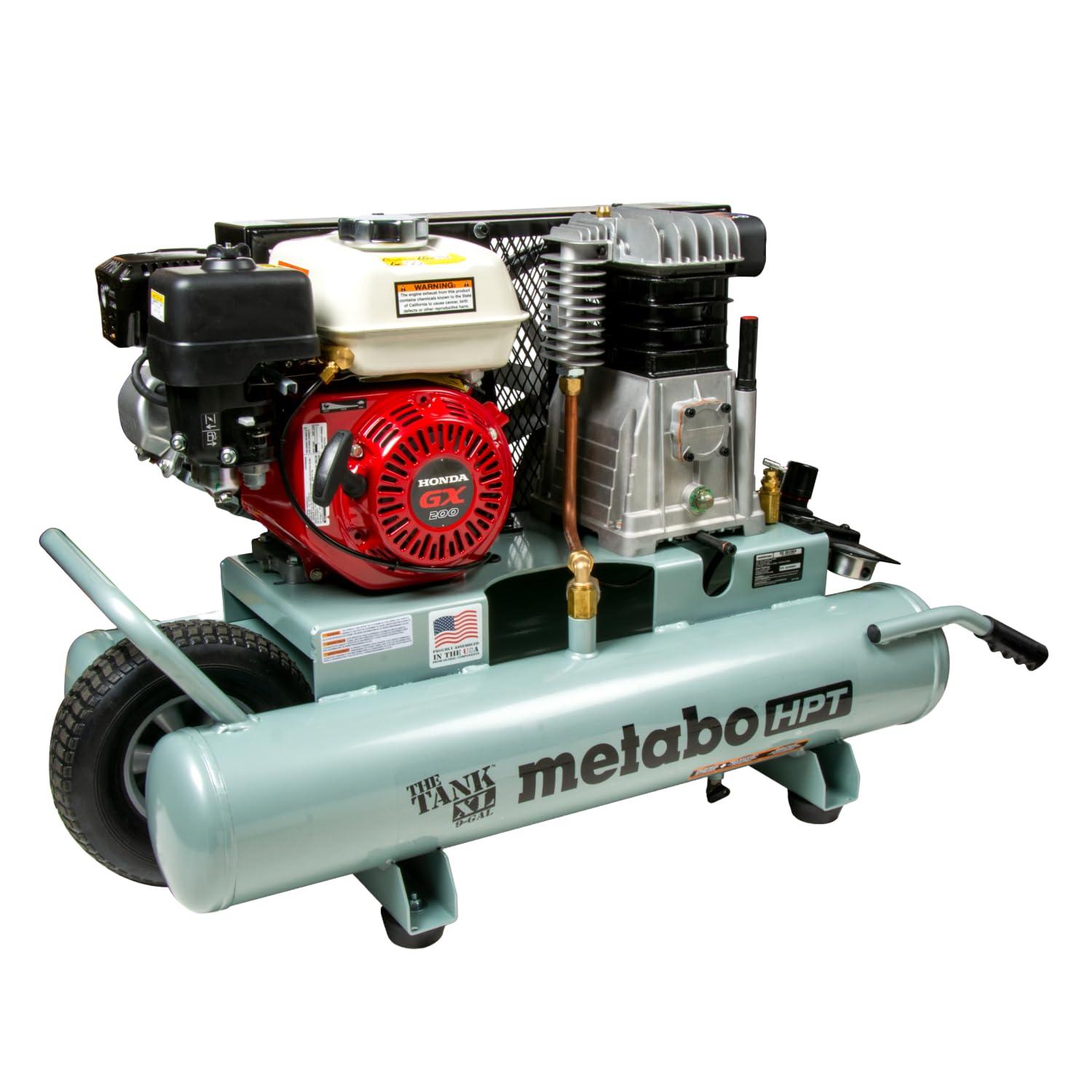
Metabo HPT calls this “The Tank XL,” and the specs back up the name. A Honda GX200 engine drives a pump that produces 9.5 CFM at 90 PSI, and the 9-gallon receiver is the largest in the company’s wheelbarrow lineup. The manufacturer claims it can simultaneously run five framing nailers, five roofing nailers, or five siding nailers without hesitation.
The wheelbarrow frame rides on a solid rubber tire that never goes flat. An oil-lubricated pump with an aftercooler helps manage air temperature during extended runs. This compressor is assembled in the USA, which contributes to parts availability and service support. The idle-down feature reduces engine load and noise when air demand stops.
Some users find the engine needs choke to start when cold, which is typical for Honda GX motors. A few have reported oil leaks during the break-in period, but Metabo’s customer service has generally been responsive in those cases. For high-volume roofing crews, the EC2610EA is a proven platform that delivers consistent nail-driving power all day.
Why it’s great
- 9.5 CFM at 90 PSI runs five nailers simultaneously with no lag.
- 9-gallon tank reduces pump cycling frequency on high-demand sites.
- Assembled in the USA with robust service support.
Good to know
- Engine may require choke for cold starts, typical of GX200.
- Weight over 150 pounds limits single-person portability.
4. NorthStar 20-Gal

NorthStar’s offering pairs a Honda GX160 engine with a 20-gallon horizontal tank and a full cast-iron pump head made from FC35-grade cast iron. The V-style cylinder design aids air cooling during extended runs. With 13.7 CFM at 90 PSI, this unit can handle a spray rig, a cutoff tool, or an impact wrench without dropping pressure.
The pump includes floating-type Swedish steel valves designed to outlast conventional reed valves. A low-oil shutdown feature protects the engine from lubrication failures. Owners who use this for remote sealcoat spraying and semi-truck tire repair report that it maintains 90 PSI without faltering, even in hot weather. The 20-gallon tank provides enough stored air to blast short bursts from a blow gun without cycling the pump.
Assembly quality can vary, with some units arriving with loose throttle linkage clips or improperly installed fittings. A small number of owners have upgraded the vinyl tubing to copper for durability. Despite these minor assembly concerns, the Honda engine and cast-iron pump combination delivers dependable long-term performance when the pre-delivery details are checked.
Why it’s great
- 13.7 CFM at 90 PSI from a 20-gallon tank — excellent continuous output.
- FC35 cast-iron pump head and Swedish steel valves.
- Honda GX160 with low-oil shutdown for engine protection.
Good to know
- 217 pounds requires careful handling for loading.
- Some units need throttle linkage and tubing adjustments out of the box.
5. VEVOR 15HP 30-Gal

VEVOR’s 15-horsepower gas compressor is built for volume. The 30-gallon tank feeds two air outlets simultaneously, and the piston pump delivers a massive 33 CFM at 115 PSI. For context, that volume can fill truck tires in seconds and run high-consumption tools like sandblasters and spray guns without pressure drop.
The frame rides on four smooth-rolling wheels, making it maneuverable around a workshop or construction site. Cast-iron cylinders and a steel frame resist deformation under load. An automatic shut-off engages when oil levels drop too low, protecting the pump from catastrophic damage. The unit’s 271-pound weight is a sign of its industrial-grade construction, not inefficiency.
Not all owners have had a flawless experience. Some reported the pressure relief valve was non-functional out of the box, and the quick-connect fittings are not compatible with standard US hose couplers, requiring an adapter. A few units arrived with cosmetic damage. However, users who have worked around these issues report that the compressor performs exceptionally well for its price tier, making it a strong budget-friendly choice for large-scale tasks.
Why it’s great
- 33 CFM at 115 PSI — highest output in this comparison.
- 30-gallon tank provides long air reserves for heavy tools.
- Four-wheel frame for workshop mobility.
Good to know
- Quick-connect fittings may not mate with standard US hoses.
- Some units require minor assembly corrections and adapter purchases.
6. NOCO Boost+Air AX65

NOCO’s AX65 is the category’s most refined all-in-one unit. It combines a 2000-amp lithium jump starter with an air compressor that moves 67 liters per minute — enough to fill a 37-inch tire from 6 to 38 PSI in just over five minutes. The digital display lets you set target pressures between 15 and 100 PSI with automatic shut-off at the programmed value.
Safety features include spark-proof technology and reverse polarity protection. The internal 2150 amp-hour lithium battery recharges in 48 minutes via 60W USB-C Power Delivery. In the field, it can top off 20 low tires (35 to 40 PSI) on a single charge. The microfiber bag keeps everything organized, including the clamps, hose, and USB-C cable.
Some owners with larger tires (33 inches and above) report that a single full inflation cycle drains the battery, leaving little reserve for the remaining tires. The unit is heavy for a handheld device at nearly 10 pounds, and the included bag offers minimal protection. For standard passenger tires and occasional off-road topping off, it excels, but heavy users may prefer a corded inflator for multiple large tires.
Why it’s great
- 2000A jump starter with override for dead-battery starting.
- 67 SLPM compressor fills a car tire from 0 to 40 PSI in under 2 minutes.
- 60W USB-C PD for fast recharging and device power bank use.
Good to know
- Large tire inflation (33-inch+) can drain the battery fully.
- At 9.79 pounds, it’s too heavy for comfortable glove-box storage.
7. AVAPOW 10000A
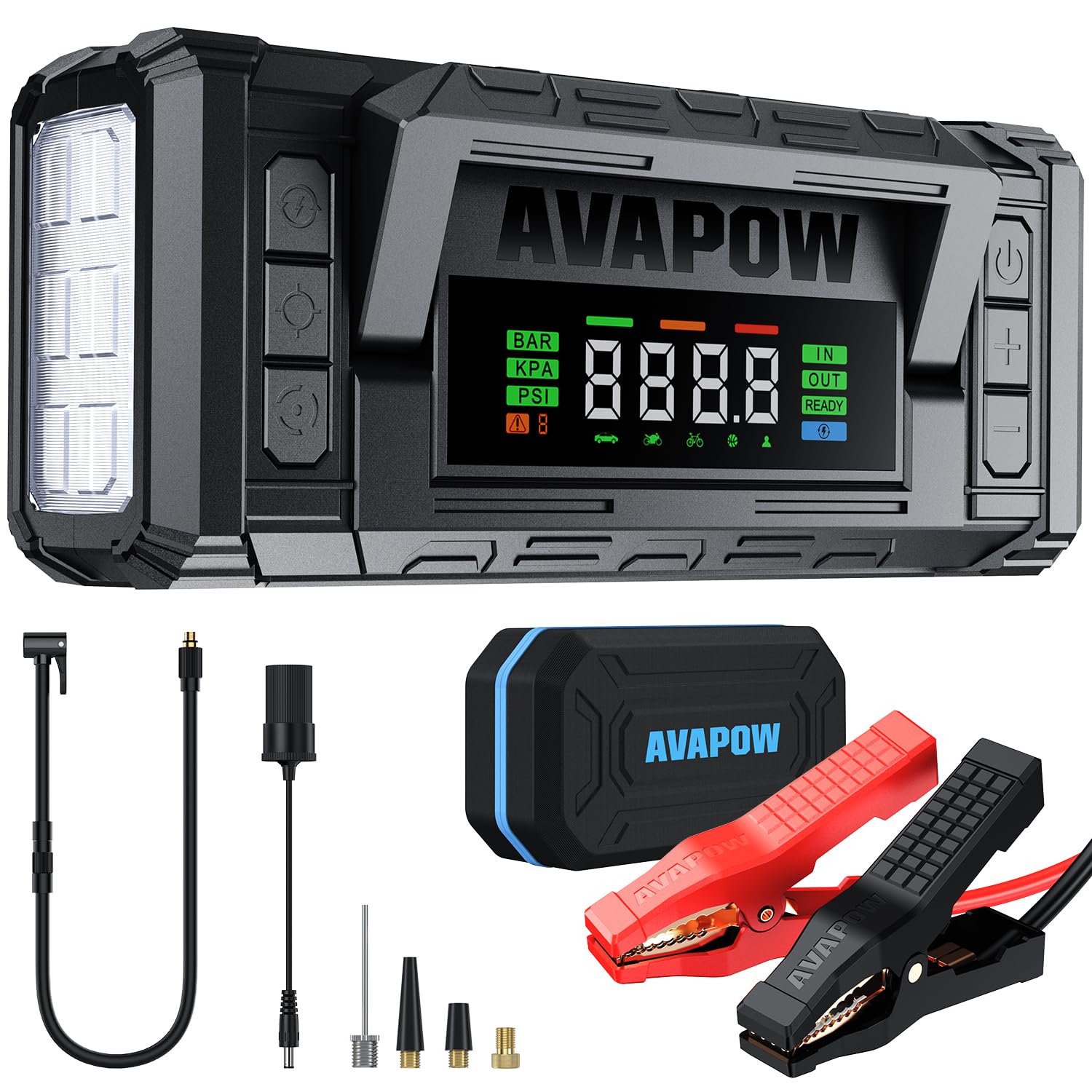
AVAPOW’s TM28 combines a 10,000-amp peak jump starter with a 150 PSI air compressor, all packed into a compact unit with a 4-inch HD color display. The display shows real-time battery level, operating status, and tire pressure with ±1 PSI accuracy. Preset modes cover cars, bikes, motorcycles, sports balls, and inflatables.
The 20,000 mAh lithium battery also functions as a 30W PD power bank, capable of charging an iPhone 16 Pro Max to 60% in half an hour. The built-in LED flashlight includes steady, flash, and SOS modes. The EVA carrying case keeps the compressor hose, four air nozzle adapters, and USB-C cable organized. The unit triggers auto shut-off when the set pressure is reached, preventing over-inflation.
The air compressor runs hot during extended use, and the hose can become uncomfortably warm to the touch. Some users note the fan noise is loud. A few reviewers have reported the unit failing after months of non-use, though the lifetime warranty helps mitigate that risk. For a single device that covers jump-starting, inflation, and device charging, the AVAPOW is a versatile mid-range option.
Why it’s great
- 10,000A peak jump start for all gas and diesel engines.
- 150 PSI inflator with auto shut-off and ±1 PSI accuracy.
- 30W PD fast charging for devices and compact EVA case.
Good to know
- Compressor runs hot; hose can get warm during extended use.
- Lifetime warranty but some units have failed in storage.
8. TOAUTO A3 PCP

The TOAUTO A3 is a purpose-built PCP (pre-charged pneumatic) air compressor designed for filling air rifles, paintball tanks, and HPA cylinders to 4500 PSI. Its oil-free pump design eliminates the mess of traditional splash-lubricated compressors, and its built-in automatic shut-off lets you set a target pressure and walk away.
Power comes from either a standard 110V AC wall outlet or a 12V car battery (requires 40A current). The integrated wire spool keeps the power cord organized and prevents forgetting the DC clip at home. The unit includes a moisture filter and an 8mm Foster female connector on both ends of the hose, compatible with most PCP rifle fill probes. It fills a 0.5L tank from 0 to 300 bar in roughly 20 minutes.
Reliability is a mixed bag across user reports. Some units fail after only a few uses, with pressure sensors or display boards malfunctioning. However, the manufacturer’s customer service often ships replacement units quickly, and the 1-year warranty is honored. For those who need a portable high-pressure air source for airgunning, the A3 offers strong capability at a mid-range price point.
Why it’s great
- 4500 PSI maximum pressure from an oil-free pump.
- Dual power: 110V AC or 12V DC with retractable wire spool.
- Precise auto-stop with programmable pressure set point.
Good to know
- About 20-minute duty cycle; must rest 10 minutes before restart.
- Some units fail after 5–6 uses; reliable warranty support is essential.
9. VEVOR PCP Compressor
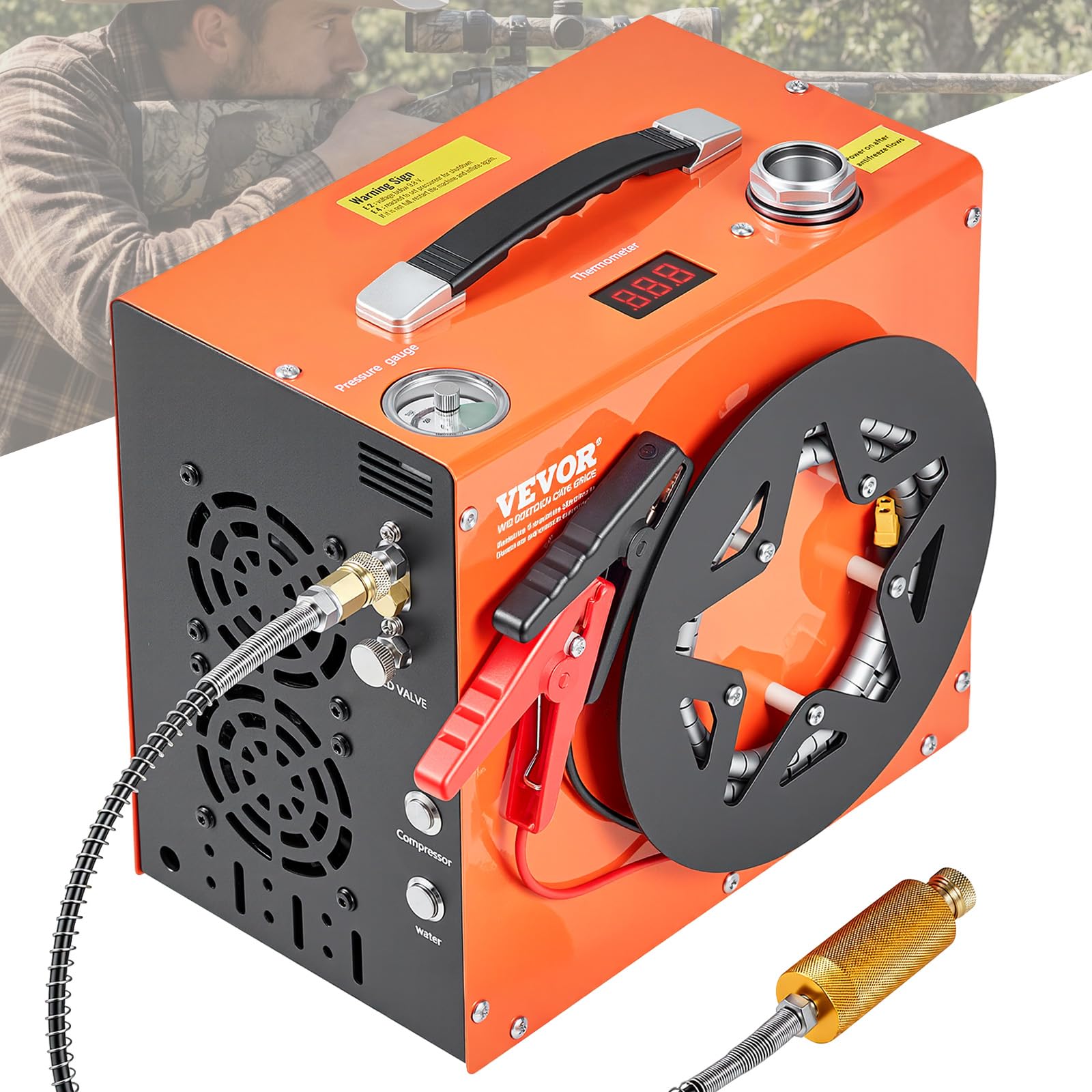
VEVOR’s PCP compressor uses a dual cooling system that combines a water tank (mounted on top) with a 12,500 RPM fan. This arrangement keeps internal temperatures well under control, even when filling larger scuba-style tanks. The maximum pressure is 4500 PSI, and it can fill a 1.0L cylinder from 0 to 300 bar in about 25 minutes. The unit includes a built-in 600W power converter that accepts either 120V AC or 12V DC input.
The upgraded linkage structure replaces traditional cam designs, reducing noise and improving heat dissipation. A digital dual-display shows real-time pressure and temperature, and the unit displays an E4 code when the target pressure is reached. The package includes replacement filter cotton, burst discs, and o-rings for basic maintenance.
Quality control can be inconsistent. Some units arrive dead on arrival with the pressure gauge needle misaligned or the sensor triggering false E4/E0 fault codes immediately. Others have run flawlessly for dozens of fills, maintaining temperatures below 31°C even in hot shops. Hearing protection is recommended due to the high-speed fan noise. This compressor is best for users who are comfortable inspecting and potentially returning a unit, as the value per PSI is excellent when you get a functional one.
Why it’s great
- Water and fan dual cooling keeps temperatures low during long fills.
- Fills 1.0L tanks to 4500 PSI in around 25 minutes.
- Dual AC/DC power with integrated converter.
Good to know
- Quality control issues: some units are DOA with sensor or gauge faults.
- Loud fan operation requires hearing protection during use.
FAQ
How much CFM do I need for a framing nailer and a roofing nailer running together?
Can I use a gas air compressor indoors or in a closed garage?
What size gas compressor do I need to run a 1/2-inch impact wrench?
How often should I change the oil in a gas air compressor?
Can I use a portable jump starter with a gas air compressor for daily tire inflation?
Final Thoughts: The Verdict
For most users, the gas air compressor winner is the Metabo HPT EC2510E because it balances Honda GX engine reliability, cast-iron pump durability, and a highly portable wheelbarrow design at a realistic price for professional framing and roofing crews. If you need maximum CFM for continuous tool use or large-volume spraying, the NorthStar 20-Gallon delivers 13.7 CFM at 90 PSI and a bigger air reserve. And for those who need a portable roadside companion that can jump-start a dead vehicle and inflate tires in minutes, the NOCO Boost+Air AX65 is the most refined all-in-one solution on the market. Choose the platform that matches the tools you run and the terrain you work on.