
The moment your generator sputters and cuts out during a storm is the moment you realize the value of reliable fuel storage. A flimsy, leaky gas can isn’t just an inconvenience—it actively threatens your power supply by wasting fuel, triggering vapor lock, or spilling precious gasoline on the ground. The right container solves this permanently.
I’m Mohammad Maruf — the founder and writer behind Drink4Good. My approach to this guide involves comparing material resilience, venting systems, and nozzle design across dozens of specifications to pinpoint which fuel jugs actually protect your generator’s runtime.
Whether you need a rugged unit for a jobsite or a sealed solution for emergency backup, this guide to the best gas can for generator breaks down the construction, safety features, and capacity options that separate real tools from garage clutter.
How To Choose The Best Gas Can For Generator
Selecting a fuel container for your generator involves more than grabbing the largest jug on the shelf. The wrong design can make refueling a two-person chore or allow vapors to escape, wasting fuel and creating a fire hazard. Here are the factors that matter most for generator use.
Material: Plastic vs. Steel
High-density polyethylene (HDPE) cans are lightweight, dent-resistant, and generally cheaper, but they can swell or crack over time if left with gas inside under heat. Galvanized steel cans are heavier and more expensive, yet they resist rust, won’t deform after years of use, and handle being transported in a truck bed without structural failure. For a generator that stays in a fixed outdoor location, steel offers unmatched longevity. For portable use where weight matters, HDPE is the practical choice.
Capacity and Runtime Math
A typical mid-size generator burns roughly 0.5 to 0.75 gallons per hour under a moderate load. A 5-gallon can gives you around 7 to 10 hours of continuous operation before you need a refill—enough to cover an overnight outage without waking up to swap containers. Larger capacities mean fewer trips to the station, but a full 5-gallon steel can weighs about 40 pounds, so consider your own lifting capability before sizing up.
Venting and Pour Control
Generator fuel tanks often have small, recessed fill necks that are difficult to access with a rigid spout. A can with a flexible hose or a detachable funnel makes refueling far cleaner. Additionally, a reliable venting system—either automatic or manual—prevents the glugging effect that causes splashback and wasted fuel. Look for cans that offer a separate vent opening or a self-venting spout cap.
Safety Standards and Compliance
OSHA and NFPA 30 compliance is not just bureaucratic paperwork—it means the can includes a flame arrestor to stop external ignition sources from reaching the fuel inside. The flame arrestor also prevents the can from acting as a fuel-air bomb in the event of a nearby fire. For generator users storing fuel near living spaces or in garages, UL and FM approvals are worth prioritizing.
Quick Comparison
On smaller screens, swipe sideways to see the full table.
| Model | Category | Best For | Key Spec | Amazon |
|---|---|---|---|---|
| Eagle UI50FS | Galvanized Steel | Stationary generator backup | 5 Gal / 24-gauge steel / flame arrestor | Amazon |
| Eagle UI50FSY | Galvanized Steel | Diesel generator storage | 5 Gal / self-closing lid / OSHA compliant | Amazon |
| Justrite 7220120 | Alloy Steel | Precision refueling into small tanks | 2 Gal / flexible metal spout / Safe-Squeeze | Amazon |
| VP Racing 35221-CA | HDPE Plastic | Portable overflow or ATV use | 5.5 Gal / 14″ filler hose / ergonomic grip | Amazon |
| ROTOPAX RX-3G | HDPE Plastic | Mounting on vehicle for mobile power | 3 Gal / 16”x17”x5” / US-made | Amazon |
| RotopaX 2 Gal Gen2 | HDPE Plastic | Compact portable emergency refuel | 2 Gal / 13.5”x17.25” / ruggedized | Amazon |
| VP Racing 3846-CA | HDPE Plastic | Budget-friendly multi-container setup | 5.5 Gal / camo / extra-wide base grip | Amazon |
In‑Depth Reviews
1. Eagle UI50FS Red 5 Gallon Type I
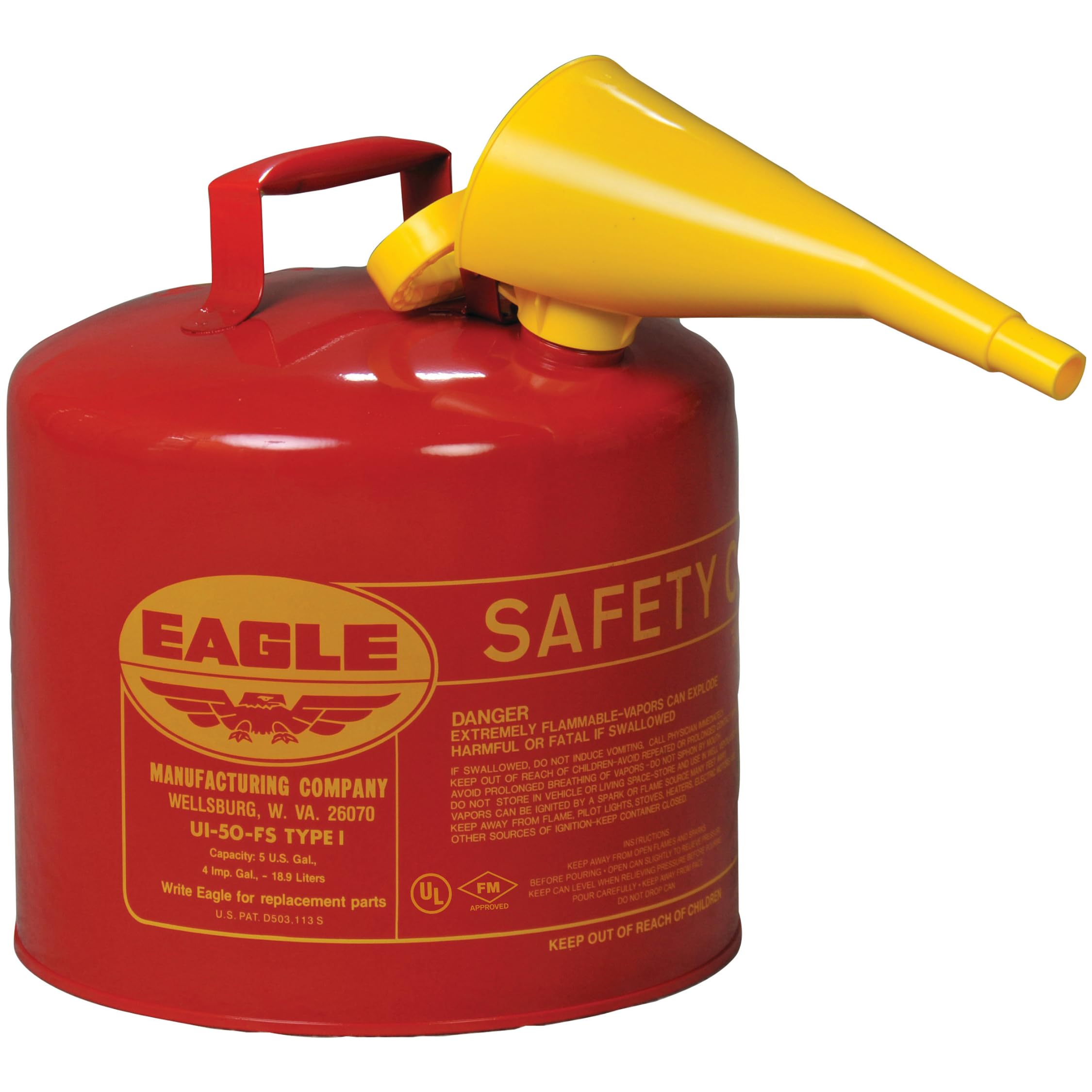
The Eagle UI50FS is the gold standard for generator fuel storage purely because it eliminates the two biggest problems with plastic cans: vapor leakage and structural failure. Its heavy-duty galvanized steel shell resists dents from being knocked over in a garage or tossed in a truck bed, and the self-closing gasketed spout cap forms a seal that completely contains gasoline vapors—no more faint fuel smell behind the generator.
The included F-15 funnel screws onto the spout and bends to reach recessed generator fill necks, which is a major time-saver during a blackout when you’re refueling by flashlight. The flame arrestor inside the spout meets OSHA and NFPA 30 standards and also acts as a debris screen, but it does slow down the pour rate noticeably compared to an open spout. Plan for about 25 seconds per gallon when funneling.
One tradeoff is the stiff spring action on the lid lever—it requires deliberate force to open, which some users find awkward during the first few uses. This tight spring tension does mean the seal stays reliable after hundreds of cycles. For long-term generator backup where the can sits full for months between emergencies, this robust seal prevents fuel degradation from moisture and vapor loss.
Why it’s great
- Thick galvanized steel resists rust, dents, and chemical corrosion far better than any HDPE container.
- Self-closing spout with gasket maintains an airtight seal when not in use, preventing vapor escape.
- Comes with a detachable flex funnel that reaches awkward generator fill ports without splashback.
- Meets OSHA, NFPA 30, UL, and ULC safety standards for stationary storage.
Good to know
- Weighs over 5 pounds empty; a full 5-gallon load is about 40 pounds with limited handle ergonomics.
- Pour rate is slower than open-spout cans due to the flame arrestor screen inside the nozzle.
- The flip-lever mechanism requires a firm squeeze to open, which can be stiff for the first dozen uses.
2. Eagle UI50FSY Yellow 5 Gallon Type I
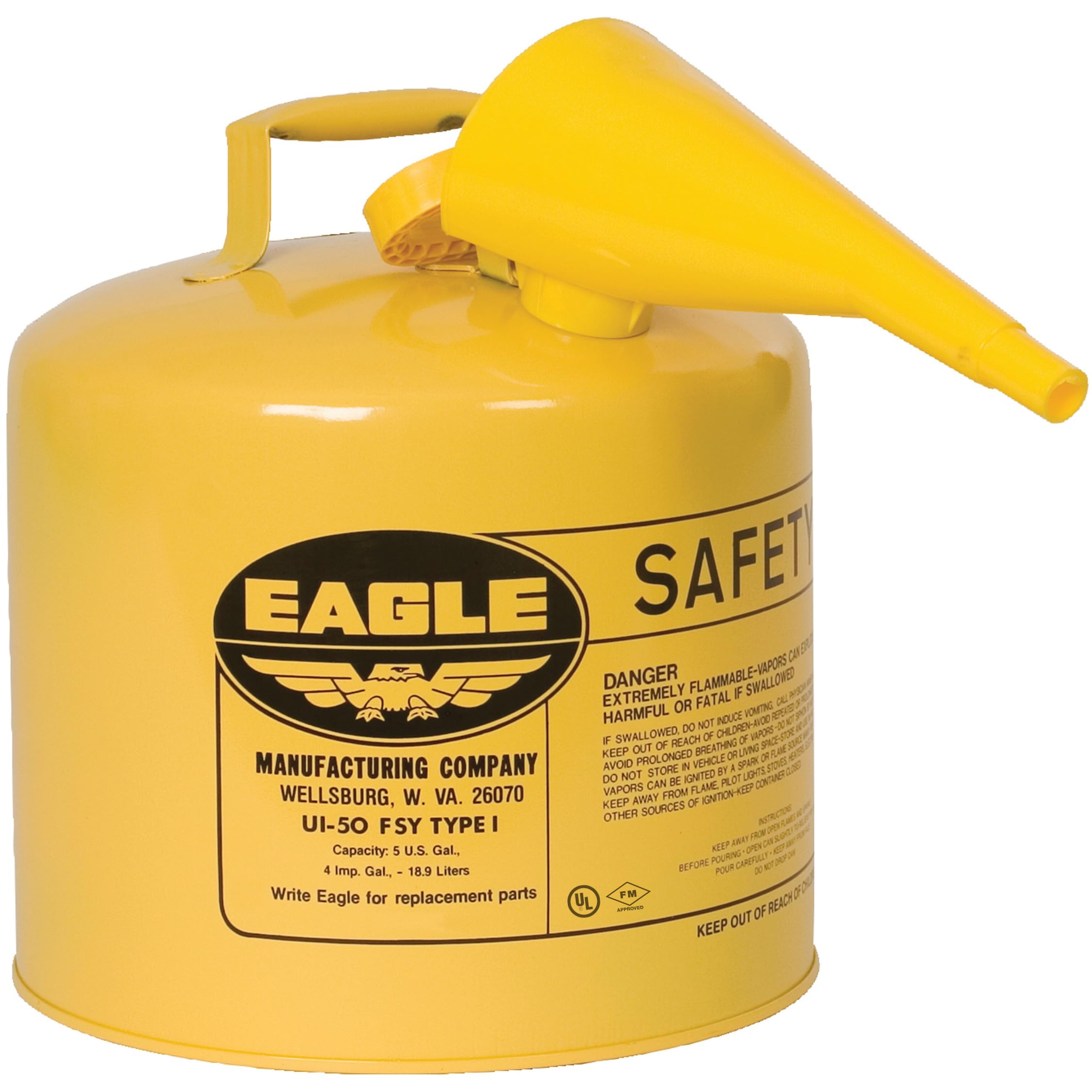
The yellow Eagle UI50FSY is essentially the same steel build as the red model but officially rated for diesel fuel, making it the correct choice if your generator runs on diesel rather than gasoline. The 24-gauge galvanized steel with baked-on powder coating handles the higher lubricity of diesel without internal corrosion, and the self-closing lid prevents the evaporation of diesel’s heavier hydrocarbons that can create a sticky residue.
The included F-15 funnel works well with diesel because the fuel’s thicker viscosity tends to flow slower anyway, so the flame arrestor doesn’t feel as restrictive as it does with gasoline. The double-interlock no-weld bottom seam is a smart design detail that eliminates any weak points where fuel could weep over time—a common issue with cheaper welded cans that sit for months between generator runs.
The primary limitation is the same as the red variant: the handle is fixed, not folding, which adds bulk during transport. And because it’s a Type I can with a single opening, you need to fully remove the funnel for venting, which can be a two-step process when you’re in a hurry. For dedicated diesel generator setups, the build quality justifies the higher weight.
Why it’s great
- Specifically rated for diesel fuel, with galvanized steel resisting the corrosive byproducts of biodiesel blends.
- No-weld bottom seam construction eliminates leak points, even after years of thermal cycling.
- FM, UL, and ULC approved—meets OSHA 1910.106 and NFPA 30 for workplace safety compliance.
- Flame arrestor prevents external ignition sources from reaching the diesel vapor inside.
Good to know
- 5-gallon capacity means it weighs over 40 pounds when full, with no wheeled base or side handles.
- The spring-loaded lid requires a strong hand to open, which can be inconvenient during fast refueling.
- Single-opening Type I design means no separate vent, so the pour rate is slower than a Type II can.
3. Justrite 7220120 2 Gallon Type II

The Justrite 7220120 is a Type II safety can, meaning it has separate openings for filling and pouring—a major advantage when you need to refuel a generator with a tight, recessed tank. The 9-inch flexible metal hose spout bends to target the fill port cleanly, and the Safe-Squeeze trigger on the manifold gives you proportional flow control, so you can trickle fuel into a small neck without overfilling.
At 2 gallons, this can is deliberately compact—great for quick refuel runs or for users who can’t handle the weight of a full 5-gallon steel can. The coated steel body is pressure-tested at the factory, and the stainless steel flame arrestor provides superior corrosion protection compared to standard steel arrestors. It’s approved by FM, UL/ULC, and TUV, and meets OSHA and NFPA requirements for workplace safety.
The downside is the price per gallon—this is the most expensive option per unit of capacity in this roundup, and the 2-gallon size means you’ll need multiple containers for an all-night generator session. Additionally, the spring-loaded filler lid is stiff enough that some users have reported minor shipping damage to the powder-coat finish. If precision refueling and absolute vapor containment are your top priorities, the Justrite delivers.
Why it’s great
- Type II dual-opening design with separate vent means faster, glug-free pouring compared to Type I cans.
- Flexible 9-inch metal hose spout reaches awkward generator fill necks without a separate funnel.
- Safe-Squeeze trigger gives variable flow control, preventing splashback when pouring into small tanks.
- Stainless steel flame arrestor resists corrosion and dissipates heat better than standard steel arrestors.
Good to know
- 2-gallon capacity means it covers only about 3-4 hours of generator runtime at moderate load.
- Premium price point makes this a niche buy for users who prioritize precision over total capacity.
- The stiff spring on the filler lid requires significant hand strength to open for filling.
4. VP Racing 35221-CA 5.5 Gal Square

The VP Racing 35221-CA is a 5.5-gallon HDPE jug that delivers the largest fuel capacity in this lineup at a very accessible price. The square shape maximizes storage efficiency, allowing you to pack multiple cans side by side without wasting shelf space. The 14-inch deluxe filler hose reaches deep into generator fill ports, and the extra-wide bottom grip makes tipping and pouring more stable than round jugs.
VP Racing manufactures these jugs with 30% more material than standard utility jugs, resulting in thick sidewalls that resist cracking from UV exposure and temperature swings. The high-density polyethylene construction means it won’t rust or dent, and the close-trimmed cap and neck create a tighter seal than the push-button spouts found on typical consumer cans. Users consistently note the complete absence of fuel odor during storage.
The catch here is that VP Racing officially labels this container “not for use with fuel”—a legal distinction related to CARB compliance in certain states. Many customers use it for gasoline anyway and report zero issues, but you should verify local regulations before filling. Also, the plastic body can develop micro-cracks after years of direct sunlight exposure if left uncovered outdoors.
Why it’s great
- Massive 5.5-gallon capacity gives you over 10 hours of generator runtime on a single fill.
- Added 30% material in the walls makes the HDPE body far more impact-resistant than budget jugs.
- 14-inch flexible hose reaches recessed generator fill ports without needing an adapter.
- Extra-wide bottom grip handle improves leverage control when pouring a full load.
Good to know
- Officially labeled “not for fuel use” in some markets; check your state’s CARB or EPA stance before buying.
- HDPE plastic can degrade after prolonged direct sunlight exposure; store in a shaded area.
- The patriotic color scheme may not suit every garage or worksite aesthetic.
5. ROTOPAX RX-3G 3 Gallon Gasoline Pack

The ROTOPAX RX-3G is a low-profile 3-gallon fuel pack designed for mounting directly onto a vehicle’s roof rack, bed rack, or tailgate, which makes it ideal if your generator travels on a trailer or truck. The flat, rectangular shape—17 inches by 16 inches by just 5 inches thick—slides into tight storage spaces where a round or square can won’t fit, and the locking mount system (sold separately) keeps it secure on rough terrain.
The US-made HDPE plastic is noticeably thicker than standard gas cans; one customer reported driving over their RX-3G without it cracking. The included pour spout gives a clean, spill-free flow, and the wide mouth makes refilling at the pump simple. ROTOPAX recommends venting the pack once per day if elevation or temperature changes significantly, which is a minor maintenance step when you’re traveling with fuel.
The main limitation is the 3-gallon capacity—enough for about 4-6 hours of generator runtime, which works for day trips but won’t cover a full overnight outage unless you daisy-chain two packs. Also, the mounting hardware is not included, so factor in the cost of the adapter plates and extension kits for your specific vehicle setup. For mobile power scenarios where space is at a premium, the form factor is unmatched.
Why it’s great
- Ultra-slim 5-inch profile fits into tight vehicle storage spots where conventional cans won’t go.
- Thick US-made HDPE withstands impacts that would rupture thinner plastic jugs.
- Locking mount system keeps the can secure during off-road travel, preventing fuel slosh and leaks.
- Wide mouth makes filling at gas stations fast and frustration-free.
Good to know
- Mounting kits and spout adapters are sold separately, which increases the total investment.
- 3-gallon capacity is limited for long-duration generator use; you may need multiple packs.
- Requires manual venting when traveling through significant elevation or temperature changes.
6. RotopaX 2 Gallon GEN 2

The RotopaX 2 Gallon GEN 2 is the smallest dedicated gasoline container in this roundup, and its size is its superpower for generator users who need a lightweight backup that doesn’t dominate cargo space. At 2 gallons, a full load weighs roughly 13 pounds, which is manageable enough to carry with one hand while steadying your generator with the other.
This container is built from the same ruggedized HDPE as the larger RX-3G and has proven itself on rough Colorado mountain passes without cracking or leaking. The compact rectangular shape mounts flat against a wall or vehicle panel with RotopaX’s adapter system, keeping it out of the way when you’re not running the generator. The included spout seals tightly, and the bright red color makes it easy to identify in low light.
The 2-gallon capacity translates to roughly 2.5 to 3.5 hours of generator runtime, which is sufficient for topping off during a short outage but not enough for sustained overnight operation unless you buy multiple units. Additionally, the spout and cap assembly protrudes slightly past the container’s edge, which can prevent a flush fit against a flat surface. For ultra-portable emergency fuel that sacrifices runtime for convenience, this is a solid choice.
Why it’s great
- Lightweight and compact at only 13 pounds full, ideal for one-handed carrying during emergency refueling.
- Proven impact resistance on rough roads—customers have driven over it without rupture.
- Mountable with RotopaX adapter system, keeping it secure and out of the way on a vehicle or garage wall.
- Sealed spout allows zero fuel odor during storage, even in enclosed spaces.
Good to know
- 2-gallon capacity covers only a few hours of generator use; requires multiple units for full-night coverage.
- Cap and spout protrusion prevents a completely flush mount against a flat surface.
- Premium price per gallon compared to traditional plastic jugs of similar capacity.
7. VP Racing 3846-CA 5.5 Gal Camo Square

The VP Racing 3846-CA Camo jug is structurally identical to the 35221-CA with the same 5.5-gallon capacity, same 14-inch hose, and same 30% thicker HDPE construction, but in a camouflage finish that appeals to outdoor users and those who want the container to blend into a wooded generator shed. The extra-wide bottom grip and ergonomic handle mirror the design of its counterpart, giving you the same stable pour control and comfortable carrying.
This camo variant is often a few dollars cheaper than the patriotic version, making it the most budget-friendly way to get 5.5 gallons of fuel capacity in a heavy-duty jug. The square shape again means efficient storage stacking, and the close-trimmed cap creates a tight seal that customers consistently praise for zero leaks and no petroleum smell. The 14-inch hose is long enough to reach the fill port on most generators without needing to tilt the jug aggressively.
The same limitation applies as with the 35221-CA: VP Racing markets it as a non-fuel container for legal compliance reasons, so you’re technically buying it at your own discretion for gasoline storage. The camo paint also shows scratches more prominently than solid colors if you’re banging the jug around a truck bed. If you want maximum capacity at the lowest entry cost and don’t mind the legal gray area, this is the most affordable option per gallon.
Why it’s great
- 5.5-gallon capacity at the lowest price per gallon in this roundup, making it ideal for building a multi-can reserve.
- Thicker wall construction than typical utility jugs provides better impact and crack resistance.
- 14-inch hose and extra-wide bottom grip enable controlled, stable pouring into generator tanks.
- Square shape stacks efficiently for organized fuel storage in a garage or shed.
Good to know
- Officially designated as a non-fuel container; verify local CARB/EPA regulations before filling with gasoline.
- Camo finish shows scratches and scuffs more easily than solid-colored jugs.
- Plastic body can develop micro-cracks after sustained UV exposure if left outdoors uncovered.
FAQ
Can I use a regular plastic gas can for a generator?
Why does my generator gas can need a flame arrestor?
How many gallons of gas should a generator can hold?
What is the difference between a Type I and Type II gas can?
Is galvanized steel better than plastic for long-term generator fuel storage?
Final Thoughts: The Verdict
For most users, the gas can for generator winner is the Eagle UI50FS because its galvanized steel shell, self-closing seal, and included flex funnel give you the best balance of vapor containment, durability, and generator-specific usability. If you need precision refueling into a small or recessed tank, grab the Justrite 7220120 for its flexible metal hose and Safe-Squeeze flow control. And for maximum capacity at the lowest absolute cost, the VP Racing 3846-CA Camo delivers 5.5 gallons with thick HDPE walls that withstand rough handling.