
When the grid goes dark, the difference between a house that stays warm and one that descends into chaos is measured in startup watts and transfer switch compatibility. A whole-home backup plan isn’t about the biggest engine — it’s about matching fuel availability, runtime, and power quality to the specific loads in your breaker panel.
I’m Mohammad Maruf — the founder and writer behind Drink4Good. I’ve spent years tracking the generator market across dual-fuel engines, inverter topologies, and LiFePO4 chemistries to understand which units actually carry a house through multi-day outages without surprises.
Whether you need quiet inverter power for sensitive electronics or a tri-fuel beast for a large home, this guide cuts through the noise to help you find the right generator for house based on real-world wattage demands and long-term reliability.
How To Choose The Best Generator For House
Selecting the right home generator starts with understanding the difference between starting (surge) watts and running (rated) watts. A refrigerator motor may draw 600W to run but needs 2200W to kick on. Sum the surge requirements of every appliance you plan to power — pumps, AC compressors, and well pumps are the hungriest. Once you have that peak number, look for a unit that delivers at least that much surge wattage while keeping the running load at 70% of its rated capacity to avoid overstressing the engine or inverter.
Fuel Logistics: Gasoline vs Propane vs Natural Gas
Gasoline is the most accessible fuel during normal times, but it degrades within months and requires carburetor maintenance. Propane stores indefinitely, burns cleaner, and slightly reduces engine power but extends engine life. Natural gas offers unlimited runtime as long as the gas line remains pressurized, but it requires a high-BTU supply and a dedicated hose. Dual-fuel units give you flexibility; tri-fuel models (including natural gas) are ideal for permanent whole-home installation where you never want to refuel.
Power Quality and Transfer Switch Integration
Total Harmonic Distortion (THD) below 5% is critical for sensitive electronics like laptops, variable-speed refrigerators, and smart home hubs. Inverter generators produce the cleanest sine wave (<3% THD) and can idle down under light load to save fuel. For permanent connection, the generator must be transfer-switch ready. A 50-amp outlet (NEMA 14-50R) is standard for feeding a panel interlock or manual transfer switch. Always verify the unit’s bonded or floating neutral configuration matches your panel setup.
Quick Comparison
On smaller screens, swipe sideways to see the full table.
| Model | Category | Best For | Key Spec | Amazon |
|---|---|---|---|---|
| Champion 201407 | Premium Inverter | Whole-house sensitive electronics | 64 dBA at 23 ft | Amazon |
| Westinghouse WGen14500TFc | Premium Tri-Fuel | Largest homes on natural gas | 713cc V-Twin engine | Amazon |
| DuroMax XP13000HXT | Tri-Fuel Workhorse | Heavy whole-home load | 13,000 surge watts | Amazon |
| Westinghouse iGen11000DFc | Mid-Range Inverter | Large home, low THD | THD <3% | Amazon |
| EcoFlow DELTA Pro 3 8kWh | Premium Battery | Silent whole-home backup | 4,096Wh LiFePO4 | Amazon |
| Growatt HELIOS 7200W | Battery Parallel | 240V whole-house battery | 7,200W/7,200Wh | Amazon |
| Jackery HomePower 3600 Plus | Battery Backup | Mid-size home, easy setup | 3,584Wh LiFePO4 | Amazon |
| EcoFlow DELTA Pro (3.6kWh) | Battery Mid-Range | Home backup + mobile | 3,600Wh, 5 AC outlets | Amazon |
| Anker SOLIX C2000 Gen 2 | Battery Compact | Compact backup power | 2,048Wh, 58 min charge | Amazon |
| Jackery Explorer 2000 v2 | Battery Portable | Lightweight home backup | 39.5 lbs, 2,042Wh | Amazon |
| WEN DF680iX | Entry-Level Dual | RV and small home backup | 6,800 surge watts | Amazon |
In‑Depth Reviews
1. Champion Power Equipment 201407

The Champion 201407 delivers 11,000 starting watts and 9,000 running watts from its 459cc Champion engine, hitting a noise floor of just 64 dBA at 23 feet — roughly the level of a modern dishwasher. That quiet operation is rare for a unit capable of powering a 3-ton central AC, a well pump, and a full set of kitchen appliances simultaneously. The wireless remote key fob works from up to 80 feet away, letting you start the generator from the comfort of your garage.
This is an inverter generator, which means the output THD stays below 3%, making it safe for sensitive electronics like mini-split heat pumps, variable-speed refrigerators, and home servers. The battery-included electric start features Cold Start Technology, so the engine fires up readily even in sub-freezing temperatures. Runtime extends to 15 hours on a full 5.5-gallon gasoline tank at 25% load, which covers an entire overnight outage cycle without refueling.
The two 120V GFCI household duplex outlets, a 120/240V 30A locking outlet, and a 120/240V 37.5A outlet provide plenty of flexibility for transfer switch hookup or direct loads. The CO Shield carbon monoxide auto-shutoff sensor adds a critical safety layer for outdoor operation near windows or vents. A few users reported sensitive CO sensor behavior, but for the combination of quiet inverter power, remote start, and whole-house capacity, this unit is the clearest premium pick for most homes.
Why it’s great
- Inverter-grade THD under 3% for electronics
- Remote key fob start from 80 ft
- Exceptional 64 dBA noise level
Good to know
- CO sensor may trigger in partially enclosed spaces
- No fuel drain valve included
2. Westinghouse WGen14500TFc
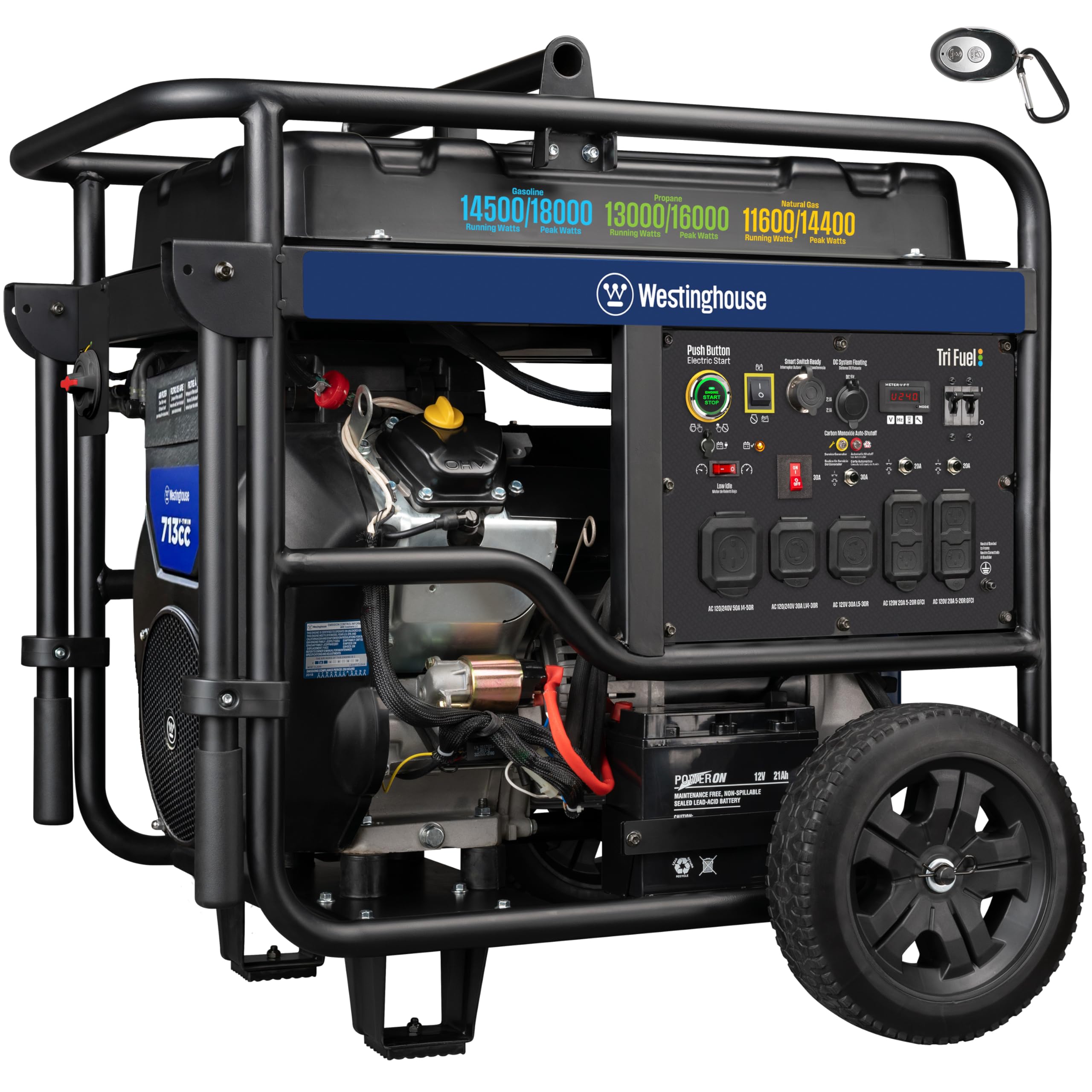
The Westinghouse WGen14500TFc is engineered for the largest homes with the heaviest loads. Its 713cc V-Twin OHV engine churns out 18,000 peak watts on gasoline, 16,000 on propane, and 14,400 on natural gas, with corresponding running ratings of 14,500W, 13,000W, and 11,600W. On natural gas, this generator can run continuously as long as the municipal gas supply remains pressurized — no refueling, no fuel stabilization, no carburetor cleaning. The 10.5-gallon gasoline tank adds 16 hours of runtime at 25% load as a fallback.
THD stays under 5%, which is acceptable for most modern appliances and electronics, though not as clean as a pure inverter. The front-facing data center shows voltage, frequency (50 Hz in some configurations but 60 Hz in this model), and lifetime hours. It includes a 50A NEMA 14-50R outlet, a 30A L14-30R outlet, a 30A L5-30R outlet, and two GFCI 120V duplex outlets, all with rubber covers for weather protection. The remote start with key fob and push-button electric start make operation straightforward.
At 74 dBA, this is louder than inverter options, but the tri-fuel flexibility is unmatched for a permanent backup installation. A few reports of a stuck fuel shutoff solenoid on gasoline are worth noting, but the unit runs flawlessly on propane and natural gas straight out of the box. For a large home with a natural gas line, this is the most capable fuel-flexible option available.
Why it’s great
- Tri-fuel operation with natural gas support
- Massive 713cc V-Twin engine output
- 50A and 30A transfer switch outlets
Good to know
- 74 dBA is louder than inverter models
- Fuel shutoff solenoid may stick on gasoline
3. DuroMax XP13000HXT
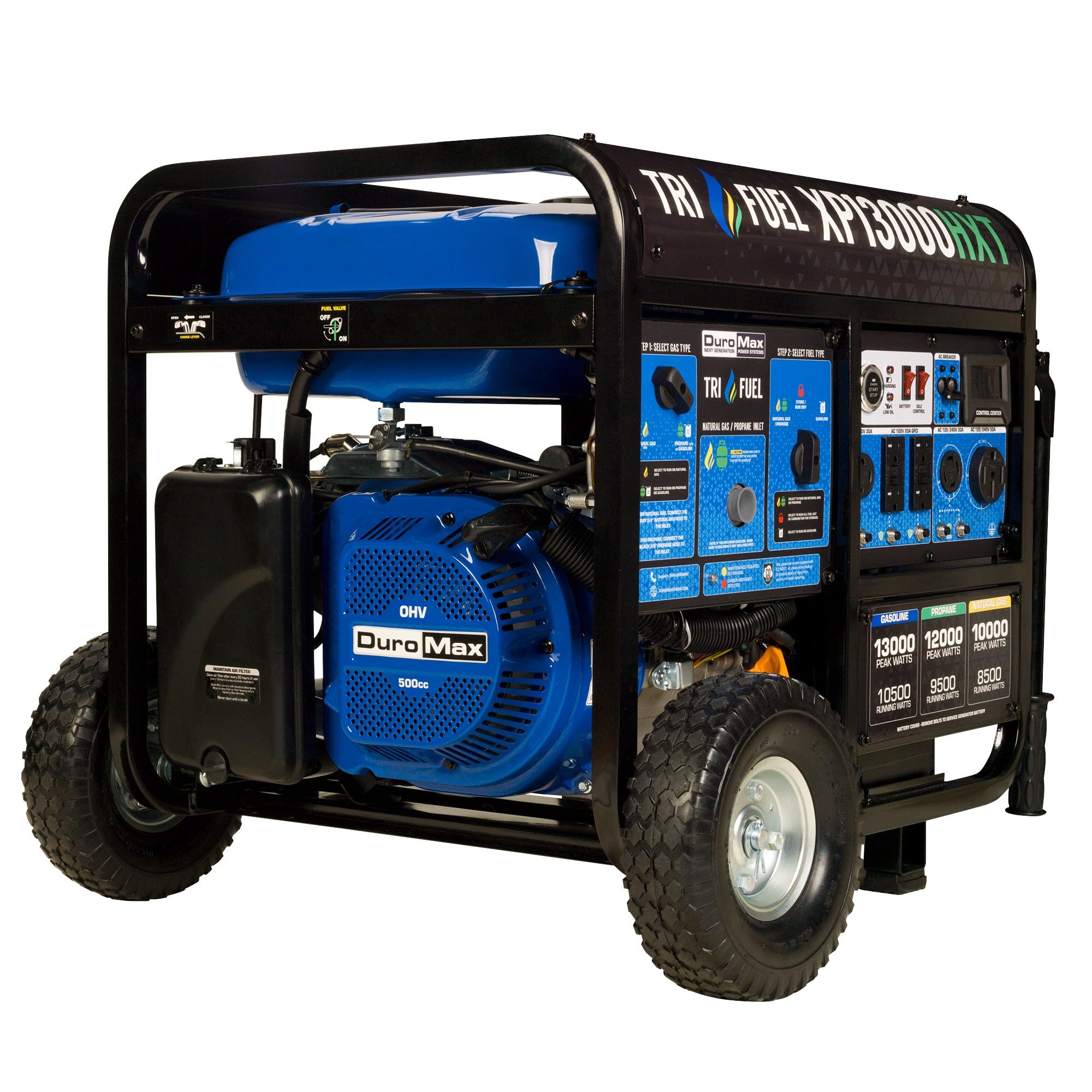
The DuroMax XP13000HXT puts out 13,000 surge watts and 10,500 running watts on gasoline, with tri-fuel capability (gasoline, propane, natural gas) that makes it a versatile whole-home companion. The 500cc OHV engine is built for sustained heavy loads — owners report running a central AC, two refrigerators, furnace blower, lights, and computers simultaneously at just 30% load. The push-button electric start and included remote start provide added convenience when starting from a distance.
The fuel selector knob on the front interface lets you switch between fuel types in seconds, and the included 15-foot natural gas hose and propane regulator get you running on piped gas or big tanks immediately. The CO Alert sensor provides automatic shutdown if carbon monoxide accumulates, which is a critical safety feature for windy outdoor setups. A bonded neutral configuration means it works with standard transfer switches and interlock kits, but off-grid users note it can be unbonded if needed.
At 240 pounds, this generator is not portable in the traditional sense, but the wheel kit and folding handle help reposition it on a flat surface. The 50-amp outlet is fully transfer-switch ready. Some noise is expected from a 500cc engine, and the fuel selector can be stiff initially. For the price, the combination of tri-fuel flexibility and heavy surge capacity is hard to beat.
Why it’s great
- Tri-fuel with natural gas hose included
- 13,000 surge watts for heavy loads
- Remote and push-button electric start
Good to know
- 240 lbs; requires wheel kit for movement
- Fuel selector knob may be stiff initially
4. Westinghouse iGen11000DFc

The Westinghouse iGen11000DFc delivers 11,000 peak watts and 9,000 running watts on gasoline, with 10,000 peak and 8,100 running watts on propane. The critical specification here is THD below 3%, which puts it firmly in inverter-class territory — your mini-split heat pumps, variable-speed fridge compressors, and smart home hubs will see pure sine wave power without voltage spikes. The 457cc Westinghouse engine with a cast iron sleeve is built for longevity, and the automatic low oil shutdown and CO sensor add essential safety layers.
The LED data center rotates through fuel level, power output, remaining run time, voltage, and lifetime hours, giving you real-time insight into your fuel strategy. On a full 9.8-gallon gasoline tank, runtime stretches to 17 hours at 25% load, which covers most overnight outage scenarios. The dual-fuel capability with included propane hose means you can switch to propane for long-term storage or unlimited runtime on large tanks.
The remote start key fob, push-button electric start, and recoil backup provide three layers of starting reliability. The unit weighs 187 pounds, but the wheel kit and foldable handle make driveway repositioning manageable. The 50-amp NEMA 14-50R outlet is transfer-switch ready, and the included battery charger keeps the starting battery topped up. Some owners noted the propane regulator connection can be slightly loose and recommend checking for leaks with soapy water before first use.
Why it’s great
- Inverter clean power with THD below 3%
- Dual fuel with robust propane support
- 17-hour runtime on gasoline
Good to know
- Propane hose connection may require re-tightening
- Heavy at 187 pounds
5. EF ECOFLOW DELTA Pro 3 8kWh

The EcoFlow DELTA Pro 3 represents the leading edge of battery-based home backup. The bundle includes the main 4,096Wh unit and an extra battery for a total of 8kWh of LiFePO4 storage, with the ability to expand up to 48kWh. Output is 4,000W continuous at 120/240V, with X-Boost allowing up to 6,000W for short surges — enough to start a 3-ton central AC or a 1 HP well pump. The X-Quiet technology holds noise to just 30 dB in silent mode, making it suitable for indoor placement near bedrooms.
The charging flexibility is exceptional: AC wall outlet (0-100% in under 2.5 hours per unit), solar up to 3,200W input, EV charging stations, gas generator, or the EcoFlow smart home panel for whole-house integration. The 10 ms UPS switchover means connected electronics never blink when the grid fails. The IP65-rated CTC battery pack uses automotive-grade LFP cells, and the 5-year warranty backs the investment.
At 188 pounds total (unit plus extra battery shipped separately), this is not a carry-around solution — the integrated handle helps, but it’s best placed on a cart or dolly. The app-based control lets you monitor charge state, set charge/discharge schedules, and track energy usage remotely. Some users noted the need for Wi-Fi to enable remote switching, and the initial sync between main unit and extra battery requires a full discharge cycle. For zero-emission, silent, whole-home backup, this is the most capable battery system available.
Why it’s great
- 30 dB near-silent operation
- Expandable to 48kWh
- 4800W output on 120/240V
Good to know
- 188 lbs; requires careful placement
- Unit and extra battery ship separately
6. GROWATT HELIOS 7200W
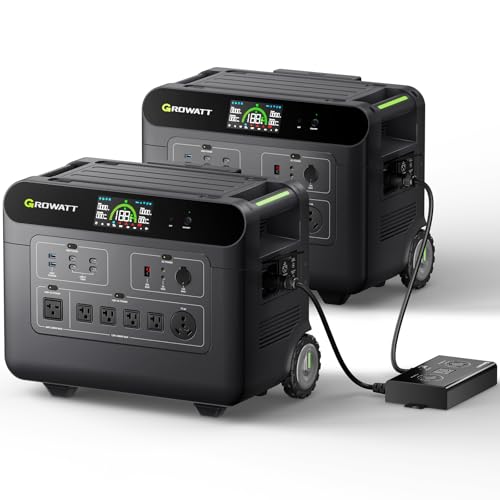
The Growatt HELIOS 7200W bundle pairs two HELIOS 3600 power stations with a split-phase connector hub to deliver 7,200W at 240V — enough to run a central AC, electric dryer, water heater, and well pump simultaneously. Each 3,600Wh LFP unit is rated for 4,000 cycles to 80% capacity, giving a 10-year service life in regular use. The parallel connection is truly plug-and-play: the included hub synchronizes both units automatically without any complex wiring.
Charging is rapid — each unit handles 2,000W solar input on top of 120V/240V AC wall power, achieving a full charge in about 1.5 hours via hybrid AC+DC mode. The EPS transfer switchover happens in under 15 milliseconds, which is within the hold-up time of most electronics. The addition of a NEMA 14-30 outlet and a NEMA 6-20 outlet means hardwired appliances like electric water heaters and pumps can be powered directly.
At 250 pounds total for both units and the hub, this is a stationary installation. The built-in handle and wheels on each unit help with garage positioning. Some users reported the Bluetooth/Wi-Fi app interface could be more polished, and the EPS feature is disabled when the units are in 240V parallel mode. For a family that needs 240V split-phase battery power without inverter generator noise or fuel costs, the HELIOS 7200W is a category-leading solution.
Why it’s great
- 7,200W at 240V for whole-home use
- Plug-and-play parallel hub included
- 4,000-cycle LFP battery life
Good to know
- EPS disabled in 240V parallel mode
- App interface needs polish
7. Jackery HomePower 3600 Plus

The Jackery HomePower 3600 Plus brings 3,584Wh of LiFePO4 storage and 3,600W of AC output (7,200W in parallel with a second unit) to the home backup market. The defining feature is the luggage-style design — wheels and a telescoping handle let you roll it from your garage to the living room without lifting. At 77 pounds, it’s the lightest 3.6kWh class unit available, thanks to automotive-grade CTB (Cell-to-Body) technology that saves weight and improves structural rigidity.
Dual voltage support (120V and 240V in parallel) means you can run a well pump or electric dryer when combined with a second unit. The ceramic membrane battery cells are tested at 302°F to prevent thermal runaway, and the system operates down to -4°F — critical for northern winter outages. Charging from 0-100% takes 2.5 hours via AC, or 2 hours via hybrid AC+DC mode, with solar input up to 2,000W.
Users consistently report powering refrigerators, CPAP machines, coffee makers, and home electronics for over 24 hours with ample reserve. The telescoping handle makes a real difference for indoor repositioning. Some users note the unit is still heavy when lifting into a vehicle, but for garage-based home backup, the portability-enhancing design is a clear advantage over open-frame generators.
Why it’s great
- Luggage wheels and telescoping handle
- Lightest 3.6kWh class at 77 lbs
- Ceramic membrane battery for safety
Good to know
- Still heavy for vehicle loading
- Parallel kit for 240V sold separately
8. EF ECOFLOW DELTA Pro (3.6kWh)
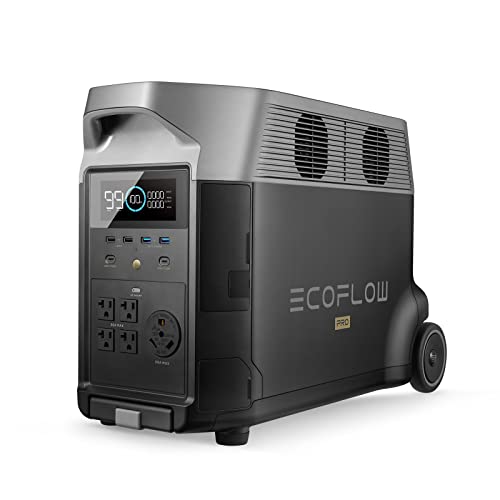
The EcoFlow DELTA Pro (3.6kWh) is the established standard in high-capacity battery backup. Its 3,600Wh LFP battery feeds five 120V AC outlets for a total of 3,600W continuous output, with X-Boost technology pushing that to 4,500W to handle motor-starting surges. Two DELTA Pro units can pair for 7,200W at 240V, covering larger appliances. The X-Stream fast charging system recharges from 0-100% in just 1.8 hours on a 240V outlet, or 2.7 hours on a standard 1800W wall outlet.
The expandable architecture is a standout: add extra batteries or the Smart Generator to scale from 3.6kWh to 25kWh or beyond. The five AC outlets, two USB-C (100W) ports, two USB-A, and the Anderson port make it easy to run multiple devices simultaneously. The app-based control via Wi-Fi or Bluetooth provides real-time monitoring of charge level, temperature, and discharge schedules, and the BMS ensures safe operation across all states of charge.
At 99 pounds, this is a heavyweight but includes integrated handles and optional wheel kit. Users report running refrigerators, freezers, and coffee makers for two days with extra batteries, and the pass-through UPS mode switches seamlessly during grid dropouts. Some owners note the initial charge can be slow on a standard 120V outlet. For a flexible, expandable battery backup that integrates with solar, EV charging, and generator inputs, the DELTA Pro remains a reference design.
Why it’s great
- Fast charging: 1.8 hrs on 240V
- Five 120V AC outlets with 3,600W output
- Expandable to 25kWh capacity
Good to know
- 99 lbs; wheel kit recommended
- Initial charge slow on 120V standard outlet
9. Anker SOLIX C2000 Gen 2
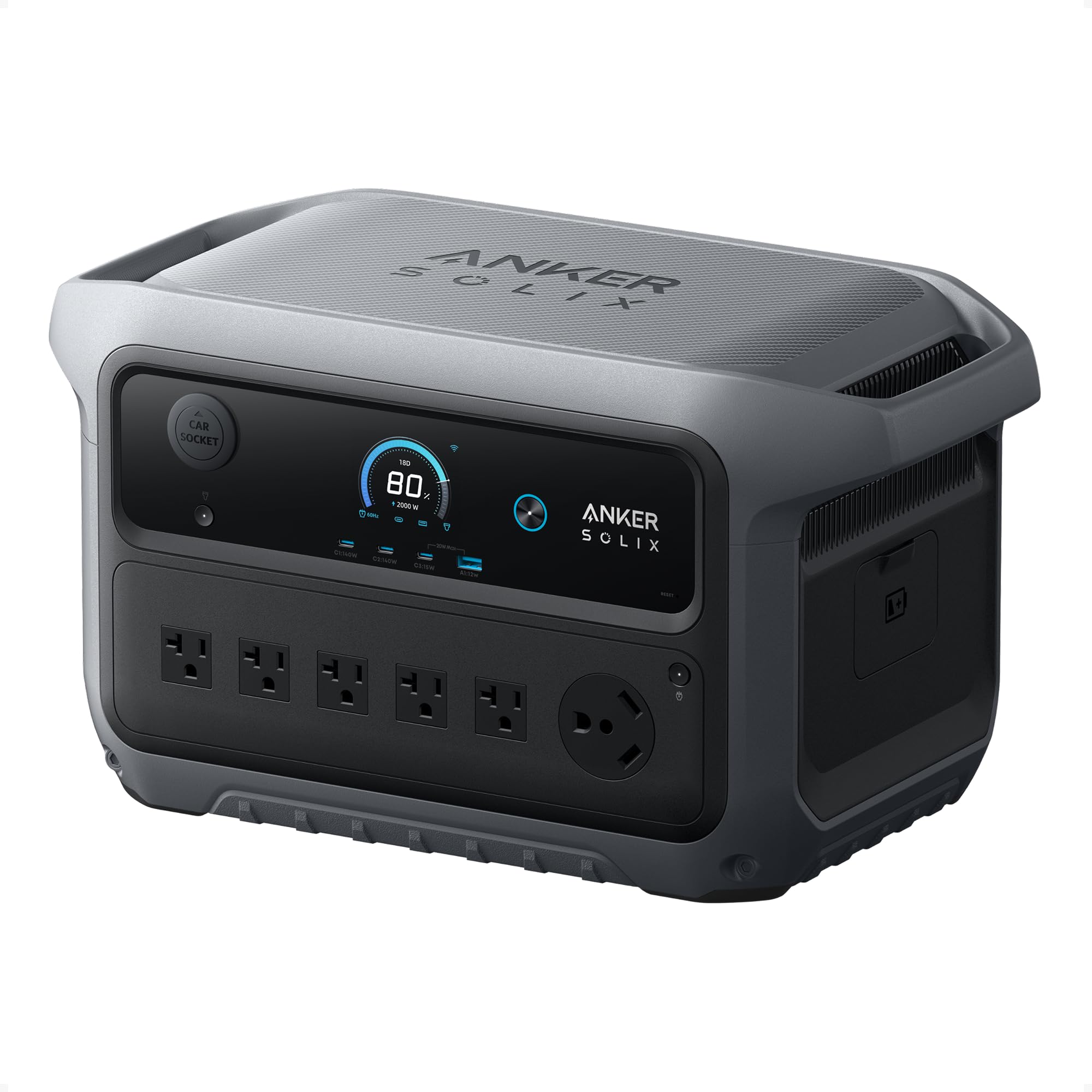
The Anker SOLIX C2000 Gen 2 packs 2,048Wh of LiFePO4 capacity into a remarkably compact 41.7-pound package — 25% lighter and 29% smaller than similarly rated competitors. The defining spec is the 58-minute full recharge time via AC input, which means you can drain the battery running a refrigerator overnight and have it fully recharged before the next big storm cell arrives. Peak output reaches 4,000W, while rated output is 2,400W, enough for most window AC units, refrigerators, and RV appliances.
Expansion capability sets this apart: connect an optional expansion battery to double capacity to 4kWh, pushing runtime on a dual-door fridge to 64 hours. The standby power draw is just 9W, meaning the unit doesn’t drain itself when stored. Charging options include AC wall outlet, solar at up to 800W, and a new 800W ultra-fast alternator charging mode that fills the battery from a car’s alternator in 3 hours — 8 times faster than a standard 12V socket.
The compact dimensions (18.1 x 9.8 x 10.1 inches) let it slide into tight spaces where a larger battery station or gas generator wouldn’t fit. Users praise the fast charging for emergency turnaround, with several reporting it runs a 30-quart fridge for 5-7 days on a single charge. The app-based manual is a minor inconvenience for those preferring a physical booklet. For a compact, ultra-fast charging battery backup, the C2000 Gen 2 punches well above its size class.
Why it’s great
- 58-minute full recharge
- 41.7 lbs; compact footprint
- Expandable to 4kWh
Good to know
- No physical manual included
- Expansion battery purchased separately
10. Jackery Explorer 2000 v2

The Jackery Explorer 2000 v2 defines the lightweight segment of home battery backup. At 39.5 pounds with a 2,042Wh LiFePO4 battery and 2,200W AC output, it’s 41% lighter and 34% smaller than typical 2kWh units. The CTB (Cell-to-Body) construction — borrowed from EV battery pack design — eliminates internal module casings, saving bulk and improving impact resistance. The 20ms UPS switchover means critical loads like Wi-Fi routers and sump pump controllers never drop during grid transitions.
Charging performance is strong: AC fast charging reaches 80% in 66 minutes and full charge in 102 minutes. Silent charging mode holds fan noise to 30 dB, making it suitable for indoor or bedroom use. Solar input up to 400W yields a full charge in about 6 hours of direct sunlight. The front panel features three AC ports, two USB-C (100W PD), two USB-A, and a car outlet. The flashlight with SOS mode is a useful secondary emergency tool.
Users consistently report the unit powers CPAP machines for multiple nights, mini-fridges for extended periods, and serves as a silent alternative to gas generators for smaller homes. Some note the 2,200W output won’t handle large motor loads like well pumps or central AC compressors. For a lightweight, silent, portable battery backup that can be carried one-handed, the Explorer 2000 v2 is the clear leader in its class.
Why it’s great
- 39.5 lbs; most portable 2kWh battery
- 30 dB silent charging mode
- 20ms UPS for seamless backup
Good to know
- 2,200W output won’t run large motor loads
- Solar charging slower with smaller panels
11. WEN DF680iX

The WEN DF680iX delivers 6,800 surge watts and 5,100 running watts on gasoline, with 6,000 surge and 4,500 running watts on propane, from its 224cc dual-fuel engine. The bonded-neutral 240V configuration is notable because it enables low-power Level 2 charging for plug-in hybrid and battery electric vehicles — a feature rarely found at this power level. The inverter technology keeps THD low enough for sensitive electronics, while the CO Watchdog sensor provides critical carbon monoxide auto-shutdown.
The fuel shutoff valve lets you run the carburetor dry before storage, a simple feature that dramatically reduces maintenance issues for seasonal users. The included tool-free LPG quick-connector and six-foot regulator hose make propane setup a 30-second job. The front panel offers an L14-30R 120/240V locking outlet, a TT-30R RV outlet, two three-prong 120V receptacles, one 12V DC outlet, and dual 5V USB ports. A voltage selector switch lets you toggle between 120V-only and 120V/240V operation.
At 99 pounds with onboard wheels and a telescoping pull handle, this is one of the most maneuverable options in the dual-fuel inverter category. Users report running a 30-amp fifth wheel RV on propane for roughly 30 hours, or powering a home’s essential circuits during outages. Some units experienced fuel solenoid issues on gasoline, and the battery disconnect requires reaching inside the chassis. For a budget-friendly entry into dual-fuel inverter home backup with EV charging capability, the DF680iX offers excellent value.
Why it’s great
- Bonded neutral for EV Level 2 charging
- Fuel shutoff extends carburetor life
- Tool-free LPG hookup in 30 seconds
Good to know
- Fuel solenoid issue reported on gasoline
- Battery disconnect is internal access
FAQ
How many watts do I need to run a typical house on a generator?
Can I connect a portable generator directly to my home’s electrical panel?
How long can I run a generator continuously during a power outage?
Final Thoughts: The Verdict
For most users, the generator for house winner is the Champion Power Equipment 201407 because it combines whole-home 9,000-watt running capacity with inverter-class power quality, a quiet 64 dBA noise profile, and convenience features like wireless remote start and a CO sensor. If you want tri-fuel flexibility for permanent natural gas installation and maximum surge capacity, grab the Westinghouse WGen14500TFc. And for silent, zero-emission home backup with no fuel storage, nothing beats the EcoFlow DELTA Pro 3 8kWh battery system.