
Cracks, chips, and separations in glass objects often bring a project to a frustrating halt. Finding a bond that remains invisible under light, resists moisture, and grips porous and non-porous surfaces alike is the real challenge, not the repair itself. The right adhesive must cure fast enough to hold a stem or a lens in place without creeping, yet remain flexible enough to withstand thermal expansion in a window or a windshield.
I’m Mohammad Maruf — the founder and writer behind Drink4Good. I have spent years analyzing chemical bonding formulas, cure mechanisms, and tensile strength data across dozens of adhesive subcategories to separate marketing claims from real-world performance.
This guide breaks down the top formulations for bonding glass to glass, glass to metal, and glass to plastic, focusing on light-activated systems, polyurethane windshield adhesives, and low-odor specialty cyanoacrylates. Whether you are repairing a tabletop, a cracked phone mount, or an automotive window, the right glass adhesive must deliver optical clarity, rapid fixture, and durable impact resistance without yellowing over time.
How To Choose The Best Glass Adhesive
Every glass repair presents a unique set of demands: the joint geometry (butt vs. lap), the environmental exposure (interior vs. exterior), and the required optical clarity (invisible seam vs. structural filler). Understanding the three core adhesive families — UV-activated cyanoacrylates, polyurethane windshield adhesives, and specialty foam-safe cyanoacrylates — will steer you toward the right tube.
Cure Mechanism and Working Time
UV-activated adhesives cure in seconds when exposed to a 395nm or 405nm light source, making them ideal for small, transparent joints where positioning can be fixed during exposure. Moisture-cure cyanoacrylates (standard super glues) set in 5–60 seconds but can leave a white bloom on glass. Two-part epoxies offer longer working times for large repairs but require clamping and often yellow under sunlight. Choose UV if the repair is small and one object is transparent; choose polyurethane if the bond must resist vibration and moisture in automotive applications.
Viscosity and Gap Filling
Thin, low-viscosity adhesives (like Bob Smith Industries Super-Gold) wick into tight hairline cracks and produce a nearly invisible seam. Medium-viscosity gels and resins (like Akisey’s UV resin) bridge gaps up to 1/16 inch without running down vertical surfaces. High-viscosity polyurethane (FORTIVO) is formulated for thick beads on windshield edges and requires a caulking gun. Never use a thin glue on a wide gap — it will run off before curing, leaving a weak joint.
Optical Clarity and UV Stability
For tabletop glass, picture frames, or display repairs, the cured adhesive must be water-clear and resist yellowing over months of UV exposure. UV-cured resins and light-activated cyanoacrylates (J-B Weld SuperWeld, Krazy Fix) generally meet this standard because the photoinitiator fully consumes reactive groups during cure. Standard ethyl cyanoacrylates yellow rapidly in sunlight due to residual unsaturation. If the bond will be exposed to direct sun, confirm the product says “non-yellowing” or “UV-stable.”
Impact Strength and Flexibility
Windshield and window adhesives must absorb road vibrations and thermal expansion without cracking. Polyurethane windshield adhesives (FORTIVO) deliver the highest peel strength and elongation — they remain slightly flexible after full cure. UV-cured cyanoacrylates are rigid and brittle; they excel on small, non-load-bearing glass items (eyeglass frames, ornaments, phone screens) but will shatter under bending stress. Match the bond’s flexibility requirement to the cure chemistry: rigid for static decoration, flexible for structural vehicle glass.
Quick Comparison
On smaller screens, swipe sideways to see the full table.
| Model | Category | Best For | Key Spec | Amazon |
|---|---|---|---|---|
| J-B Weld SuperWeld 2-Pack | UV Cyanoacrylate | High-strength glass-to-metal repairs | 2800 PSI tensile strength | Amazon |
| Bob Smith Industries BSI-139H | Odorless Cyanoacrylate | Foam-safe, gap-filling glass joints | Foam-safe, bonds in 5-15 seconds | Amazon |
| Krazy Fix Light Cure | Light-Activated Cyanoacrylate | Fast 5-second glass repairs | Holds over 1000 pounds (vertical) | Amazon |
| Akisey UV Resin Kit | UV Resin | Small arts, glass ornaments, clear fill | 100g resin, 395nm 1300mW flashlight | Amazon |
| FORTIVO Windshield Adhesive | Polyurethane | Automotive glass, vertical bonding | 310ml cartridge, non-sag formula | Amazon |
In‑Depth Reviews
1. J-B Weld SuperWeld Light-Activated 2-Pack

J-B Weld brings its industrial reputation to a light-activated cyanoacrylate that cures in 10 seconds under the included UV light and reaches a tensile strength of 2800 PSI — the highest in this roundup. The precision tip applicator deposits a controlled bead ideal for glass-to-metal joints on phone mounts, eyeglass stems, and small glass fixtures. Because the adhesive remains liquid until exposed to UV, you can reposition parts without losing the bond, a clear advantage over instant-set cyanoacrylates that grab the moment they touch moisture.
Users report the cured material is as hard and clear as glass, making it nearly invisible on transparent repairs. The 2-pack gives you two tubes and two UV lights, which is practical for multiple small jobs or for storing one in a workshop kit. The liquid formula flows well into tight hairline cracks but can run on vertical surfaces if over-applied — a medium layer (1/32 inch) is optimal.
The cap on the tube tends to stick if glue residue remains on the threads; wiping the tip before recapping solves this. Some users note the UV light can burn skin if held too close for extended periods — standard precaution for any 395nm source. For the highest structural strength in a clear, UV-curable glass adhesive, this 2-pack leads the category.
Why it’s great
- Highest tensile strength (2800 PSI) in the group
- Repositionable before UV exposure
- Dries crystal clear and hard like glass
Good to know
- Cap can adhere to tube if not cleaned
- Liquid viscosity runs on vertical surfaces
2. Bob Smith Industries BSI-139H Super-Gold Odorless
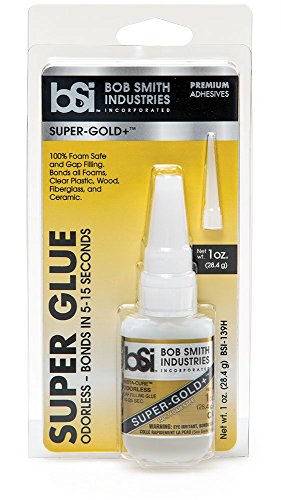
Bob Smith Industries BSI-139H is the only odorless, foam-safe cyanoacrylate in this guide, making it the optimal pick for bonding glass to foam, cork, or fabric in craft and model-building projects. The liquid formula penetrates small crevices and sets in 5–15 seconds, creating a strong bond without the harsh fumes typical of standard super glues. Hobbyists use it extensively for diorama terrain, D&D models, and scratch-built structures where glass windows or glass gems need a secure, invisible attachment.
The 1-ounce bottle with a precision extender tip allows controlled application even in tight corners. Because it is a standard moisture-cure cyanoacrylate, it does not require a UV light — just careful clamping for the first 60 seconds. The bond remains clear and does not bloom (turn white) on glass surfaces, a common problem with cheaper ethyl cyanoacrylates. Users report it bonds silicone and other difficult substrates that typical super glues fail on.
The bottle must be capped immediately after use; any air exposure accelerates hardening inside the tip. It is not designed for high-impact or load-bearing automotive glass — the cured joint is rigid and will crack under vibration. For indoor decorative glass repairs, craft projects, and foam-safe bonding, this is the most versatile formulation available.
Why it’s great
- Odorless and foam-safe — no melting or fuming
- Extender tip for precise, small-bead application
- Bonds silicone and other non-porous materials
Good to know
- Not impact-resistant — can crack under stress
- Bottle tip can clog if not sealed properly
3. Krazy Fix Light Cure Super Glue with LED Light

Krazy Fix brings a dual-cure cyanoacrylate from the makers of the original Krazy Glue, pairing a gel-like adhesive with a UV-A LED that cures the bond in 5 seconds. The gel consistency stays where you put it — no dripping on vertical glass repairs like a glass shelf mounting block or a picture frame corner. Users report it holds over 1000 pounds on a properly prepared joint, which is exceptional for such a small tube (0.14 oz).
The LED light is bright enough to cure through clear glass but struggles with thick or colored glass layers. The gel is ideal for gap-filling on uneven glass edges or filling small chips before bonding. For eyeglass frames, phone cable strain relief repairs, and costume jewelry, the fast cure lets you hand the item back to the owner within a minute. The adhesive is made in the USA with globally sourced components.
The tube has one major drawback: once the cap is punctured, the remaining glue can thicken into a putty-like consistency within days, even when sealed. This makes it best for single-use repairs rather than ongoing projects. The light is small and easy to misplace. For fast, high-strength glass repairs where you use the entire tube at once, the performance is excellent.
Why it’s great
- Gel consistency prevents running on vertical glass
- Extremely fast 5-second cure with included LED
- Claims over 1000 pounds holding strength
Good to know
- Tube does not store well — thickens after first use
- Small LED light easy to lose
4. Akisey UV Resin Kit with 395nm Flashlight
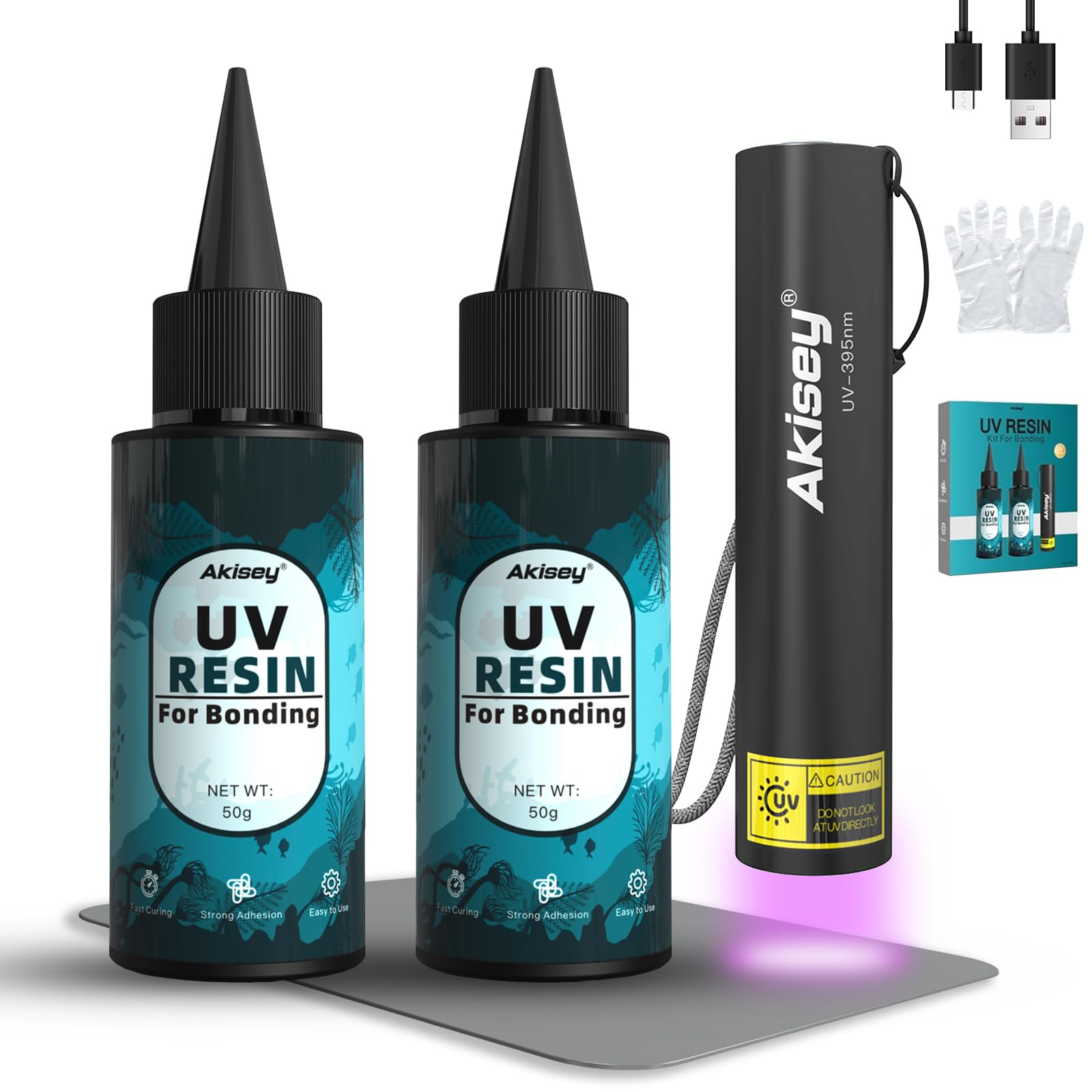
Akisey’s UV resin kit offers a complete starter package — 100g of clear UV resin, a rechargeable 395nm flashlight rated at 1300mW, a silicone mat, gloves, and a storage bag — all designed for bonding small glass ornaments, acrylic pieces, and crafting projects. The resin is low-viscosity and flows into tight spaces, curing in 5–10 seconds under the focused beam. It is not a cyanoacrylate but a true UV-curable resin, meaning it stays liquid until exposed to UV and cures into a hard, high-gloss, non-yellowing solid.
Hobbyists use it for embedding pressed flowers in resin or bonding glass gems to jewelry findings. The flashlight is metal, compact (3.2 x 0.8 inches), and rechargeable via USB-C, making it far more convenient than button-cell-powered UV pens. The 100g bottle provides enough material for dozens of small repairs, significantly more value per repair than single-use cyanoacrylate tubes.
The resin is not suitable for opaque or load-bearing glass joints — at least one surface must be transparent for the UV to penetrate. Thick layers (over 1/8 inch) may remain tacky underneath because the 395nm beam does not penetrate deep resin. The kit is best for clear-on-clear bonding, coatings, and artistic fills, not for structural automotive glass.
Why it’s great
- Complete kit with 100g resin, light, mat, gloves
- Rechargeable 395nm flashlight (1300mW output)
- Non-yellowing, high-gloss finish
Good to know
- Requires at least one transparent surface for UV
- Thick layers may not cure fully
5. FORTIVO Polyurethane Windshield Adhesive
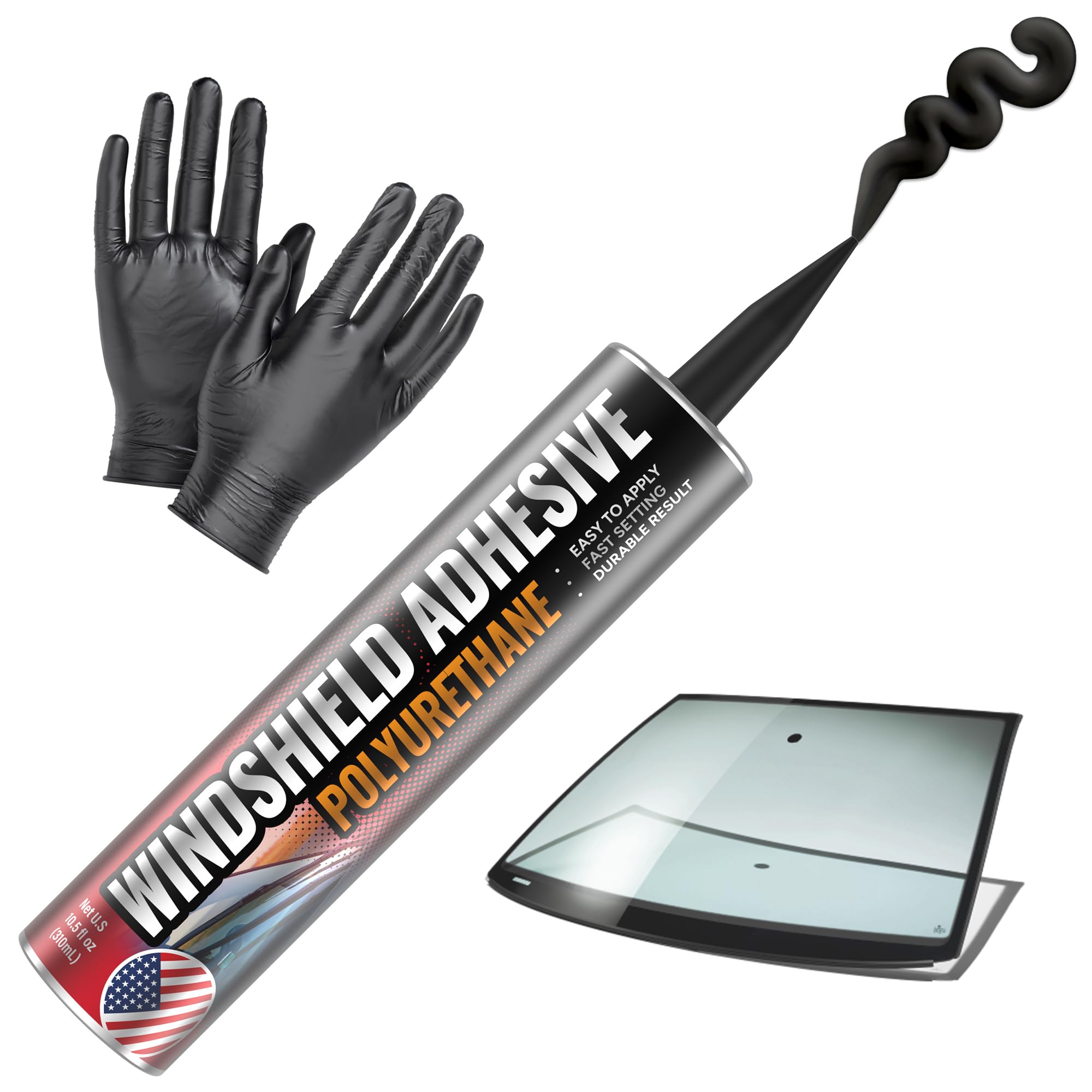
FORTIVO’s polyurethane windshield adhesive is the only product in this guide designed specifically for automotive glass — windshields, backlights, sidelights, and heavy equipment windows. The 310ml cartridge is compatible with standard caulking guns and dispenses a non-sagging bead that stays in place on vertical and overhead surfaces. No primer is required, which simplifies installation: clean the glass and frame, apply the bead, and press into place. The adhesive cures via atmospheric moisture, forming a tough, flexible bond that absorbs road vibration and thermal expansion.
Users report successful repairs on truck windows, tractor glass, and RV sidelights, even at temperatures as low as 40°F. The polyurethane formulation remains slightly elastic after full cure, preventing stress cracks in the glass. Excess adhesive can be trimmed with a razor blade after 24 hours, leaving a clean, watertight seal. The kit includes gloves and an applicator tip, though a caulking gun is required separately.
For non-automotive glass repairs (picture frames, tabletops, decorative glass), this adhesive is overkill — its thick texture and black color make it unsuitable for clear, cosmetic bonds. It is also aggressively tacky; users stress wearing gloves and covering surrounding areas to avoid permanent stains. For any vehicle glass or exterior structural joint, this is the most reliable option in the category.
Why it’s great
- Non-sag formula for vertical and overhead glass
- Flexible after cure — resists vibration and thermal shock
- No primer needed; works in cold weather
Good to know
- Requires a caulking gun (not included)
- Black color — not for clear or cosmetic repairs
FAQ
Can I use a UV glass adhesive on a tinted windshield?
Will clear super glue yellow on my glass table repair?
How do I prepare a glass surface before bonding?
Can I use a glass adhesive for bonding glass to metal?
Final Thoughts: The Verdict
For most users, the glass adhesive winner is the J-B Weld SuperWeld Light-Activated 2-Pack because it combines the highest tensile strength (2800 PSI) with the convenience of repositionable liquid and an included UV light, all at a mid-range investment. If you need a foam-safe, odorless formula for craft and model glass work, grab the Bob Smith Industries BSI-139H. And for automotive glass repairs requiring a flexible, vibration-resistant bond, nothing beats the FORTIVO Polyurethane Windshield Adhesive.