
Concrete is deceptive: it looks like a single solid mass, but it’s a porous, brittle composite that sheds thin layers, spalls in freeze-thaw cycles, and offers adhesives almost no surface area to grip. A general-purpose glue that works beautifully on wood or plastic will simply sit on top of cement dust, pop free at the first temperature swing, and leave you with a crusty smear and a broken repair. Cement bonding demands a glue that chemically marries the substrate — either a penetrating epoxy that locks into microscopic pores or a polymer admixture that becomes part of the cement matrix itself. Without that chemical marriage, every winter is a ticking clock.
I’m Mohammad Maruf — the founder and writer behind Drink4Good. I’ve spent years analyzing adhesive chemistries, from polyurethane construction adhesives to high-build masonry epoxies, and the critical distinction in this category is whether a product simply sits on the surface or actually integrates into the cement’s crystalline structure.
After reviewing hundreds of real-user reports and technical datasheets, the field narrows to five formulations designed for concrete’s unique demands. This guide breaks down the specific chemistries, work times, and real-world holding power of each option to help you find the best glue for cement that matches your project’s scale and environment.
How To Choose The Best Glue For Cement
The wrong glue for cement is a failure you won’t see coming until a bolt loosens or a patch cracks. Because concrete is both porous and alkaline, standard wood glues and most household adhesives lack the chemical resistance to hold long-term. Your choice comes down to three variables: the glue’s chemistry, its physical form (paste, liquid, syringe), and the temperature range your project will experience.
Epoxy vs. Acrylic vs. Construction Adhesive: Which Chemistry?
Two-part epoxy pastes (like PC-Concrete or PC-Masonry) are the gold standard for anchoring and crack repair because they cure into a rigid, high-compressive-strength solid that mechanically locks into concrete pores. Acrylic latex admixtures (like SikaLatex) are completely different: you mix them into fresh mortar or concrete to improve bond strength — they aren’t a “stick this to that” glue. Construction adhesives (like Loctite Power Grab) rely on grab and flexibility; they work when bonding lightweight materials to concrete but lack the tensile strength needed for structural loads.
Work Time and Cure Speed
Concrete adhesives range from 4-minute epoxy syringes to 20-minute work-life epoxies and 24-hour full-cure construction adhesives. For vertical or overhead repairs, a non-sag paste with a 20-minute work time gives you enough window to position hardware but sets fast enough to stay put. For large-area patching, a longer cure allows working the material into voids. Temperature dramatically affects these times: below 50°F, epoxy reactions slow and construction adhesives may remain tacky for days.
Moisture Resistance and Temperature Range
Concrete lives outdoors or in damp basements. If your glue can’t handle 0°F to 140°F or won’t cure in humid conditions, the bond degrades. Look for adhesives rated for wet surface application and a service temperature that brackets your local climate. Epoxies (PC Products, Brampton) typically serve -20°F to 200°F. Construction adhesives like Loctite Power Grab work from 0°F to 140°F but struggle in freezing weather during cure.
Quick Comparison
On smaller screens, swipe sideways to see the full table.
| Model | Category | Best For | Key Spec | Amazon |
|---|---|---|---|---|
| PC-Masonry Epoxy | Epoxy Paste | Structural repair on overhead surfaces | Service range -20°F to 200°F | Amazon |
| PC-Concrete Epoxy | Epoxy Syringe | Anchoring bolts & hairline cracks | 4-hour cure at 75°F | Amazon |
| Brampton Extra Strength | Two-Bottle Epoxy | Multi-material bonding (metal, stone) | 20-min work life, 15-hr cure | Amazon |
| Loctite Power Grab | Construction Adhesive | Bonding decorative tile to concrete | Crystal clear, 24-hr full cure | Amazon |
| SIKA SikaLatex R | Acrylic Fortifier | Mixing into mortar for bond strength | 500 PSI bond strength | Amazon |
In‑Depth Reviews
1. PC Products PC-Masonry Epoxy Adhesive Paste
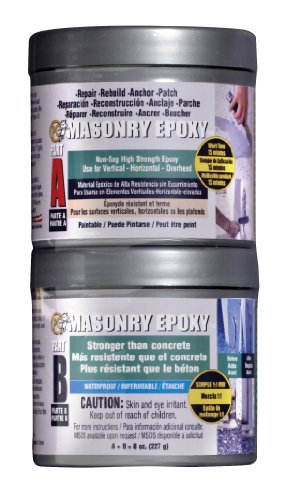
The PC-Masonry Epoxy is the single most versatile formulation in this lineup precisely because it was designed as a non-sag paste that stays put on vertical and overhead concrete without dripping. Its two-part epoxy chemistry delivers a service temperature range from -20°F to 200°F, which covers extreme freeze-thaw cycling and hot rooftop repairs alike. Real users have successfully bonded thin slate pavers to concrete, repaired pool gunite after freeze-thaw spalling, and fixed drill damage on walls — all with the same can. The thick dough-like consistency makes mixing a bit more effort than a syringe, but that viscosity is exactly what allows it to work on overhead applications without slump.
The 8-ounce two-can kit provides significantly more material than small syringes, making it suitable for medium-scale repairs like patching missing concrete corners or re-adhering loose masonry caps. One reviewer noted that the paste set up in roughly 3 hours and became fully hardened overnight, which aligns with the 20-minute work-life claim. The gray color matches raw concrete closely, though some users applied gray paint over the repair for a seamless cosmetic finish. The key trade-off: the thick consistency makes getting deep into hairline cracks difficult — this is a gap-filling surface repair epoxy, not a capillary-penetrating crack sealer.
For anyone needing a structural bond to concrete that will survive outdoor weather and mechanical stress, this is the most reliable single product in the group. It requires no special mixing tools beyond a stirring stick and a clean surface, and the moisture-resistant formulation allows application to damp concrete — a common scenario in basement or foundation work. The 0.64-pound can set feels substantial, and the price per ounce is the best among the premium options reviewed here.
Why it’s great
- Non-sag paste works on vertical and overhead surfaces without dripping
- Service temperature range -20°F to 200°F handles extreme climates
- Large 8-ounce kit offers best value per ounce for structural repairs
Good to know
- Thick consistency makes mixing more labor-intensive than syringe formats
- Gray color may require painting for a cosmetic match
- Not ideal for capillary-penetrating hairline crack injection
2. PC Products PC-Concrete Two-Part Epoxy Syringe
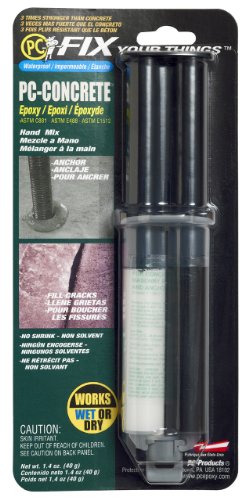
When the job is small but the holding strength is critical — anchoring a threaded rod, reattaching a broken concrete chunk, filling a thin crack — the PC-Concrete syringe delivers precision that a paste cannot match. The two-part epoxy mixes inside the applicator as you push, giving you a consistent ratio every time without any hand-stirring or guesswork. The 4-hour cure time at 75°F is fast enough to hold an anchor bolt after a single afternoon, and users have reported it holding a 6-inch concrete reattachment with just a 25-minute hand press and tape job. The gray color matches most concrete work, and the seam on repairs is nearly invisible when applied sparingly.
The 1.4-ounce tube is deliberately small — this is a convenience product for small repairs, not a bulk patching solution. Multiple reviewers praised its performance for reattaching bird bath statues, pool deck anchors, and small masonry pieces. The 20-minute work time at 75°F gives enough open time to position parts before the epoxy sets. The main limitation reported by users is the quantity-to-price ratio: at this volume, larger repairs like filling a 12-inch crack will require multiple syringes, which pushes the total cost up. One reviewer noted the epoxy runs slightly on vertical surfaces if applied too thickly, so thin, even application is key.
For any homeowner or DIYer facing a single cracked step, a loose fence anchor, or a decorative concrete repair, the PC-Concrete syringe is the fastest route to a strong bond. Its primary strength is convenience: no measuring, no mixing tools, no waste.
Why it’s great
- Syringe applicator delivers precise mix ratio without measuring
- 4-hour cure time is fast enough for same-day anchoring
- Gray color blends nearly invisibly into concrete surfaces
Good to know
- 1.4 oz quantity is small; larger repairs need multiple syringes
- Can run slightly on vertical surfaces if applied too thickly
- More expensive per ounce than bulk paste options
3. Brampton Extra Strength Epoxy

The Brampton Extra Strength Epoxy occupies a unique niche: it is the only two-bottle liquid epoxy in this comparison, giving you the flexibility to mix exactly the volume you need and apply it to a wider variety of materials than any paste or syringe can reach. Its 1:1 volume ratio (Part A 114g : Part B 100g) is simple to measure, and the 20-minute work life is generous enough for multi-step repairs. The epoxy is impact-resistant and suitable for vertical surfaces, making it a strong contender for automotive parts, garden tools, and household items that happen to be bonded to concrete. Reviewers have successfully used it to attach G10 knife scales, reattach ceramic handles, and repair pool light assemblies — all testaments to its versatility across metal, stone, and ceramic interfaces.
The 24-hour full cure time is longer than the PC-Concrete syringe, but the result is a hard, sandable, paintable bond that can be customized after cure. Users consistently note that the epoxy is easy to spread and sets up exactly as advertised. The one consistent criticism is that the marketing claims it dries clear, but in reality it cures to an amber color — important if you need a transparent finish for a glass or clear-concrete repair. The two-bottle format also means you need a mixing container and stirring tool, adding a small step compared to the syringe’s push-and-apply convenience.
If your project involves bonding concrete to metal, wood, or ceramic in a controlled indoor environment, Brampton’s 20-minute work window and impact resistance make it the most adaptable chemistry here. It is less specialized for pure concrete-on-concrete structural anchoring than the PC Products epoxies, but for mixed-material repairs where concrete is one of several substrates, this is the best all-around performer.
Why it’s great
- Works on metal, wood, stone, tile, and concrete for multi-material bonding
- 20-minute work life allows time for complex assemblies
- Impact-resistant and sandable after full cure
Good to know
- Cures to amber color, not clear as sometimes advertised
- Requires separate mixing container and stirring tool
- 24-hour full cure is longer than syringe-based epoxies
4. Loctite Power Grab Ultimate Crystal Clear Construction Adhesive
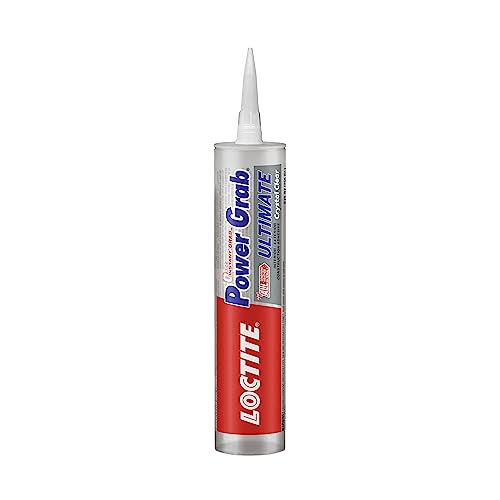
The Loctite Power Grab is not an epoxy and it won’t anchor a structural bolt, but for bonding lightweight materials like decorative ceiling tiles, baseboards, or thin plywood to concrete walls or floors, it offers a combination of quick grab and invisible finish that no epoxy can match. The crystal-clear formula is a genuine differentiator: unlike the amber-tinted epoxies, Power Grab leaves no visual trace on the bond line, making it the best choice when the glue itself would be visible. It bonds non-porous surfaces (including plastic and metal) and can be applied to wet surfaces, a real advantage in damp basement or bathroom settings. The initial tack is strong enough to reduce bracing for many lightweight applications.
The 24-hour full cure time and 0°F to 140°F temperature range cover most indoor and moderate outdoor applications. The biggest limitation reported by users is performance in freezing weather: multiple reviews noted that the adhesive remained tacky and failed to cure properly when applied in temperatures below freezing, even with heaters running. The tip is also prone to breaking if dropped, and cleanup requires mineral spirits when fresh. This is a polyurethane-based construction adhesive, not a concrete epoxy — it bonds well to concrete but does not chemically integrate with it, meaning freeze-thaw cycles can eventually break the bond if the material is heavy or stressed.
For non-structural projects like mounting decorative panels, securing trim to concrete, or bonding lightweight fixtures, Power Grab offers the best cosmetic finish at the most budget-friendly entry price. Just don’t use it for anything load-bearing outdoors in freezing climates.
Why it’s great
- Crystal clear formula leaves an invisible bond line
- Works on wet surfaces and bonds non-porous materials
- Strong initial tack reduces need for clamping or bracing
Good to know
- Fails to cure in freezing temperatures below 0°F
- Not a structural epoxy; unsuitable for load-bearing anchoring
- Cleanup requires mineral spirits when adhesive is fresh
5. SIKA SikaLatex R Concrete Adhesive Glue

SikaLatex R is the only product in this comparison that is not a glue in the traditional sense — it is an acrylic-polymer latex admixture designed to be added to Portland-cement mortar or concrete to increase bond strength, improve freeze-thaw resistance, and achieve 500 PSI tensile bond strength. If you are pouring a thin concrete overlay, repairing a spalled slab, or setting new mortar over old concrete, you mix this directly into the dry cement powder before adding water. It transforms standard mortar into a chemical-bonding adhesive that resists the vapor barrier issue common with straight cement repairs. The 1-gallon pail is a large quantity, intended for ongoing projects or professional use.
Real-world user reports confirm the formulation works exactly as described: one reviewer used it to bond ceramic fixtures to concrete with quickset mix, requiring only a 24-hour hold before the assembly was solid. Another used it as a bonding adhesive before applying a concrete patch, creating a new surface that looked like original work after painting. The product has a 1-year shelf life from the manufacture date, so check the stamp on the pail before purchase. At 8.5 pounds per gallon, this is the heaviest and most project-specific option — you need a cement mixer or mixing bucket and a willingness to work with wet concrete.
For any project involving fresh cement, mortar, or concrete work bonded to existing concrete, SikaLatex R is the single best additive available. It does not replace a glue or epoxy — it upgrades the cement itself. If your project is about sticking one finished object to concrete (rather than pouring new concrete that sticks), choose one of the epoxy options. If you are repairing or resurfacing concrete itself, this is the essential base product.
Why it’s great
- 500 PSI tensile bond strength upgrades standard mortar to structural grade
- Improves freeze-thaw resistance in new concrete repairs
- 1-gallon pail provides enough for multiple large-scale projects
Good to know
- Not a standalone glue — must be mixed into cement or mortar
- 30-day full cure is significantly longer than epoxy options
- 1-year shelf life; check expiration date before purchase
FAQ
Can I use construction adhesive instead of epoxy for anchoring bolts into concrete?
How long does concrete glue take to cure in cold weather?
Will SikaLatex R work as a glue to attach wood to concrete?
Final Thoughts: The Verdict
For most users, the best glue for cement winner is the PC-Masonry Epoxy because it combines non-sag vertical performance with the widest service temperature range and the most material per dollar. If you want a precision syringe for anchoring and small crack repairs, grab the PC-Concrete Epoxy. And for upgrading fresh mortar or concrete into a high-bond-strength repair, nothing beats the SIKA SikaLatex R.