
Nothing ruins a car’s interior faster than a headliner drooping down onto your passengers’ heads. That sagging fabric is a constant reminder that the foam backing has rotted — and a simple can of the right adhesive is all that stands between you and a permanently fixed ceiling. This isn’t about slapping on any glue; it’s about choosing a spray that can handle the brutal heat inside a parked car without letting go.
I’m Mohammad Maruf — the founder and writer behind Drink4Good. I’ve spent years breaking down hardware specifications and analyzing real-world adhesive performance across hundreds of DIY automotive projects.
The dry heat, the moisture from daily humidity, and the constant vibration from driving all test a bond to its breaking point. That’s why you need a spray specifically rated for the job — and we’ve found the very best options for glue for headliner that will keep your roof fabric firmly in place for the long haul.
How To Choose The Best Glue For Headliner
Automotive headliner adhesive isn’t a one-size-fits-all product. The foam backing on modern headliners is often rotted or brittle, and a glue that works on paper or wood will fail within weeks in a car roof. Focus on three core criteria before you buy.
Heat Resistance Ratings
Inside a closed vehicle on a summer day, roof temperatures can exceed 180°F. An adhesive rated for 160°F may soften and let go. The best headliner glues are rated for 200°F or higher, using a heat-resistant formula that doesn’t re-activate when the sun beats down.
Spray Pattern and Nozzle Control
A fan spray or web pattern covers wide areas evenly without soaking the foam backing. Stream-type nozzles concentrate glue in one spot, making it harder to apply a uniform layer. Adjustable nozzles let you dial in the coverage you need for different panel sections.
Open Time and Tack Strength
Open time refers to how long the adhesive remains workable after spraying. A glue that tacks up in 30 seconds leaves no room to reposition fabric. A 2-to-5-minute open window gives you time to align the headliner properly before the bond locks in permanently.
Quick Comparison
On smaller screens, swipe sideways to see the full table.
| Model | Category | Best For | Key Spec | Amazon |
|---|---|---|---|---|
| 3M Headliner & Fabric Adhesive | Spray | General auto headliner repair | 18.1 oz can, dries in 30-60 min | Amazon |
| Polymat 797x Hi Temp Spray | Spray | High-heat environments | 220°F heat resistance rating | Amazon |
| Polymat 797 Hi-Temp Spray | Spray | Marine and outdoor gear | 160°F heat and water resistant | Amazon |
| Thermo-Tec 12005 Spray-On Adhesive | Spray | Precision application | 16.75 oz, fast-drying contact bond | Amazon |
| 3M Headliner & Fabric (2-Pack) | Spray | Multiple large panels or big jobs | 2 cans, 18.1 oz each | Amazon |
In‑Depth Reviews
1. 3M Headliner & Fabric Adhesive (38808)

The 3M 38808 delivers exactly what the name promises: a strong, even spray bond that holds heavyweight automotive fabrics to metal surfaces without soaking through. The adjustable nozzle lets you control the spray pattern, so you can cover large headliner panels evenly while keeping excess glue off surrounding trim. Customers consistently note that the fabric stays put even after months of hot weather and daily driving.
One recurring point is the strong chemical odor — you absolutely need good ventilation during and after application. The adhesive requires a full 24 hours to cure completely, though it tacks up fast enough that you can set the fabric within a few minutes. The 18.1-fluid-ounce can covers one typical sedan roof with a bit left over for small touch-ups.
User reviews highlight how the formula resists moisture and temperature swings without losing grip. Many first-timers report achieving a professional-looking finish on their first attempt, with no sagging or bubbling months later. It is the most trusted name in the category for good reason.
Why it’s great
- Even fan spray pattern, no stream blobs
- Dries clear — no visible residue on fabric
- Pack of 2 version available for bigger jobs
Good to know
- Strong fumes require full ventilation
- Full 24-hour cure time before handling
2. Polymat 797x Hi Temp Spray Adhesive
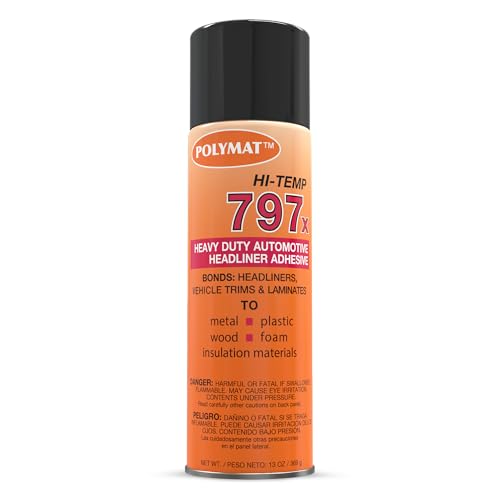
The Polymat 797x is engineered for the hottest environments, with a heat resistance rating of 220°F — significantly higher than most competitors. That makes it the go-to choice for vehicles parked in full sun, convertibles with dark roofs, or anyone living in a desert climate where standard adhesives soften and fail. The industrial-grade formula bonds vinyl, heavy-weight headliners, and even hood silencer pads with equal tenacity.
One thing to note: the adhesive sprays out in a web-like pattern rather than a fine mist. This works well for covering large areas without overspray, but some users note that it occasionally shoots thin streams instead of a consistent fan. You need to follow the instructions — spray both the fabric and the roof surface, wait about five minutes for it to become tacky, then press into place.
Customer feedback reports excellent hold over extended periods, with one user saying the headliner stayed perfectly flat on a four-door sedan with a sunroof using just two cans. The water-resistant formulation also makes it suitable for marine upholstery projects. It dries to a clear finish that won’t yellow or discolor your fabric.
Why it’s great
- Highest heat rating in this comparison at 220°F
- Water resistant for marine and outdoor use
- Web pattern reduces overspray waste
Good to know
- Spray pattern can be uneven — occasional thin streams
- Requires spraying both surfaces before bonding
3. Polymat 797 Hi-Temp Spray Adhesive (13 oz)

The smaller 13-ounce can of Polymat 797 still delivers the industrial heat and water resistance that make the Polymat line famous, but at a lower entry point. It is rated for 160°F — adequate for most climates, though not as extreme as the 797x version. This makes it an excellent option for smaller repairs, side panels, or marine upholstery where you don’t need a full can of adhesive.
The formula comes out white initially, then dries clear. One reviewer noted that it lays material down easily without creating creases, calling it a significant improvement over the 3M version in terms of workability. The spray pattern is consistent, and the adhesive holds tightly on vinyl, fabric, and foam bonded to metal, wood, or plastic surfaces.
Some customers mention that the nozzle can be a bit finicky — the adhesive comes out thick and may require practice to apply evenly. The 13-ounce size is best for small-to-medium projects; a full sedan headliner will likely need two cans. It bonds heavier-weight materials reliably and has proven durable for years in vehicles and even on door jambs in one reported application.
Why it’s great
- Heat and water resistant for diverse applications
- Easier to lay fabric without wrinkles than some competitors
- Good for marine and automotive use
Good to know
- Small 13-ounce can may not cover a full sedan roof
- Comes out white initially — check coverage visually
4. Thermo-Tec 12005 Spray-On Adhesive

The Thermo-Tec 12005 is formulated as a heavy-duty, fast-drying contact adhesive with a stream-like nozzle that allows for precise application. This makes it ideal for small repair areas, edge tacking, or working around tight curves where an overspray-prone fan nozzle would create a mess. It bonds fabric, foam, and metal quickly and is designed to protect the wrap from abrasion and liquid spills.
The adhesive is extremely tacky and fast-drying — some users report that once it touches the surface, repositioning is nearly impossible. This is a pro for those with experience, but a potential pitfall for beginners. The chemical fumes are notably strong and have been reported to cause headaches or dizziness even in ventilated garages; full outdoor use is recommended.
One important consideration: a reviewer who attached a sticker to an engine valve cover found that the bond failed after 1-2 hours at roughly 130°F, suggesting the 160°F rating may be optimistic under sustained direct heat. For interior headliner use where temperatures are lower, it performs well — but for extreme heat zones, the Polymat 797x is a safer bet.
Why it’s great
- Precise stream nozzle for targeted application
- Extremely strong initial tack for instant hold
- Protects fabric from abrasion and liquid spills
Good to know
- Very strong fumes — use only outdoors
- Heat resistance may not match interior roof temps
5. 3M Headliner & Fabric Adhesive (2-Pack)

This is simply the same 3M 38808 formula from the number-one spot, now in a two-can bundle. If you’re redoing a full SUV headliner, a van conversion, or multiple vehicles, buying this pack saves you from having to buy a second can mid-project. Each 18.1-ounce aerosol dispenses the same even spray pattern and dries clear within 30 to 60 minutes for initial set.
A customer who used nearly four cans to install a convertible top on a Super Beetle praised the strong hold. Another user who tackled a sedan headliner with just two cans noted professional-looking results with zero overspray issues. The adhesive resists moisture, humidity, and temperature fluctuations — exactly what you want in a car roof that bakes in summer and freezes in winter.
One caution from a less experienced user: the adhesive is extremely sticky, and if you aren’t careful, you can easily wrinkle the fabric during installation. The 2-pack is a budget-friendly way to get professional-grade adhesive for larger jobs, but beginners should practice on a small panel first.
Why it’s great
- Two cans cover SUVs, vans, or multiple repairs
- Same reliable 3M formula as the top pick
- Dries clear with no visible residue
Good to know
- Very high tack — no room for repositioning errors
- Strong odor requires good ventilation
FAQ
Can I use regular spray adhesive for a headliner repair?
Should I spray the headliner fabric, the roof, or both?
Will headliner glue ruin my fabric if I need to reposition it?
How long does headliner glue take to dry completely?
Final Thoughts: The Verdict
For most users, the glue for headliner winner is the 3M Headliner & Fabric Adhesive (38808) because it offers the best balance of even spray control, clear drying, and reliable heat resistance for everyday repair jobs. If you need maximum protection against extreme sun and interior heat, grab the Polymat 797x Hi Temp Spray. And for a precision-focused patch repair where you need to control exactly where the glue goes, nothing beats the Thermo-Tec 12005 with its stream nozzle accuracy.