
Finding an adhesive that actually holds a flexible rubber bumper to a rigid plastic panel — without cracking, peeling, or turning brittle — is one of the more frustrating repair tasks around the home or workshop. Most general-purpose glues fail because they cannot accommodate the way rubber and plastic expand, flex, and contract at different rates. The right formula needs a balance of peel strength, impact resistance, and chemical compatibility with both material families.
I’m Mohammad Maruf — the founder and writer behind Drink4Good. I’ve spent years analyzing adhesive chemistries, from neoprene-based contact cements to cyanoacrylate gels, cross-referencing tensile strength data and cure-time specs against real-world user feedback to separate the formulations that genuinely bond from those that just claim to.
After evaluating dozens of formulations across five price tiers, the top contenders for best glue for rubber and plastic share two traits: a flexible polymer backbone and a cure profile that allows slight movement after the bond sets.
How To Choose The Best Glue For Rubber And Plastic
The biggest mistake buyers make is reaching for a standard super glue that forms a rigid, glass-like joint. Rubber and plastic move — in heat, under load, during everyday use — and a brittle bond shatters or debonds within weeks. The ideal adhesive stays flexible after curing, resists water and oil, and grabs both porous and non-porous surfaces equally well.
Understand the chemistry: neoprene vs. cyanoacrylate
Neoprene-based contact adhesives (like the RH Adhesives S-18 and the 3M spray) create a flexible film that absorbs movement without losing grip. They excel on rubber-to-metal and rubber-to-plastic joints that face vibration or temperature swings. Cyanoacrylate gels (like the J-B Weld SuperWeld) cure fast and deliver high tensile strength, but they work best on rigid plastics where minimal flex is expected. For general repairs that involve any soft rubber component, neoprene is the safer bet.
Check the peel strength and tensile strength specs
Peel strength measures how well the adhesive resists being pulled apart at the edges — critical for thin rubber sheets or gaskets. Tensile strength matters more when the joint is under direct pulling force. A formulation that lists both numbers (or references ASTM testing) gives you a reliable picture of real-world performance. The J-B Weld SuperWeld, with its 3,000 PSI tensile rating, handles rigid joints, but the neoprene-based S-18 offers superior peel resistance for flexible bonds.
Don’t ignore cure time and working time
Some adhesives set in 30 seconds (J-B Weld SuperWeld), while others need 24 hours for full cure (RH Adhesives S-18). A fast set is convenient for small repairs, but it leaves zero room for adjustment. A longer working time — like the 60-minute open window of the 3M spray adhesive — allows you to reposition parts before the bond locks in. Match the cure speed to your skill level and the complexity of the repair.
Surface preparation is non-negotiable
Every single adhesive in this category fails if the surface is dirty, oily, or glossy. Rubber often has mold-release agents, and plastic can have silicone-based coatings. A quick sand with fine-grit paper, followed by a wipe with isopropyl alcohol, removes these barriers. The Loctite Vinyl, Plastic, and Fabric Adhesive, for example, relies entirely on the user following this prep step — skip it and the bond peels off.
Quick Comparison
On smaller screens, swipe sideways to see the full table.
| Model | Category | Best For | Key Spec | Amazon |
|---|---|---|---|---|
| RH Adhesives S-18 | Neoprene | Rubber-to-metal, flexible bonds | Water-resistant, oil-resistant film | Amazon |
| Loctite Vinyl, Plastic, Fabric | Paste | Vinyl repairs, fabric-to-plastic | Clear dry, flexible after cure | Amazon |
| J-B Weld SuperWeld Extreme Gel | Cyanoacrylate Gel | Rigid plastic, quick impact repairs | 3,000 PSI tensile, 30-sec set | Amazon |
| Jet Glue Instant CA | Liquid CA | Pointe shoes, porous-to-non-porous | Penetrates porous materials | Amazon |
| 3M Hi-Strength 94 ET | Spray Contact | Large surfaces, foam, upholstery | 60-min open time, Low VOC | Amazon |
In‑Depth Reviews
1. RH Adhesives S-18 All-Purpose Adhesive
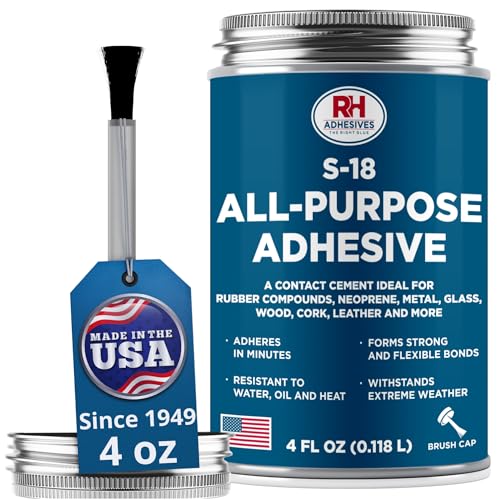
The S-18 is a neoprene-based contact adhesive that remains flexible after curing, making it the single most versatile formulation for bonding rubber to plastic, metal, leather, or wood. The 4-ounce can delivers a liquid consistency that brushes on evenly and creates a film with excellent peel strength — exactly what you need when a rubber gasket or neoprene pad must resist pulling forces. It is also water-resistant and oil-resistant, which sets it apart from basic craft glues that degrade when exposed to moisture or automotive fluids.
Real-world users confirm its reliability on leather boot repairs, neoprene yoga mat fixes, and attaching SBR rubber to metal surfaces. The required 24-hour full cure time is longer than instant glues, but the payoff is a bond that stays intact through temperature swings and vibration. Multiple reviewers noted that thorough surface preparation — sanding and cleaning — is essential; the adhesive itself performs exactly as the chemistry suggests when the prep work is done right.
One limitation: the can opening can gum up if not cleaned after each use, and some users reported slight weakening if the can sat unused for extended periods. For anyone who needs a tough, flexible, multi-material bond and is willing to wait a day for full cure, this is the formulation to beat.
Why it’s great
- Flexible neoprene film resists peel and oil
- Bonds porous and non-porous surfaces reliably
- Water-resistant formula works in marine conditions
Good to know
- Requires 24-hour full cure time
- Can opening may gum up between uses
- Strong solvent fumes — needs ventilation
2. Loctite Vinyl, Plastic, and Fabric Adhesive (Pack of 2)

Loctite’s formulation is a paste-style adhesive that stays slightly flexible after curing — a critical trait for vinyl upholstery, fabric-to-plastic laminates, and lawn mower seat repairs where the substrate bends during use. The twin-pack provides two tubes, which is practical because once opened, the tube’s shelf life is limited. The adhesive dries clear, leaving no yellowing or residue on visible seams, and the precision nozzle helps control application on narrow tears or trim pieces.
Buyers consistently report strong results on vinyl barstool cushions and padded mower seats, but nearly every positive review emphasizes the same prerequisite: the surfaces must be clean and dry. The adhesive forms a durable bond that lasts a full mowing season or longer when this step is followed. One trade-off is the tendency to “string” during application if you pull the nozzle away too quickly — a minor nuisance that resolves with a steady hand and a slower withdrawal.
This is not the adhesive for heavy structural loads or rigid plastic joints that need instant grab. It is purpose-built for flexible, fabric-and-vinyl repairs at a budget-friendly price point that makes the two-pack an easy buy for basic household fix-its.
Why it’s great
- Dries clear and remains flexible after cure
- Precision applicator for controlled placement
- Two tubes offer good value for multiple repairs
Good to know
- Strings easily if nozzle is pulled away too fast
- Not ideal for load-bearing rigid plastic repairs
- Surface prep is critical — fails on glossy or oily plastic
3. J-B Weld SuperWeld Extreme Gel (2-Pack)

When speed matters most, the J-B Weld SuperWeld Extreme Gel delivers a 30-second set time and an impressive 3,000 PSI tensile strength — numbers that outperform nearly every consumer-grade CA glue on the market. The gel consistency is the key differentiator here: it stays in place on vertical surfaces and allows a few seconds of repositioning before locking, unlike runny liquid CAs that drip into unwanted areas. It bonds most plastics, rubber, leather, metal, and stone, making it a go-to for quick household fixes like oven handle trim, rearview mirror mounts, and microwave handles.
Reviewers highlight the gel’s impact resistance — a direct result of its flexible formulation that absorbs shock better than standard super glues. One user repaired a heavy-duty vinyl sailcloth seam and reported it outperformed dozens of other adhesives in a direct comparison. The lack of drips and the clean application are frequently mentioned as practical advantages over liquid cyanoacrylates.
The trade-off for speed is a narrower window for adjustment: once the gel grabs, it grabs hard. It also requires careful storage — the nozzle can clog if the cap is not seated perfectly after each use. For anyone who needs an instant, high-strength bond on rigid plastic or rubber components without waiting overnight, this is the top performer.
Why it’s great
- 30-second set time with 3,000 PSI tensile strength
- Gel consistency stays put — no drips on vertical surfaces
- Impact-resistant bond absorbs shocks without cracking
Good to know
- Very short working time — no room for repositioning
- Nozzle clogs easily if cap isn’t sealed perfectly
- Not ideal for flexible rubber that undergoes constant bending
4. Jet Glue Instant CA Adhesive (2 oz)
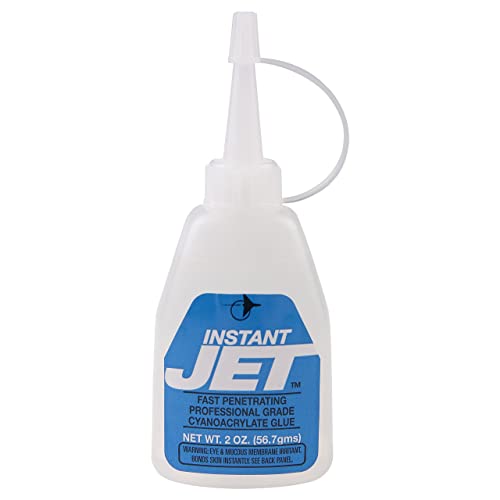
Jet Glue occupies a specific niche: it is a low-viscosity liquid cyanoacrylate that penetrates deep into porous materials like wood, fabric, and leather, then wicks into nearby fibers to create a structural matrix. This penetrating ability makes it uniquely effective for stiffening and reinforcing ballet pointe shoes — an application where the glue must soak into the fabric layers and harden without adding bulk. The same property works well on rubber products and plastic goods that have micro-cracks or rough surfaces that need capillary action to seal.
The 2-ounce bottle is small but concentrated; a few drops go a long way on pointe shoes, and the 1-minute cure time means repairs are ready almost immediately. Users in the dance community consistently call it a must-have, and groomers have found it useful for quick pet-gear repairs. The glue dries clear, is heat-resistant, and resists acetone, which matters for repairs that may encounter cleaning solvents.
Because it is a thin liquid, it runs easily — avoid using it on polished or vertical surfaces where gravity will pull the glue away from the joint. It also bonds skin instantly, so gloves and a steady hand are non-negotiable. This is a specialist’s tool that excels when the repair requires deep penetration rather than surface bridging.
Why it’s great
- Penetrates porous materials for deep structural bonds
- 1-minute cure time for fast repair turnaround
- Heat-resistant and acetone-resistant finish
Good to know
- Thin liquid runs on vertical surfaces — not for overhead jobs
- Bonds skin instantly — wear gloves
- Small bottle may feel expensive per-ounce vs. tubes
5. 3M Hi-Strength 94 ET Spray Adhesive
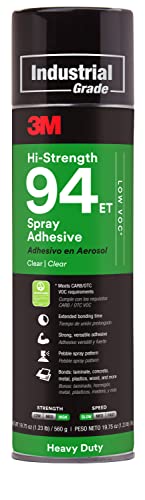
The 3M Hi-Strength 94 ET is a spray contact adhesive designed for large surface laminations where brush-on or tube adhesives are impractical. It bonds rubber, plastic, metal, wood, carpet, foam, and fabric with a longer open time (up to 60 minutes) than most contact cements, giving you the freedom to reposition large panels before the bond sets. The Low VOC formulation and GREENGUARD certification make it a safer choice for indoor projects, and it contributes to LEED credits for commercial work — a rare distinction in this category.
Real-world applications include attaching foam soundproofing to plastic panels in vehicle interiors, reupholstering cushions, and laminating countertops. Users report that the aggressive tack holds foam and fabric securely even in freezing temperatures, which speaks to the adhesive’s temperature range. The 19.75-ounce can covers significant square footage, and the spray pattern allows even coverage without pooling.
The main drawbacks are the strong solvent odor (even the Low VOC version requires a respirator or excellent ventilation) and the 24-hour full cure time for maximum strength. The can also has a limited shelf life — around 18 months — so it is best for users who have regular large-scale projects rather than a one-time fix. For anyone bonding wide sheets of rubber to plastic panels or tackling interior upholstery, this spray adhesive is the most efficient tool available.
Why it’s great
- 60-minute open time for large-panel repositioning
- Even spray coverage on foam, fabric, rubber, and plastic
- Low VOC formula with GREENGUARD certification
Good to know
- Strong solvent smell — requires ventilation or respirator
- 24-hour full cure for maximum bond strength
- Limited 18-month shelf life after purchase
FAQ
Will standard super glue work on rubber and plastic?
How do I prepare rubber and plastic surfaces before gluing?
Can I use the same glue for EPDM rubber and polypropylene plastic?
Final Thoughts: The Verdict
For most users, the best glue for rubber and plastic winner is the RH Adhesives S-18 All-Purpose Adhesive because its neoprene-based film delivers the ideal combination of flexibility, peel strength, and water resistance that both rubber and plastic joints need to stay bonded under real-world conditions. If you want instant grab and 3,000 PSI tensile strength for rigid plastic repairs, grab the J-B Weld SuperWeld Extreme Gel. And for large surface laminations like foam-to-plastic or upholstery projects, nothing beats the 3M Hi-Strength 94 ET Spray Adhesive.