
Nothing kills an ATV ride faster than watching your phone’s map freeze because you’ve lost the signal. Deep woods, mountain valleys, and wide-open desert terrain are exactly where you want to ride, but they’re also where cellular coverage disappears. A dedicated GPS built for the powersport environment doesn’t just show your location—it guides you to the trailhead, logs every mile of fresh track, and, if things go sideways, gives rescue services your exact coordinates.
I’m Mohammad Maruf — the founder and writer behind Drink4Good. I spend my time dissecting category-specific hardware specs, analyzing trail-use cases from the Rockies to the Appalachians, and comparing battery endurance, satellite lock speeds, and display readability under full sun so you don’t have to guess which unit keeps up with your machine.
Whether you’re exploring a new trail system or retracing a familiar route, choosing the right gps for atv means balancing trail-grade durability, screen visibility through dust and glare, and battery life that outlasts a full day of riding without needing a charge.
How To Choose The Best GPS For ATV
Choosing a GPS for your ATV comes down to three real-world factors: can you read the screen with mud on your glove, will the battery last past lunch, and does it show the trails you actually ride. The right unit is the one that stays accurate when the canopy closes in and keeps working when you splash through a creek.
Screen Readability and Glove-Friendly Operation
An ATV GPS sits on your handlebars, exposed to direct sunlight, bouncing through ruts, and often covered in dust or water droplets. Look for a display rated at least 500 nits of brightness—preferable ultra-bright transflective screens that actually become more readable in direct light. Capacitive touchscreens that work through thick riding gloves save you from having to stop and pull off a glove to punch a waypoint. A truly trail-ready unit pairs high visibility with a responsive interface that your index finger can operate at speed.
Battery Life and Power Management
Trail days rarely end in four hours. A dedicated powersport GPS should offer at least 10 hours of continuous navigation on a single charge. Many premium models reach 18 hours or more, and the best units accept an optional AA battery adapter so you can swap fresh cells in the field when a wall outlet is miles away. Hardwired power mounts that connect directly to your ATV’s battery eliminate range anxiety entirely, keeping the display alive from sunrise to sunset without a second thought.
Mapping, Satellite Support, and Durability
Multi-GNSS support—using GPS, GLONASS, and Galileo simultaneously—provides faster position locks and better accuracy under tree cover than a phone’s single-constellation receiver. Preloaded topographic maps with trail and forest-service road data save you the headache of relying on cellular downloads that won’t load in the backcountry. IPX7 waterproofing and MIL-STD-810 shock resistance mean the unit survives a rollover or a puddle deep enough to swallow the handlebars. If you ride alone or in remote areas, a model with built-in satellite SOS messaging turns your GPS into a lifeline.
Quick Comparison
On smaller screens, swipe sideways to see the full table.
| Model | Category | Best For | Key Spec | Amazon |
|---|---|---|---|---|
| Garmin Tread | Powersport Navigator | Dedicated off-road nav | 5.5″ ultra-bright display, IPX7 | Amazon |
| Garmin Montana 750i | Handheld with SOS | Global satellite messaging | inReach tech, 18hr battery | Amazon |
| Garmin Montana 700 | Rugged Handheld | Versatile trail & road nav | 5″ glove-friendly touchscreen | Amazon |
| Amazfit T-Rex 3 Pro | Smart Watch | Wrist-based navigation | Dual-band GPS, offline maps | Amazon |
| Rapid Radios LTE Walkie-Talkie | LTE Radio Set | Nationwide group comms | Unlimited range, 2 radios | Amazon |
| Spot X Satellite Messenger | Satellite Communicator | 2-way SOS & messaging | Globalstar network, SOS | Amazon |
| Bushnell BackTrack Mini | Compact GPS | Simple waypoint return | 35hr battery, micro USB | Amazon |
| Carpuride W702 | Motorcycle CarPlay | Smartphone screen mirroring | 7″ IPS, 1000 nits, IP67 | Amazon |
| GPS7000 Hidden Tracker | Vehicle Tracker | Anti-theft & recovery | 4G LTE, 24mo service inc. | Amazon |
In‑Depth Reviews
1. Garmin Tread Powersport Off-Road Navigator

The Tread is purpose-built for powersports, and you feel it the second you mount it on the handlebars. The 5.5-inch ultra-bright touchscreen stays legible under full midday sun, and the glove-friendly interface lets you scroll trail maps or drop a waypoint without taking your hand off the grips. Preloaded TopoActive maps cover North and Central America, and the BirdsEye satellite imagery downloads over Wi-Fi—no subscription required—giving you a real-world view of the terrain ahead.
Riders report using it all day in northern Minnesota’s dense trail networks, marking every turn, dead end, and creek crossing without ever losing the route home. The IPX7 water rating shrugged off rain and river splashes, and the powered mount keeps the unit alive off your ATV’s battery so you never worry about plugging in. The barometric altimeter, compass, and pitch-and-roll gauges add a layer of situational awareness that matters when you’re crawling up a rocky incline.
Pairing with a compatible inReach device unlocks global two-way messaging, and integration with Garmin PowerSwitch lets you control accessory lighting from the screen. The mapping interface has a minor learning curve for first-time Garmin users, but the trail data accuracy and display brightness make it the most cohesive ATV navigation package available.
Why it’s great
- Glove-friendly operation with an exceptionally bright 5.5-inch display that defeats glare
- Preloaded topo and trail maps with free BirdsEye satellite imagery via Wi-Fi
- Hardwired powered mount eliminates battery anxiety during all-day rides
Good to know
- Map interface takes some time to learn for new Garmin users
- Battery life drops to around 6 hours on internal charge alone
2. Garmin Montana 750i

The Montana 750i merges the rugged DNA of Garmin’s handheld lineup with full Iridium satellite communication. When you ride alone or push into areas where the nearest trailhead is a half-day hike away, the interactive SOS feature and two-way messaging via the inReach network turn this GPS into your primary safety line. The 5-inch glove-friendly touchscreen is 50% larger than the previous generation, and the dual-orientation display works whether you mount it vertically on your bars or carry it in a chest pack.
Preloaded TopoActive maps and City Navigator street data mean you can navigate from forest service roads to paved highways without switching devices. The 8-megapixel camera lets you geotag obstacles or points of interest, though it’s admittedly a secondary feature—most riders use it sparingly. Multi-GNSS support with GPS and Galileo delivers fast satellite locks even under thick canopy, and the 18-hour battery life handles a full day of tracking plus a second day of occasional use without a recharge.
At roughly , this is an investment best justified by riders who prioritize backcountry safety above all else. The device is bulky compared to smartphone-based solutions, and the camera resolution is low by modern standards, but the combination of topo navigation and two-way satellite SOS is unmatched for serious solo ATV expeditions.
Why it’s great
- Built-in inReach satellite SOS and two-way texting for remote-area safety
- 18-hour battery endurance covers multi-day outings
- Large 5-inch screen with excellent sunlight readability
Good to know
- Heavier and bulkier than standard handheld models
- Camera quality is poor compared to any modern smartphone
3. Garmin Montana 700

The Montana 700 strips out the satellite messenger and camera to deliver the core navigation experience at a more approachable price point. It retains the same rugged MIL-STD-810 construction, the same 5-inch glove-friendly transflective touchscreen, and the same multi-GNSS engine that locks onto GPS, GLONASS, and Galileo simultaneously. This is the sweet spot for riders who want Garmin’s top-tier trail navigation without paying for features they won’t use.
Preloaded TopoActive maps give you routable trail and road data out of the box, and the three-axis compass with barometric altimeter provides accurate elevation and heading even when you’re stopped under heavy tree cover. Bluetooth, ANT+, and Wi-Fi connectivity allow BirdsEye satellite imagery downloads and data syncing through the Garmin Explore app. The AA battery adapter is a field-swappable backup that removes range anxiety when you’re days from a power outlet.
Some buyers have noted that the preloaded topographic maps lack the fine contour detail needed to identify subtle terrain features like benches and saddles, which matters if you hunt off the ATV. The touchscreen also lags slightly when wet or when you’re wearing very thick winter gloves. Still, for trail navigation and road routing, the Montana 700 represents the best balance of durability, screen size, and accuracy in the mid-range category.
Why it’s great
- Rugged MIL-STD-810 construction survives drops and water immersion
- Multi-GNSS support provides reliable position locking under canopy
- AA battery adapter option keeps navigation running in remote areas
Good to know
- Topo map detail may not be sufficient for advanced hunting terrain analysis
- Touchscreen responsiveness can be sluggish with thick winter gloves
4. Amazfit T-Rex 3 Pro
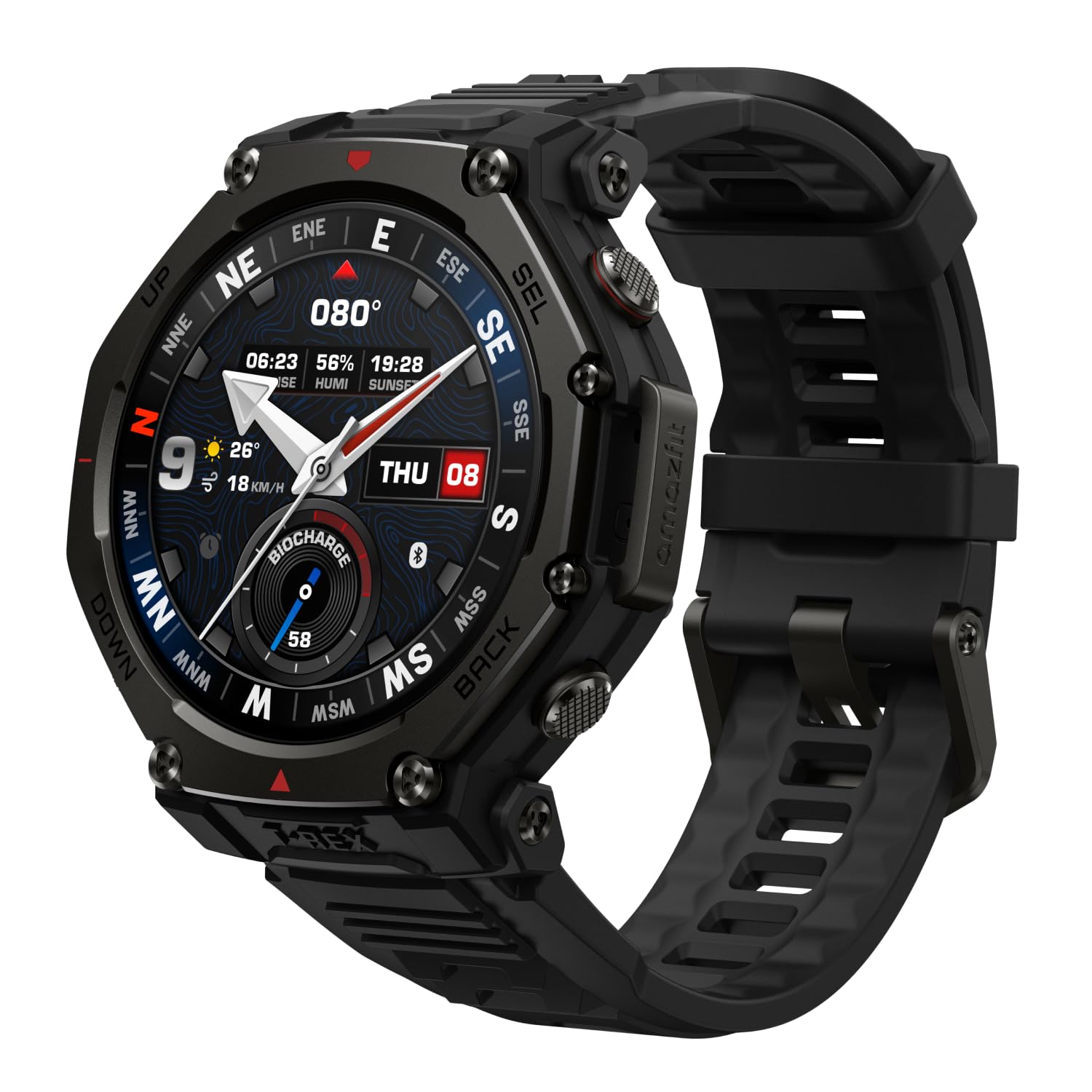
The T-Rex 3 Pro brings true offline mapping and dual-band GPS to your wrist, making it a compelling secondary navigation tool for ATV riders who also want fitness and recovery data. The 3000-nit sapphire AMOLED display is absurdly bright—visible even against direct desert sun—and the titanium bezel shrugs off impacts from low-hanging branches. You get up to 25 days of battery life in smartwatch mode and solid GPS tracking endurance for a full day on the trail.
Dual-band GPS with support for six satellite systems provides fast and accurate location tracking that holds up well under tree cover, approaching dedicated handheld GPS reliability. The built-in offline maps support point-of-interest search and route planning, and you can download regional maps ahead of time to avoid relying on a cellular connection. The two-color flashlight (red and white) with SOS mode is a surprisingly useful feature when you’re loading the ATV back onto the trailer after sunset.
The watch excels as a fitness tracker, capturing heart rate, elevation, and route data across 180 sport modes. It also handles Bluetooth calls and voice replies via Zepp Flow when paired with an Android phone. The screen can be hard to unlock when cold or wet, and routing recalculation rarely works mid-route, which limits its utility as a primary GPS for complex trail networks. It’s best used alongside a dedicated handlebar-mounted unit rather than replacing one.
Why it’s great
- Industry-leading 3000-nit AMOLED screen readable in any light
- Offline maps and dual-band GPS for reliable navigation without a phone
- Exceptional battery life with multi-day endurance between charges
Good to know
- Route recalculation does not work well during active navigation
- Screen can be difficult to interact with while wearing wet or cold gloves
5. Rapid Radios Nationwide LTE Walkie-Talkie Set

When your riding group spreads across multiple valleys or splits up to explore different trail branches, traditional two-way radios are limited by line-of-sight and terrain. Rapid Radios uses LTE cellular networks to provide truly unlimited range across the continental US, letting you talk to riders hundreds of miles away as easily as the one right behind you. The set includes two radios, each with one year of service, and supports private one-to-one calls or group talk with up to 200 people.
Crystal-clear audio with noise cancellation keeps conversations legible even when you’re revving through a mud bog, and the USB-C charging and five-day battery life mean you won’t be hunting for a charger mid-trip. The 256-bit AES encryption ensures your ride coordinates and communications stay private—a serious consideration for groups scouting hunting or fishing access points. The radios are rugged enough for all-weather use and come with belt clips for easy mounting on your gear or the ATV frame.
The main catch is that the radios require an active LTE network, so they won’t function in truly remote areas with zero cellular coverage. Setup involves inserting a SIM card and activating service, which is less turnkey than a satellite communicator. At per set plus ongoing LTE service fees, this is best suited for groups who ride primarily within cell range and need reliable, unlimited-distance coordination rather than SOS capabilities.
Why it’s great
- Unlimited nationwide range for group communication over any distance
- Five-day battery life and USB-C charging for extended trips
- 256-bit encryption keeps group communications private and secure
Good to know
- Requires active LTE coverage and ongoing service subscription
- One radio in a set can arrive with connectivity issues requiring customer support
6. Spot X with Bluetooth 2-Way Satellite Messenger

For solo riders or groups exploring areas without any cellular infrastructure, the Spot X provides two-way satellite messaging and SOS alerts that work anywhere visible to the Globalstar satellite constellation. The dedicated physical keypad and screen allow you to compose messages without a smartphone, though the keypad is cramped for longer texts. The SOS button connects you to the GEOS 24/7 search-and-rescue coordination center, and the two-way nature means you can describe your emergency and receive confirmation that help is en route.
The battery life is rated at 240 hours in tracking mode based on 10-minute intervals, which is enough for a week-long expedition. Bluetooth pairing with your phone allows easier message typing via the Spot app, but the core functionality works independently—the Spot X is a standalone device. The device comes with a carabiner and kickstand for easy mounting on handlebars or backpack straps, and the rugged plastic housing handles rough weather without issue.
Message delivery typically takes around three minutes in open-sky conditions, but the unit struggles in dense canopy or deep canyons where satellite visibility is limited. The interface is slow, the buttons feel dated, and the micro-USB charging port is increasingly obsolete. A satellite subscription is required for messaging and SOS features, making this a recurring expense. It’s a dedicated tool for riders whose priority is communication far from cell towers rather than trail mapping.
Why it’s great
- Reliable two-way satellite messaging and SOS outside cellular range
- Exceptional standby and tracking battery life for long expeditions
- Functions as a standalone communicator without needing a phone
Good to know
- Message transmission is slow and struggles under dense tree cover
- Outdated micro-USB charging and a sluggish user interface
7. Bushnell BackTrack Mini GPS

The BackTrack Mini is the most stripped-down navigation tool in this roundup, designed for one job: getting you back to where you started. It captures your starting waypoint with a button press and continuously shows an arrow pointing toward that location, plus the distance remaining. There are no topo maps, no trail overlays, and no satellite imagery—just basic breadcrumb navigation that works for riders who want a simple backup to a phone or a larger GPS.
Battery life is a standout here at up to 35 hours, more than enough for a long weekend without charging. The large physical buttons work perfectly with heavy gloves, and the IPX7 waterproof rating means it survives unexpected creek crossings. Bluetooth connectivity syncs trip data to the Bushnell Connect app for reviewing your route later, though the app is clunky and not essential for the device to function. The display also shows elevation gain, barometric pressure, sunrise/sunset, and moon phase data.
The distance tracking has been reported to overestimate mileage by up to 60%, and the elevation readings can be off by over 200 feet, which matters if you’re using it to gauge climb difficulty. At about , many users feel the price is high for what is essentially a GPS arrow pointer. It’s best used as a compact emergency return device tucked into a pack, not as a primary ATV trail navigator.
Why it’s great
- Outstanding 35-hour battery life for multi-day trips without recharging
- Large physical buttons are easy to use with thick riding gloves
- Waterproof and rugged construction suitable for harsh weather
Good to know
- No map display, only directional arrow and distance to waypoint
- Distance and elevation accuracy can be significantly inaccurate
8. Carpuride W702

The Carpuride W702 is a 7-inch wireless CarPlay and Android Auto display designed for motorcycles but easily adaptable to ATV handlebars. It mirrors your phone’s navigation apps—Apple Maps, Google Maps, Waze—onto a bright 1000-nit IPS screen that’s fully readable in sunlight. The IP67 waterproof rating means it survives heavy rain and hose-down cleaning without a cover, and the anti-theft detachable bracket lets you remove the screen when you park overnight at a trailhead camp.
Dual Bluetooth connectivity pairs the screen to your phone for navigation and to a helmet headset or earbuds for voice directions and music, keeping your phone tucked away in a waterproof bag. The 64GB TF card stores music and video files for offline playback, though software updates require a small-capacity card rather than the included 64GB. Installation uses a motorcycle power line rated at 12V and 1A, which is compatible with most ATV electrical systems, and reverse polarity protection prevents accidental damage during wiring.
The W702 relies entirely on your phone’s GPS and cellular data, so it loses functionality in areas without cell service—a critical limitation for backcountry ATV use. The unit can suffer from freezing and reconnection issues with some phone models (particularly iPhone 15) during long rides, and it’s not compatible with Samsung Note or S series phones for CarPlay. It works best for riders who stay within cellular coverage and want a larger, waterproof display for their phone’s map apps.
Why it’s great
- Large 7-inch screen with high brightness for clear daytime navigation
- IP67 waterproof rating handles rain, mud, and direct hose washing
- Wireless CarPlay and Android Auto support keeps phone safely stored
Good to know
- Does not function at all in areas without cellular coverage
- Compatibility issues with some phone models and occasional freezing
9. GPS7000 Hidden GPS Tracker for Vehicles
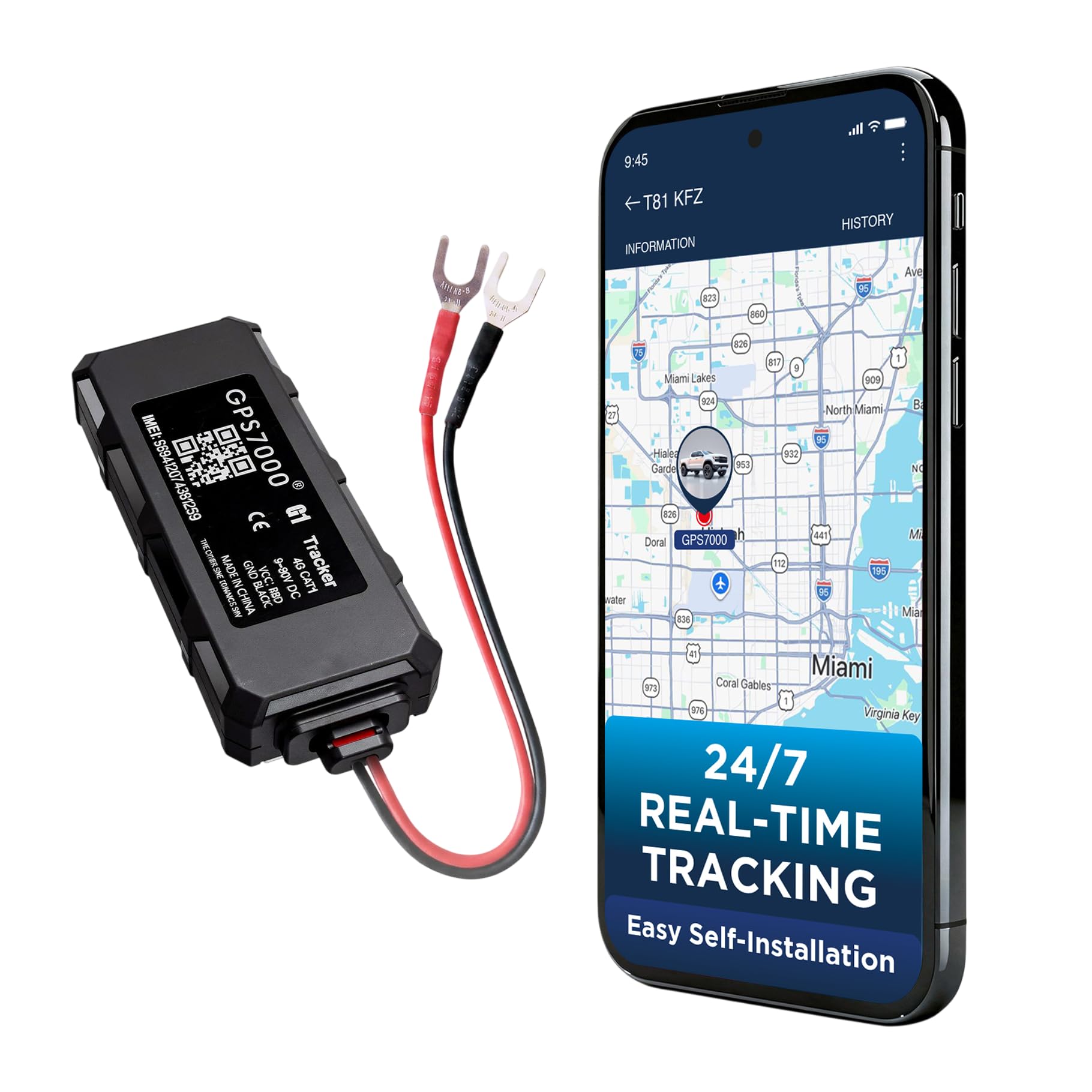
The GPS7000 serves a different purpose than the navigators above: it’s a real-time vehicle tracker designed for theft recovery, fleet monitoring, or keeping tabs on a ATV that’s stored in a shared garage or remote cabin. The compact 87 x 40 x 11 mm body wires directly to your ATV’s 9–30V battery via two simple wires, and the included Velcro allows you to hide it deep inside the chassis where it won’t be spotted during a casual inspection.
Live location updates, speed monitoring, route history, and geofence alerts are all available through the GPS7000 platform on iOS, Android, Windows, or Mac. The IP65 waterproof shell and internal backup battery keep it running even if the main power is cut. The standout feature is the included 24 months of 4G LTE service—no monthly fees or contracts for the first two years—after which renewal is optional at roughly per month. This makes it a true no-subscription tracker for the initial ownership period.
This is a tracking-only device with no navigation screen, no mapping interface, and no SOS button. It relies on cellular connectivity, so it won’t report a location in deep wilderness without LTE coverage. A small number of buyers reported issues activating the service, and the tracking updates have a slight 1–2 minute delay. It’s an excellent anti-theft tool for your ATV when parked at home or at a trailhead lot, but it will not help you navigate a single trail.
Why it’s great
- 24 months of LTE service included with no monthly fees required
- Compact and concealable design with easy two-wire installation
- IP65 waterproof with backup battery for continued operation after power disconnect
Good to know
- No navigation display, mapping, or SOS features
- Requires cellular network coverage to transmit location data
FAQ
Can I use my smartphone instead of a dedicated GPS For ATV?
What does IPX7 waterproof rating mean for an ATV GPS?
Do I need a satellite subscription for an off-road GPS?
What is the difference between BirdsEye satellite imagery and preloaded topo maps?
Can I mount a motorcycle GPS on my ATV handlebars?
Final Thoughts: The Verdict
For most riders, the gps for atv winner is the Garmin Tread because its dedicated powersport mount, ultra-bright 5.5-inch glove-friendly screen, and preloaded topo maps with free satellite imagery deliver the most cohesive off-road navigation experience without compromise. If you ride solo in areas where a broken machine means a long walk out, grab the Garmin Montana 750i for its built-in inReach SOS and two-way messaging. And for a budget-conscious backup that fits in your pack and runs for 35 hours, nothing beats the Bushnell BackTrack Mini for its simple, reliable waypoint return.