
Dealing with stubborn weeds, invasive vines, and brush overtaking your walkways or fence lines requires a herbicide that works from the root up. The wrong choice leaves you re-spraying every few weeks, fighting regrowth instead of eliminating the source.
I’m Mohammad Maruf — the founder and writer behind Drink4Good. This buying guide is the result of analyzing the chemical formulations, concentration percentages, and application rates of each product to separate powerful, long-lasting weed killers from watered-down alternatives.
Whether you need to clear a large area or spot-treat persistent weeds, understanding the glyphosate concentration and adjuvants in each formula is critical to choosing the right glyphosate weed killer for your specific job without wasting time or money on ineffective solutions.
How To Choose The Best Glyphosate Weed Killer
The core metric in any glyphosate concentrate is the percentage of active ingredient and whether the formula includes built-in surfactants. A straight 41% glyphosate solution works well for deep-rooted perennial weeds but requires a non-ionic surfactant to be mixed in for maximum leaf adhesion. Pre-mixed formulas with surfactants and secondary active ingredients like diquat offer faster visual burn but may sacrifice complete root kill. Your choice depends on whether you prioritize speed of visible results or total systemic eradication.
Concentration and the Gallon Makeup
A 41% glyphosate concentrate making 85 gallons of spray is dramatically different from a pre-mixed ready-to-use formula. Larger properties call for high-concentration gallons that stretch further. Smaller jobs benefit from quart-sized concentrates or single-dose packets that eliminate measuring guesswork. Always calculate the total square footage you need to cover against the concentrate’s water-to-chemical ratio.
Adjuvants and Rainfastness
Surfactants lower the surface tension of the spray droplets so the herbicide sticks to waxy leaf cuticles. Some products, like Roundup Quikpro, include surfactants and a secondary contact killer (diquat) for faster burn. Rainfastness—the time the product needs to stay on the leaf without rain washing it off—ranges from 30 minutes up to a few hours. For regions with unpredictable weather, a shorter rainfast window is critical. Straight glyphosate without built-in surfactant generally requires longer dry times and performs best when mixed with a separate adjuvant.
Quick Comparison
On smaller screens, swipe sideways to see the full table.
| Model | Category | Best For | Key Spec | Amazon |
|---|---|---|---|---|
| Compare-N-Save 75324 | Liquid Concentrate | Large area coverage | 128 fl oz, makes 85 gal | Amazon |
| Roundup Quikpro 5-Pack | Powder Packets | Quick visible results | 1.5 oz/packet, contains diquat | Amazon |
| Hi-Yield Killzall 365 | Liquid Concentrate | Hard-to-kill brush and vines | Treats 4,300 sq ft | Amazon |
| Control Solutions Eraser | Liquid Concentrate | Entry-level spot treatment | 32 fl oz, 41% glyphosate | Amazon |
| Roundup Weed & Grass Killer₄ | Liquid Concentrate | Multi-weed garden prep | Trifluralin & Diquat formula | Amazon |
In‑Depth Reviews
1. Compare-N-Save 75324 Herbicide, 1-gallon
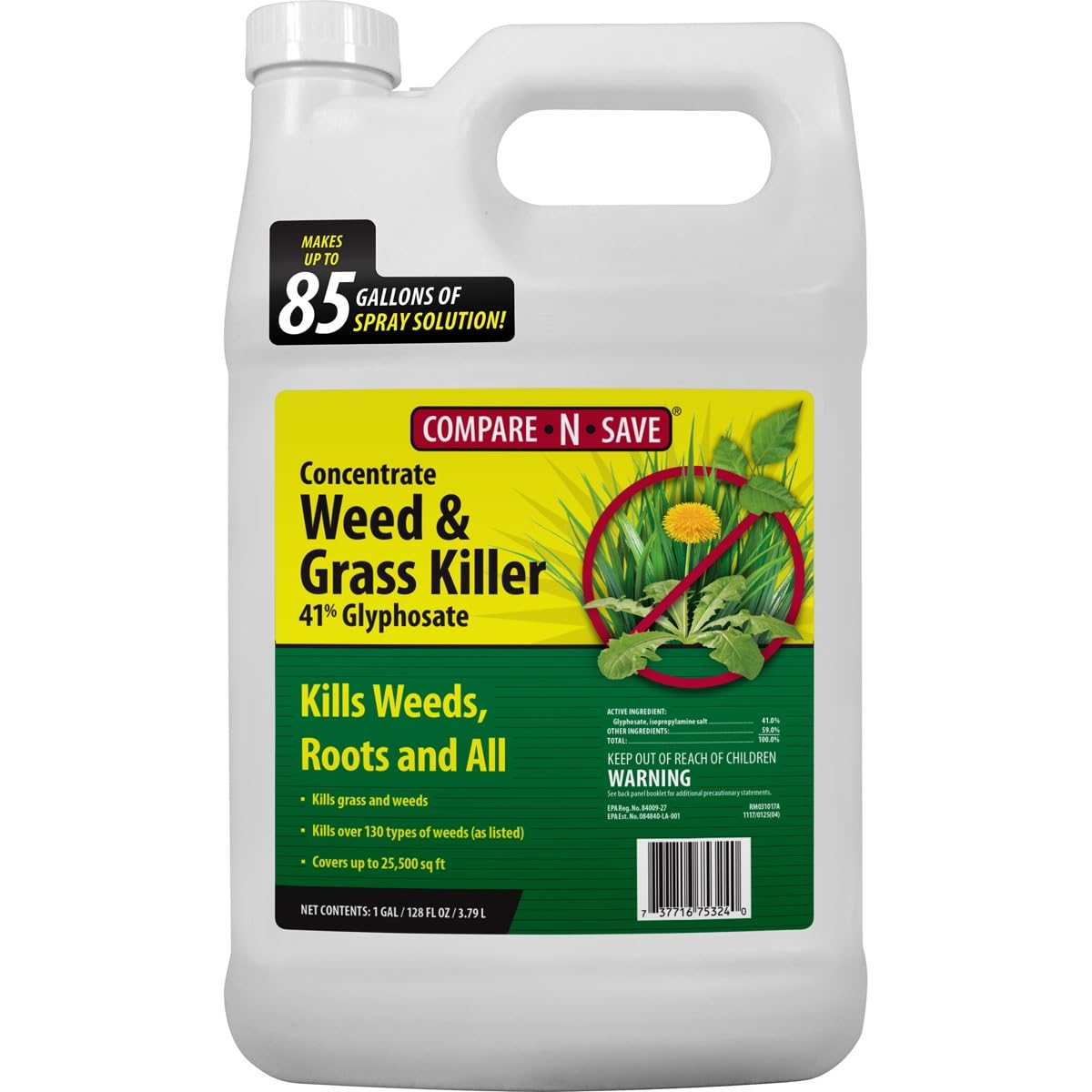
The Compare-N-Save 75324 delivers the highest value per gallon of spray solution in this lineup. One gallon of concentrate makes up to 85 gallons of ready-to-use spray, covering over 25,000 square feet — ideal for clearing large fence lines, driveways, or preparing a garden plot. The 41% glyphosate concentration matches the professional-grade standard, and the formula is rainproof in just two hours.
Visible results take 2 to 4 days, though some users report complete root kill taking several weeks. This is standard behavior for systemic glyphosate that must travel through the plant’s vascular system. The product works on annual and perennial broadleaf weeds and grasses, including tough varieties like poison ivy and crabgrass when mixed at the correct ratio.
Keep in mind that the gallon jug lacks a built-in surfactant, so adding a non-ionic surfactant to the tank mix will improve adhesion on waxy leaves. The packaging can vary, and the jug cap may loosen during shipping. Inspect the seal before opening. Despite the price increase over recent years, this remains the most economical bulk option available.
Why it’s great
- Exceptionally low cost per gallon of finished spray
- Rainproof in only 2 hours
- Full 41% glyphosate concentration for deep root kill
Good to know
- Requires separate surfactant for best leaf adhesion
- Complete die-off can take several weeks
- Jug cap may arrive slightly loose in transit
2. Roundup Quikpro Weed Killer Herbicide, 5 Packs
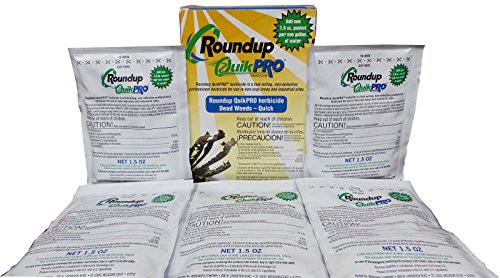
Roundup Quikpro stands apart because it combines glyphosate for systemic root kill with diquat dibromide, a contact herbicide that burns down foliage within 24 hours. This dual-action approach gives you the visual satisfaction of fast dieback while the glyphosate continues working underground. Each 1.5-ounce packet mixes with one gallon of water, making application simple without measuring liquid concentrate.
Testers report this formulation is particularly effective against aggressive species like bamboo and poison ivy, often requiring fewer repeat applications than straight glyphosate. The powder format dissolves easily and includes a built-in surfactant, so you don’t need to add extra adjuvants. The pack contains five packets, enough to cover small to medium infestations or spot treatments around flower beds.
On the downside, the cost per gallon of finished spray is higher than liquid concentrates. Some users note that tough perennial grasses may need 4 to 5 applications before full eradication. Always wear appropriate safety gear — gloves, long sleeves, and eye protection — since the diquat component is a strong contact irritant. Store unused packets in a dry, cool place to prevent clumping.
Why it’s great
- Visible wilting within 24 hours thanks to diquat
- Pre-measured packets eliminate mixing errors
- Contains surfactant for superior leaf coverage
Good to know
- Higher cost per finished gallon than bulk concentrates
- Multiple applications may be needed for stubborn perennials
- Requires careful handling — diquat is a strong irritant
3. Hi-Yield Killzall 365 (32 oz)

Hi-Yield Killzall 365 is formulated for non-crop areas where total bare-ground control is the goal — gravel drives, fence lines, and industrial lots. The 32-ounce bottle treats up to 4,300 square feet when mixed at 7.4 ounces per 1 to 10 gallons of water. It controls a broad spectrum of broadleaf weeds, grasses, trees, brush, and vines, making it one of the most versatile concentrates in the mid-range tier.
Users confirm it kills established weeds effectively, though some species like moss require a separate product — this formulation does not affect moss growth. For spot control of brush and vines, the label recommends a stronger mix of 6 ounces per gallon. The liquid concentrate does not include a built-in surfactant, so mixing one separately improves results on hairy or waxy leaves.
Several customers mention that it does not sterilize the soil for a full 365 days; regrowth can appear within a few months, necessitating follow-up sprays. The cost per bottle is competitive with big-box retailers, making it a solid option if you already have a surfactant on hand. The smaller bottle size works well for homeowners with modest weed problems who want a concentrated formula without committing to a gallon jug.
Why it’s great
- Kills tough brush and woody vines
- Treats up to 4,300 sq ft per bottle
- Cost-effective compared to box-store brands
Good to know
- No built-in surfactant — requires separate mixing
- Does not kill moss
- Soil sterility duration is shorter than 365 days in practice
4. Control Solutions Eraser & Grass Killer Concentrate, 1 Quart
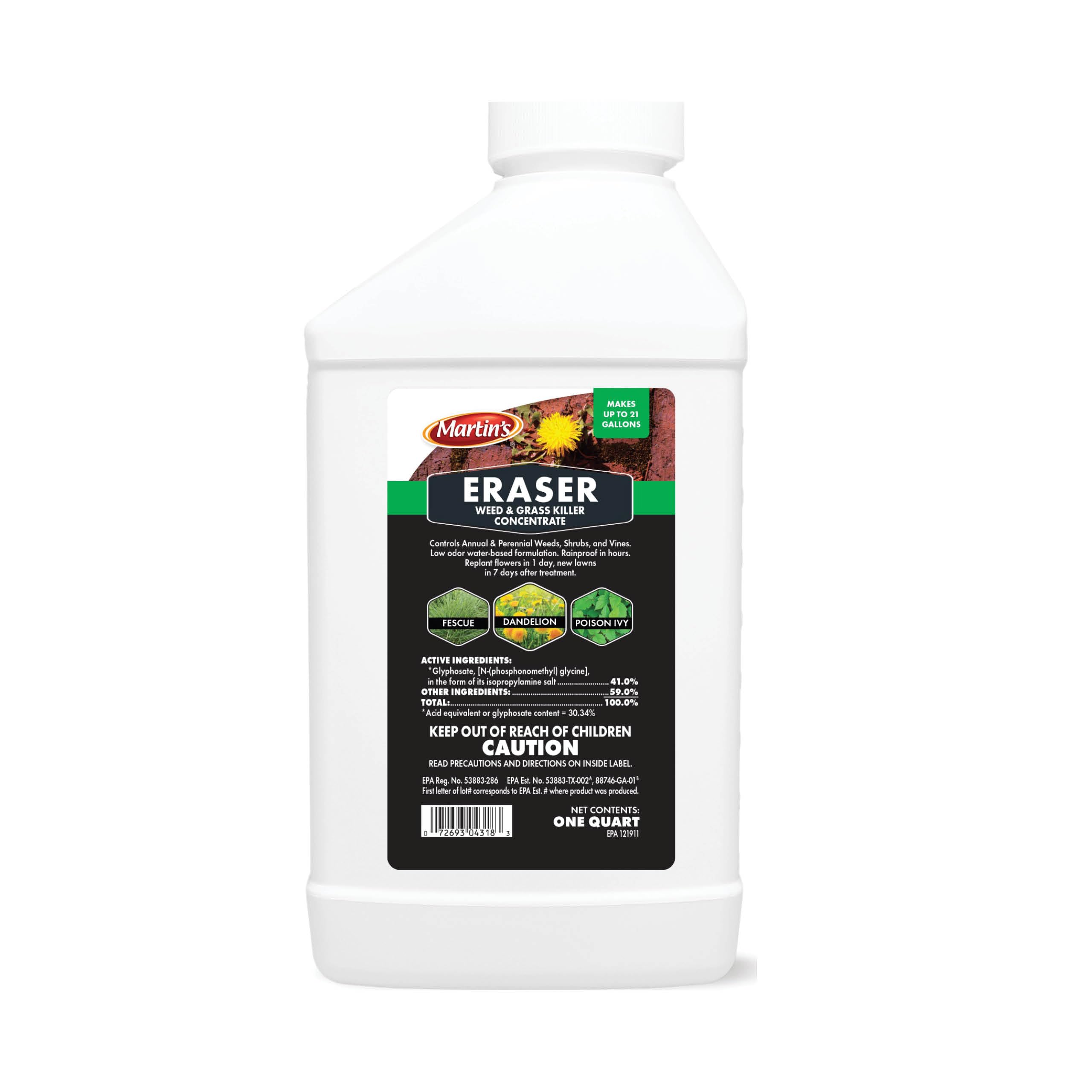
Control Solutions Eraser offers the same 41% glyphosate concentration as the premium options but in a smaller 32-ounce quart size at an entry-level price point. This is a no-frills formula: water-based, low-odor, and free of additional actives or surfactants. It targets annual weeds, perennial weeds, trees, vines, and shrubs with no residual soil activity, meaning you can replant treated areas after the product has dried.
Because it lacks a surfactant, the spray beads up on certain waxy leaf surfaces, reducing effectiveness. For best results, mix in a non-ionic surfactant at 0.25% to 1% of the total spray volume. The concentrate is rainproof in a few hours, slower than premium options that include built-in sticking agents. Users tackling light weed pressure in backyard gardens find the quart size convenient for small sprayer tanks.
The natural material composition means fewer chemical solvents, but it also means the glyphosate may take longer to translocate to roots on tough perennials. This product is a smart starting point for new users who want to test a high-concentration glyphosate without investing in a gallon. Just factor in the cost of a separate surfactant when comparing overall value.
Why it’s great
- Affordable entry into 41% glyphosate
- Low-odor water-based formula
- Small quart size fits small sprayer tanks
Good to know
- No built-in surfactant — must add separately
- Slower rainfast window than premium concentrated
- May require multiple passes on tough perennials
5. Roundup Weed & Grass Killer₄ Concentrate, 1 gal.

The Roundup Weed & Grass Killer₄ concentrate uses a different active chemistry than the other products here — it relies on triclopyr, triethylamine salt, fluazifop-p-butyl, and diquat dibromide rather than a high percentage of glyphosate. This cocktail targets a broader range of broadleaf weeds and grasses including dandelion, crabgrass, poison ivy, clover, and spurge. It is rainproof in as little as 30 minutes, the fastest window in this lineup.
Users report visible wilting within hours and a quicker overall die-off compared to straight glyphosate. The formula allows planting in treated areas after 1 to 30 days depending on the plant species, making it suitable for preparing garden beds. The gallon concentrate covers approximately 300 square feet per gallon of finished spray when mixed at label rates — much less coverage than 41% glyphosate concentrates.
The trade-off is cost per acre and weed recurrence. Several customers note that while the burn-down is fast, it does not prevent new weeds from germinating, and some deep-rooted perennials may require re-treatment. This product is best for quick knockdown in established garden areas or along walkways where you want fast results, not for long-term sterilization of large open spaces.
Why it’s great
- Extremely fast rainfast — only 30 minutes
- Visible results within hours
- Controls a wide range of broadleaf and grass weeds
Good to know
- Much lower finished spray volume per gallon of concentrate
- Does not prevent new weed germination
- Not a glyphosate-dominant formula — uses multiple actives
FAQ
How long does glyphosate weed killer take to show results?
Do I always need to add a surfactant to glyphosate concentrate?
Can I use glyphosate weed killer in my flower bed without killing my flowers?
Final Thoughts: The Verdict
For most users, the glyphosate weed killer winner is the Compare-N-Save 75324 because it delivers the lowest cost per gallon of finished spray with a full 41% glyphosate concentration. If you want fast visible results and pre-measured convenience, grab the Roundup Quikpro 5-Pack. And for quick knockdown in a garden or flower bed setting, nothing beats the fast rainfast time of the Roundup Weed & Grass Killer₄ Concentrate.