
The moment your chain goes silent and the pavement disappears into a wrong turn, a GPS bike computer earns every watt of its existence. These handlebar-mounted units replace fumbling with a phone, providing turn-by-turn guidance, ride data, and sensor integration in a package that withstands rain, vibration, and direct sunlight. The challenge is separating the units that deliver seamless navigation from those that drain your battery and patience.
I’m Mohammad Maruf — the founder and writer behind Drink4Good. Over years of analyzing cycling technology, I’ve spent hundreds of hours comparing satellite chipsets, battery management systems, and map-processing logic to understand what separates a true navigation tool from a glorified speedometer.
Whether you are chasing Strava segments on a gravel road or plotting a cross-state tour, choosing the right gps bike computer means matching display type, battery endurance, and mapping depth to the terrain you actually ride, not the one in the marketing photos.
How To Choose The Best GPS Bike Computer
Buying a bike computer is about reconciling three forces: navigation depth, battery endurance, and sensor ecosystem. The unit that wins on paper often loses on the road if its maps require a constant phone connection or its screen washes out at noon. Focus on the features that match your riding style rather than the spec sheet’s highest number.
Navigation Depth vs. Simplicity
Not every rider needs full offline maps with street names. If you stick to known loops, a breadcrumb-style unit (Beeline Velo 2) keeps things clean. If you explore unfamiliar roads or gravel routes, a computer with offline global maps and re-routing (GEOID CC700 Pro, Magene C606 V2) prevents dead-end frustration. The re-routing speed and whether it requires a phone connection remain the real differentiators.
Battery Life in Real Conditions
Manufacturer battery claims assume conservative backlight settings and minimal sensor pairing. A unit rated for 35 hours may drop to 12-15 hours with a bright touchscreen, ANT+ sensors, and continuous GPS logging. If you do endurance events or multi-day tours, prioritize solar-assisted models (COROS DURA) or battery-saver modes (Garmin Edge 540). For daily commutes and weekend rides, 15-20 hours is plenty.
Sensor Connectivity and Ecosystem Lock-In
The best GPS bike computer is the one that talks to your power meter, heart rate strap, radar tail light, and electronic groupset without pairing headaches. Most modern units support ANT+ and Bluetooth, but check for specific compatibility: Magene and iGPSPORT models integrate well with their own sensor ecosystems, while Garmin units are the gold standard for third-party sensor pairing and live segment integration. If you already own sensors, let that ecosystem guide your choice.
Quick Comparison
On smaller screens, swipe sideways to see the full table.
| Model | Category | Best For | Key Spec | Amazon |
|---|---|---|---|---|
| Garmin Edge 540 | Premium | Performance training | 26hr battery, multi-band GNSS | Amazon |
| COROS DURA Solar | Premium | Ultra-endurance touring | 120hr GPS, solar charging | Amazon |
| iGPSPORT BiNavi | Premium | Large-screen navigation | 3.5″ touch, dual-band GPS | Amazon |
| Garmin Edge 1040 | Premium | All-road touring | 35hr battery, 3.5″ screen | Amazon |
| Magene C606 V2 | Mid-Range | Climb-focused riders | 2.8″ touch, ClimbPro | Amazon |
| iGPSPORT iGS630 | Mid-Range | Value navigation | 35hr battery, iClimb | Amazon |
| Magene C506 | Mid-Range | Budget touchscreen | 24hr battery, 2.4″ LCD | Amazon |
| Beeline Velo 2 | Budget | Minimalist navigation | 11hr battery, compass mode | Amazon |
| GEOID CC700 Pro | Budget | Entry-level color maps | 2.8″ touch, IPX7 | Amazon |
In‑Depth Reviews
1. Garmin Edge 540

The Edge 540 uses physical buttons instead of a touchscreen, a deliberate design choice that pays off when your gloves are wet or your hands are shaking from a hard effort. Multi-band GNSS keeps you locked onto the correct track even in heavy tree cover, and the ClimbPro feature now works on any ride without requiring a pre-loaded course.
Battery life reaches 26 hours in demanding use and stretches to 42 hours in battery-saver mode, which is enough for multi-day stage events. The adaptive coaching feature pulls data from a connected power meter and heart rate monitor, then suggests daily workouts that adjust to your current recovery and training load.
Where the 540 stumbles is its rerouting logic—customers report it can send you into dangerous loops when you deviate from a course. Additionally, the learning curve is steep for first-time Garmin users; the included documentation is sparse. But once configured, the data fields, stamina tracking, and power guide make it the most complete training computer at its price tier.
Why it’s great
- Excellent multi-band GNSS accuracy
- Long battery life with battery-saver mode
- Personalized adaptive coaching
Good to know
- Rerouting can be unreliable
- User manual is insufficient
2. COROS DURA Solar GPS Bike Computer

The COROS DURA redefines endurance standards with 120 hours of GPS tracking on a single charge, and solar charging that adds up to two hours of ride time per hour of direct sunlight. For bikepackers and ultra-distance riders, this means weeks of use without removing the unit from the handlebar. The 2.7-inch MIP color touchscreen remains crisp under direct sun and the adaptive backlight works well at night.
Navigation uses Google Maps for route creation, with turn-by-turn directions and smart rerouting that activates through a phone connection. The route quality surpasses many competitors—the COROS app favors bike paths and low-traffic streets. Pairing with a COROS watch aggregates recovery, sleep, and HRV data in one dashboard, though the unit works fine as a standalone device.
Some customers note that the solar panel is more gimmick than necessity given the already extraordinary battery life, and the maps lack street names, showing the turn street only 500 feet before the junction. The default map zoom is too far out for urban navigation, and adjusting it mid-ride requires menu diving. Still, for pure stamina and a clean user interface, it is unmatched.
Why it’s great
- Best battery life in class
- Solar charging extends rides indefinitely
- Seamless COROS watch integration
Good to know
- Maps lack street names
- Default zoom level too distant
3. iGPSPORT BiNavi Bike Computer

The BiNavi’s 3.5-inch color touchscreen is the largest display in this roundup, offering enough real estate to view maps, data fields, and the iClimb Pro elevation profile simultaneously without clutter. Dual-band GPS (L1+L5) provides sub-meter accuracy even under dense foliage, making it ideal for mountain bikers who navigate tight tree lines.
Battery life is rated at 35 hours, but real-world tests with full brightness and all sensors connected average closer to 12-15 hours—still competitive for a screen this large. The music control feature lets you skip tracks or adjust volume from the handlebar, and the yaw-planning rerouting works quickly when you miss a turn.
Initial setup can be buggy: some units flash a green screen, and loading complex navigation routes is occasionally slow. The instructions are poor, but YouTube tutorials fill the gap. For serious cyclists who want Garmin-level features at a lower entry point, the BiNavi is a strong contender, especially for long-distance touring where screen readability matters.
Why it’s great
- Large, clear 3.5″ touchscreen
- Dual-band GPS for trail accuracy
- Music control from handlebar
Good to know
- Real battery closer to 12-15 hours
- Occasional software glitches
4. Garmin Edge 1040

The Edge 1040 is Garmin’s flagship non-solar computer, packing a 3.5-inch color touchscreen alongside button controls for glove-friendly operation. Multi-band GNSS ensures it holds a lock in tunnels or heavy canopy, and the battery lasts up to 35 hours in demanding use or 70 hours in battery-saver mode. It ships with a full sensor suite: speed sensor, cadence sensor, and premium heart rate monitor.
Navigation is proactive—the device alerts you to upcoming turns, elevation changes, and points of interest without requiring a pre-planned course. The stamina feature, paired with a power meter and HR monitor, shows in real time how much longer you can sustain your current effort. Wi-Fi syncing with Strava and TrainingPeaks is nearly instant.
The main drawback is the cost, and the included mounts require readjustment on bumpy terrain. Some customers note the IP54 rating is less robust than the IPX7 found on budget competitors, meaning it is splash-resistant but not submersible. If budget allows, the Edge 1040 remains the most complete package for both training and navigation.
Why it’s great
- Large, responsive screen
- Excellent battery life
- Comes with sensor bundle
Good to know
- Significant investment
- IP54 less water-resistant than competitors
5. Magene C606 V2 Bike Computer
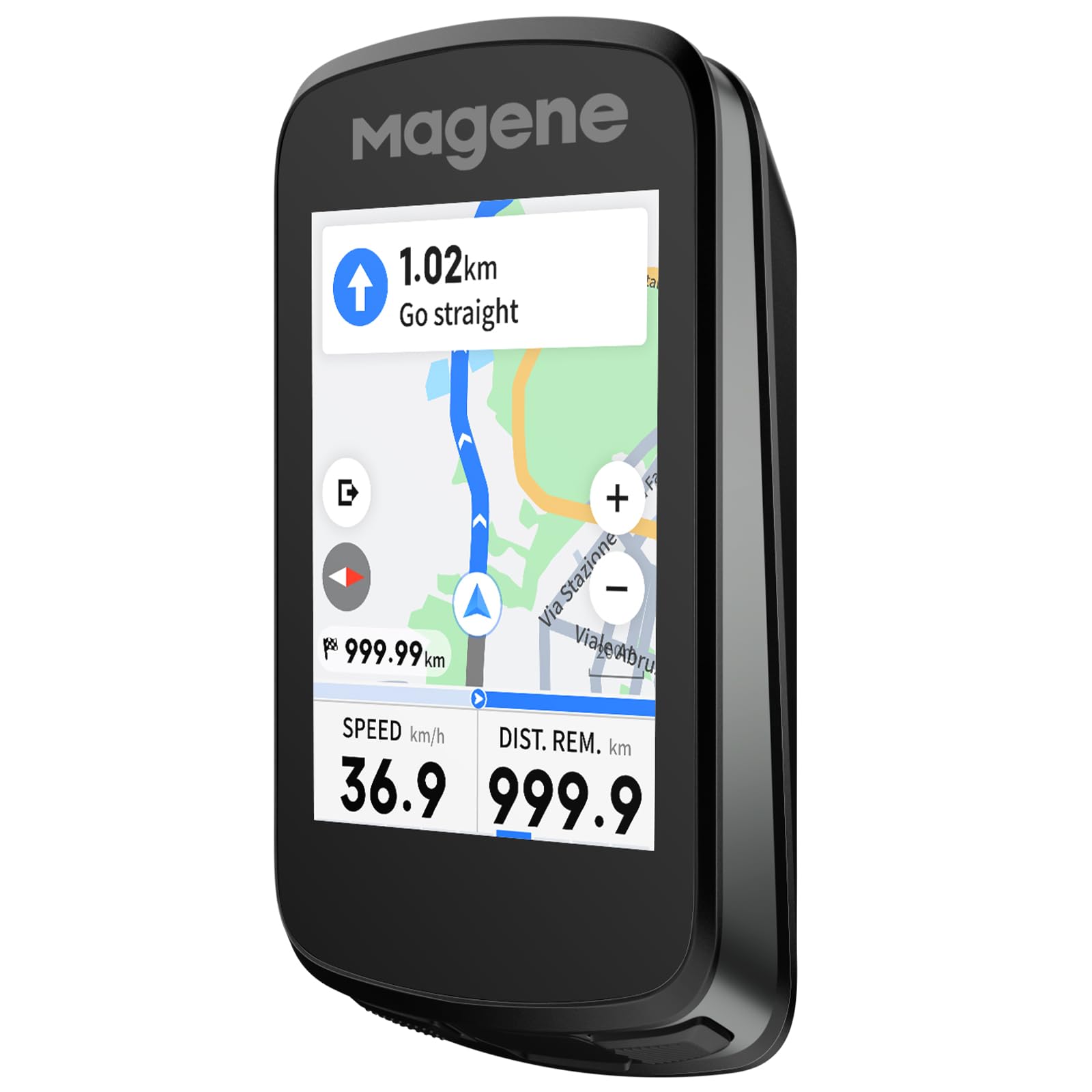
The C606 V2 targets riders who live in the hills. Its Multi-Scenario ClimbPro feature provides full route climb planning, automatic mid-ride summit detection, and real-time displays of gradient, remaining elevation gain, and profile. When paired with a compatible power meter, cycling dynamics reveal seated vs. standing time and platform center offset, helping you optimize each pedal stroke.
The 2.8-inch color touchscreen is responsive even in the rain, and the battery delivers a solid 25 hours in standard mode. Strava Live Segments sync automatically over WiFi, showing segment times and approach alerts without any manual input. The unit also supports DJI and Insta360 camera control, a unique feature for riders who film their descents.
Early firmware limited GPX route uploads to 300 km, though a later update resolved this. The screen is slightly dim in very bright direct sun, and the radar integration lacks the speed-based color coding found on Garmin systems. For recreational cyclists who climb frequently, the C606 V2 offers near-premium climbing tools at a mid-range price.
Why it’s great
- Comprehensive ClimbPro features
- Strava Live Segment integration
- IPX7 waterproof rating
Good to know
- Screen dim in direct sunlight
- Radar lacks color-coded speed alerts
6. iGPSPORT iGS630 GPS Bike Computer

The iGS630 uses a five-satellite GNSS engine (GPS, BeiDou, GLONASS, Galileo, QZSS) that delivers positioning accuracy rivaling units costing twice as much. Its 2.8-inch display uses physical buttons, which many riders prefer for sweaty or wet conditions. The iClimb function provides route previews with grade and remaining ascent, helping you pace climbs without a pre-loaded course.
Battery life is rated at 35 hours, and real-world reports confirm 9+ hour rides with 40% remaining. The unit supports over 150 data fields, off-course alerts, real-time tracking for group rides, and shares data directly to Strava, Komoot, and TrainingPeaks. Sensor pairing across ANT+ and Bluetooth 5.0 is fast and reliable.
Some users find the interface less intuitive than top-tier brands, and the default power screen is not helpful without a power meter. Route uploads require GPX file conversion, and there is no live tracking feature. For riders who want solid mapping and reliable sensor connectivity without paying for premium branding, the iGS630 is a proven workhorse.
Why it’s great
- Excellent satellite lock speed
- Long battery life
- Reliable sensor connectivity
Good to know
- Interface not very intuitive
- No live tracking feature
7. Magene C506 GPS Bike Computer
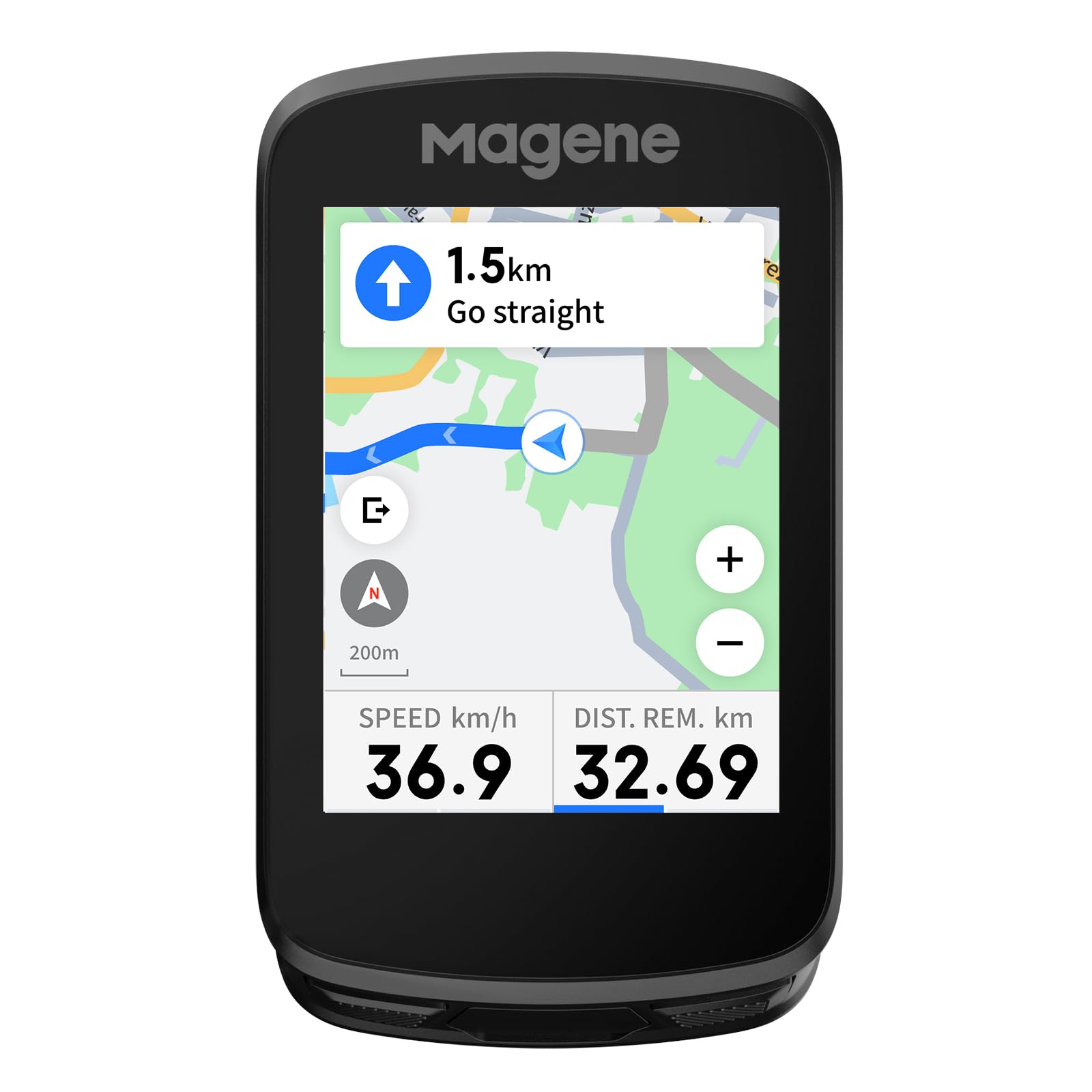
The C506 brings a 2.4-inch color touchscreen to an entry-level price point, offering global offline maps, turn-by-turn navigation, and a 24-hour battery in endurance mode. The Airoha chipset achieves GPS lock in as little as 5 seconds, and the smart riding assistant auto-activates compatible Magene lights when you hit 10 km/h.
Indoor training support lets you upload FIT files to a smart trainer for structured workouts with power targets and gradient simulation. The unit connects to 9 device types simultaneously, including heart rate monitors, power meters, and electronic shifting systems (SRAM eTap, Shimano Di2). With 105 data items across 14 categories, customization depth is surprising for the price.
The OnelapFit App is functional but slow and poorly translated, making map downloads unintuitive—you must connect via WiFi through the app, then switch to the device’s settings. The touchscreen occasionally requires multiple presses. Still, for anyone seeking a color navigation unit without spending for a premium badge, the C506 delivers strong value.
Why it’s great
- Color touchscreen at a budget price
- Fast GPS lock time
- Supports 9 device connections
Good to know
- App is slow and poorly translated
- Touchscreen requires firm presses
8. Beeline Velo 2

The Velo 2 takes a radically different approach: instead of a color map, it shows a simple arrow pointing toward your destination or next turn. Compass mode lets you ride with complete freedom over your route while the unit guides you to a saved location. This minimalism is liberating for riders who feel overloaded by data-dense screens.
The free companion app handles route planning and imports from Komoot, Strava, and RideWithGPS. The unit uses sensor fusion for higher location accuracy, reducing dependency on phone signal. Battery life is 11 hours, and the IPX7 waterproof rating means it survives heavy downpours without issue.
The screen auto-turns off while riding to save battery, requiring a tap to reactivate—an annoyance for those who want constant visibility. The audio cues are quiet, easily masked by wind or traffic noise. And the initial app integration can be clunky. If you value exploration over data analysis, the Velo 2 is a delight. If you need detailed performance metrics, look elsewhere.
Why it’s great
- Intuitive minimalist interface
- Compass mode for free riding
- IPX7 waterproof
Good to know
- Screen auto-turns off during ride
- Audio cues too quiet
9. GEOID CC700 Pro
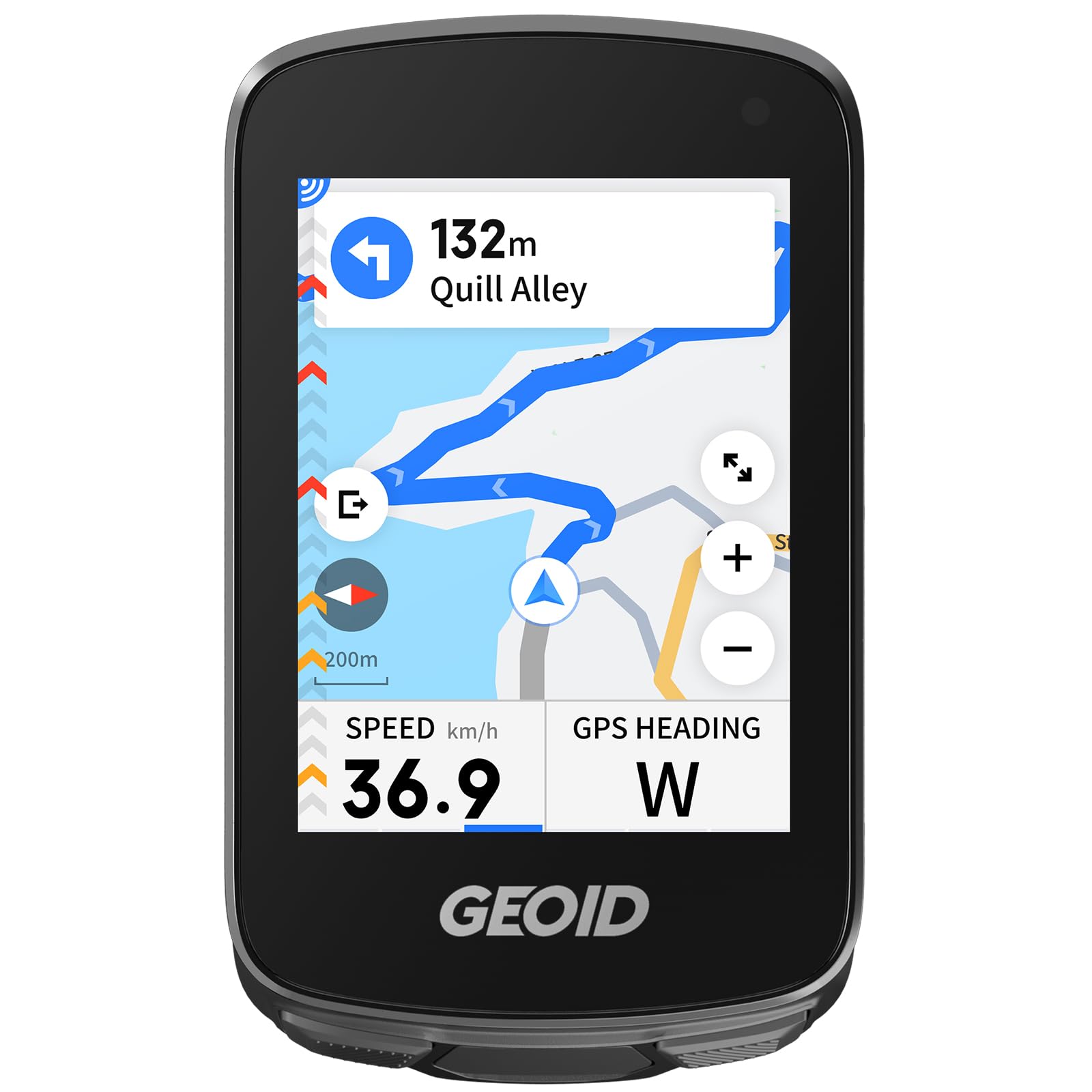
The CC700 Pro offers a 2.8-inch color touchscreen with offline global maps and re-routing at a price that undercuts most competitors. Its five-satellite system (GPS, BeiDou, GLONASS, QZSS, Galileo) with AGNSS support achieves a 5-second position lock. Free indoor training support via smart trainer connection adds value for riders who cross-train through winter.
WiFi syncing dramatically improves upload speeds over Bluetooth, and the unit stores 4GB of map data for multiple routes. The included tempered glass screen protector and IPX7 rating mean it is ready for wet and bumpy conditions right out of the box. Strava and TrainingPeaks auto-sync work seamlessly after account binding.
Not all features work without the app—auto rerouting requires the smartphone connection active. Some users report the GPS defaults to Singapore or EU regions and require manual region switching, which caused confusion. And there is no climbing profile or interval training mode on the device. For casual weekend riders who want a bright map without complexity, the CC700 Pro is a solid entry point.
Why it’s great
- Vivid 2.8″ color touchscreen
- Quick 5-second GPS lock
- Great value for navigation features
Good to know
- Rerouting requires phone connection
- Region setup can be confusing
FAQ
Do I need a phone connection for navigation on all GPS bike computers?
How important is touchscreen responsiveness in wet or cold conditions?
Can I use any power meter or heart rate monitor with these computers?
Final Thoughts: The Verdict
For most users, the gps bike computer winner is the Garmin Edge 540 because it balances pro-level training features, multi-band GNSS accuracy, and physical button reliability at a price competitive with newer challengers. If you prioritize battery life above all else and ride multi-day tours, grab the COROS DURA Solar. And for the budget-conscious rider who wants a color touchscreen and offline maps without breaking the bank, nothing beats the GEOID CC700 Pro.