
Greenhouse plastic is the single most important investment you’ll make for your plants’ survival — but a flimsy sheet that degrades in six months will cost you more in replacements and lost crops than a heavier film ever could. The right polyethylene cover controls temperature, blocks UV radiation, and stays flexible through snow, sleet, and scorching sun without cracking or tearing. Choosing wrong means constant patching, poor light diffusion, and a cold frame that barely keeps frost at bay.
I’m Mohammad Maruf — the founder and writer behind Drink4Good. This guide is the result of cross-referencing hundreds of verified buyer experiences against tensile strength ratings, UV additive claims, and mil-thickness performance data to separate genuine commercial-grade greenhouse film from repurposed painter’s drop cloth.
After analyzing seven real-world-tested polyethylene covers ranging from 6 mil to 16 mil, one clear winner emerges for balancing durability, light transmission, and long-term value in your greenhouse plastic selection.
How To Choose The Best Greenhouse Plastic
Greenhouse plastic is not a commodity. The difference between a single-season film and a four-year cover lies in three factors: the resin quality, the UV stabilization package, and the manufacturing method used to bond the layers. Beginners often buy the cheapest 6 mil sheeting they can find, only to watch it yellow, embrittle, and tear within eight months. Here is the correct way to evaluate your options.
Mil Thickness vs. UV Life Expectancy
A 6 mil film can last two to four years if it contains genuine UV inhibitors and is manufactured using co-extrusion technology. A 16 mil tarp without UV additives will still crack within a single season because thickness does not block UV degradation — the chemical stabilizers do. Look for explicit “4 Year UV” or “UV treated” claims from reputable greenhouse brands like Farm Plastic Supply or A&A Green Store, and avoid generic hardware-store poly sheeting that lists no UV rating.
Light Transmission and Diffusion
Clear greenhouse film should transmit 85 to 90 percent of visible light for maximum photosynthesis, but “clear” does not mean optically transparent like glass. Most quality greenhouse polyethylene has a slight haze — this is actually desirable because it diffuses direct sunlight, preventing scorch spots while delivering uniform light to lower leaves. Anti-drip or drip-proof treatments create a hydrophobic layer that causes condensation to run down the sides rather than dripping onto foliage, which prevents fungal diseases and leaf burn from water droplets acting as lenses.
Grommet Spacing and Edge Reinforcement
For tarps with grommets, spacing should not exceed 18 inches. Wider gaps (35 inches or more) allow wind to billow the plastic between attachment points, stressing the material until it tears at the grommet edge. Double-stitched hems with rope inside the fold — often called “rope-reinforced” edges — dramatically improve tear resistance where the cover is under the highest load. If your greenhouse frame has sharp edges or exposed wire, consider a film without grommets that you can secure with wiggle-wire channels for a continuous, stress-free hold.
Quick Comparison
On smaller screens, swipe sideways to see the full table.
| Model | Category | Best For | Key Spec | Amazon |
|---|---|---|---|---|
| Farm Plastic Supply 8 mil | Premium Film | Hoop houses & permanent greenhouses | 8 mil with 4-year UV rating | Amazon |
| A&A Green Store 6 mil | Premium Film | Greenhouse roofs & cold frames | 6 mil, Made in USA, 4-year UV | Amazon |
| Ansgery 16 mil Tarp | Premium Tarp | Rough environments & animal shelters | 16 mil, grommets every 18 inches | Amazon |
| Chicarry 6 mil Film | Mid-Range Film | Seasonal tunnels & chicken runs | 6 mil, 5-layer co-extrusion | Amazon |
| ToLanbbt 6 mil Film | Mid-Range Film | DIY hoop houses & seed starting | 6 mil, drip-proof, 90% light transmission | Amazon |
| Doniks 14 mil Tarp | Budget Tarp | Temporary covers & wind breaks | 14 mil, grommets every 35 inches | Amazon |
| Aluf Plastics 6 mil Roll | Budget Roll | Large-area coverage & vapor barriers | 6 mil, 20’x100′, Made in USA | Amazon |
In‑Depth Reviews
1. Farm Plastic Supply 8 mil Clear Greenhouse Plastic

Farm Plastic Supply’s 8 mil film is the benchmark for serious greenhouse growers who need a cover that survives more than one season. Real buyers report it standing up to tornado-level storms, hail, and heavy snow loads without tearing — one reviewer noted the film outlasted their first greenhouse rebuild entirely, simply transferring it to a new frame. The 8 mil thickness adds significant puncture resistance compared to standard 6 mil options while remaining flexible enough for DIY installation with wiggle-wire channels.
The UV-stabilized formula is explicitly rated for four years of continuous sun exposure, and field reports confirm the material holds its integrity well past the 18-month mark even in high-wind regions. Some users note that the film becomes slightly cloudy over time, which is normal for UV-treated polyethylene and actually improves light diffusion for lower-canopy growth. The 16 x 25 foot size provides generous coverage for a moderate hoop house or a large cold frame.
Installation is straightforward with the right channel system — the film unfolds easily and does not have the deep crease lines that plague cheap tarps. The material can also be used as a swimming pool cover or a heavy-duty dust wall on construction sites, adding versatility beyond greenhouse use. For growers who want one purchase to last multiple growing cycles, this is the most reliable option on the market.
Why it’s great
- 8 mil thickness with genuine 4-year UV rating outperforms thinner films in durability
- Verified storm survival including hail and tornado-force winds without tearing
- Flexible enough for wiggle-wire channels; no grommet failure points
Good to know
- Film becomes hazy over time — expected for UV-treated polyethylene
- Limited size availability; large greenhouses may need multiple panels
2. A&A Green Store 6 Mil Greenhouse Plastic
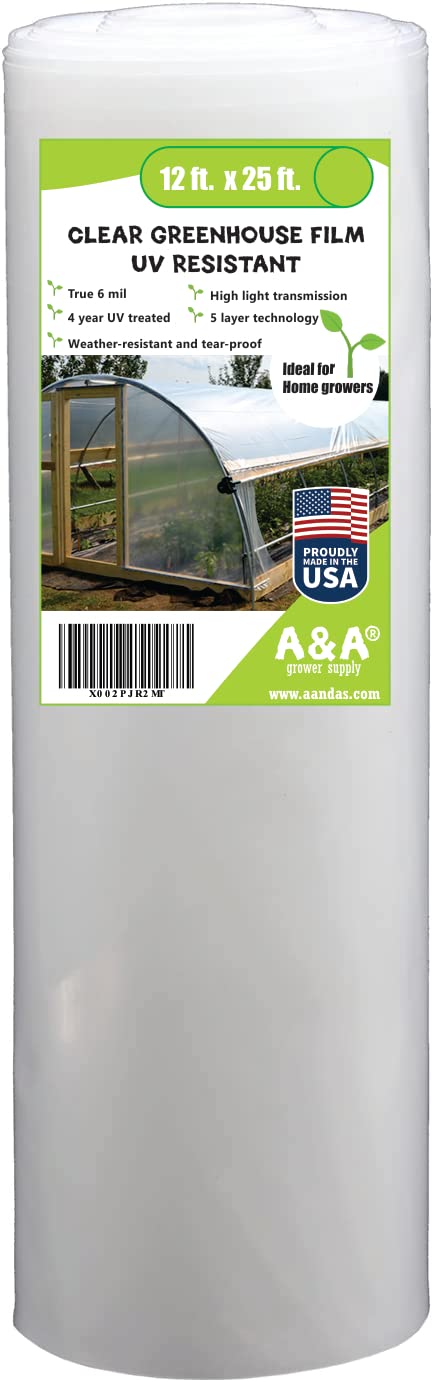
A&A Green Store produces what is arguably the best 6 mil film in its class — a true 6 mil thickness manufactured in the USA with a five-layer co-extrusion system that provides superior tear resistance compared to single-layer films of the same gauge. Verified buyers in South Texas report it holding up to persistent strong winds without ripping or degrading, which is a common failure point for budget 6 mil sheeting that lacks co-extrusion reinforcement.
The 4-year UV rating ensures the film does not become brittle under intense sun, and users confirm it remains pliable through freeze-thaw cycles. The light transmission is described as “ideal” for photosynthesis, though the film has a slight haze that diffuses rather than beams direct light — this is the same property that prevents leaf scorch in high-sun environments. Several reviewers successfully used it to enclose patios and chicken coops, noting a measurable temperature increase inside within 30 minutes of installation.
One important detail: the 12 x 25 foot size is narrower than many competitive rolls, so taller structures may require seam taping or overlapping panels. The material accepts DIY grommets well, but the film’s strength makes it better suited for channel-mount systems where the edge is clamped continuously rather than tied at discrete points. For a mid-size greenhouse that needs a factory-rated UV lifespan, this film delivers consistent performance at a premium tier.
Why it’s great
- 5-layer co-extrusion adds tear resistance not found in single-layer 6 mil films
- 4-year UV rating confirmed in high-wind and high-sun climates
- Made in USA with verified 6 mil thickness — no gauge inflation
Good to know
- 12 ft width requires multiple panels for wide greenhouses
- Not optically clear; hazy appearance may surprise first-time buyers
3. Ansgery 16 Mil Clear Greenhouse Cover
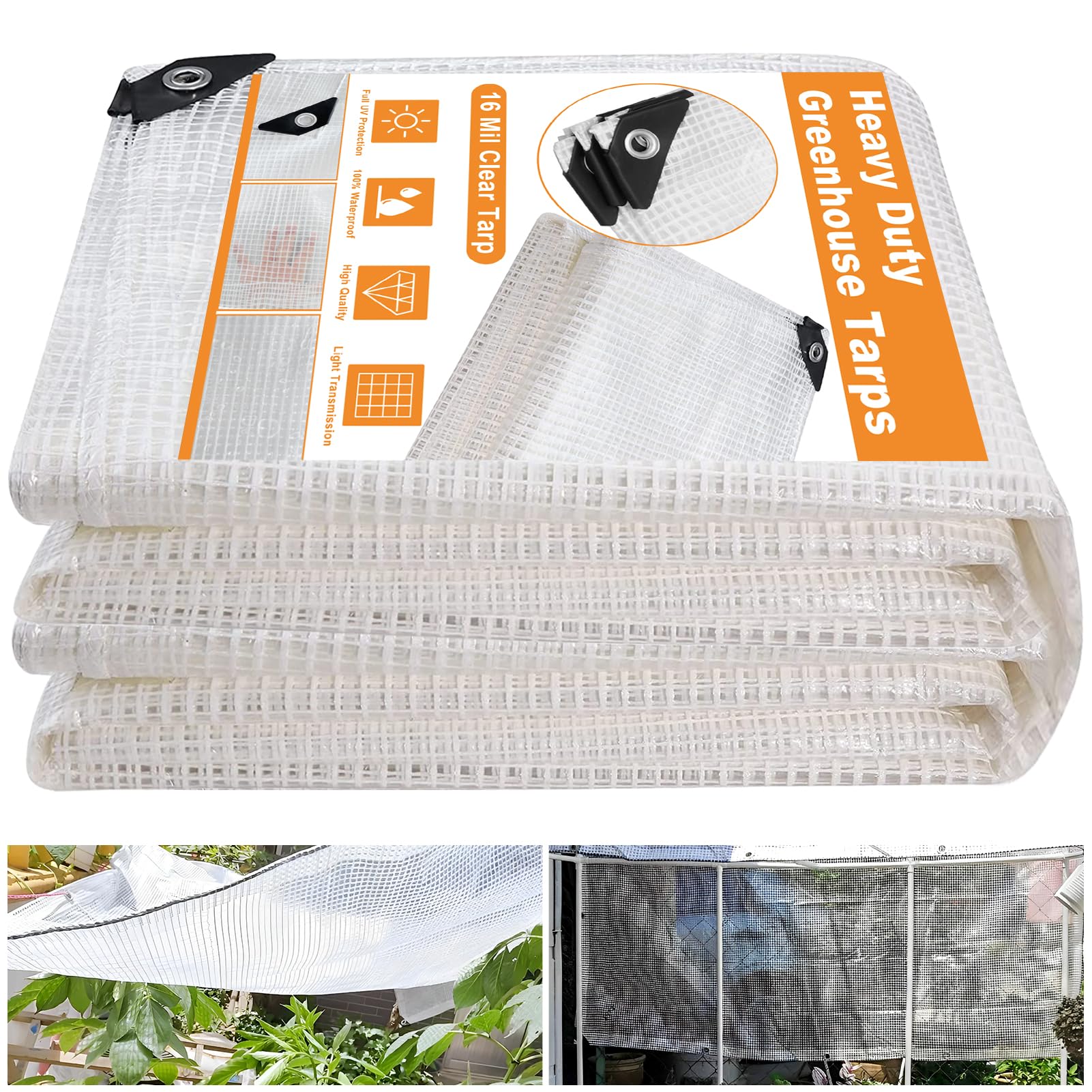
The Ansgery 16 mil tarp is built for the harshest conditions where a standard 6 mil film would fail within weeks. The woven poly core sandwiched between two polyethylene layers gives it a fabric-like toughness that resists punctures from staple guns, branch scrapes, and curious animals. Buyers using it to cover duck pens and chicken runs report it surviving winter snow loads and staple attachment without tearing — something no single-layer film can match.
Grommets are placed every 18 inches, which is the correct spacing for wind resistance. Each grommet is rust-proof and the edges are rope-reinforced and double-stitched. Some users note the material is very hot when used on animal enclosures because it traps heat effectively — a benefit for greenhouses but a consideration for livestock. The 16 x 20 foot size covers a large area, and the manufacturer advises ordering a few inches larger than your frame to allow for sag and securing room.
While the tarp is advertised as “clear,” the woven construction creates a translucent effect rather than true clarity — you will get diffuse light, not a window view. A few reviewers experienced grommet pull-out under extreme wind if not tied down correctly, which is a risk with any grommeted tarp. The manufacturer explicitly warns about fastening methods, which suggests this is not a set-it-and-forget-it product; it needs proper tensioning to reach its two-year typical lifespan.
Why it’s great
- 16 mil woven poly construction resists punctures that destroy thinner films
- Rope-reinforced edges with grommets every 18 inches for wind stability
- Creates strong heat retention ideal for extending growing seasons
Good to know
- Translucent, not clear — diffused light only, no direct sunbeam transmission
- Requires careful fastening; grommets can pull out under extreme wind loads
4. Chicarry 6 Mil Greenhouse Plastic Sheeting
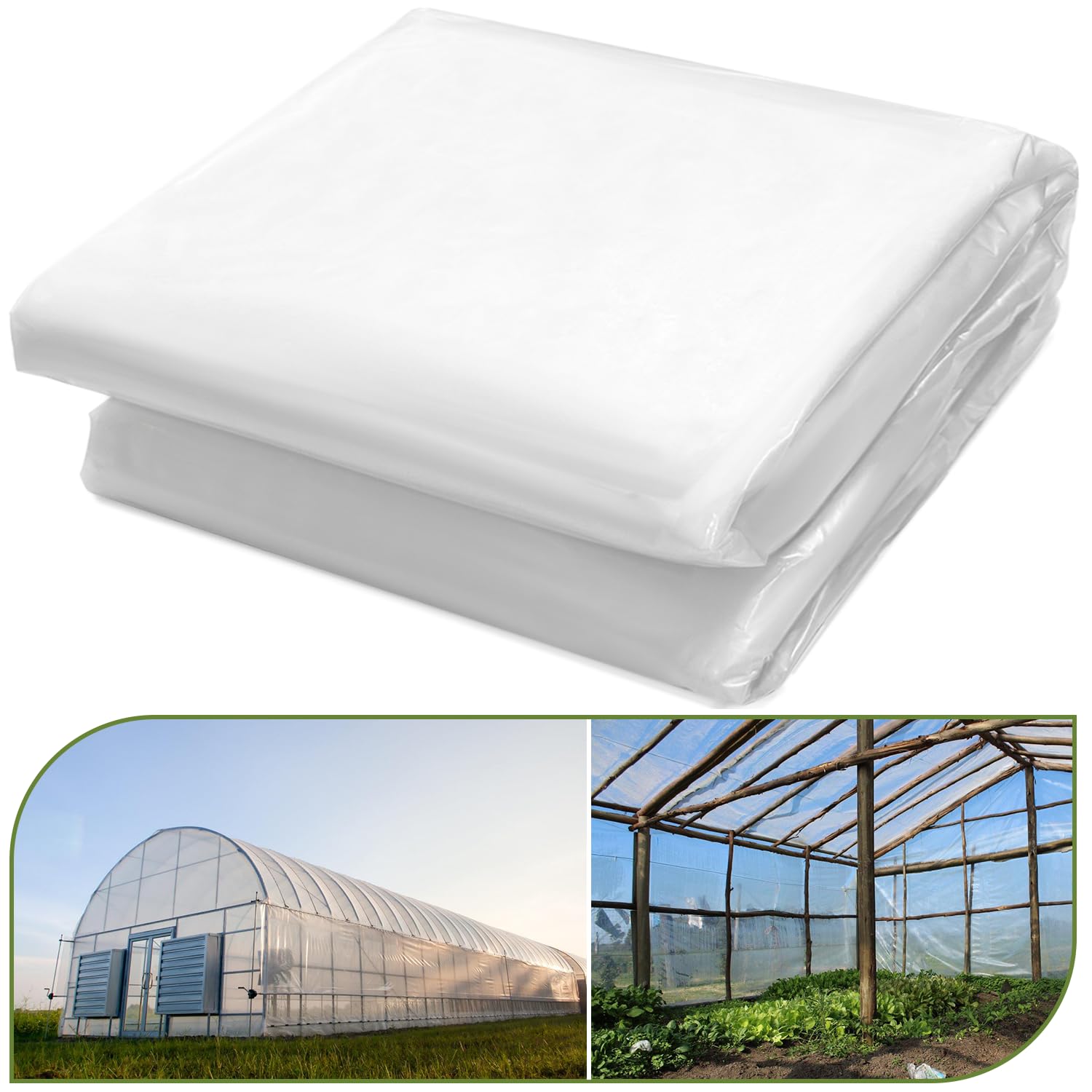
Chicarry’s 6 mil film uses a 5-layer co-extrusion structure that gives it mechanical strength well above typical 6 mil greenhouse plastic. Buyers consistently describe it as “thick” and “slightly stretchy” — the stretch is actually a sign of quality polyethylene that can flex under wind load instead of tearing. One user reported the film survived several days under snow and ice buildup after the 2026 winter storm, which is a tough test for any film in this thickness class.
The anti-drip surface treatment is a genuine feature, not just marketing. The hydrophobic layer causes condensation to sheet down the sides rather than dripping onto plants, which reduces fungal pressure and prevents water droplet lensing that can scorch leaves. The film is slightly hazy as a result of this treatment — the manufacturer explicitly states this is by design. For growers who manage humidity-sensitive crops like tomatoes or peppers, this is a critical advantage over untreated plastic.
The 24 x 25 foot size offers generous coverage for a medium greenhouse, and the film installs best on warm days when the polyethylene is most flexible. Some users note the white-ish appearance when rolled out, which is the anti-drip layer reflecting light. For a mid-range price point, you get co-extrusion durability and functional drip control that usually only appears on premium films — making this the strongest value proposition in the 6 mil category.
Why it’s great
- 5-layer co-extrusion provides mechanical strength that outperforms single-layer 6 mil films
- Effective anti-drip surface prevents condensation drip and leaf burn
- Survived snow/ice loading in real-world winter conditions
Good to know
- Anti-drip coating creates a hazy appearance, not optically clear
- Best installed on warm days when film is most pliable
5. ToLanbbt 6 Mil Clear Greenhouse Plastic Sheeting
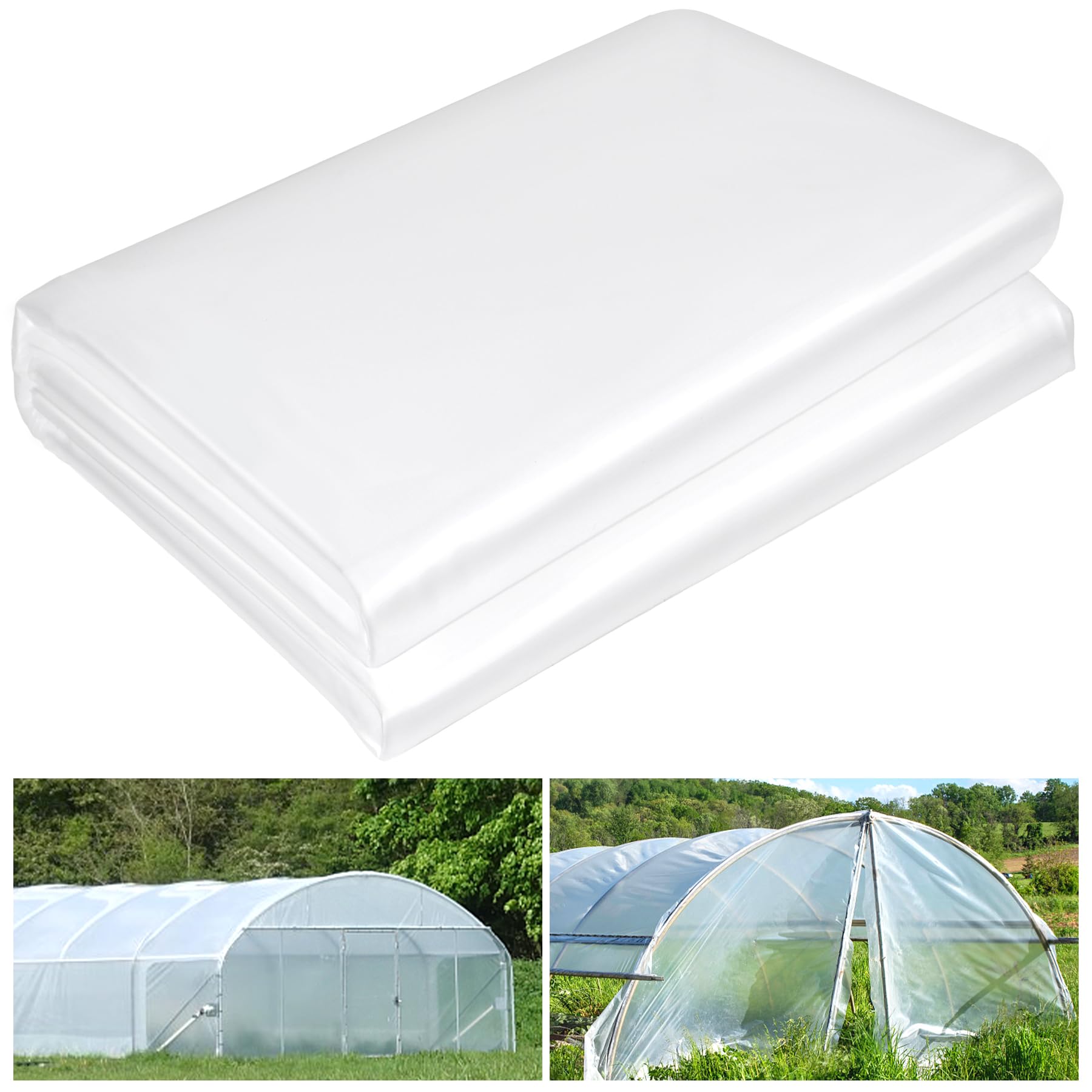
ToLanbbt’s 6 mil film is the most straightforward entry in the mid-range tier — a no-frills polyethylene sheet with published mechanical specs (longitudinal tensile strength 26 MPa, transverse 24 MPa) that gives buyers real data rather than vague claims. The drip-proof design directs condensation to the side edges rather than dripping onto plants, which is the same functional benefit as the more expensive anti-drip films from premium brands.
The manufacturer claims up to 90 percent light transmission, and while the film is not optically clear (no 6 mil polyethylene is), it provides enough light for strong seed germination and consistent growth. Users report it works well for chicken runs, cold frames, and DIY hoop houses. A few reviewers noted the plastic is “not very clear” but functional for its purpose — this is typical of greenhouse film that prioritizes durability over transparency.
The 16 x 26 foot size is practical for a standard backyard greenhouse, and the film can be secured with stones, clamps, or wood strips. Some users wish the material were more transparent for visibility into the enclosure, but the trade-off is a film that resists UV aging better than fully clear alternatives. Durability feedback is mixed on long-term lifespan — one buyer reported less than one year in harsh sun — which suggests this film is best suited for seasonal use rather than permanent multi-year installations.
Why it’s great
- Published tensile and tear strength specs give buyers concrete data for comparison
- Drip-proof side-flow design prevents water droplets from landing on foliage
- Up to 90% light transmission supports strong seed germination
Good to know
- Longevity varies with sun exposure; some users saw degradation under 1 year
- Film is functional but not optically clear for visibility into the structure
6. Doniks 14 Mil Clear Waterproof Tarp

The Doniks 14 mil tarp offers an eye-catching gauge number at a budget-friendly price point, but the 35-inch grommet spacing is a structural weakness that experienced greenhouse builders will notice immediately. With attachment points more than three feet apart, wind can create significant billowing between grommets, and some buyers reported grommets pulling out under extreme wind loads — one user had to switch to fender washers to keep the tarp secured.
The waffle-textured polyethylene surface provides a foggy appearance that blocks direct line-of-sight while still passing sufficient light for plant growth. Buyers using this as a chicken run cover noted a temperature increase of about 5 degrees Fahrenheit from wind blockage alone — modest compared to greenhouse-specific films but adequate for cold protection. The material is 3-ply with UV protection claims, but one detailed review reported seam glue failure within nine months, creating holes up to 7 inches long.
For short-term temporary use such as covering firewood, construction materials, or seasonal wind breaks, this tarp functions adequately. However, the combination of wide grommet spacing and potential seam adhesion issues makes it a risky choice for a permanent greenhouse structure where wind and UV exposure are daily factors. The manufacturer recommends contacting them directly for grommet failure issues, which suggests this is a known weak point.
Why it’s great
- 14 mil thickness provides a thick physical barrier for temporary applications
- Waffle texture diffuses light reasonably well for non-critical plant cover
- Inexpensive entry point for first-time greenhouse builders on a tight budget
Good to know
- 35-inch grommet spacing allows excessive billowing in wind; grommet pull-out reported
- Seam glue degradation reported within 9 months by multiple buyers
7. Aluf Plastics 6 Mil Heavy Duty Sheeting Roll
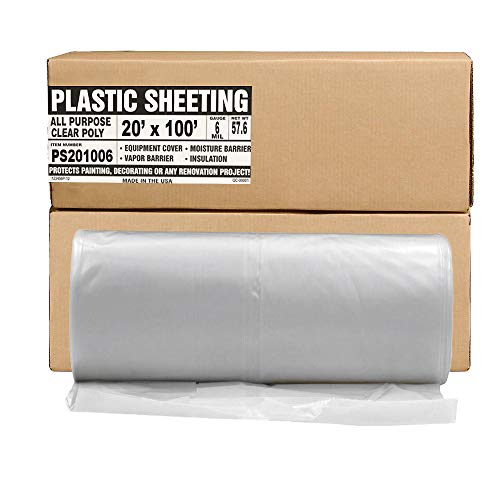
The Aluf Plastics 6 mil roll is a massive 20 x 100 foot sheet of low-density polyethylene that is best understood as a vapor barrier and drop cloth rather than a dedicated greenhouse film. It is made in the USA, scent-free, and provides decent puncture resistance for its thickness — buyers using it for crawlspace liners and floor protection report it outperforming thinner contractor-grade sheeting.
For greenhouse use, the limitations are significant. This polyethylene lacks any UV stabilization, meaning direct sunlight will cause it to yellow and become brittle within a single growing season. It is translucent but not clear — one reviewer described it as “hazy” enough that visibility through the material is limited. The material does cut easily with scissors and can be layered for additional strength, but this compensates for a fundamental lack of greenhouse-specific additives.
The value proposition here is raw square footage per dollar. If you need to cover a very large area temporarily — such as protecting a construction site, encapsulating a crawl space, or creating a seasonal wind barrier — this roll delivers economy of scale. But for a greenhouse that needs to transmit light for photosynthesis and resist UV degradation for multiple seasons, this is not the correct product. Treat it as high-volume contractor sheeting, not agricultural greenhouse film.
Why it’s great
- Unmatched square footage coverage at a budget-friendly per-foot cost
- Made in USA with consistent 6 mil thickness and no scent
- Good puncture resistance for vapor barrier and floor protection uses
Good to know
- No UV additives — will degrade rapidly under direct sunlight
- Translucent, not clear; poor light transmission for plant growth
FAQ
What is the difference between greenhouse plastic and contractor-grade poly sheeting?
Does thicker mil always mean a longer-lasting greenhouse cover?
Why does my greenhouse plastic look hazy instead of crystal clear?
How do I prevent water droplets from burning my plants through greenhouse plastic?
Final Thoughts: The Verdict
For most users, the greenhouse plastic winner is the Farm Plastic Supply 8 mil because it delivers genuine 4-year UV protection, verified storm durability, and the right balance of light transmission and puncture resistance for permanent greenhouse structures. If you want anti-drip performance with co-extrusion strength at a lower cost, grab the Chicarry 6 mil. And for the toughest environments where punctures from animals or debris are a daily risk, nothing beats the Ansgery 16 mil tarp with its woven poly construction and 18-inch grommet spacing.