
Guitar synth pedals have moved beyond cheesy octave effects into a legitimate ecosystem of polyphonic tracking, granular synthesis, and modular sound design. Whether you want massive pads, bubbling arpeggios, or a full backup band, the right unit transforms your six strings into a sound design workstation.
I’m Mohammad Maruf — the founder and writer behind Drink4Good. I’ve spent hundreds of hours researching latency specs, polyphonic algorithm quality, and firmware support across the current market to separate the usable from the gimmicky.
After tracking down 9 distinct units ranging from compact polyphonic synths to full-blown modular platforms, this guide delivers a clear, category-specific breakdown of the best guitar synth pedals available right now so you can find the one that matches your playing style and signal chain.
How To Choose The Best Guitar Synth Pedals
A guitar synth pedal must track your picking dynamics without glitching, blend the effect with your dry signal without latency, and actually sound like a synth rather than a weird chorus. Here are the critical specs to evaluate before you buy.
Polyphonic vs. Monophonic Tracking
Monophonic tracking processes one note at a time and works great for bass lines, leads, and synth solos. Polyphonic tracking processes chords. If you plan to strum full voicings into your synth patch, you need a polyphonic engine, like those in the BOSS SY-1 or the MXR Poly Blue Octave. Monophonic units glitch out on chords.
Analog Dry-Through and Latency
Your unprocessed guitar tone should pass through the pedal without being digitized. Analog dry-through circuits keep your core sound pure and zero-latency while the effect blends on top. This prevents the unnatural, processed feel that plagues budget digital units. Look for pedals that explicitly advertise analog dry-through or true bypass.
Attack Response and ADSR Control
Synth sounds often have slow attacks, but that’s only desirable for pads. If you play palm-muted riffs or staccato passages, you need to control the attack envelope. Some pedals, like the BOSS SY-1, lock the attack internally, while others give you dedicated knobs. Verify whether the pedal’s response matches your playing style.
Quick Comparison
On smaller screens, swipe sideways to see the full table.
| Model | Category | Best For | Key Spec | Amazon |
|---|---|---|---|---|
| BOSS SY-1 | Synth Engine | Polyphonic pads & leads | 11 synth types, hold function | Amazon |
| Electro-Harmonix SYNTH9 | Vintage Synth | Classic analog synth emulation | 9 presets, no special pickup needed | Amazon |
| Empress Effects ZOIA | Modular Platform | Full modular synthesis & effects | 80+ modules, 64 patch slots | Amazon |
| MXR Poly Blue Octave | Pitch Shifter | Octave fuzz & modulation | 4 octave divisions + fuzz | Amazon |
| BOSS OC-5 | Octave | Polyphonic bass substitution | Poly/mono modes, dry output | Amazon |
| Zoom G1X FOUR | Multi-Effects | All-in-one practice & synth | 71 effects, expression pedal | Amazon |
| ALABS NOVADRIFT | Modulation | Expression-recorded modulation | ∞ Explore Mode, analog dry-through | Amazon |
| JOYO Vision R-09 | Modulation | Stereo modulation stacking | 18 mod effects, series/parallel | Amazon |
| MOOER E7 | Pocket Synth | Portable synth tones & arpeggiator | 7 synth types, 7 presets, 100mA | Amazon |
In‑Depth Reviews
1. BOSS SY-1

The BOSS SY-1 is the most reliable polyphonic synth pedal you can put on a board today. It delivers 11 synth categories (lead, bass, pad, bell, strings, plus subcategories) with rock-solid tracking across the fretboard. The send/return loop lets you run your own effects inside the synth voice — a game-changer for layering fuzz or chorus into the core sound without messy cabling.
Its compact BOSS pedal format and 300 mA power draw slot into any standard board. The hold function freezes a note or chord underneath your dry playing, perfect for drone-based ambient sections. The expression input adds real-time filter sweeps, giving you dynamic control that makes the synth feel alive on stage.
One limitation is the fixed attack envelope — you cannot slow down the natural attack. Palm-muted staccato passages don’t translate well. It also lacks preset saving, so live players must remember dial positions. But for pure, usable polyphonic synth tone with zero latency, the SY-1 is the undisputed leader in its class.
Why it’s great
- Flawless polyphonic tracking, even on complex chords
- Send/return loop for placing external effects inside the synth voice
- Hold function for sustained drones over dry playing
Good to know
- No adjustable attack envelope — fixed internal attack
- No onboard preset saving, requires manual re-dial for different songs
2. Electro-Harmonix SYNTH9

The SYNTH9 captures classic analog synthesizer textures and maps them to your guitar without requiring a hex pickup or MIDI conversion. Each of the nine presets recreates a specific vintage synth vibe — from resonant filter sweeps to thick oscillator stacks — and the tracking range extends cleanly to the 23rd fret on the high E string, which is wider than many competing units.
The pedal includes a dry blend knob that lets you mix your original tone with the synth effect, so you never lose your guitar’s natural attack. It also works with acoustic guitar, which is rare for synth pedals. Combine it with EHX’s other 9-series pedals (B9, C9, KEY9) for a full keyboard simulation rig.
Build quality is solid, but users have reported the pedal dying after a couple of years without heavy abuse. EHX offers an out-of-warranty repair for around thirty dollars, which is fair, but it’s something to keep in mind if you buy used. The lack of a second expression jack also limits real-time parameter control for live players.
Why it’s great
- Genuine vintage synth tones without hex pickups or MIDI
- Usable tracking range up to 23rd fret on high E, down to open A on bass
- Dry blend knob preserves natural guitar attack
Good to know
- Some units have failed after 1–2 years without heavy use
- Only one expression input, limiting dual-parameter control
3. Empress Effects ZOIA

The Empress ZOIA is not a pedal — it is a complete modular synthesis environment inside a stompbox. It gives you oscillators, LFOs, filters, envelope followers, bit crushers, and over twenty ready-made effects modules, all interconnectable via an intuitive patch-cable-like interface. You can build your own synth from scratch, save it as one of 64 patches, and load community-created presets from an ever-growing online library.
The sound quality is pristine, with 24-bit processing and no noticeable latency, even on complex multi-module patches. It works with guitar, bass, synth, or any line-level instrument. The ZOIA is also a fantastic standalone instrument — you can build complete drones, sequencers, and ambient textures without any external gear.
The steep learning curve is real. You will need to commit time to reading the manual and working through introductory tutorials before you can create your own patches. The lack of USB MIDI is also a minor frustration for DAW integration. But if you want limitless sonic possibilities in one box, nothing else on this list comes close.
Why it’s great
- Full modular synthesis platform with 80+ modules
- Vibrant community sharing free patches online
- Zero perceived latency on complex patches
Good to know
- Very steep learning curve — requires dedicated time
- No USB MIDI port for direct DAW integration
4. MXR Poly Blue Octave

The MXR Poly Blue Octave is a pitch-shifter and synth hybrid that delivers four independent octave divisions (two up, two down), each with its own level control. You can blend them freely, toggle between monophonic and polyphonic tracking, and trigger a thick, unruly fuzz inspired by the classic MXR Blue Box. This makes it a one-box solution for everything from subtle organ coloration to full-on synth bass.
The modulation section, switchable between a Phase 90-style phaser and a Leslie rotary, adds movement to octave tones. The expression input lets you sweep between any two knob settings, giving you morphing control over the mix or fuzz level. Polyphonic tracking is clean enough for chords, though some minor warble appears on very dense voicings.
I’ve used this pedal for sub-octave bass lines in a looping setup, and the -2 octave remains tight and rumbling even on a downtuned guitar. The only downside is the fuzz level is not independently controllable — it clamps to the overall mix. Still, at this price point, the feature density is unmatched for octave-based synthesis.
Why it’s great
- Four separate octave divisions with dedicated level controls
- Integrated modulation (Phase 90 or Leslie) adds motion
- Expression input allows real-time morphing between settings
Good to know
- Fuzz level is not independently adjustable from overall mix
- Some polyphonic warble on dense chord voicings
5. BOSS OC-5

The BOSS OC-5 is the updated version of the industry-standard octave pedal, now with genuine polyphonic tracking that lets you play full chords without glitching. The poly mode uses a “Lowest Range” setting that applies the octave effect only to the lowest note in your chord — ideal for root-note bass doubling while keeping the higher strings clean. The classic mode reproduces the vintage monophonic OC-3 tracker for authentic old-school octave sounds.
The separate dry output is invaluable for bassists or loopers: you can send the dry signal to your regular amp and route the octave to a subwoofer or bass amp for massive low-end separation. The tracking is organic and musical, avoiding the robotic, digitized feel of older octave pedals.
Polyphonic chords can introduce a slight warble, especially when strummed aggressively, which is common to all poly-octave algorithms. Some players prefer the TC Electronic Sub N Up for chord clarity, but the OC-5’s tone is more natural and blends better with bass-heavy mixes. It runs on just 20 mA, making it one of the most power-efficient octave pedals out there.
Why it’s great
- Polyphonic tracking works on full chords without glitching
- Lowest Range mode only octaves the root note
- Separate dry output for dedicated bass amp routing
Good to know
- Polyphonic chords can exhibit slight warble under heavy strumming
- Classic mode is monophonic only
6. Zoom G1X FOUR

The Zoom G1X FOUR is a multi-effects processor that also handles synth duties via its 71 effects, 13 amp models, and built-in expression pedal. While not a pure synth pedal, its synth effects (including filters, pitch shifters, and ring modulators) are surprisingly capable when paired with its amp and cab sims. The 30-second looper and 68 rhythm patterns turn it into a full practice and songwriting station.
It runs on batteries, a power bank, or a standard wall plug, so you can take it anywhere. The USB port connects to Zoom Guitar Lab for deep patch editing on PC or Mac. You can chain up to five effects per patch, which is plenty for synth-like textures like filter sweeps into reverb with octave doubling.
The UI is not intuitive — factory presets are uninspiring and you will need the manual and the app to build usable patches. The looper is limited to 30 seconds. But at this price point, it offers more synth flexibility than any dedicated budget pedal. For players who want one box for everything, including synth sounds, the G1X FOUR is hard to beat.
Why it’s great
- Massive bank of 71 effects including synth, pitch, and filter modules
- Built-in expression pedal for real-time filter control
- 68 rhythm patterns and a looper for full band practice
Good to know
- UI is non-intuitive and factory presets are poor
- Looper is limited to 30 seconds
7. ALABS NOVADRIFT
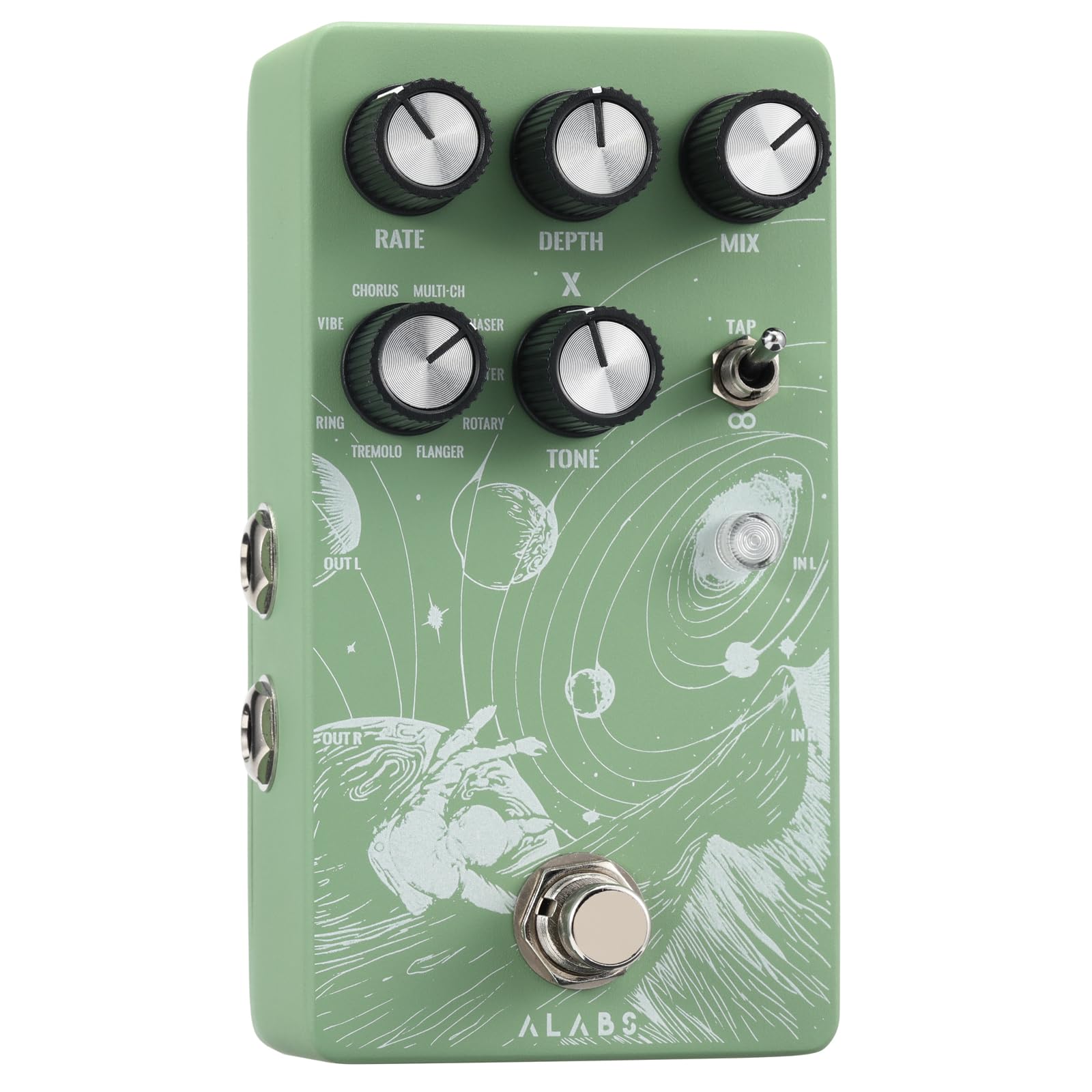
The ALABS NOVADRIFT is a modulation pedal that blurs the line into synth territory with its ∞ Explore Mode — a built-in expression recorder that captures up to 5 seconds of dynamic knob movements and loops them into real-time modulation. You can record a filter sweep, rate ramp, or mix fade and let it repeat, creating synth-like movement without an external expression pedal.
It offers 9 effects: Vibe, Chorus, Multi-Chorus, Phaser, Filter, Rotary, Flanger, Tremolo, and Ring Mod. The dedicated “X” knob controls a unique parameter for each effect (filter resonance on the filter mode, feedback on vibe, etc.), giving you deep sound shaping. The analog dry-through circuit keeps your core tone pure and zero-latency, so the modulation never muddies your original signal.
The stereo I/O and selectable true bypass/buffer are welcome features, though the 250 mA power draw is higher than average. The side-mounted jacks can be tight on crowded boards. For players who want moving, evolving modulation textures that act as a synth layer, the NOVADRIFT delivers a unique blend of effect and synthesis that few traditional mod pedals can compete with.
Why it’s great
- ∞ Explore Mode creates synth-like dynamic modulation without extra gear
- Analog dry-through circuit preserves pure guitar tone
- X knob offers deep, effect-specific control
Good to know
- Draws 250 mA — requires a dedicated power port
- Side-mounted jacks can be tight on crowded boards
8. JOYO Vision R-09

The JOYO Vision R-09 squeezes 18 distinct modulation effects across two independent channels, with true stereo I/O and series/parallel routing. Channel A covers classic mods (phaser, chorus, flanger, rotary) while Channel B handles lo-fi and experimental textures (auto-wah, bit crusher, stutter, vibrato). You can stack them in series for cascading layers or run them in parallel for wide stereo imaging.
The tap tempo feature is independent per channel, allowing you to sync the LFO rate to your song tempo on each effect separately. The rugged aluminum chassis and purple LED lighting look great on a dark stage. The stutter effect is a highlight for rhythmic synth-like chopping, and the auto-wah is impressively expressive for the price.
There is no preset storage, so you must dial in sounds from scratch every time you switch songs. The knob labels are small and hard to read under stage lighting. A few users have reported volume drop when engaging both channels simultaneously, so check your levels if you plan to stack heavily.
Why it’s great
- 18 mod types across two independent channels with stereo series/parallel routing
- Independent tap tempo per channel for tempo-synced modulation
- Stutter and auto-wah effects stand out for synth-like textures
Good to know
- No preset storage — must re-dial for different songs
- Possible volume drop when both channels are engaged
9. MOOER E7

The MOOER E7 is a tiny polyphonic synth pedal that packs seven distinct synth tones (trumpet, organ, ocean wave, Weeyo, saw wave, 8-bit, EDM, pad) into a compact enclosure just 3.68 x 1.65 x 2.06 inches. Each tone has its own arpeggiator with adjustable speed, high/low frequency cut, attack, and overall speed. It stores seven user presets, so you can switch between sounds quickly on stage.
Tracking is decent for a budget unit, though it can struggle with very fast legato runs or wide interval jumps. The arpeggiator is the real highlight — it turns simple chords into evolving synth patterns that sound far more expensive than the pedal costs. It draws only 100 mA and fits on any standard board without taking up real estate.
The biggest downside is reliability. Some units have failed after a few months, and MOOER’s customer service is notoriously slow. If you get a good unit, it is an excellent entry point into synth pedals. For a quiet living room player or a bedroom producer experimenting with guitar synthesis, the E7 is a low-risk, high-fun investment.
Why it’s great
- Ultra-compact footprint fits any board
- Seven synth tones with individual arpeggiator per tone
- Seven user presets for live switching
Good to know
- Some users report unit failure after a few months
- Tracking can struggle with fast legato or wide intervals
FAQ
Can I use a guitar synth pedal with a standard electric guitar without special pickups?
What is the difference between polyphonic and monophonic tracking in a synth pedal?
How much latency should I expect from a guitar synth pedal?
Final Thoughts: The Verdict
For most users, the best guitar synth pedals winner is the BOSS SY-1 because it delivers flawless polyphonic tracking, a send/return loop for external effects, and a format that fits any board. If you want vintage synth emulation without special pickups, grab the Electro-Harmonix SYNTH9. And for maximum creative freedom, nothing beats the Empress Effects ZOIA.