
If your fingertips crowd the fretboard the moment you form a chord, you know the unique struggle standard nut widths and narrow string spacing create for players with thicker digits. Muting adjacent strings during a simple open G or struggling to find clean single-note runs isn’t a skill issue—it’s a geometry problem. The physical space between strings at the nut and along the fretboard determines whether your fingers land cleanly or mush together, and most guitars are built around an average hand size that leaves many players fighting the instrument.
I’m Mohammad Maruf — the founder and writer behind Drink4Good. I’ve spent hundreds of hours analyzing fretboard dimensions, neck profiles, nut widths, and string spacing across acoustic and electric guitars to pinpoint which models genuinely accommodate larger fingers without requiring a grip adjustment from the player.
Reading through real owner feedback and measuring the critical specs that separate a cramped feel from a relaxed one, this guide breaks down the best guitar for fat fingers across every budget so you stop fighting the fretboard and start playing freely.
How To Choose The Best Guitar For Fat Fingers
The single biggest mistake players with larger fingers make is buying a guitar based on looks or brand reputation without checking the nut width and string spacing. A guitar that feels great to someone with slender hands can feel like a torture device for you. Here is what genuinely matters when shopping for more fretboard real estate.
Nut Width — The Golden Number
The nut width determines how much space exists between the strings at the headstock end of the fretboard. Standard electric guitars measure around 1.65 inches (42mm), which often feels cramped. For larger fingers, a nut width of 1.75 inches (44.5mm) or wider provides noticeably more separation. Acoustic guitars typically start at 1.69 inches, but 1.75-inch or even 1.8-inch nuts make open chords and barre chords significantly easier to execute without muting adjacent strings.
Neck Profile — Thicker Isn’t Always Better
Many players assume a thicker neck profile automatically helps larger hands, but the real comfort comes from string spacing, not the thickness of the neck itself. A thin neck with wide string spacing can feel far more playable than a baseball-bat neck with tight strings. Look for C-shaped or D-shaped profiles that fill the palm without forcing your fingertips into a cramped zone—but always prioritize string spacing measurements over neck depth.
Fretboard Radius — Flatter Is Friendlier
A flatter fretboard radius (12 to 16 inches) allows your fingers to press strings without the outer strings feeling too far away or too close together. Vintage-style 7.25-inch radius necks curve more steeply, which can cause the middle strings to feel bunched. For barre chords and bending, a flatter radius gives thicker fingers a more consistent feel across all six strings.
Quick Comparison
On smaller screens, swipe sideways to see the full table.
| Model | Category | Best For | Key Spec | Amazon |
|---|---|---|---|---|
| Yamaha FG830 | Acoustic Dreadnought | Wide nut acoustic playability | Nut width 1.75″ | Amazon |
| Yamaha FG800J | Acoustic Dreadnought | Beginner with thick fingers | Nut width 1.75″ | Amazon |
| Fender CN-140SCE | Nylon String Acoustic-Electric | Classical feel for larger hands | Nut width 1.875″ | Amazon |
| Ibanez AW54 | Acoustic Dreadnought | Solid top with a roomy neck | Nut width 1.69″ | Amazon |
| Fender CD-60S | Acoustic Dreadnought | Traditional big-body comfort | Nut width 1.69″ | Amazon |
| Jackson JS22-7 Dinky | Electric 7-String | Extended range with wide spacing | Nut width 1.875″ | Amazon |
| Squier Sonic Stratocaster | Electric Solid Body | Affordable electric with decent spacing | Nut width 1.65″ | Amazon |
| Grote LPYS-006 | Electric Solid Body | Budget LP-style with wide neck | Nut width 1.69″ | Amazon |
| Leo Jaymz 39″ Solid Body | Electric Solid Body | Entry-level electric on a budget | Nut width 1.65″ | Amazon |
In-Depth Reviews
1. Yamaha FG830 Solid Top Acoustic Guitar

With a full 1.75-inch nut width, the Yamaha FG830 provides the kind of string separation that immediately relieves the cramped feel standard acoustic nuts create for thicker fingers. The rosewood back and sides push the tonal spectrum into a rich, balanced zone with surprising projection for a mid-range instrument, and the solid Sitka spruce top delivers a clarity that lets each note ring distinctly even during dense chord voicings.
Owners consistently compare this guitar favorably to instruments costing three times as much, praising the build quality and the roomy fretboard that allows barre chords to land cleanly without muting. The dreadnought body fills the sound nicely, and the rosewood fingerboard feels smooth under the fingertips during long practice sessions. A minor truss rod adjustment often suffices to dial in a comfortable action height.
Some players note that fret edges could be slightly better finished from the factory, and the nut can require a small filing if you prefer ultra-low action. The tobacco sunburst finish looks far more premium than the price point suggests, and the overall package punches well above its weight class for players who need that extra width without moving into custom territory.
Why it’s great
- Wide 1.75″ nut gives noticeably more string spacing
- Solid Sitka spruce top delivers rich, balanced tone
- Rosewood back and sides add warmth and projection
Good to know
- Factory frets may need light dressing
- Action can require a truss rod tweak out of box
2. Fender CN-140SCE Thinline Concert Nylon String Acoustic-Electric
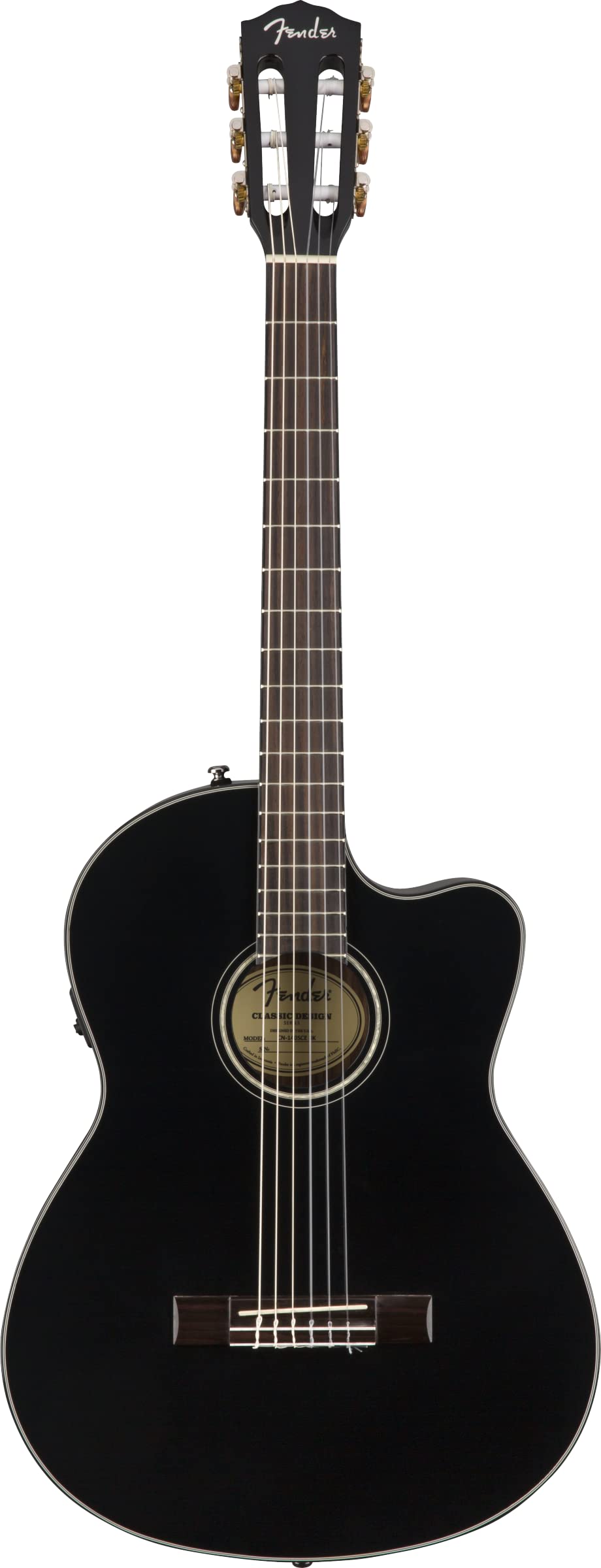
If you have larger fingers, the 1.875-inch nut width on the Fender CN-140SCE is a game-changer, offering the widest string spacing of any guitar on this list by a meaningful margin. The thinner concert body with a cutaway makes upper-fret access comfortable, and the solid cedar top paired with ovangkol back and sides produces a warm, rounded nylon-string voice that excels in fingerstyle and classical settings.
One owner with “gorilla hands” specifically noted the fretboard still felt a touch narrow despite the generous spec, which underscores how personal fit remains, but the majority of reviews highlight the exceptional playability for players who previously struggled with standard nut widths. The Fishman Classic Design pickup system accurately reproduces the natural acoustic tone when plugged in, and the included hard case adds genuine value.
The glossy neck finish can feel a bit sticky during sweaty sessions, and the small fingerboard markers are nearly invisible in low light, requiring some adaptation. The overall build quality and comfortable fret edges, however, make this one of the most accommodating production guitars for larger hands that does not require a full classical guitar commitment.
Why it’s great
- Widest nut at 1.875″ for maximum string separation
- Nylon strings are gentle on fingertips
- Fishman preamp delivers great amplified tone
Good to know
- Glossy neck finish can get sticky
- Fret markers are very small and hard to read
3. Yamaha FG800J Solid Top Acoustic Guitar

Yamaha’s FG800J brings the same 1.75-inch nut width found on the pricier FG830 but at a lower entry point, making it the best acoustic option for players on a budget who still need that crucial extra finger room. The solid spruce top yields a bright, articulate tone with impressive low-end punch for a dreadnought in this price tier, and the nato and mahogany back and sides keep the weight manageable during long practice sessions.
Reviewers with large hands consistently mention how the wider nut transforms their playing experience, turning previously frustrating chord shapes into comfortable formations. The guitar stays in tune reliably, and the rosewood fingerboard feels smooth under the fingers. The dreadnought body size actually complements larger players by providing enough surface area to rest the forearm comfortably.
A few owners note that the factory setup can leave the intonation slightly sharp on the thicker strings, and the action may need a small adjustment to reach ideal playability. The finish quality is excellent for the price range, and the FG800J serves as a reliable workhorse that does not punish larger fingers the way standard-width acoustic guitars do.
Why it’s great
- Same 1.75″ nut as the FG830 at a lower price
- Solid spruce top projects well for the price
- Large dreadnought body suits bigger frames
Good to know
- Factory intonation may need adjustment
- Action is not perfectly dialed out of box
4. Fender CD-60S Dreadnought Acoustic Guitar

The Fender CD-60S uses a standard 1.69-inch nut width rather than the wider 1.75-inch, so it falls into the “better for borderline fingers” category rather than being a dedicated wide-neck solution. What makes it worth considering is the all-mahogany construction, which produces a warm, compressed tone that sits beautifully in a mix, and the dreadnought body’s bold bass response fills a room without needing amplification.
Owner feedback consistently praises the quality control and near-perfect factory setup, with many noting that the guitar plays and sounds like an instrument well above its price range. The rolled fingerboard edges and smooth fret ends make transitions between chords comfortable even during long sessions. For players whose fingers are only slightly thicker than average, the 1.69-inch nut may work fine.
The main drawback is the muted unplugged volume compared to premium dreadnoughts, making this guitar better suited for quiet practice or living room playing than loud acoustic jams. The glossy mahogany finish looks beautiful but shows fingerprints easily. If 1.69 inches feels tight, skip this one and go directly to the Yamaha FG800J or FG830.
Why it’s great
- All-mahogany body delivers warm, balanced tone
- Excellent factory setup out of the box
- Rolled fretboard edges for smooth play
Good to know
- Standard 1.69″ nut may feel tight for larger fingers
- Quiet unplugged volume for a dreadnought
5. Ibanez AW54 Open Pore Natural Acoustic Guitar

The Ibanez AW54 features a solid mahogany top that produces a warm, focused tone ideal for fingerpicking and chord work, though its 1.69-inch nut width places it in the standard territory rather than the wide-neck category. The open pore natural finish keeps the weight down and allows the mahogany to resonate freely, resulting in surprisingly rich overtones for a guitar at this price point.
Players who have compared this guitar to the Martin D-15M note that the AW54 holds its own for roughly one-third of the cost, offering a similar tonal character with good string-to-string definition. The rosewood fingerboard and nyatoh neck provide a stable platform, and the guitar arrives with decent playability straight from the factory. For players with moderately thicker fingers, the comfortable neck profile helps offset the standard nut width.
Setup consistency varies, with some units requiring minor truss rod and saddle adjustments to dial in the action. The open pore finish, while visually appealing, can feel slightly rough on the forearm compared to gloss finishes. This guitar works best for players whose finger size is on the borderline of standard spacing rather than those who need the widest possible layout.
Why it’s great
- Solid mahogany top ages well with rich tone
- Open pore finish allows wood to resonate freely
- Great value compared to premium mahogany acoustics
Good to know
- 1.69″ nut is standard width, not wide
- Finish may feel rough on the forearm
6. Jackson JS22-7 Dinky 7-String Electric Guitar

With a 1.875-inch nut width, the Jackson JS22-7 Dinky offers the widest string spacing on the electric side of this list, and the seven-string configuration provides an extra low B for players who want extended range without sacrificing finger room. The poplar body keeps the weight manageable, and the thin maple neck with a satin finish allows your hand to slide freely across the full width of the fingerboard.
Owners consistently praise the comfortable neck shape and the minimal neck dive, both of which contribute to a balanced feel during long practice sessions or performances. The stock humbuckers provide adequate output for modern metal and rock tones, and the fixed bridge stays in tune reliably even during aggressive playing. For players with larger fingers who want to explore lower tunings or seven-string territory, this is the most accessible option available.
Quality control varies, with some units arriving with sharp fret ends or requiring a truss rod adjustment to eliminate buzz. The stock pickups lack clarity for clean chord work and sound best with some gain. This guitar is best suited for experienced players who understand setup and are comfortable making minor adjustments to unlock its full potential.
Why it’s great
- 1.875″ nut is among the widest available
- Seven strings add range without cramping fingers
- Thin satin neck is fast and smooth
Good to know
- QC can be inconsistent, may need setup
- Stock pickups are dark and lack clean clarity
7. Squier Sonic Stratocaster Electric Guitar

The Squier Sonic Stratocaster uses a standard 1.65-inch nut width, which is on the tighter side for larger fingers, but its lightweight poplar body and satin-finished maple neck make it one of the most comfortable budget electrics to hold and play for extended periods. The HSS pickup configuration provides versatility from glassy cleans to moderate overdrive, making it suitable for a wide range of musical styles.
Owner reviews frequently mention that the neck and fretwork quality rivals Mexican-made Fenders from a decade ago, with excellent sustain and surprising playability straight out of the box. The small headstock reduces neck dive, and the tremolo bridge adds expressive flexibility for players who enjoy subtle pitch modulation. For players whose fingers are only modestly thicker, the comfortable neck profile somewhat compensates for the standard nut width.
This guitar falls into the “try before you buy” category for larger-fingered players, as the 1.65-inch nut may cause crowding during open chords. The stock pickups are adequate but not exceptional, and serious players will likely want to upgrade the electronics over time. It serves as an excellent mod platform but may not provide enough width for players with significantly thicker digits.
Why it’s great
- Lightweight body reduces fatigue during long sessions
- Neck feel rivals more expensive Fender models
- HSS configuration offers versatile tonal options
Good to know
- 1.65″ nut is tight for larger fingers
- Stock pickups are entry-level quality
8. Grote LPYS-006 Electric Guitar

The Grote LPYS-006 delivers a Les Paul-style experience at a budget price point with a 1.69-inch nut width that sits on the wider end of standard electric measurements. The mahogany body and neck produce a warm, sustaining tone that mimics classic LP characteristics, while the stainless steel frets offer exceptional longevity compared to the nickel frets found on comparably priced competitors.
Owner feedback highlights the surprising build quality, with many noting that the guitar stays in tune as well as far more expensive Gibsons and Epiphones. The 60s-style neck profile provides enough substance to fill the palm without feeling like a baseball bat, and the printed flame top, while not real veneer, looks attractive enough to draw compliments. Several experienced players reported that they felt no need to upgrade any components after dialing in the setup.
The heavy weight (7–9 pounds) can cause shoulder fatigue during long standing sessions, and the factory setup often requires a truss rod adjustment and intonation correction. Some units ship with pickup height issues that introduce hum until adjusted. The printed fretboard markers lack the premium look of real pearl inlays, but the overall value proposition remains strong for players who want a wide-ish neck on a budget.
Why it’s great
- 1.69″ nut is wider than standard 1.65″
- Stainless steel frets last much longer than nickel
- Stays in tune surprisingly well for a budget guitar
Good to know
- Heavy weight causes neck dive and shoulder fatigue
- Factory setup usually needs correction
9. Leo Jaymz 39 Inch Solid Body Electric Guitar

The Leo Jaymz 39-inch solid body enters the list as the most affordable electric option, with a standard 1.65-inch nut width that will feel snug for players with thicker fingers. The poplar body with a carved maple top and flame finish looks far more expensive than the price suggests, and the H-H pickup configuration provides solid output for rock and blues applications straight out of the box.
Customer reviews consistently praise the fit and finish, with many noting that the guitar required only minor setup adjustments such as a truss rod turn and action lowering. The neck feels comfortable with level frets and no sharp ends, and the double-cut design provides easy access to the upper register. For beginners with larger fingers who are on a tight budget, this guitar offers a functional starting point that looks the part.
The pickups can be microphonic at higher volumes, causing squealing during amplified play, and the stock tuners feel somewhat cheap despite holding tune reasonably well. The guitar benefits significantly from a string replacement and a fretboard conditioning treatment to reach its full potential. This is a budget-modding platform rather than a long-term solution for players who need genuine width—consider spending more for the Grote LPYS-006 if you need the extra 0.04 inches of nut space.
Why it’s great
- Incredible visual appeal for the price
- Neck feels comfortable with level frets
- Solid foundation for beginner modding projects
Good to know
- 1.65″ nut is the tightest on this list
- Pickups can be microphonic at high volume
FAQ
What nut width do I need for fat fingers?
Does a thicker neck profile help larger fingers?
Can I replace the nut on a standard guitar to get more space?
Are 7-string guitars better for fat fingers than 6-string guitars?
Final Thoughts: The Verdict
For most players seeking a guitar for fat fingers, the winner is the Yamaha FG830 because its 1.75-inch nut width, solid spruce top, and rosewood construction deliver the best balance of finger room and acoustic tone at a price that undercuts competitors by hundreds of dollars. If you want a wider nylon-string experience with built-in electronics, grab the Fender CN-140SCE. And for budget-conscious players who need the widest possible electric guitar spacing, the Jackson JS22-7 Dinky provides a 1.875-inch nut that leaves nothing on the table.